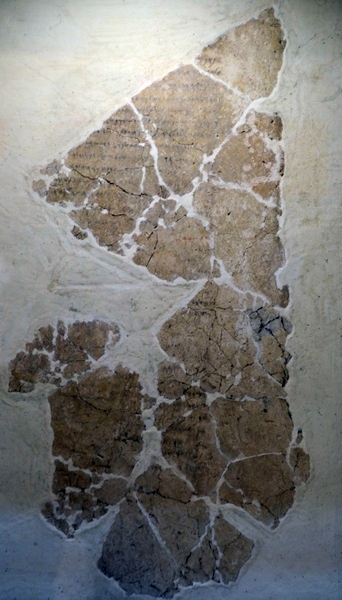
Artifact · Inscription
The Siloam Tunnel Inscription: Excavation, Water, and the Limits of Dating
An object record bringing together its image, metadata, rights, and context.
- Names
- Siloam Inscription · Siloam Tunnel Inscription
- Timeline
- From 750 BCE to 650 BCE
- Region
- Jerusalem / Silwan
A six-line Paleo-Hebrew stone inscription from the Siloam Tunnel wall, describing the diggers’ picks meeting and water reaching the pool. The entry compares it with biblical accounts without attributing Hezekiah’s name to it.
Estimated reading time: 9 min Published Last reviewed:
Share article
Photograph
Photograph by oncenawhile (account Onceinawhile), via Wikimedia Commons. · CC0
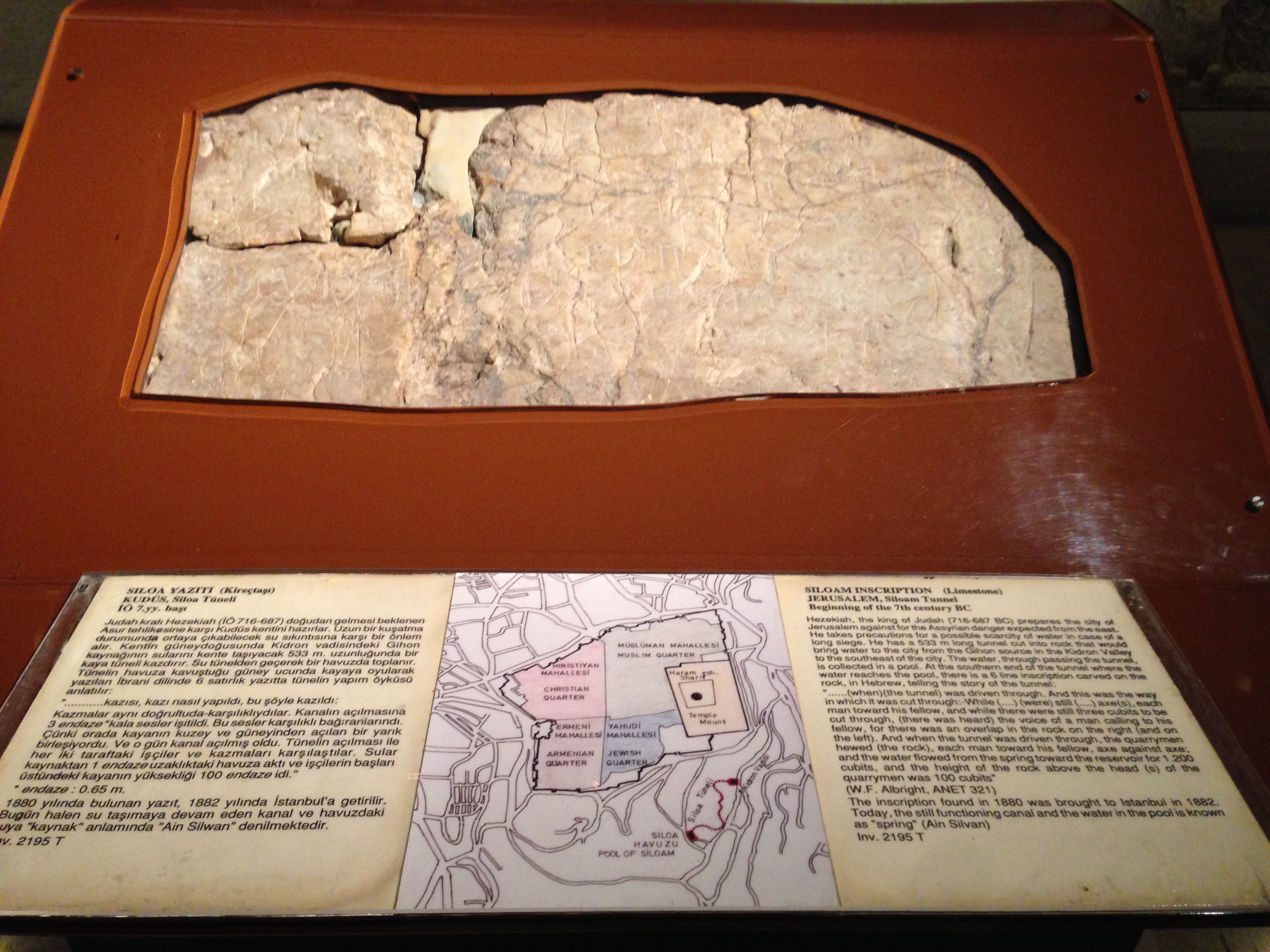
The original limestone Siloam Inscription photographed on display at the Istanbul Archaeological Museums in 2014. The breaks and writing are visible in their display frame; the modern label below is not evidence for dating the letters
License · Image sourceObject details
- Title
- The Siloam Tunnel Inscription: Excavation, Water, and the Limits of Dating
- Timeline
- From 750 BCE to 650 BCE
- Region
- Jerusalem / Silwan
- Rights
- CC0
Text
Introduction
The Siloam Inscription is a short material witness incised on a rock surface inside the tunnel that carried water from the Gihon Spring towards the Pool of Siloam in JerusalemJerusalemJerusalem is a city of religious importance in Judaism, Christianity and IslamGlossary · Click to read the explanation. It is not a biography of a king. Its subject is the moment when excavators approaching from opposite directions met, their tools broke through, and the water began to flow. These six lines preserve an unusual ancient account of engineering work, but they name neither the authority who ordered it nor the year of completion. This entry therefore separates the rock and its surviving letters from editorial restoration, the age of the waterworks, and later accounts that associate the project with King HezekiahHezekiah, king of JudahKing of Judah in the late eighth century BCE, named in Sennacherib’s Assyrian accounts of the 701 BCE campaign.Glossary · Click to read the explanation.
A part of the tunnel wall, not originally a separate tablet
The writing was cut into the natural limestone of the tunnel wall near the southern outlet leading towards the pool, approximately six metres from that opening according to Rendsburg and Schniedewind. The surface was prepared for the inscription. It carries six lines of HebrewHebrewA Northwest Semitic language of the Canaanite group, encompassing Iron Age epigraphy, Biblical, Rabbinic, medieval and Modern Hebrew; its scripts and pronunciations changed over time.Glossary · Click to read the explanation written in the alphabetic script conventionally called Paleo-Hebrew, with dots separating words in places. Calling it a “stele” should not obscure the material fact that the text originally belonged to the tunnel's rock face and only became a transportable slab when that face was cut out. [1][2]
The Palestinian Virtual Museum describes the recessed writing field as approximately 50 cm in length and 66 cm in height, with uninscribed space above the text. These are the dimensions it gives for the inscription field, not a verified measurement of the entire damaged stone as displayed today. A modern exhibition photograph likewise cannot replace field documentation. Secondary catalogues sometimes cite inventory number 2195 T for the original; an independently accessible official Istanbul museum inventory card was not established during this research, so the number is identified here as secondary and unconfirmed, not certified collection data. [3]
Discovery, removal, damage, and copies
The inscription became known to scholars in 1880 after being noticed inside the tunnel. The familiar discovery account credits the initial observation to a pupil connected with Conrad Schick, who issued an early report. Subsequent investigators copied and studied the lettering during the 1880s; neither this modern discovery nor the history of the tunnel's exploration dates the ancient incision. In 1890 the inscribed section was illicitly detached from the wall and damaged and broken. Ottoman authorities recovered it, and it entered the collections of the imperial museum in Istanbul. Modern editions therefore work both from the damaged surviving stone and from early copies and squeezes that can clarify damage sustained before or during removal. [1][4]
The original is associated with the Istanbul Archaeological Museums and is photographed in an Istanbul exhibition in 2014, as in the photograph reproduced here. That image alone cannot verify the institution's room-by-room display in 2026. The Louvre holds a documented plaster cast, inventory AO 1310, associated with casts taken at the tunnel around 1881. Its published size—38.1 × 72.8 × 2.8 cm—belongs to the cast, not the original inscribed stone. The original, the historical plaster casts, and subsequent replicas near the tunnel must not be conflated. [4][5]
What the six lines actually say about excavation and water
The start of the first line is broken; its legible remainder introduces the “breakthrough” or cutting-through. In subsequent lines, workers advance towards one another from opposite ends. A voice is heard when, in the published reconstruction, about three cubits remain; finally the tools break through as the excavators meet face to face. The surviving inscription does not record the workers' names, the number of crews, or the designers' identities. [6]
Lines five and six describe water flowing from the source to the pool and give a length conventionally transcribed as “two hundred and one thousand cubits”—an additive expression for 1,200 cubits, not a number written in modern Arabic numerals. They also mention “one hundred cubits” of rock above the workers' heads, not a directly measured depth for the entire modern passage. The text supplies no metric definition of a cubit. Assuming one cubit of approximately 44–46 cm gives a hypothetical 528–552 metres for the stated length, a modern conversion rather than a figure inscribed in metres. The tunnel's present measured course, often reported at about 533 metres, is an independent modern measurement; it does not by itself establish the exact cubit used by the ancient writer. [3][6]
A word usually transliterated zdh in line three remains disputed. Some translations take it to indicate a fissure or crevice in the rock; others relate it to a rising sound, overlap, or audibility. There is also a dispute about the designation of the cutting tool: the abstract of T. C. Mitchell's 2005 article (made available online in 2006) favours a pick or pickaxe rather than a chisel. The work being commemorated is relatively clear; the exact acoustic mechanism and shape of each tool are interpretive proposals, not simply preserved facts. [7][8]
A short example: letters, restoration, transliteration, and translation
The academic Mnamon guide gives this portion of line five in Latin-letter transliteration: BM’TY[M W]’LP ’MH. These are editorial transliteration symbols, not a tracing of the characters visible in our photograph. The elements [M W] in square brackets mark the source's restoration of a damaged stretch, rather than wholly preserved letters. A concise analytical translation of the reading is “two hundred cubits and one thousand cubits.” Adding the quantities to obtain 1,200 cubits is a useful calculation and interpretation, not a modern numerical symbol incised in the stone. Neither this example nor the photograph constitutes an independent letter-by-letter collation of the Paleo-Hebrew original, and no claim of unanimity among all editors is made. [6]
Who speaks? Commemoration and linguistic inference
The text names no king and no deity and lacks the usual formulations in which a ruler explicitly credits himself or a god with construction. Accordingly Rendsburg and Schniedewind (2010, p. 191) distinguish it from a royal display inscription and favour some form of commemoration of the workers' or engineers' accomplishment. Political sponsorship of a major water project remains possible; it is simply not attested by a royal name here. The placement inside a tunnel, rather than prominently at a city gateway, also leaves its intended audience uncertain: perhaps those involved in the work or later visitors to the passage. Its prepared inscribed surface shows deliberation, but the scribe is anonymous. [2][9]
The same authors discuss forms such as rʿw (“fellow”), hyt (“was”), and mwṣʾ (“source”) and interpret them as linguistic indications of a Hebrew dialect from the Benjamin–southern Ephraim border region. They further suggest that migrants from the north during Assyrian upheavals may have worked on the tunnel and that one of them wrote the inscription. These are separate levels of argument: letters read in editions; comparative dialect identification; and a historical hypothesis about scribal origin and workers' migration. A few forms cannot identify the birthplace or ethnicity of every excavator. [9]
The date of the script is not the date of every water installation
The customary epigraphic date for the inscription is the late eighth century or around 700 BCE, based on letter forms and their sequence within epigraphicEpigraphyThe study of writing preserved on physical objects and monuments: its documentation, reading, dating, translation, material context and historical interpretation.Glossary · Click to read the explanation typology. It is a relative date of writing, not a year recorded in the text. Much later datings have been proposed, including a Hellenistic setting; nevertheless Ronald Hendel's 1996 rejoinder, as represented by its accessible abstract, maintains that the letter forms fit an eighth–seventh-century BCE series better than a Hasmonean script. The mere existence of divergent published suggestions does not make their supporting evidence equally persuasive. [10]
Frumkin, Shimron, and Rosenbaum (2003) dated organic material in the tunnel's hydraulic plaster by radiocarbon and later carbonate deposits by uranium–thorium methods. They argued for an Iron Age II framework and connected the results with a late-eighth-century scenario. Frumkin and Shimron (2006) developed a geoarchaeological interpretation of the winding excavation route, geological conditions, and possible communication between the crews. Yet dated organic matter in waterproof plaster, or calcium carbonate deposited after use, dates a material sample according to its stratigraphic relationship to the tunnel—not the moment these particular letters were incised. Only the published abstracts, not the complete experimental datasets, were accessible for those studies in this review. [11][12]
On the basis of excavations near the Gihon Spring and the tunnel's head, Ronny Reich and Eli Shukron (2011) proposed that the tunnel itself may have been completed in the early eighth century BCE, before Hezekiah. This is an archaeological argument about construction layers and should be kept distinct from dating the lettering. Nor does a presumed date of completion automatically establish whether the commemoration was inscribed immediately or later. The complete 2011 article was unavailable in this review; the proposal is reported from the University of Haifa abstract, not from a claimed full reading of the argument. [13]
More recent work actually consulted in 2025 (Regev and colleagues, PNAS) dates the Siloam Pool dam itself, on the basis of plant remains enclosed in its construction mortar, to approximately 805–795 BCE at a 68.3% confidence range. Crucially the paper separates that dam and the earlier Channel II from the rock-cut tunnel, suggests that the tunnel replaced the channel decades later, and acknowledges that the precise excavation date remains elusive. The radiocarbon samples do not directly date the inscribed letters, nor do they turn every water installation into a single construction project of precisely 800 BCE. No one measurement—of a letter shape, plaster, or dam mortar—can legitimately erase the different evidentiary layers. [14]
Biblical passages are comparanda, not carved names
2 Kings 20:20 credits HezekiahHezekiah, king of JudahKing of Judah in the late eighth century BCE, named in Sennacherib’s Assyrian accounts of the 701 BCE campaign.Glossary · Click to read the explanation with making a pool and conduit for water. 2 Chronicles 32:3–4, 30 describes measures concerning springs and the diversion of Gihon water, while Isaiah 22:11 mentions a reservoir between two walls in a different, admonitory context. These are three distinct literary passages requiring attention to their respective composition and transmission, not three names preserved on the inscription. The wording of Kings alone cannot assign every archaeologically discovered element of the water network to the structure its author had in mind. [15][16][17]
A large-scale water conduit is broadly compatible with those accounts, but compatibility does not prove a one-to-one identification of every passage with every archaeological phase or turn an anonymous inscription into a “document of Hezekiah.” Examination of royal projects against architectural and written witnesses extends beyond this artifact entry. Links to textual criticismTextual criticismComparison of written witnesses and ancient translations to explain variant readings and textual transmission, distinguishing attested text from restorations and inferred ancestors.Glossary · Click to read the explanation and the Books of Kings assist readers without misclassifying the text record as a glossary term. [9][13]
What the material witness establishes—and leaves unresolved
The object establishes that an ancient Hebrew inscription describing a tunnel breakthrough, converging excavators, flowing water, and distances expressed in cubits was cut on this tunnel wall before its modern discovery in 1880. It directly testifies to the way an engineering accomplishment was narrated and memorialised, not to the full administrative history of its execution. It cannot by itself name the king in charge, date every building phase, identify the social origin of the work crews, determine the disputed technical word, or settle the correspondence with every biblical passage. Its positive evidence is most useful when those separate chronological, linguistic, and material questions remain visible. [6][9][14]
References and notes
- Conrad Schick, “Phœnician Inscription in the Pool of Siloam,” Palestine Exploration Fund Quarterly Statement 12/4 (1880), 238–239; publication details and early-report identity only. Bibliographic catalogue information only; the historical article’s page images could not be opened and were not quoted. Return to the text ↑
- Gary A. Rendsburg and William M. Schniedewind, “The Siloam Tunnel Inscription: Historical and Linguistic Perspectives,” Israel Exploration Journal 60/2 (2010), 188–203. Selected PDF passages actually read, particularly printed pp. 188–191 on location, genre, and absence of the royal name; not a full-page-by-page audit. Return to the text ↑
- Palestinian Virtual Museum, “The Silwan Tunnel Inscription,” institutional object description, not a critical epigraphic edition. Available object-description page read; reported writing-field dimensions and tunnel length are secondary institutional descriptions, not measurements made by IL Archive. Return to the text ↑
- Documentary excerpt on the 1890 detachment and Ottoman recovery, reproduced via COJS from Britain and the Holy Land, 1838–1914. Only the posted document excerpt concerning the 1890 removal and recovery was read; not the entire edited documentary volume. Return to the text ↑
- Musée du Louvre, Collections, inventory AO 1310: documented plaster cast of the Siloam inscription associated with an 1881 impression, not the Istanbul original. Louvre collection record inspected for cast identity and its 38.1 × 72.8 × 2.8 cm dimensions; no transfer of those measurements to the original. Return to the text ↑
- Mnamon, Scuola Normale Superiore (Pisa), “Siloam Inscription,” academic Hebrew-script example and transliteration. Published six-line transliteration and translation consulted, especially line 5, BM’TY[M W]’LP ’MH; brackets identified as editorial restoration, not autoptic reading. Return to the text ↑
- University of Michigan Near Eastern Studies Image Database, “The Siloam Inscription,” short scholarly item on the contested zdh reading. Object-page discussion of the competing interpretations of the line-three term read; not a full critical edition. Return to the text ↑
- T. C. Mitchell, “New Light on the Siloam Tunnel Inscription,” Buried History 41 (2005), 43–50, DOI:10.62614/hkb8kv64; posted online in 2006. Publisher abstract and bibliographic page only; full PDF unavailable. The pick/pickaxe interpretation is attributed, not presented as established consensus. Return to the text ↑
- Rendsburg and Schniedewind, “The Siloam Tunnel Inscription” (2010); commemorative genre, dialect forms rʿw, hyt, mwṣʾ, and the Benjamin/southern Ephraim migration hypothesis. Selected printed pp. 188–191 and 193–199, with focus on linguistic argument and conclusion; no independent Paleo-Hebrew collation. Return to the text ↑
- Ronald Hendel, “The Date of the Siloam Inscription: A Rejoinder to Rogerson and Davies,” Biblical Archaeologist 59 (1996), 233–237. Publisher abstract and bibliography only; 233–237 is the publication range, not a claim of full-text reading. Return to the text ↑
- Amos Frumkin, Aryeh Shimron, and Jeff Rosenbaum, “Radiometric dating of the Siloam Tunnel, Jerusalem,” Nature 425 (2003), 169–171. Available Nature abstract only; experimental tables and full study not read. Dated plaster and deposits are not direct measurements of letters. Return to the text ↑
- Amos Frumkin and Aryeh Shimron, “Tunnel engineering in the Iron Age: Geoarchaeology of the Siloam Tunnel, Jerusalem,” Journal of Archaeological Science 33/2 (2006), 227–237. Hebrew University institutional abstract only; no claim to full experimental or geological data review. Return to the text ↑
- Ronny Reich and Eli Shukron, “The Date of the Siloam Tunnel Reconsidered,” Tel Aviv 38/2 (2011), 147–157. University of Haifa publication abstract only; early-eighth-century construction dating attributed to authors, not asserted as a direct inscription date. Return to the text ↑
- Johanna Regev et al., “Radiocarbon dating of Jerusalem’s Siloam Dam links climate data and major waterworks,” PNAS 122/35 (2025), e2510396122. Article HTML text read in the pertinent methods/results/discussion passages on the dam, Channel II, and tunnel; 805–795 BCE at 68.3% concerns dam mortar, not incised lettering. No claim to have examined all supplements. Return to the text ↑
- 2 Kings 20:20, biblical passage available through the United States Conference of Catholic Bishops (USCCB) Bible site; literary comparator, not an inscription. Verse 20 in chapter 20 consulted on the USCCB page; the archive Books of Kings entry is linked with an ordinary URL rather than a glossary term. Return to the text ↑
- 2 Chronicles 32:3–4, 30, USCCB Bible translation, independent literary passages concerning springs and water diversion. Chapter 32 verses 3–4 and 30 consulted; not ascribed to the ancient inscription. Return to the text ↑
- Isaiah 22:11, USCCB Bible; a reservoir between two walls in an admonitory literary context. Verse 11 consulted in chapter context; limited literary comparison, no proof of exact archaeological identification. Return to the text ↑
Archive records may be reviewed and refined as better evidence or sources become available. Suggest a correction
Suggest a correction · Suggest a source for this record
Cite this record
IL Archive, «The Siloam Tunnel Inscription: Excavation, Water, and the Limits of Dating», https://ilarchive.com/en/artifacts/siloam-tunnel-inscription
Continue reading