Artifact · Inscription
The Deir ʿAlla Plaster Inscriptions: Balaam, Evidence, and Restoration
An object record bringing together its image, metadata, rights, and context.
- Names
- Balaam Inscription of Deir Alla · Deir ʿAlla Plaster Inscriptions
- Timeline
- From 800 BCE to 700 BCE
- Region
- Tell Deir ʿAlla, Jordan
Fragments of plaster inscribed in black and red ink, discovered at Tell Deir ʿAlla in Jordan in 1967 and variously dated within the eighth century BCE. The entry examines Combinations I and II, physical joins and textual supplements, Balaam son of Beor and the seer title, the shaddayin and disputed verb in I.6, distinguishing the plaster witness from the Book of Numbers.
Estimated reading time: 9 min Published Last reviewed:
Share article
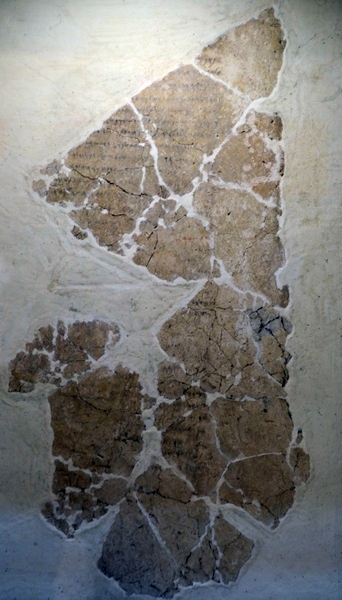
Photograph
Photograph by Jona Lendering, Livius. · CC0
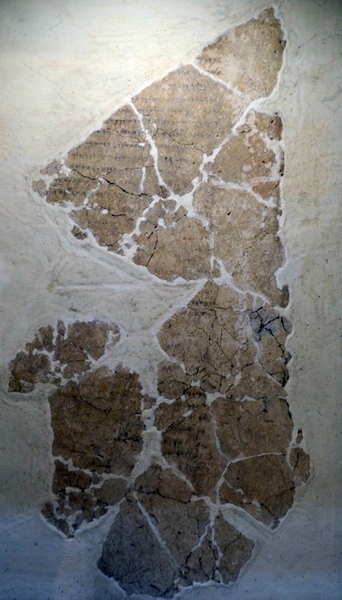
Ink-inscribed plaster fragments from Deir ʿAlla, shown in a Livius photograph identified as taken at the Jordan Museum in Amman. The image illustrates breakage and modern assembly, not fine letterforms or the original position of every fragment
Image source · Related reference · LicenseVideo
The Night the Gods Closed the Sky: Balaam and the Council of the Gods
More than twenty-seven centuries ago, someone wrote a vision on a plastered wall at Deir ʿAlla: the gods come to Balaam son of Beor at night, and a council orders the sky shut. We read the wall line by line, then set it beside Ugarit, the Book of Numbers and later traditions, and settle neither reading. Some scenes are AI-generated illustrations.
The YouTube player loads only when you press play. Watch on YouTube
Object details
- Title
- The Deir ʿAlla Plaster Inscriptions: Balaam, Evidence, and Restoration
- Timeline
- From 800 BCE to 700 BCE
- Region
- Tell Deir ʿAlla, Jordan
- Rights
- CC0
Text
Introduction
The Deir ʿAlla inscriptions are neither a clay tablet nor a continuous text preserved on an intact wall. They survive as pieces of ink-inscribed plaster that were recovered broken and subsequently assembled into competing editorial combinations. They refer to Balaam son of BeorBalaam son of BeorA figure in Numbers whose path is blocked by the angel of Yahweh acting as his “adversary”.Glossary · Click to read the explanation, described as a seer of the gods, and recount a divine decision and ominous disorder. Their importance rests on the physical strokes that survive, the fragments that can be arranged, and the words that editors supply. This entry examines those distinctions rather than retelling Balaam’s biography or settling the origins of the Book of Numbers.
An inked plaster witness, not a stone stele
The fragments were discovered at Tell Deir ʿAlla, in the Jordan Valley east of the Jordan River, on 17 March 1967 during the Dutch excavations directed by H. J. Franken. Writing was noticed on fallen plaster in an Iron Age architectural context. The artifact consists of pale plaster bearing letters written primarily in black ink, with red lettering, marking and divisions. A modern photograph alone cannot establish whether the plaster was first applied to a wall or to a separate plaster-covered support. The inscribed plaster should not be confused with other vessels and implements excavated at the settlement. [1][2]
The plaster pieces were extremely delicate. Infrared photographs taken before the joins and later conservation are themselves evidence for their readings. André Caquot and André Lemaire cautioned that the process of assembly could affect traces of ink, and questioned identifications for which adequate photographs were missing. Three layers must therefore be distinguished: the surviving fragment, its proposed location within a combination, and the letters supplied in a drawing or transcription. Printing all three as continuous lines does not turn them into one intact surface. [2]
The first major edition, Aramaic Texts from Deir 'Alla, edited by J. Hoftijzer and G. van der Kooij, appeared in 1976. “Aramaic” here is the historical title, not the final resolution of the language debate. Editions group the finds into Combinations, especially I and II; these are editorial assemblages rather than numbers of complete ancient tablets. The 1976 edition’s bibliography was checked, but its full plates and text were not directly available for examination in this study. [3]
Where did the fragments originally stand?
Archaeological provenance and reconstructed display are different questions. Lemaire locates large parts of Combination II in locus 57/58 (EE 335) near the outside corner of walls 36 and 42. Parts of Combination I and fragment XIV were recovered from a shallow pit in locus 34 (EE 334) on the opposite side of wall 36. Some probably fell from the upper eastern face of that wall. These are findspots, not an exact plan of the ancient columns. [4]
The initial publication considered a plaster-covered standing support against the wall. Lemaire instead favored writing on a wall near an opening, referring to a fragment edge, associated mudbrick and the lack of a separate base. He also suggested red rulings framing columns of black writing with certain passages emphasized in red. The number and order of columns and the position of nearby drawings remain reconstructions, not an intact wall found in place. A later study interprets EE 335 as a bench-room in which an audience may have listened to recitation; such an architectural reading does not establish a single specific cultic function. [4]
The date of plaster is not the date of the story
We must distinguish the construction of the building, application of the ink, collapse and burial, the events narrated, and the modern discovery in 1967. The fragments belong to an Iron Age archaeological setting, but a destruction layer cannot specify the day or year the writing was made. Nor does the mention of Balaam establish when the narrator’s protagonist lived. Scholars have located the writing in the eighth century BCE, with different proposed ranges. Caquot and Lemaire favored its second half, while Lemaire also argued for a date around the middle of the century; a later scholarly survey gives an approximate date of 700 BCE. None of these is an explicit ancient date on the plaster. [5][6]
Its language belongs to a local Northwest Semitic dialect continuum. Earlier editions called it AramaicAramaicNorthwest Semitic language varieties documented since the early first millennium BCE, including Old and Imperial Aramaic, Syriac, Jewish dialects, and living Neo-Aramaic forms.Glossary · Click to read the explanation, but later debate has emphasized Canaanite as well as Aramaic traits. The phrase Aramaic Texts in the edition title does not settle every linguistic feature, nor can a modern national border identify an ancient language. These are analyses of epigraphyEpigraphyThe study of writing preserved on physical objects and monuments: its documentation, reading, dating, translation, material context and historical interpretation.Glossary · Click to read the explanation and comparative linguistics, not an independent autopsy of letter forms from a photograph. [6]
Balaam son of Beor and what survives of the name
The opening of Combination I is edited as a report concerning Balaam son of BeorBalaam son of BeorA figure in Numbers whose path is blocked by the angel of Yahweh acting as his “adversary”.Glossary · Click to read the explanation, followed by a title often translated “seer of the gods.” It would be misleading to present the entire name and patronymic as unbroken lettering in line one. In Caquot and Lemaire’s placement, some letters in the opening are supplied in brackets; they moved a fragment relative to the initial edition, also changing line numbers. Against that incomplete first mention, Martti Nissinen notes that Balaam’s name occurs in preserved form in I.2 and I.4 according to the edition he follows. Repetition strengthens the identification independently of the opening restoration. [7][8]
“Seer of the gods” situates the character within a story of receiving a divine communication. It does not independently prove that the vision happened as narrated. The editors’ sequence has gods approach him during the night and Balaam subsequently grieve and weep as he tells others what he heard. These are claims inside the plaster narrative, not dated diary entries written and signed by the seer. [7][8]
A short example of the editorial layers
A short excerpt from Combination I, line 6 in Caquot and Lemaire’s 1977 arrangement demonstrates these layers. Their scholarly transcription includes šdyn in the gathering scene, then ls[... ]d, where brackets warn of missing material in the address to a female addressee, and tpry. These are the editors’ readings from plaster fragments, not an independent transliteration from a photograph here. šdyn is a transliteration; “mighty ones” or “shaddayin” is an interpretative rendering. The form ls[... ]d shows that proposed surrounding signs do not restore the lost middle as actual ink. The opening name and patronymic of Balaam also contain bracketed supplements, whose placement must not be transferred unannounced between differently ordered editions. [7][9]
The sequence of operations matters. Material evidence consists of detectable ink and fragment edges. Scholarly transliteration maps strokes into letters and word divisions. Restoration supplies lost material. Translation adopts one interpretation of words and clauses. Claiming that the name necessarily proves every episode of the BalaamBalaam son of BeorA figure in Numbers whose path is blocked by the angel of Yahweh acting as his “adversary”.Glossary · Click to read the explanation in the Book of Numbers adds a separate historical inference that those operations alone cannot warrant. [7][8]
The shaddayin and a divine deliberation
A passage in Combination I preserves or transcribes the sequence šdyn, conventionally discussed as powerful beings or shaddayin assembled to deliberate and speak. Its resemblance to El ShaddaiEl ShaddaiA compound El name or title associated with ancestral narratives and identified with Yahweh in Exodus 6; Shaddai’s meaning and etymology remain uncertain.Glossary · Click to read the explanation invites a linguistic comparison but does not identify all these beings with one god, settle the derivation of Shaddai, or prove that the same group persisted unchanged in other literatures. A parallel with a divine councilDivine councilA divine council is a religious and literary scene in which divine beings gather before a superior authority for discussion, commissioning or judgment; it is not identical to a pantheon list.Glossary · Click to read the explanation motif is useful only within the limits of each witness; see also the archive’s comparative study of El’s and Yahweh’s councils. [9]
The disputed words appear in I.6 as numbered in Caquot and Lemaire’s revised arrangement. They take tpry and the following verb as feminine imperatives, yielding something like “sew up / close the heavens” by means of a cloud; they favor a female solar deity as addressee, rather than the Shagar conjecture in an earlier interpretation. The addressee’s name is not securely intact. By contrast, Bryan Elliff and Robert Coleman (2023) propose “fasten the bolts of heaven,” reflecting another account of the verb and image. Here their publisher’s abstract and a later open-access article quoting their proposal were consulted, not their entire article. Accordingly neither reading should be called an established consensus or an independently verified decipherment. [9][10]
The contrast shows why transliterated letters need not yield one inevitable translation and why both the goddess’s identity and the precise action are interpretations. The surrounding dark imagery, omens and altered behavior among creatures point to a disturbing announcement, but many animals and outcomes remain difficult to identify in the damaged lines. [9]
Combination II is not an established sequel
Some pieces assigned to Combination II are larger, yet continuous reading is even more difficult. In 1985, Lemaire stated that no convincing restoration of even one complete line had yet won acceptance; proposals differed greatly in joins and vocabulary. Passages may be read as counsel, instruction, wisdom or another discourse. They cannot be appended to Balaam’s revelation as a securely preserved second chapter. [11]
Scholars have proposed neighboring columns and different ways of relating I and II. Timothy Hogue’s 2025 discussion advances a model of extended display within a bench-room, potentially involving oral reading, seated listeners and movement through the building. Such reconstructions are informative but do not reconstitute an intact surface or supply erased words. Physical joins, proximity within a room, and narrative unity are three distinct claims. [4][11][12]
Comparison with the Book of Numbers
In the Book of Numbers, chapters 22–24, Balaam is summoned by Balak, king of Moab, and Numbers 22:21–35 relates the donkey and the angel blocking his way. The legible fragments at Deir ʿAlla do not recount that journey, name the donkey or describe that roadside angel. The shared name Balaam son of Beor and the association with divine communication establish a connection between traditions about a named figure, not proof of every biblical scene or direct copying of one surviving narrative into the other. Dating the plaster also does not automatically date the composition of Numbers. [8][13]
What the artifact can and cannot establish
Ink-bearing plaster was found in an Iron Age context at Deir ʿAlla. Editorially assembled readings name Balaam, narrate a revelation involving divine beings, and evoke impending disorder. The writing was a physical display, perhaps read or heard in an architectural setting, though its audience and precise function are not securely known. [1][8][12]
The exact year of writing, a single undisputed language label, the position of every fragment, the addressee and verb in I.6, the unity of Combination II with I, and the equation of the protagonist with every detail of the biblical Balaam are different degrees of open question. That distinction between the edited text and surviving material is foundational for responsible textual criticismTextual criticismComparison of written witnesses and ancient translations to explain variant readings and textual transmission, distinguishing attested text from restorations and inferred ancestors.Glossary · Click to read the explanation and epigraphicEpigraphyThe study of writing preserved on physical objects and monuments: its documentation, reading, dating, translation, material context and historical interpretation.Glossary · Click to read the explanation inference. [2][5][10][11]
References and notes
- André Lemaire, “Les inscriptions de Deir 'Alla et la littérature araméenne antique,” CRAI 129/2 (1985), 270–285; discovery and excavation. Printed p. 270 directly read, particularly the 17 March 1967 discovery and initial documentation. Return to the text ↑
- André Caquot and André Lemaire, “Les textes araméens de Deir 'Alla,” Syria 54/3–4 (1977), 189–208; plaster, ink, infrared photographs and assembly. Printed pp. 189, 192–193 read on Persée; p. 193 on photographic limits and assembly. Return to the text ↑
- J. Hoftijzer and G. van der Kooij (eds.), Aramaic Texts from Deir 'Alla, DMOA 19 (Brill, 1976); bibliographic metadata. Publisher metadata only. Full 1976 edition and plates were not read. Return to the text ↑
- Lemaire (1985), archaeological locations, reconstructed display and alternative wall-versus-plastered-support hypothesis. Printed pp. 274–275 read directly; loci 34/57–58 (EE 334/335), walls 36/42 and the red column frames. Return to the text ↑
- Lemaire (1985), dating arguments and Iron Age phases; compared to Caquot and Lemaire (1977). Printed pp. 271–273 consulted; suggested eighth-century dating, contrasted with Syria (1977), p. 192. Return to the text ↑
- Martti Nissinen, Ancient Prophecy: Near Eastern, Biblical, and Greek Perspectives (OUP, 2017), discussion of date and language. Printed p. 108, located in the PDF around viewer page 129; relevant displayed page inspected, not the whole book. Return to the text ↑
- Caquot and Lemaire (1977), revised joining, the Balaam name and seer title, and bracketed supplements. Printed pp. 193–195, especially the newly proposed first lines on p. 194. Return to the text ↑
- Nissinen (2017), Balaam’s repeated name and the narrative/prophecy distinction. Printed pp. 108–109 consulted for this passage, with visual page check for p. 108; not the entire monograph. Return to the text ↑
- Caquot and Lemaire (1977), šdyn, tpry, feminine imperatives, a solar goddess hypothesis and disagreement with Hoftijzer. Printed pp. 196–197 read directly; their revised line numbering is not assumed identical to 1976. Return to the text ↑
- Bryan Elliff and Robert Coleman, “‘Fasten the Bolts of Heaven’: A New Interpretation of a Difficult Line of the Deir 'Alla Plaster Texts (I.6),” Semitica 65 (2023), 33–52. Publisher’s English/French abstracts only; full article and apparatus not read. Return to the text ↑
- Lemaire (1985), problems of Combination II and the tentative nature of its restoration. Printed pp. 276–277 read; the statement about a complete line explicitly concerns the situation in 1985. Return to the text ↑
- Timothy Hogue, “Texts, Architecture, and Ritual in the Iron II Levant,” Religions 16/9 (2025), article 1178. Open-access sections “3.2. Tell Deir ʿAlla” and conclusion read directly; ritual sequence is reconstructed, not observed. Return to the text ↑
- Book of Numbers, chapter 22, USCCB online translation; comparator rather than epigraphic source. Verses 22:21–35 read from the indexed page text; no independent collation of the Hebrew claimed. Return to the text ↑
Archive records may be reviewed and refined as better evidence or sources become available. Suggest a correction
Suggest a correction · Suggest a source for this record
Cite this record
IL Archive, «The Deir ʿAlla Plaster Inscriptions: Balaam, Evidence, and Restoration», https://ilarchive.com/en/artifacts/deir-alla-plaster-inscriptions
Continue reading
Related readings
Related posts and imagesAll videos and images