Ancient text
The Balaam Text of Deir ʿAlla: The Night Vision and the Closed Heavens
A text for line-by-line reading, with transliteration, translation, and resources.
- Timeline
- From 800 BCE to 700 BCE
- Region
- The Levant
Gods visit a seer at night. He weeps, then tells his people that a council of divine beings has ordered the sky shut with cloud. A line-by-line reading of the plaster text, separating the ink from what scholars supplied.
Estimated reading time: 8 min Published Last reviewed:
Share article
Video
The Night the Gods Closed the Sky: Balaam and the Council of the Gods
More than twenty-seven centuries ago, someone wrote a vision on a plastered wall at Deir ʿAlla: the gods come to Balaam son of Beor at night, and a council orders the sky shut. We read the wall line by line, then set it beside Ugarit, the Book of Numbers and later traditions, and settle neither reading. Some scenes are AI-generated illustrations.
The YouTube player loads only when you press play. Watch on YouTube
Text
Introduction
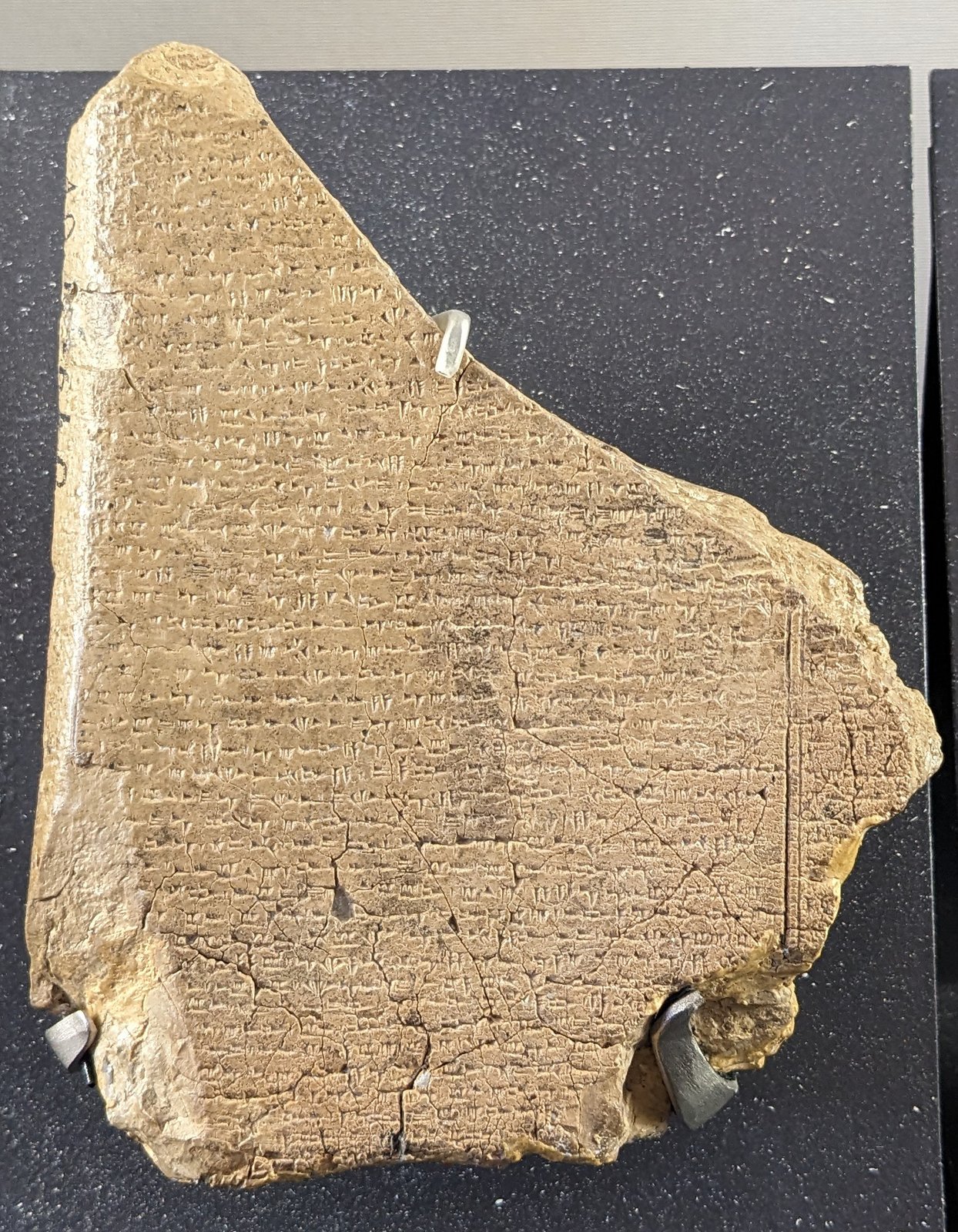
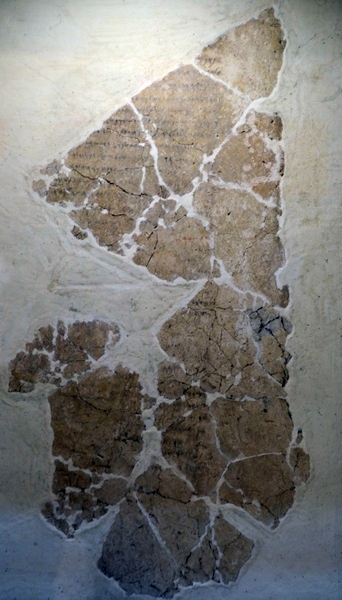
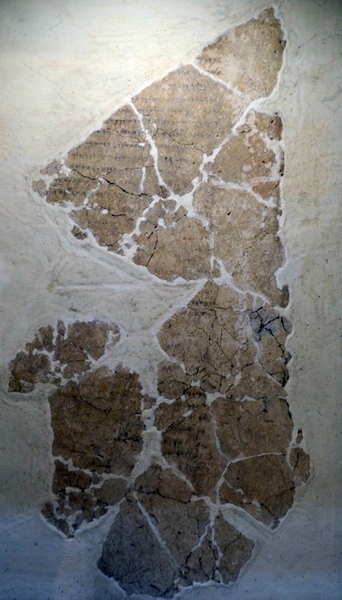
On fragments of wall plaster from Tell Deir ʿAlla, in the valley east of the river, in today's Jordan, a scribe wrote a story in black and red ink more than 2,700 years ago. It concerns "Balaam son of Beor", a seer who receives a terrible message from the gods. The object itself, its joins and its editions are described in our entry The Deir ʿAlla Plaster Inscriptions. This entry tells the story, as far as it can be read.
Every sentence below depends on the editors' work. Some words survive whole, others are partly supplied, and some are guessed from a few letters. We follow mainly the readings of André Caquot and André Lemaire (1977) and of Lemaire (1985), and we say where other scholars read differently. [1][2]
A title in red
The scribe wrote most of the text in black, but the title and some key passages are in red, like a heading printed in another colour. Scholars call such red headings rubrics, from the Latin word for red. [1][2]
In Caquot and Lemaire's reading, the first line begins: "[Ins]cription of [Balaa]m [son of Be]or, the man who saw the gods". The words ʾš ḥzh ʾlhn, "the man who saw the gods", are often translated "seer of the gods". A seer, in plain words, is someone who sees what others cannot: visions, and signs from the gods. Only a few letters of the name survive in this first line, and the editors supplied the rest. Further down, however, the name Balaam survives whole, in the second line and again in the fourth. [1][3]
Some scholars read the first word as "book" (spr). In that world a book was a scroll, not writing on a wall. The wall text may therefore copy, or quote from, an older written work about Balaam. [3]
The night visit
"Behold, the gods came to him in the night." The gods, ʾlhn, speak to him. Their message, again written in red, is the hardest part of the line to read. Lemaire later proposed: "The last flame has appeared, a fire for punishment has appeared!" Other scholars leave the words open. Whatever they were, their effect is clear: the message is terrible. [1][2]
"And Balaam rose the next day… and he wept." People come in to him and ask: "Why do you weep?" In Lemaire's later reading they ask: "Why do you fast, and why do you weep?" These are words inside a story, not the diary of a real night, but the story wants its hearers to feel the seer's grief. [1][2]
The council of the shaddayin
Balaam answers them: "Sit down, I will show you…; come, see the works of the gods." Then he tells what he saw: "The gods have gathered", and "the šdyn held an assembly". [1][2]
The four letters šdyn are what the plaster shows. Scholars pronounce the word "shaddayin" and translate it "the Mighty Ones", which is an interpretation. Caquot and Lemaire saw in it a plural of the biblical title Shaddai. The resemblance invites a comparison with the biblical name El ShaddaiEl ShaddaiA compound El name or title associated with ancestral narratives and identified with Yahweh in Exodus 6; Shaddai’s meaning and etymology remain uncertain.Glossary · Click to read the explanation, but it does not show that these beings are one god, and the meaning of Shaddai itself is uncertain. [1][4]
The gathering is a scene of the divine councilDivine councilA divine council is a religious and literary scene in which divine beings gather before a superior authority for discussion, commissioning or judgment; it is not identical to a pantheon list.Glossary · Click to read the explanation: divine beings meet, deliberate and speak. One word here is uncertain too. In 1977 Caquot and Lemaire read mwʿd as "held an assembly"; in 1985 Lemaire preferred "fixed the appointed time". Either way, the Mighty Ones have met to decide. [1][2]
"Shut the heavens with your cloud"
Scholars agree on the outline of what follows: the council tells a goddess to do something in the heavens. Her name is damaged. Caquot and Lemaire thought she was probably the sun, seen here as a goddess, and they set aside an older reading of the name as "Shagar". But her name is not securely there. [1][5]
In Caquot and Lemaire's reading the order runs: "Sew up, close the heavens with your cloud; let there be darkness there, and not brightness." They heard in it an eclipse: a cloud closes the sky and hides the sun. The council then says: "Make no noise, for ever." In their reading these words are spoken to the sun, whose journey across the sky was thought to make a sound. [1]
Bryan Elliff and Robert Coleman (2023) read the verb differently, as "fasten", not "sew". They point to an image from MesopotamiaMesopotamiaHistorical region associated with the Tigris and Euphrates: Uruk, Ur, Eridu, cuneiform, Sumer, Akkad, Babylon and Assyria, their languages and cults, and the limits of archaeological evidence.Glossary · Click to read the explanation, in which the sun god ShamashShamashMesopotamian god of the sun and justice, shown before Hammurabi on an eighteenth-century BCE stele preserved in the Louvre.Glossary · Click to read the explanation opens the bolts of heaven to give light and closes them to take the light away. Their translation runs: "Fasten the bolts of the heavens with your cloud. There, there will be darkness, and for brightness there will be gloom." [5][6]
The two readings differ in the image: a sky sewn shut, or a sky bolted shut. Neither is settled, and who the goddess is remains unknown. But both close the heavens, and both bring the dark. [1][5]
The world turned upside down
The next lines fill with birds. The plaster is badly broken here, and every edition reads the names a little differently. Both of Lemaire's editions, the first with Caquot, find a sparrow, vultures, an owl, a dove and a pigeon, the chicks of a heron, and a bird of prey, which the later edition calls an eagle. What they are doing is harder to say. The text seems to show creatures acting against their nature, the signs of a world out of order. [1][2]
The later lines, though badly damaged, keep the same tone. As the editors read them: "where the shepherd's staff used to lead the ewes, hares eat"; hyenas listen to instruction; a poor woman perfumes herself with myrrh, a costly perfume; "the deaf hear from afar"; a panther and a piglet change places. Caquot and Lemaire call the style of these reversals "almost apocalyptic", that is, like the writings that tell of the end of a world. Martti Nissinen describes Balaam's message as "cataclysmic events turning the world upside down". [1][2][3]
Two words in this part, šgr and ʿštr, were once read as the names of two deities, Shagar and ʿAshtar. Caquot and Lemaire read them instead as ordinary words for the young of the herds and the flocks, as in a similar pair in Deuteronomy 7:13. Even the number of gods on this wall depends on how it is read. [1]
Two letters: "El" or "these"?
In the second line of the story, after the word for "words" or "utterance", stand two letters, ʾl. They are the two letters that spell the name El.
Read one way, they are that name, and several scholars read them so. Martti Nissinen writes that the divine council approaches Balaam with an oracle "from El, presumably the supreme god". Read another way, they are a small, everyday word, "these". Caquot and Lemaire read the line as "according to these words". In their reading, El does not appear in this part of the text at all, and the gods are always written with the plural word ʾlhn. [1][3]
In the more broken second group of fragments, Lemaire himself reads the name El more than once. But no line there has a reading that scholars agree on. Does the plaster name El? It depends on two letters and on how they are read, and scholars have not settled it. [2]
What kind of text is this?
The story is not a speech written down on the spot. Nissinen classes it as "literary prophecy": a narrative that introduces a seer and gives him an awesome message. Its picture of catastrophe, he writes, comes closer to the much later apocalyptic writings than to the ordinary prophecies of doom. [3]
A second group of fragments, Combination II, may continue the text in some way, but its lines are even harder to read. In 1985 Lemaire wrote that no one had yet restored a single complete line of it in a way that others accepted. It may hold advice, teaching or wisdom, but it cannot be read as a secure second chapter of Balaam's vision. [2][7]
Language and date
The first editors called the language Aramaic. Later scholars stress that it also has features closer to HebrewHebrewA Northwest Semitic language of the Canaanite group, encompassing Iron Age epigraphy, Biblical, Rabbinic, medieval and Modern Hebrew; its scripts and pronunciations changed over time.Glossary · Click to read the explanation and to the other Canaanite languages, such as Phoenician. It seems to be a local dialect, not clearly any of the languages of the kingdoms around it. [3][7]
Scholars date the writing by the shapes of its letters and by the layers around it, from about 800 to about 700 BCE. No date is written on the plaster, and the date of the writing is not the date of the story, nor of the time when Balaam may have lived. [3][7]
Ink, placement, restoration
Each line above rests on three things that must be kept apart: the ink that survives on a fragment, the place where editors put that fragment, and the letters editors supplied where the plaster is lost. Our quotations follow the editions, and the ellipses and brackets mark the gaps. The story of Balaam's night vision is real evidence of what was written on this wall, and perhaps read aloud there. It is not an intact text, and many details may change as the fragments are studied again. [7]
References and notes
- André Caquot and André Lemaire, “Les textes araméens de Deir ʿAlla”, Syria 54, no. 3–4 (1977), pp. 189–208 Pp. 192–203: the arrangement of Combination I and lines 1–16 with commentary: the title and the red passages (pp. 194–195), the reading “these” for ʾl (pp. 194–195), šdyn and mwʿd (p. 196), the order to the goddess, the eclipse and “make no noise” (pp. 197–198), the birds (pp. 198–199), the reversals and “almost apocalyptic” (pp. 199–202), šgr and ʿštr (pp. 196, 200–201), Combination II (p. 203). Return to the text ↑
- André Lemaire, “Les inscriptions de Deir ʿAlla et la littérature araméenne antique”, Comptes rendus de l’Académie des Inscriptions et Belles-Lettres 129, no. 2 (1985), pp. 270–285 Pp. 270–281: the discovery and the red ink (pp. 270, 275), Combination II and Lemaire’s readings of El there (pp. 276–277), text and translation of Combination I, lines 1–16, including “the last flame…” and “why do you fast” (pp. 279–281). Return to the text ↑
- Martti Nissinen, Ancient Prophecy: Near Eastern, Biblical, and Greek Perspectives (Oxford University Press, 2017) Pp. 107–109 and nn. 255–257: the “book” (spr) of Balaam and the seer’s name in lines 2 and 4 (n. 255), the oracle “from El, presumably the supreme god”, the date and the language (p. 108), “literary prophecy” and the comparison with apocalyptic writing (p. 109). Return to the text ↑
- Aren M. Wilson-Wright, “The Helpful God: A Reevaluation of the Etymology and Character of (ʾēl) šadday”, Vetus Testamentum 69 (2019), pp. 149–166 Pp. 150, 154–160: the occurrences of Shaddai and the proposed etymologies, including “mountain” and a root meaning “help”. Return to the text ↑
- Bryan Elliff and Robert Coleman, “‘Fasten the Bolts of Heaven’: A New Interpretation of a Difficult Line of the Deir ʿAlla Plaster Texts (I.6)”, Semitica 65 (2023), pp. 33–52 Publisher’s abstract only: the agreed outline of line I.6, earlier proposals, the reading “fasten” and the Mesopotamian motif of Shamash and the bolts of heaven. Return to the text ↑
- Timothy Hogue, “Texts, Architecture, and Ritual in the Iron II Levant”, Religions 16, no. 9 (2025), article 1178 (open access, CC BY 4.0) Section 3.2: the quotation of Elliff and Coleman’s translation of lines I.6–7 (their p. 45). Return to the text ↑
- IL Archive, “The Deir ʿAlla Plaster Inscriptions: Balaam, Evidence, and Restoration” (artifact record) and the sources it cites The sections on the three layers of evidence (fragment, placement, supplied letters), Combination II, the language and the date, with their notes. Return to the text ↑
Archive records may be reviewed and refined as better evidence or sources become available. Suggest a correction
Suggest a correction · Suggest a source for this record
Cite this record
IL Archive, «The Balaam Text of Deir ʿAlla: The Night Vision and the Closed Heavens», https://ilarchive.com/en/texts/deir-alla-balaam-text
Continue reading