Entity · Concept
Hebrew Vorlage
A reference page linking a name, group, or concept to the materials that discuss it.
Hebrew text underlying a translation; may survive partly or be inferred, so reconstruction is not a discovered copy.
Text
Vorlage names the exemplar used by a translator. Some Jeremiah differences are explained by another HebrewHebrewA Northwest Semitic language in the Canaanite group, with ancient and modern forms.Glossary · Click to read the explanation source, considering translation technique and surviving QumranDead Sea ScrollsJudaean Desert manuscripts, especially Qumran cave finds. Biblical copies and other works reveal textual diversity; a copy’s age is not the work’s initial date.Glossary · Click to read the explanation readings. [1]
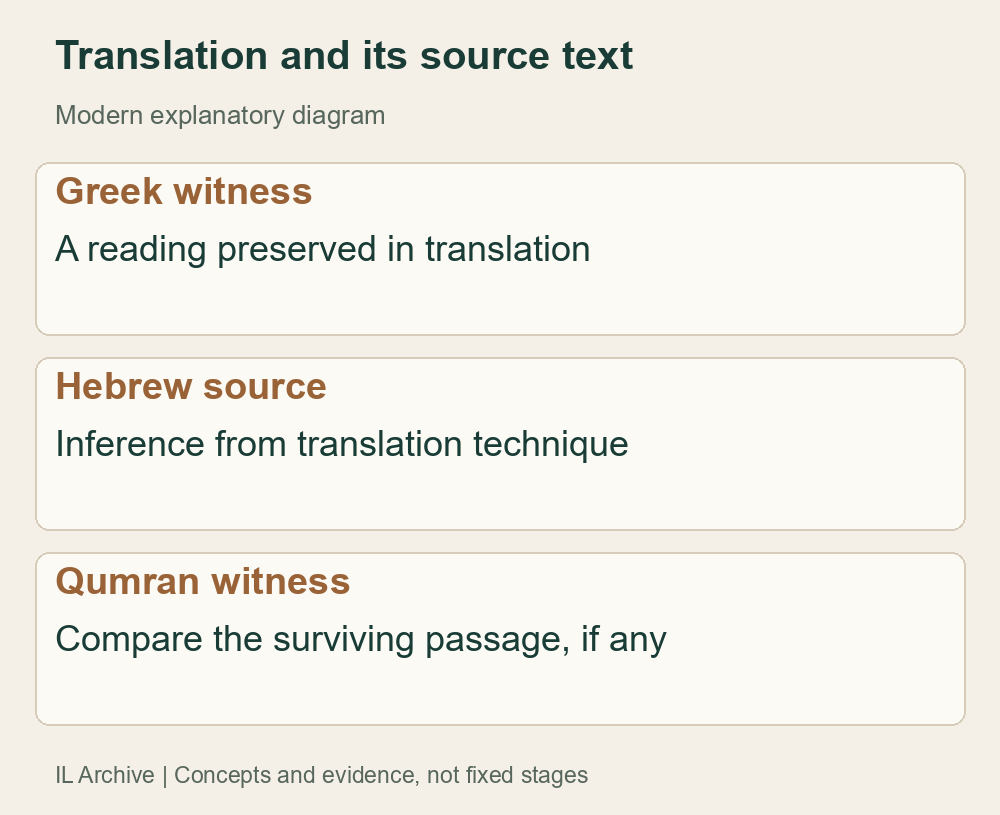
A Greek expression may represent several Hebrew formulations. One agreement does not establish an identical whole edition, and a retroverted text is not a physical manuscript. The diagram distinguishes reading, evidence and inference. [2]
References and notes
- Kristin De Troyer (2012). “Greek Papyri and the Texts of the Hebrew Bible.” In Editing the Bible, pp. 81–90. SBL. Pp.88–89: Ulrich/Tov models for Jeremiah, Exodus and Samuel editions; Greek can reflect different Hebrew editing. Reports scholarship, not independent collation of every manuscript. Return to the text ↑
- James C. VanderKam (2016). “Texts, titles, and translations.” In The Cambridge Companion to the Hebrew Bible/Old Testament, pp. 9–27. DOI: 10.1017/CBO9780511843365.002. Pp. 9–12, 17–21: Masoretic layers, Aleppo c.925 and Leningrad 1009, witnesses, translations and variation. Counts depend on classification; no uniform percentage for all books. Return to the text ↑
Research history
Substantive changes are retained here. Minor copy edits remain in the internal operational log.
-
Substantive record update
Suggest a correction · Suggest a source for this record
Cite this record
IL Archive, «Hebrew Vorlage», Edition 2, https://ilarchive.com/en/entities/hebrew-vorlage