Entity · Deity
Ishum, the Watchman Who Counsels Erra
A reference page linking a name, group, or concept to the materials that discuss it.
- Names
- Ishum · Išum
- Region
- Mesopotamia
Ishum guides people through dark streets and advises Erra in Babylonian poetry. Amulets, scholarly lists and a Kassite land grant record other settings in which the god's name mattered.
Estimated reading time: 5 min Published Last reviewed:
Share article
Text
Introduction
In the Babylonian poem named for Erra and Ishum, Ishum goes about at night, guiding people with a light bright enough to recall daylight. He also accompanies the warrior god Erra and confronts him with the consequences of his actions. The poem gives the same god the work of watching over people and speaking to a power that threatens them. Other sources name him in household protection and in a royal inscription, where his name takes its place among those of many gods. [1][2][3][4]
A name in a Kassite land grant
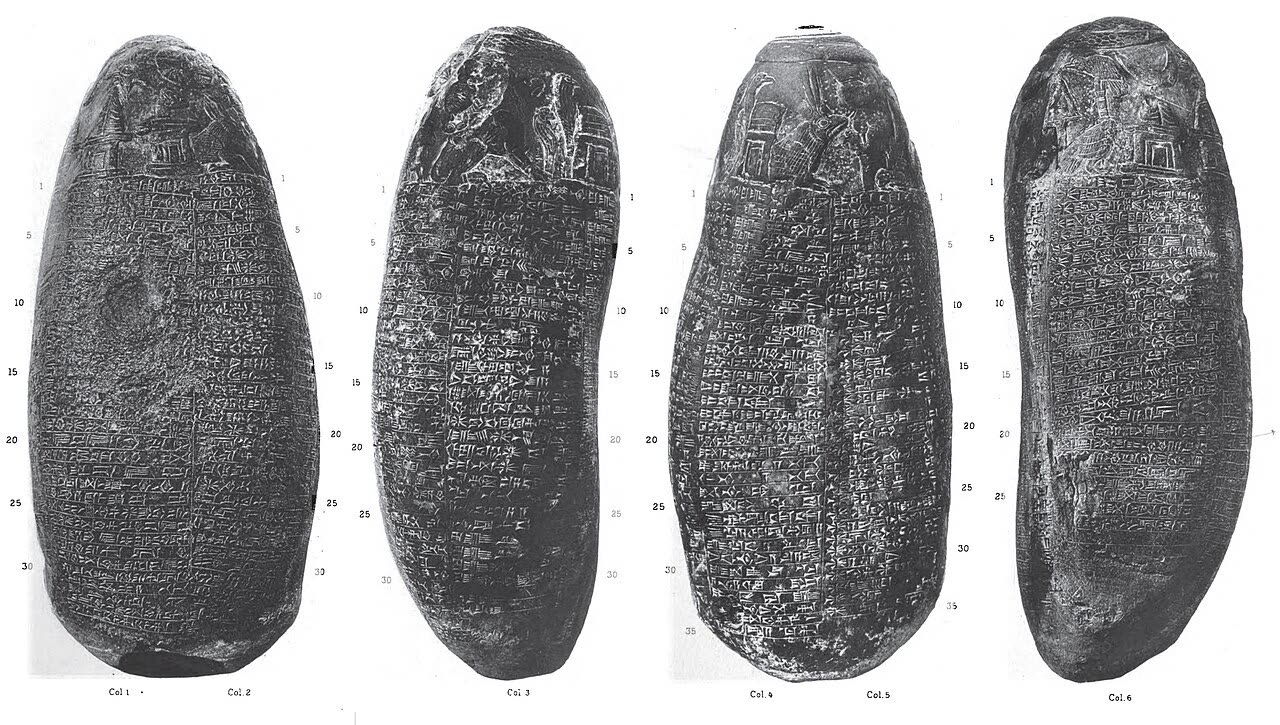
A stone from the reign of Marduk-apla-iddina I, now cataloged as Louvre SB 26, records a dispute over property originally granted under Meli-Shipak. The later king confirms the grant. The stone was made in Babylonia and found at Susa. Jean-Vincent Scheil's edition places Ishum at the beginning of the sixth column, after a passage naming Nergal and Laz and immediately alongside Shubula. The inscription's divine list and its legal record are parts of the same monument. [3][4]
The relief register above the writing has a coiled serpent and a series of divine emblems. The Louvre identifies a lamp there as the emblem of Nusku. Ishum's presence on the stone is established by the written name in the lower part. This distinction matters because Ishum is sometimes associated with a torch and because the stele names more gods than it displays emblems. Scheil's published photographs show the stone from several sides, giving a sense of how extensively the inscription covers its surface. [1][3][4]
The herald in the street
Andrew George compares titles for Ishum in god listsGod ListsTexts collecting divine names for preservation, teaching and classification, with varying theological organization.Glossary · Click to read the explanation with the way he is addressed in amulet texts. In one of those formulas he is the gods' herald, with authority in the street. A household invokes him as he passes on his rounds. The familiar translation of his title as herald captures his association with carrying and making announcements. The reference to the street also suggests a watchman's or constable's duties, as George argues. In the AkkadianAkkadianAn ancient East Semitic language written in cuneiform from the third millennium BCE; its varieties include Babylonian and Assyrian, and it served in international diplomacy.Glossary · Click to read the explanation poem the titles help explain why the god who guides people at night is also entrusted with messages and warnings. [1]
Hendursaga appears among Ishum's names in Babylonian scholarly tradition. The comparison fits the Sumerian god's own descriptions of patrolling by night and opening city gates at dawn. Another name connected to Ishum, Engidudu, is used to address the night patrol figure in the poem. George notes that the name was used for the divine sentinel whose statue guarded the Tabira Gate at Ashur. The Sumerian descriptions, the god list and the gate tradition give related evidence about guarding public routes, each with its own setting. [1][5]
Torch language also has a place in this comparison. Near the start of the poem, Ishum is likened to a firebrand that the gods follow. George takes the metaphor and the night watch passage together and proposes a connection between the god's name and the Akkadian word for fire. Kynthia Taylor finds the etymology uncertain and argues for greater caution in identifying Ishum principally with fire. The torch remains part of the poem's imagery whether or not it helps explain the name. [1][6]
The counselor in the poem
Ishum and Erra exchange speeches as the poem moves from preparation for violence to its consequences. Ishum asks why Erra has intended harm against both gods and people. Erra explains the disorder that followed MardukMardukBabylon’s leading god, worshipped at Esagil and elevated in the Akkadian Enūma eliš. His symbols include a spade and mušḫuššu dragon. His earliest origins remain obscure; Nibiru is no evidence of a planetary homeland.Glossary · Click to read the explanation's departure from his seat. In the fourth tablet Ishum returns to the obligations Erra was supposed to observe. The exchange exposes the difference between what Erra promised to preserve and what he has allowed to happen. Simonetta Ponchia traces how this return to dialogue helps bring an end to indiscriminate destruction. [2]
Ishum participates in the poem's action as well as judging it. His position beside Erra gives him reason to address a god who, in the account of the second tablet, pays no heed to others. In the later exchanges he names the consequences that the two of them have seen and makes the question of divine responsibility explicit. His work in the story depends on being close enough to speak and on being willing to challenge what the warrior god has done. [1][2]
Words kept in a house
The poem promises protection for a house in which its tablet is placed. Surviving copies and extracts give that promise a physical context. Some tablets with passages from the poem were formed with a pierced projection suitable for hanging. The black stone amulet BM 118998, found at Ashur, carries the closing thirteen lines of the third tablet, a speech by Ishum praising Erra. The amulet and the protective passage from the final tablet provide different witnesses to the use of this poem. [1][7]
The association of Ishum with the night watch supplies one explanation scholars have offered for the display of an amulet. A text could address the god who passes by the building. Others emphasize the protective force ascribed to the words present inside it. The object records a use of the poem that complements the events it describes. In the story Ishum's speech helps calm Erra. In a house, an extract of his speech could itself be kept as part of the household's appeal for safety. [1][2][7]
References and notes (7)
- Andrew R. George, The Gods Išum and Ḫendursanga: Night Watchmen and Street-lighting in Babylonia Read pp. 2–5 on god-list names, titles, the streets, the Tabira Gate, the firebrand image and protective texts. Return to the text ↑
- Simonetta Ponchia, From Dialogue to Debate Read pp. 193–197 on the introduction to Ishum, the conflict following Marduk's departure, the exchanges on Tablets III and IV and the return to order. Return to the text ↑
- Jean-Vincent Scheil, Textes élamites-sémitiques, troisième série Read the digitized transcription of pp. 31–39, including the account of Munnabittu's claim and the name I-sum at the start of column six. Return to the text ↑
- Musée du Louvre, Kudurru de Marduk-apla-iddina I, SB 26 Read the object and inscription entries on date, findspot, confirmation of the land grant, divine list and symbols. Return to the text ↑
- Electronic Text Corpus of Sumerian Literature, A Hymn to Hendursaga Read Segment A, especially lines 8–14 on the patrol and the city gates, and 42–68 on the invocation of Hendursaga. Return to the text ↑
- Kynthia Taylor, The Erra Song Read the chapter on Ishum, especially its treatment of proposed etymologies and the assessment of fire as a defining characteristic. Return to the text ↑
- The Art of the Āšipu in Narrative Poetry Read pp. 158–159 on BM 118998, suspended tablets, the quotation from Tablet V and different explanations of an amulet's protective function. Return to the text ↑
Suggest a correction · Suggest a source for this record
Cite this record
IL Archive, «Ishum, the Watchman Who Counsels Erra», https://ilarchive.com/en/entities/ishum
Continue reading