Entity · Deity
Martu, the Amorite God of the Steppe
A reference page linking a name, group, or concept to the materials that discuss it.
- Names
- Amurru · MAR.TU · Martu
- Region
- Mesopotamia
Martu, called Amurru in Akkadian, receives a bride in a Sumerian poem and offerings in Mesopotamia. His crook links him with the steppe, while hymns credit him with granting justice and supporting kings.
Estimated reading time: 5 min Published Last reviewed:
Share article
Text
Introduction
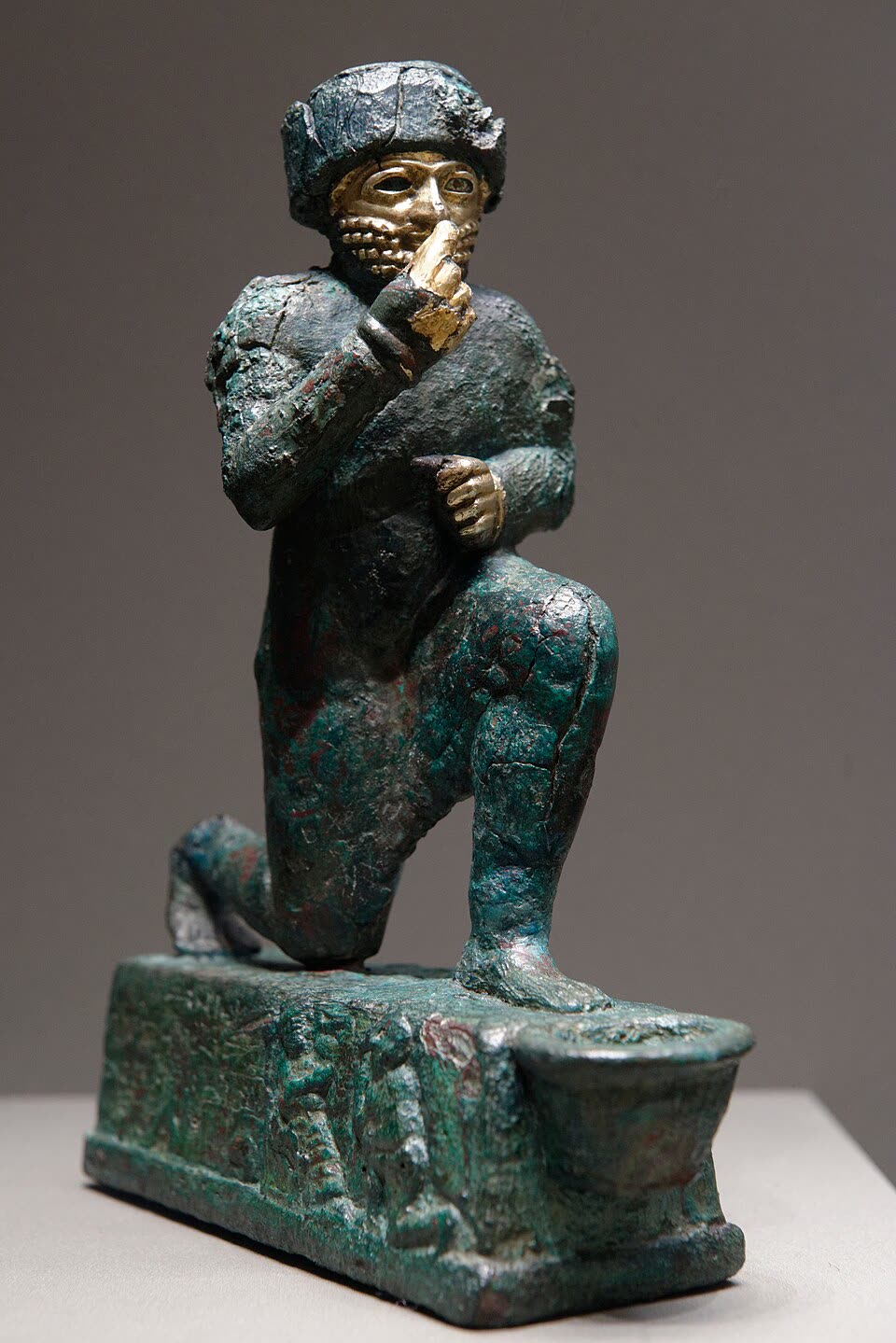
At the festival of Inab, Martu wins the favour of the god Numushda in a wrestling contest and asks to marry his daughter. In a Sumerian hymn he protects a king and is praised for giving just verdicts. An inscribed figure from Larsa shows another side of the god, whom its dedicator addresses as Amurru in a prayer for the life of HammurabiHammurabiKing of Babylon in Mesopotamia, reigning around 1792–1750 BCE. A celebrated legal text preserved on a stele and cuneiform copies bears his name.Glossary · Click to read the explanation. The stories and objects show how people in Mesopotamian cities made room for a deity associated with mountain country and the steppe. [1][2][3]
The festival at Inab
The marriage poem begins in a time when Inab already existed and neighbouring Kiritab did not. People living around Inab catch gazelles with nets and gather for the distribution of rations. A man receives a different ration depending on whether he is single, married or has a child. Martu is single but gets the share of a married man. He tells his mother that his friends already have wives, and she encourages him to choose someone himself. In the account of the festival that follows, Martu and his friends plan to visit Inab's alehouses. Numushda attends with his wife Namrat and their daughter Adgar-kidug. [1]
Drums sound and spectators arrive for wrestling in honour of Numushda. Martu competes in the courtyard, and Numushda, pleased with him, repeatedly offers silver and jewels. Martu asks for Adgar-kidug instead. The intervening lines are damaged. In the next passage Numushda sets terms for marriage gifts of cattle, sheep and goats, with attention to the young animals and the milk that nourishes them. The gifts extend beyond the two households. The poem mentions ornaments, textiles and vessels given to different groups of people in Inab. [1]
As the decision is delayed, a friend of Adgar-kidug warns her about the match. The speech moves between hostile descriptions of a group and personal accusations against Martu. It depicts a tent dweller who eats raw meat, disregards places of worship and will have no proper burial. The same poem has already shown him taking part in an urban festival. The accusations belong to the friend's attempt to dissuade Adgar-kidug, who ends the exchange with her own decision to marry him. [1]
The god who gives judgment
The hymn usually called Martu A also locates him in mountain country. In it An fathers him and Ninhursag gives him his imposing body. The great gods equip him with authority and weapons. He selects a king to support, grants favour and protects him. The poem also assigns him the work of giving fair verdicts, helping fruit grow and increasing abundance. The mountain imagery extends to his own sacred dais and the lands An gives him. The poem calls him a man of the hills at the same time as it credits him with maintaining the order that kings are expected to protect. [2]
In the more fragmentary Martu B, An is again his father but Urash bears him, and EnlilEnlilEnlil/Ellil: a major Mesopotamian god associated with destinies, kingship, and Ekur at Nippur, already prominent in third-millennium god lists. His name’s origin and cult beginnings remain debated.Glossary · Click to read the explanation bestows a favourable destiny. The closing wishes concern the well-being of a city, including its wives and children. Alongside these literary texts are records of offerings. Andreas Johandi discusses an Ur III administrative tablet in which a deity written with Martu's name receives offerings at Kuara, as well as the difficulty of assuming that this spelling always indicated the same identity. Local arrangements and later works could associate the god with different divine relatives. [4][5]
The worshipper of Larsa
The Louvre's kneeling figure from Larsa raises one hand toward its mouth. Lu-Nanna, a local dignitary, dedicated it to Amurru for Hammurabi's life, according to its Sumerian inscription. The base incorporates an offering bowl and reliefs of a recumbent ram and a kneeling man facing an enthroned deity. Gudrun Colbow identifies the seated figure as Amurru on the strength of the accompanying dedication. The large figure is the worshipper. A small scene on the same object supplies a view of the god as the recipient of the prayer. [3][6]
In Old Babylonian seal imagery the god can stand with a crooked staff or rest a foot on a horned animal. In some images the crook also stands for him by itself. Identification depends on whether the object preserves a name or whether a combination of attributes supplies the evidence. The Metropolitan Museum, for example, identifies a standing figure on a hematite seal as a possible Amurru because of his pose and the horned animal. In another case, Edith Porada points to a seal whose owner explicitly calls himself a servant of Amurru. She suggests that a small figure carrying a crook may show the owner bearing his god's emblem. [6][7][8]
The name links the god to the AmoritesAmoritesGroups associated with West Semitic speech in the Levant and Mesopotamia, whose dynasties were particularly prominent in the nineteenth and eighteenth centuries BCE (ca. 1900–1700 BCE).Glossary · Click to read the explanation, but its meaning depends on its setting. In a votive text it can specify the god who receives a prayer. The hymn can name the god and the lands associated with him in the same passage. The story at Inab, in turn, draws on ideas about life outside the city to give a prospective bride and her friend something to argue over. These uses explain why a divine name, an association with a people and the practices of individual worshippers need to be read in context. [1][2][3][7]
References and notes (8)
- Electronic Text Corpus of Sumerian Literature, The Marriage of Martu Read lines 1–142 on the opening and rations, festival, contest, marriage gifts and final conversation. Return to the text ↑
- Electronic Text Corpus of Sumerian Literature, A Shir-gida to Martu (Martu A) Read lines 1–60 on An, Ninhursag, the mountain dais, verdicts, abundance and support of kingship. Return to the text ↑
- Musée du Louvre, L'Adorant de Larsa, AO 15704 Read the description of the figure, base and inscription, the dedicant and recipient, and the period and findspot. Return to the text ↑
- Electronic Text Corpus of Sumerian Literature, A Hymn to Martu (Martu B) Read segments A and B on Urash, An, Enlil and the surviving wishes for the city. Return to the text ↑
- Andreas Johandi, The Identity of Martu (dMAR.TU) in the Ur III Period Read the introduction and the discussion of the offerings at Kuara, TCL 2 5482 and TCL 2 5514. Return to the text ↑
- Gudrun Colbow, Amurru, Iconography of Deities and Demons Read sections I and II.1 on the crook, horned animal and the identification of the figure on the Larsa base. Return to the text ↑
- Metropolitan Museum of Art, Cylinder Seal X.304.13 Read the qualified identification of the standing figure, the attributes, and the interpretation of the deity's associations. Return to the text ↑
- Edith Porada, Columbia's Oldest Inscribed Works of Art Read pp. 31–32 on the seal of Ginat um, its inscription and the possible function of the crook-bearer. Return to the text ↑
Suggest a correction · Suggest a source for this record
Cite this record
IL Archive, «Martu, the Amorite God of the Steppe», https://ilarchive.com/en/entities/martu
Continue reading