Entity · Deity
Mummu, the adviser of Apsu
A reference page linking a name, group, or concept to the materials that discuss it.
- Names
- Mummu
- Region
- Mesopotamia
In the Babylonian creation epic, Mummu urges Apsu to act against the younger gods and ends up bound by Ea. The word mummu also appears in the poem as a creative description and as a name of Marduk.
Estimated reading time: 5 min Published Last reviewed:
Share article
Text
Introduction
Mummu is the adviser to the primeval Apsu in the first tablet of the Babylonian creation epic Enūma elišEnuma ElishA seven-tablet Babylonian creation poem in Akkadian, recounting Marduk’s rise, victory over Tiamat, cosmic ordering and human creation, and culminating in praise through fifty names. Its composition date is debated; later manuscripts and recitation traditions preserve it.Glossary · Click to read the explanation. When Apsu complains that the younger gods give him no peace, Mummu encourages him to destroy their way of life. EaEnkiMesopotamian deity also known as Ea, linked with Eridu and the Abzu (deep fresh waters), wisdom, incantations, and narratives of creation and cosmic order. Later written attestations do not identify the deity of Eridu’s earliest layers.Glossary · Click to read the explanation hears of the plot, kills Apsu and takes Mummu captive. The epic uses the same spelling elsewhere in ways that have prompted both ancient and modern readers to consider how sound and creation are linked. [1] [2]
The first advice in the poem
At the beginning of the epic, the waters of Apsu and TiamatTiamatTiamat is a primeval divine mother and watery figure in Enūma eliš who later opposes Marduk; he divides her body in making the cosmos. No Babylonian portrait of her is securely identified.Glossary · Click to read the explanation mingle before the named generations of gods take shape. The young gods then disturb their elders with their activity. Apsu calls his vizier Mummu and invites him to go with him to Tiamat. Mummu is the first addressee in the poem's direct speech, according to Sophus Helle's reading. The first conversation concerns the conditions under which the gods can go on living together in the world just brought into being. [1] [2]
Apsu tells Tiamat that the gods' behaviour leaves him unable to rest by day or sleep at night. He proposes to destroy their way of life so that silence can return. Tiamat acknowledges the disturbance and asks how the two of them could destroy the beings they gave birth to. William Lambert's translation has her propose gentler discipline. Mummu instead endorses the destruction Apsu already wants and repeats the promise of daytime rest and nighttime sleep. The three speeches make the alternatives explicit. Mummu brings the discussion back to its starting point and gives Apsu the approval Tiamat withheld. [1]
Apsu brightens at the advice. The poem follows with a scene of embrace and kissing, though translations differ on who embraces whom and whose knees are involved. In Lambert's reading it is Mummu who puts his arms around Apsu. When the younger gods learn what the gathering planned, fear leaves them sitting quietly. Helle's attention to sound makes the reversal especially visible. The gods who caused the commotion suddenly fall silent, and their silence clears the way for one of their number to act. [1] [2] [3]
Ea and the captive
Ea works out a plan and recites an incantation. Apsu goes into a deep sleep while Mummu is distressed. Ea removes Apsu's crown, takes his aura and kills him. Mummu is confined and remains in Ea's grasp, with a nose-rope explicitly mentioned. That detail gives the defeat an image of physical restraint. It also marks how differently the conspirators end the episode. Apsu is dead and his chamber becomes the setting of a new household. The vizier, whom he consulted so intimately, survives here under the conqueror's control. [1] [3]
Ea rests in his chamber and names the place Apsu. He establishes his quarters there with Damkina, who bears MardukMardukBabylon’s leading god, worshipped at Esagil and elevated in the Akkadian Enūma eliš. His symbols include a spade and mušḫuššu dragon. His earliest origins remain obscure; Nibiru is no evidence of a planetary homeland.Glossary · Click to read the explanation. A name that first belonged to a speaking ancestor now also designates the place from which the epic's future champion emerges. Tiamat continues in the story and later prepares for war. By then Mummu's part as a counsellor is over, except for a recollection of his capture. His role belongs chiefly to the change of power that precedes Marduk's birth. [1] [2] [3]
Reading the same signs
The opening of the poem places mummu next to Tiamat several lines before Apsu addresses the vizier. The CuneiformCuneiformWriting with wedge-shaped signs, developed from Mesopotamian recording traditions and used for several languages from the third millennium BCE.Glossary · Click to read the explanation Digital Library Initiative's composite transliteration gives mu-um-mu ti-amat, and its English display joins the two as a name. Lambert instead translates the first word as a description of Tiamat as creator. Eckart Frahm surveys other proposed meanings, including a primordial mist and a productive or creative force. Frahm also notes that some manuscript lines for the adviser write Mummu with the sign used to mark divine names while neighbouring lines can write the word without it. The signs and their immediate surroundings are both part of the reading. [1] [3] [4]
In the seventh tablet, the gods bestow many names on Marduk. One is Mummu, associated there with creating heaven and earth. An ancient commentary explains the word in the opening with a gloss reconstructed as creation or productiveness. In a different line of the seventh tablet, the commentary glosses mummu as noise. The editors of the commentary discuss how the latter gloss may reflect a nearby line or a lexical tradition, so the two glosses preserve ways in which ancient scholars interpreted distinct passages. Helle sees their juxtaposition as evidence that those readers took seriously the poem's recurrent connection between sound and the making of the world. [1] [2] [3] [5]
Following the tablet witnesses
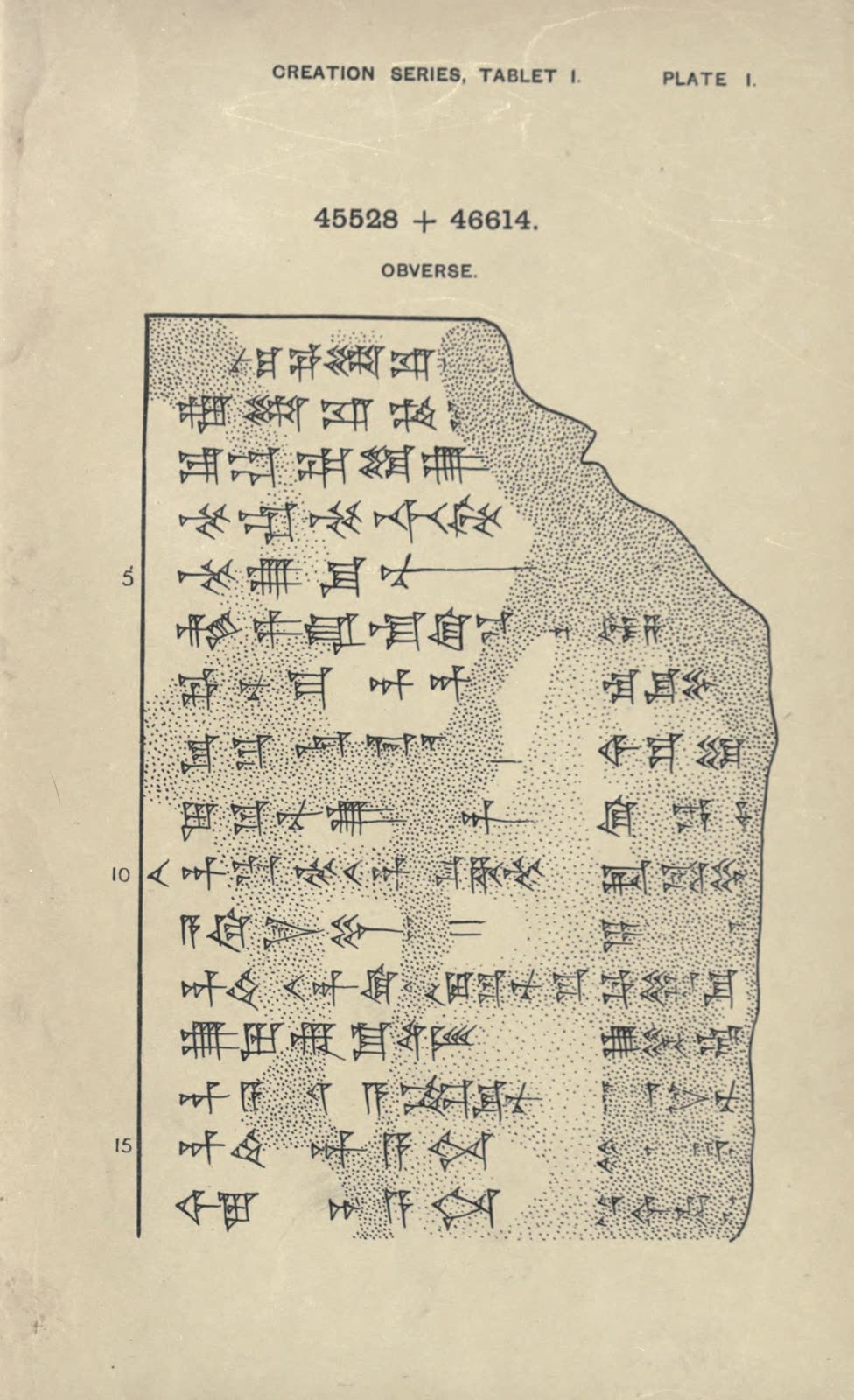
The surviving copies also put a physical limit on what any one piece can show. Leonard W. King's 1902 plate reproduces one part of the obverse of a joined Tablet I witness, 45528 and 46614. Other copies include an important witness from the joint Oxford and Chicago excavations at Kish in 1924. The plate shows the broken edge and the incomplete ends of rows that an editor has to compare with other witnesses. Read across the full tablet, Mummu enters with Apsu's complaint and disappears from the action when the plot against the younger gods collapses. The repeated word outlives his part in the story, carrying a different sense into Marduk's praise. [1] [3] [6] [7]
References and notes (7)
- W. G. Lambert, Babylonian Creation Myths 2013. Enūma Eliš, Tablet I 1–84 and 118, Tablet VII 86–87, and Tablet I manuscript apparatus. Return to the text ↑
- Sophus Helle, World Philology or Philology of the World 2023. The ancient commentary's treatment of mummu and sound, and the comparative discussion of names in the poem. Return to the text ↑
- Eckart Frahm, Creation and the Divine Spirit in Babel and Bible 2013, pp. 97–116. Studies the readings of mummu in the opening, the role of Apsu's vizier, and Marduk's name. Return to the text ↑
- Cuneiform Digital Library Initiative, Tablet I composite P480701 Opening lines of the composite transliteration and translation. Return to the text ↑
- Eckart Frahm and Enrique Jiménez, Myth, Ritual, and Interpretation 2015. Commentary on Enūma eliš I–VII, entries 2 and 57ʹ and their editorial notes. Return to the text ↑
- L. W. King, The Seven Tablets of Creation, volume II 1902, preface, contents and plate I in the University of Toronto copy. Return to the text ↑
- Jacob Dahl, CDLI Tablet feature on the creation epic Tablet I witness and its excavation at Kish by the joint Oxford and Chicago expedition. Return to the text ↑
Suggest a correction · Suggest a source for this record
Cite this record
IL Archive, «Mummu, the adviser of Apsu», https://ilarchive.com/en/entities/mummu