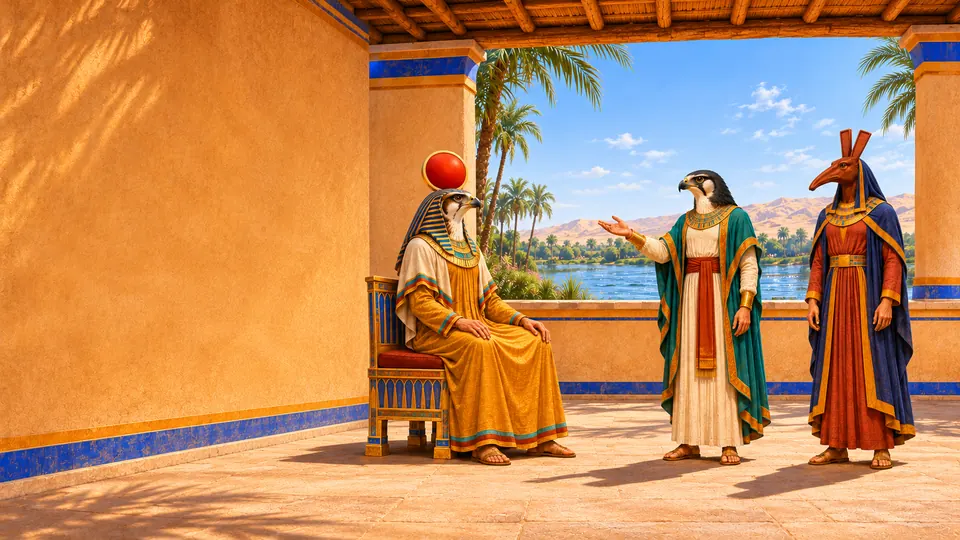
Entity · Deity
Neith of Sais and Esna
A reference page linking a name, group, or concept to the materials that discuss it.
- Names
- Neit · Neith
- Region
- Egypt
Neith was the patron goddess of Sais and a creator in the temple texts of Esna. In the Contendings of Horus and Seth, the divine assembly writes to her for a ruling on Osiris's office.
Estimated reading time: 5 min Published Last reviewed:
Share article
Text
Introduction
Neith was an Egyptian goddess particularly associated with Sais in the Nile Delta. Images and inscriptions give her several kinds of authority. Early emblems connect her with arrows and other implements. Saite donors presented metal statuettes in her honour. In the Contendings of Horus and Seth, a divine tribunal asks her who should take the office of OsirisOsirisOsiris was an ancient Egyptian deity associated with the dead, life after death, renewal, and kingship. His roles appear in changing funerary texts, rituals, and judgment scenes, notably the weighing of the heart.Glossary · Click to read the explanation. At Esna, temple texts place her at the beginning of the created world and describe a festival observed in her honour. [1] [2] [3] [4]
Emblems and offerings
The evidence for Neith's early cult includes objects on which her sign appears in several forms. Anne-Sophie von Bomhard discusses examples with crossed arrows or bows, and a two-lobed emblem that in some early representations has a ribbon falling beside the shaft. A vessel dated to the reign of Djet carries both kinds of device. Von Bomhard traces changes in the form of the object behind the arrows, including increasingly shield-like outlines during the Middle and New Kingdoms. Different versions could be recognised as belonging to Neith while keeping details that are difficult to identify from the outline alone. [2]
Stan Hendrickx studied carved stone fragments in Brussels and a joining fragment from Umm el-Qaab at Abydos. On this evidence he proposed that the two-lobed sign originally showed a pair of click beetles beside crossed arrows attached to a pole. The hypothesis relates the shapes on a small set of early objects to the later sign. The publication brings out both the variety of the early forms and the difficulty of assigning one fixed explanation to all of them. Neith's association with arrows also becomes explicit in much later texts describing her festival at Esna. [2] [4] [5]
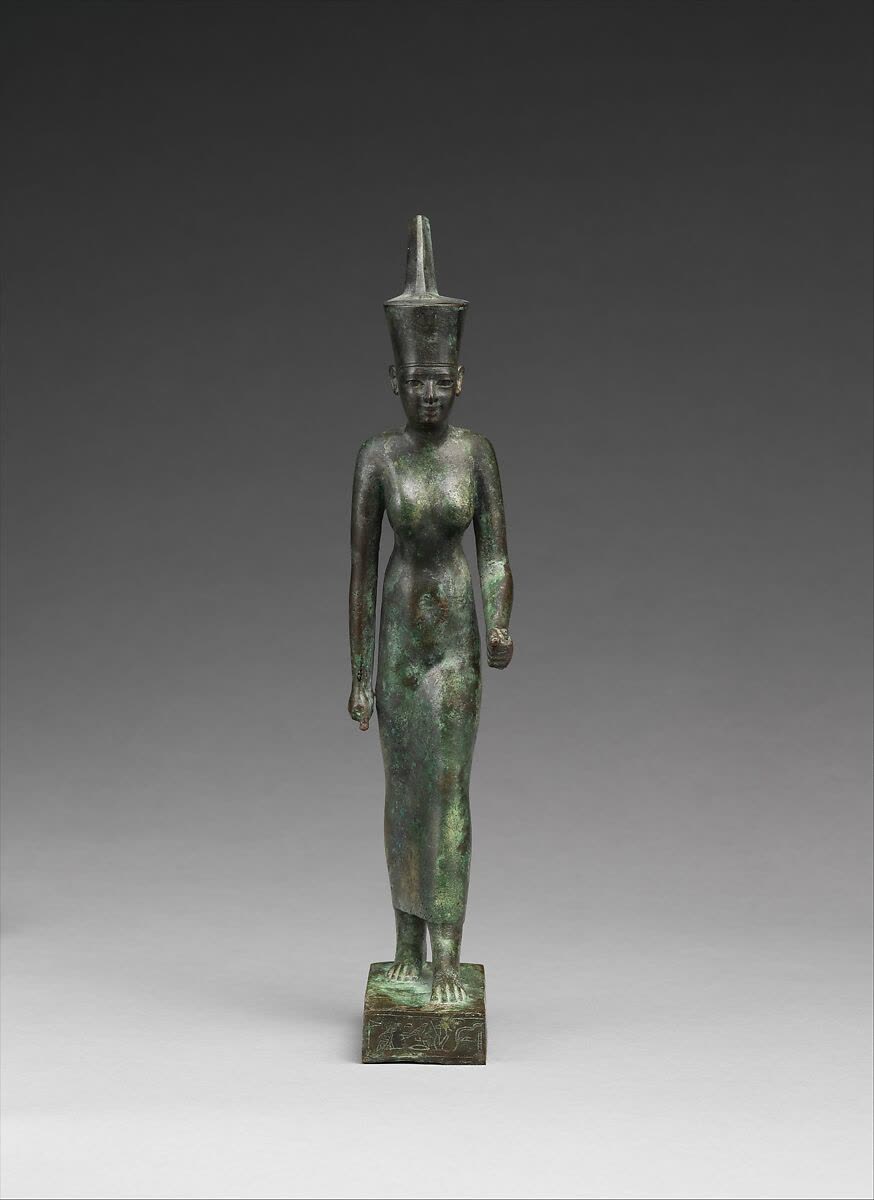
During Dynasty 26, when the rulers associated with Sais were prominent, there was a proliferation of metal images of Neith. The Metropolitan Museum's statuette 08.202.9 preserves a specific example. The museum reads the names of two beneficiaries, Nesnaisut and Pediese, and identifies Wahibreemkhebyt as a temple doorkeeper who helped with the donation. The temple to which they gave the figure is uncertain. Sais and Memphis are possibilities raised by the museum. The dedication illuminates how a statue could be supplied to a sanctuary and how the people connected with the gift could be recorded in its inscription. [1]
The letter to the divine assembly
In the Contendings of Horus and Seth, the gods are divided over which claimant should receive Osiris's office. Banebdjedet proposes that the assembly seek Neith's judgement before acting. The gods tell Thoth to write in the name of the Lord of All. The resulting letter addresses Neith as great and as the god's mother, and describes the sun god's continuing concern about Osiris. Neith is sought as an authority at a moment when those present have found it difficult to agree among themselves. [3]
Her response calls for Horus to take his father's office and threatens a collapse of the heavens if the gods act wrongly. She proposes that Seth's possessions be increased and that AnatAnatAnat is an ancient Near Eastern goddess attested at Mari, Ugarit and in Egypt. In Ugaritic narratives she is a warrior, Baal’s ally and a mourner for him; her roles vary by tradition and context.Glossary · Click to read the explanation and Astarte be given to him. Thoth reads the letter aloud and the assembly acclaims the judgement. The sun god responds by questioning Horus's youth and fitness, and the dispute continues. Horus eventually receives Osiris's office, the result Neith had advised. Her letter thus identifies a successor early in the tale, and the gods still have to reckon with the competing claims and enmities that have delayed the decision. [3]
The making of the world at Esna
An inscription on column 2 at Esna, edited as Esna 206 and dated by David Klotz to Trajan, frames its creation account as part of a ritualRitualAn organised or distinguished practice meaningful to a community; it may leave traces, but its form alone does not reveal an associated doctrine.Glossary · Click to read the explanation for Neith on the thirteenth day of Epiphi. The title names her both Lady of Esna and Lady of Sais. In the translation, she is present in the primordial waters and is described in terms of both fatherhood and motherhood. She takes the form of a cow and then of a fish. Light comes from her eyes, and her utterances are involved in the emergence of land. The story relates the primeval places to the two towns named at the outset. [4]
Klotz's translation and notes relate this account to festival instructions in the adjoining inscription, Esna 207. Archery and the lighting of torches belong to that ritual setting. The association is especially clear because the creation text also describes Neith speaking to her son, nursing him and promising protection against those who plot against him. Here the goddess who brings forth the world and the armed guardian belong to the same local tradition. The temple juxtaposes her with Khnum, who also bears creator epithets. Jochen Hallof and Emanuele Ciampini examine passages that give Neith female and male aspects and that bring the two deities together in formulations of primordial creation. [4] [6] [7]
Sais and Esna therefore appear in the same inscription as places where a rite for Neith is performed, despite their different settings in the Delta and Upper Egypt. The Saite statuette gives an earlier example of people acting through a temple officer to honour her. The court tale applies her authority to the question of which god should inherit a throne. Across those sources, the evidence for Neith lies in particular acts of dedication, worship and storytelling. [1] [3] [4] [6]
References and notes (7)
- The Metropolitan Museum of Art, Statuette of the goddess Neit, 08.202.9 Object record, dating, donation and beneficiaries, and open-access image designation. Return to the text ↑
- Anne-Sophie von Bomhard, The Decree of Saïs Appendix II, Some representations of the Temple of Neith. Read the discussion of the signs, their forms and periods. Return to the text ↑
- Alan H. Gardiner, The Library of A. Chester Beatty: Description of a Hieratic Papyrus 1931, section 8, The Contendings of Horus and Seth, pp. 14–16 and 26, correspondence with Neith and the final award of the kingship. Return to the text ↑
- David Klotz, The Temple of Esna: An Evolving Translation Column 2, texts 206–207, creation translation and accompanying comments on speech, archery and ritual torches. Return to the text ↑
- Stan Hendrickx, Two Protodynastic objects in Brussels and the origin of the bilobate cult-sign of Neith Journal of Egyptian Archaeology 82 (1996), pp. 23–42. Read the presentation of artifacts and the proposed derivation of the bilobate sign. Return to the text ↑
- Jochen Hallof, Esna UCLA Encyclopedia of Egyptology, Temple Deities section on Neith and Khnum. Return to the text ↑
- Emanuele M. Ciampini, Some Suggestions on the Androgynous Creator from the Texts Mentioning Neith at Esna Read pp. 1065–1069, especially the paired titles, Sais and Esna, and the relation of Neith and Khnum. Return to the text ↑
Suggest a correction · Suggest a source for this record
Cite this record
IL Archive, «Neith of Sais and Esna», https://ilarchive.com/en/entities/neith