Entity · Deity
Upelluri, the Support of Heaven and Earth
A reference page linking a name, group, or concept to the materials that discuss it.
- Names
- Ubelluri
- Region
- Hittite Anatolia (present-day Türkiye)
In the Song of Ullikummi, heaven and earth were built upon Upelluri and later cut apart. His account of that separation gives Ea a means to cut the growing stone challenger from his shoulder.
Estimated reading time: 5 min Published Last reviewed:
Share article
Text
Introduction
Upelluri is the being on whom heaven and earth were built in the Song of Ullikummi. In the surviving Hittite account, he says that their construction and separation passed without his knowing. What he feels is the pain in his right shoulder, where other gods have planted KumarbiKumarbiHurrian god in Hittite songs from Hattusha; he overthrows Anu and carries the storm god. A study of CTH 344, contested genealogy, and Greek parallels.Glossary · Click to read the explanation’s stone son. His explanation to EaEnkiMesopotamian deity also known as Ea, linked with Eridu and the Abzu (deep fresh waters), wisdom, incantations, and narratives of creation and cosmic order. Later written attestations do not identify the deity of Eridu’s earliest layers.Glossary · Click to read the explanation gives the older history of that shoulder and supplies the clue with which Ea intervenes in the struggle over heaven. [1] [2]
The shoulder Kumarbi chooses
Upelluri first enters the story through Kumarbi’s instructions. The stone child has been born and named Ullikummi. Kumarbi wants him to grow far from the sight of the sun god, the storm god, and the goddess IshtarInanna / IshtarA prominent Mesopotamian goddess whose Sumerian name Inanna became associated with Akkadian Ishtar across diverse traditions. She was associated with desire, war, royal authority and Venus, while local forms and genealogies varied among texts.Glossary · Click to read the explanation. He sends his messenger Impaluri for the Irsirra deities and tells them to carry the newborn into the dark earth. The command identifies a particular resting place, Upelluri’s right shoulder. It specifies that the child should grow a cubit in one day and gives a further measure for a month. [3]
The Irsirra lift the child from Kumarbi’s knees and place him before EnlilEnlilEnlil/Ellil: a major Mesopotamian god associated with destinies, kingship, and Ekur at Nippur, already prominent in third-millennium god lists. His name’s origin and cult beginnings remain debated.Glossary · Click to read the explanation. Enlil recognizes the stone body as the work of Kumarbi and understands that this is a rival for the storm god. After Enlil’s speech the bearers set the child upright on Upelluri like a spear. The first tablet gives Upelluri no answer at this point. The narrator follows the stone child’s growth through the water and out into the open. Upelluri’s own account of what he felt comes much later, after Ullikummi has reached the divine dwellings. [3] [1]
What he felt
Ea goes in search of a way to check the stone figure. Before he speaks to Upelluri, his conversation with Enlil is preserved in part. Ian RutherfordIan RutherfordSpecialist in Greek literature and religion at the University of Reading, studying contacts with Anatolia and Egypt.Glossary · Click to read the explanation notes a repeated question in the two encounters. Addressing Upelluri, Ea asks whether he knows about the danger and whether anyone has brought him word. Very similar language is restored in the earlier speech to Enlil. The second exchange makes the difference between hearing of the threat and feeling its effects part of the dialogue. [1] [4]
Ea tells Upelluri that the stone has grown in water and cut off the celestial temples and Hebat. Upelluri replies that he felt nothing when heaven and earth were built on him. He likewise failed to notice when they were cut apart with a tool. The pain in his shoulder is present and particular, even though he cannot identify the god responsible. Ea turns the shoulder and sees the stone standing there. The first tablet had already told its audience where the new body was planted. In the third, knowledge of that placement finally reaches the god who can act on it. [1] [2] [3]
Some translations give Ea’s greeting as an address to Upelluri in the dark earth, while also making Ea ask whether distance from the dark earth explains his ignorance. The condition of the passage and the shifting perspective make a precise diagram of his position difficult to infer. The two firm details that the story returns to are the right shoulder and the construction of heaven and earth upon him. Ahmet Ünal’s edition retains the references to the dark earth and takes the question about distance as a reference to standing high. [1] [2] [5]
The old cutting tool
Ea turns to the former gods, the keepers of ancient knowledge. He asks for the old sealed storehouses to be opened and the old seal to be brought. The tool they are to produce is the one that divided heaven from earth. Ünal and the TITUS edition use a word for a saw, while Hans Gustav Güterbock also translates it as a knife or, more generally, a cutter. Its purpose is clear across the renderings. Ea intends to cut the stone free underneath his feet where the child was set on Upelluri. [1] [5] [2]
Damage to the tablet interrupts the account between the order and Ea’s report that he has struck the stone. He tells TashmishuTashmishuDivine figure named in Kumarbi’s pregnancy with the storm god and the river Aranzah.Glossary · Click to read the explanation to send the gods back to battle. The storm god descends toward the sea and engages Ullikummi, who still has enough speech left in the surviving text to mention Ea’s help and claim kingship for himself. The surviving account leaves the outcome open. Upelluri’s part is already clear at that point. His body was both the means by which the challenger could grow in concealment and the place where Ea could break the connection that sustained him. [1] [2]
The clay witnesses at Hattusa
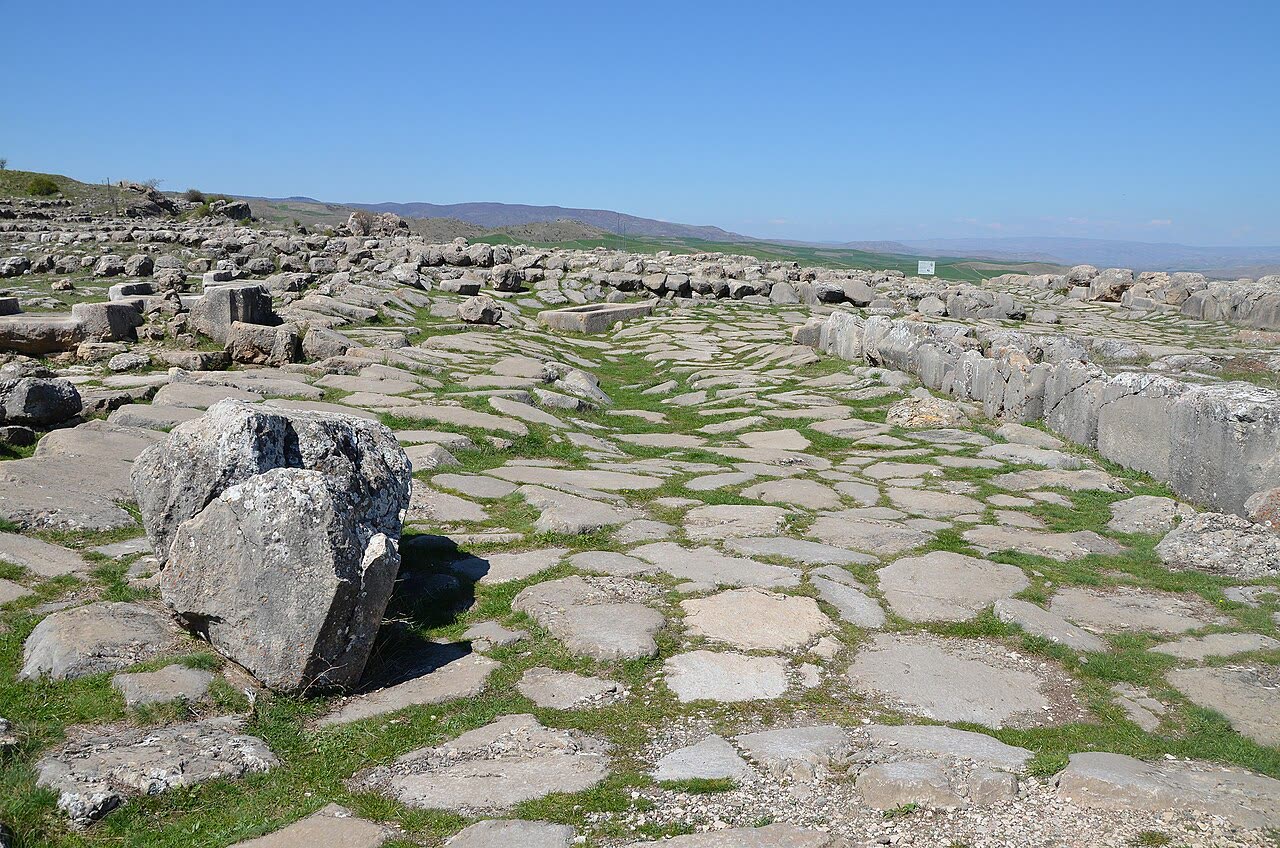
The spelling Ubelluri appears in Güterbock’s later treatment. In another study, A. A. Korolev identifies the name in the little fragment KBo 26.140 and suggests that it probably belongs to this song, while leaving its exact place uncertain. A fragment assigned more securely to the third tablet, KBo 58.4, came from collapse debris on the north street beside storeroom 25 of the Great Temple at Hattusa. It is a duplicate of part of the tablet that contains Ea’s visit. The photograph shows the paved street around the central temple building, in the complex where fragments of the song came to light. The concordance distinguishes that fragment’s recorded findspot from the context of KUB 33.106, an Istanbul piece assigned to the same temple area through its join with other fragments. [2] [6] [7]
References and notes (7)
- TITUS, Corpus of Hittite Mythological Texts, Song of Ullikummi, Tablet III Lines 175–236 and 253–301, Ea’s questions, Upelluri’s account, retrieval of the cutting tool, and the renewed fight Return to the text ↑
- Hans Gustav Güterbock, The Hittite Version of the Hurrian Kumarbi Myths, and Hittite Mythology Reprinted in Perspectives on Hittite Civilization, pp. 44–45 and 59–61, Upelluri’s speech and the attack Return to the text ↑
- TITUS, Corpus of Hittite Mythological Texts, Song of Ullikummi, Tablet I Lines 118–212, concealment, Enlil’s recognition, Upelluri’s shoulder, and growth in the water Return to the text ↑
- Ian Rutherford, Ea and the Beast. The Hittite Text and its Relation to the Greek Poetry P. 220, the formula in Ea’s questions to Upelluri and Enlil Return to the text ↑
- Ahmet Ünal, Das Lied von Ullikummi, CTH 345 Texte aus der Umwelt des Alten Testaments III, pp. 842–843, Upelluri’s dialogue, gloss on his position, and the saw Return to the text ↑
- A. A. Korolev, Hittite Texts: New Readings, Joins, and Duplicates Pp. 281–282, section I.3, possible placement of fragment KBo 26.140 Return to the text ↑
- Silvin Košak, Konkordanz der hethitischen Keilschrifttafeln, CTH 345 Entry 499/z, KBo 58.4 findspot, and its parallel in the joined witness that includes KUB 33.106 Return to the text ↑
Suggest a correction · Suggest a source for this record
Cite this record
IL Archive, «Upelluri, the Support of Heaven and Earth», https://ilarchive.com/en/entities/upelluri