Person · Figure
Amenhotep III
- Names
- Amenhotep III · Amenophis III · Mimmureya · Nebmaatre · Nimmureya
- Timeline
- From 1390 BCE to 1353 BCE
- Region
- Egypt
Amenhotep III built temples and a palace city during Egypt's Eighteenth Dynasty. Letters preserved at Amarna record exchanges and marriage alliances with other royal courts.
Estimated reading time: 5 min Published Last reviewed:
Share article
Text
Introduction
Amenhotep III ruled Egypt in the fourteenth century BCE, conventionally from about 1390 to 1353 BCE. The royal name Nebmaatre appears in hieroglyphs on objects from his reign. Foreign correspondents used forms such as Nimmureya to address him in cuneiformCuneiformWriting with wedge-shaped signs, developed from Mesopotamian recording traditions and used for several languages from the third millennium BCE.Glossary · Click to read the explanation. On a scarab from Malqata, the hieroglyphs for the throne name include the sun disk and a seated MaatMaatAn Egyptian principle of truth, justice, and right order, also embodied by the ostrich-feather goddess Maat; differently expressed in rule, ritual, and funerary judgment.Glossary · Click to read the explanation. His building projects survive around ThebesThebes, EgyptThebes, Egyptian Waset, was an ancient Egyptian city in the area of modern Luxor, with monuments on both banks of the Nile.Glossary · Click to read the explanation and farther south in Nubia. The palace site at Malqata and letters later stored at AmarnaAmarna / AkhetatenAmarna is the archaeological site of Akhetaten, Akhenaten’s fourteenth-century BCE capital in Middle Egypt, preserving royal boundary stelae, temples, houses and cemeteries.Glossary · Click to read the explanation bring two kinds of evidence together. They show what the king commissioned in Egypt and how his court received and preserved exchanges with rulers abroad. [1][2][3][4]
A jubilee city on the west bank
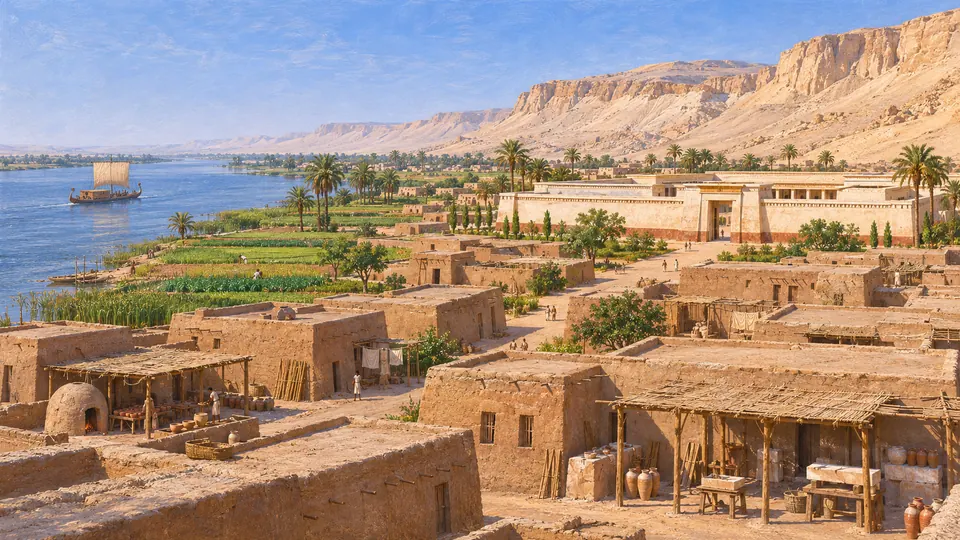
In year thirty of his reign, Amenhotep III celebrated a royal jubilee called a heb-sed. The complex planned for it lay at Malqata, on the west bank opposite modern Luxor. Excavators have identified palaces, ceremonial and administrative buildings and settlements for people who provided labor or supplies. A large artificial harbor, Birket Habu, lay beside the complex. The distribution of these remains helps explain the scale of a festival that occupied the court and its workers for a month or more. It also makes the official buildings intelligible as parts of a royal residence with its own supporting settlements. [4]
The festival complex was used again. Amenhotep III celebrated another jubilee in year thirty-four, when new buildings included a sanctuary to Amun. Buildings were refurbished for the third jubilee in year thirty-six. Archaeologists can study these successive uses because different parts of the site preserve traces of planning, construction and occupation. Finds from the early Metropolitan Museum excavations, carried out over six seasons between 1910 and 1920, were divided between the museum and the Egyptian Antiquities Service. Among them is a ceremonial menat necklace with a counterweight and beads of several materials. Its archaeological provenance connects a portable object to the palace site. [4]
Images and inscriptions
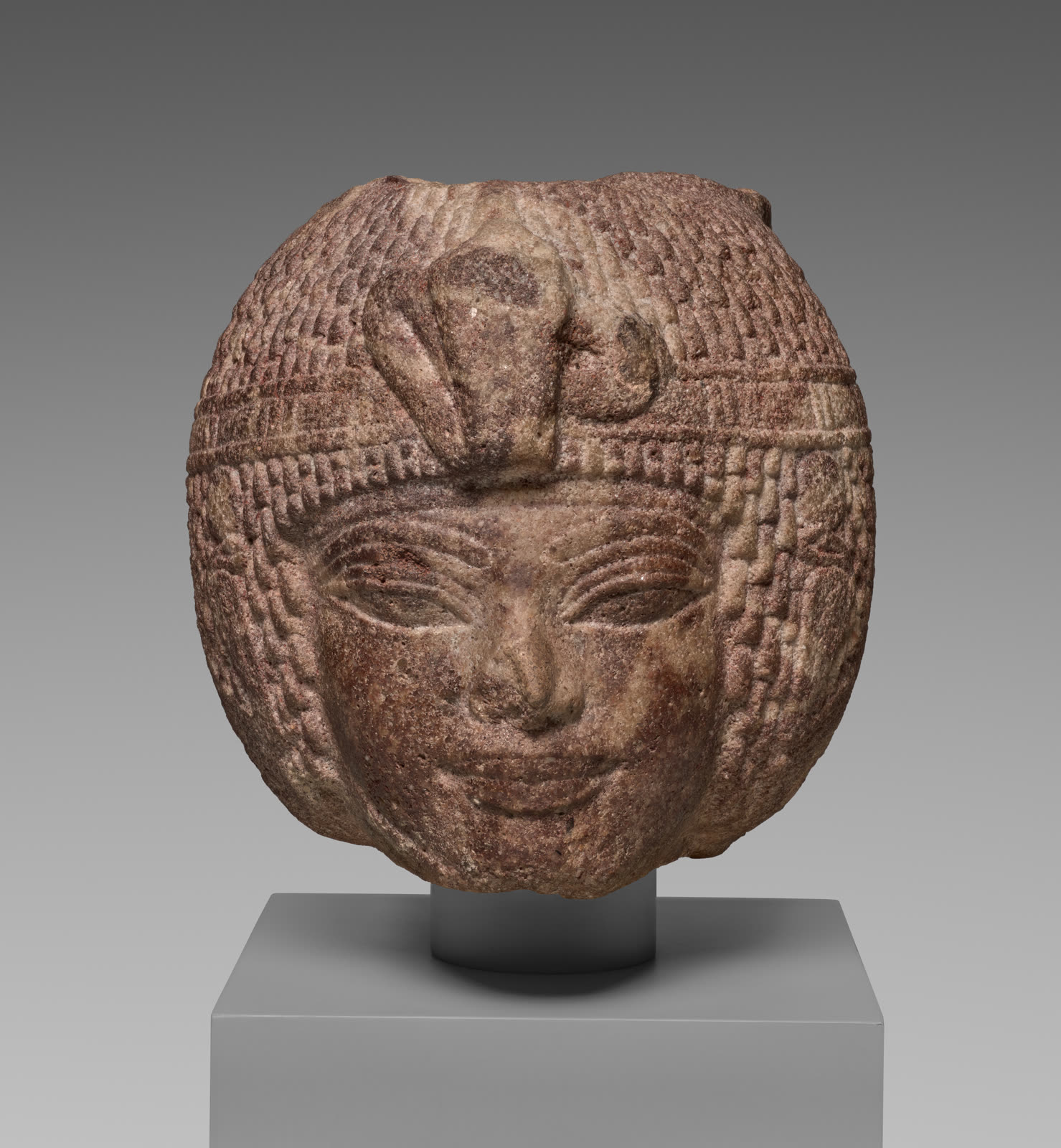
A quartzite portrait in Cleveland depicts the king in a rounded wig with a diadem decorated with cobras and sun disks. The museum interprets the face as a youthful image made when the king was considerably older. The figure shows how age could be represented in a royal portrait. Another kind of statement appears in the stone scarabs commissioned in the reign. One glazed steatite example records the completion of an artificial lake made for Tiye, the king's principal wife. It names a royal undertaking in a form small enough to circulate. The lake mentioned by that scarab has its own inscriptional evidence, while the harbor at Malqata is documented by the site plan. [4][5][6]
Life-size and colossal sculpture could also carry a history of later intervention. A seated colossus in the Metropolitan Museum once stood at the temple of Amen-Re in Luxor, a building of Amenhotep III. Around a century and a half later, Merneptah moved it and its companion to the eastern portal and put his own titulary on the sculpture. The surviving carving combines distinctive features associated with the earlier king and a later ruler's deeply incised names. That sequence can be read from the object and its recorded provenance. The temple at Soleb in Upper Nubia is another example of Amenhotep's building beyond the palace district. [7][8]
A letter received in year thirty-six
The king's correspondence survives in part because his son and successor AkhenatenAkhenatenEgyptian eighteenth-dynasty king, formerly Amenhotep IV, who reorganized royal religion around Aten and founded Akhetaten.Glossary · Click to read the explanation established a new capital at Akhetaten, modern Amarna, and earlier documents were retained there. One clay tablet, EAEnkiMesopotamian deity also known as Ea, linked with Eridu and the Abzu (deep fresh waters), wisdom, incantations, and narratives of creation and cosmic order. Later written attestations do not identify the deity of Eridu’s earliest layers.Glossary · Click to read the explanation 23, came from Tushratta of Mitanni. He calls Amenhotep III both brother and son-in-law. The letter announces the sending of the goddess Shaushka of NinevehNineveh and KuyunjikNineveh is an ancient Assyrian city near Mosul in northern Iraq; Kuyunjik is one of its archaeological moundsGlossary · Click to read the explanation, present in the form of a statue. The dispatch was an act of courtly diplomacy as well as an occasion of religious significance. It belongs to an exchange in which messengers and valuable objects passed between the two courts. [1][3]
Egyptian officials wrote a short note in hieratic on the tablet. Its surviving lines record receipt in year thirty-six, when the king was in a southern residence of the House of Rejoicing. That description is generally connected with the palace at Malqata. The docket therefore gives a likely place of receipt that differs from the later archive in which the letter was preserved. It also helps tie an episode in foreign relations to the last phase of the jubilee city. The original letter and the annotation belong to different stages of a single document's use. [3][4]
Tiye and an alliance across two reigns
After Amenhotep III's death, Tushratta wrote to Tiye. In EA 26 he cites assurances she had conveyed to him and presses her to tell Akhenaten the details of his father's undertakings. One dispute centered on statues. Tushratta says he had asked for cast gold and had received gold-plated wooden figures from the successor's court. Those details survive through his account, written in support of his own claim. They show how the foreign king expected Tiye to use her knowledge of the earlier negotiations to maintain the relationship. The scarab in Tiye's name and the letter addressed to her preserve evidence from quite different settings. One commemorates her place at the Egyptian court, while the other shows her taking part in an exchange between courts. [6][9]
References and notes (9)
- Elizabeth Knott, The Amarna Letters, Metropolitan Museum of Art Archive context and conventional dates of Amenhotep III Return to the text ↑
- The Metropolitan Museum of Art, Scarab with the Throne Name of Amenhotep III Reading of Nebmaatre and Malqata provenance Return to the text ↑
- Centre for the Study of Manuscript Cultures, University of Hamburg, A Journey through Kingdoms EA 23, divine statue, address and hieratic docket Return to the text ↑
- Catharine H. Roehrig, The Met's Joint Mission to Malqata Jubilees, Birket Habu, palace plan and excavated objects Return to the text ↑
- Cleveland Museum of Art, Head of Amenhotep III Wearing the Round Wig Object 1961.417, material and portrait interpretation Return to the text ↑
- The Metropolitan Museum of Art, Scarab Commemorating the Construction of an Artificial Lake Material and commemoration of construction for Tiye Return to the text ↑
- The Metropolitan Museum of Art, Colossal Statue of Amenhotep III Object provenance, sculpture and Merneptah's reuse Return to the text ↑
- Janice Kamrin and Adela Oppenheim, The Land of Nubia New Kingdom temple building, including the temple at Soleb Return to the text ↑
- William L. Moran, The Amarna Letters EA 26, lines 19–57, Tiye's reported intervention and dispute over the statues Return to the text ↑
Suggest a correction · Suggest a source for this record
Cite this record
IL Archive, «Amenhotep III», https://ilarchive.com/en/people/amenhotep-iii