Person · Figure
Augustus and the Egyptian-Nubian Frontier
- Names
- Augustus · Gaius Julius Caesar Augustus · Octavian
- Timeline
- From 63 BCE to 14 CE
- Region
- مصر والنوبة
Augustus made Egypt a Roman province in 30 BCE. On the southern frontier his prefects combined diplomacy and warfare with Kush, while temples and a displaced imperial portrait preserve different images of his rule.
Estimated reading time: 5 min Published Last reviewed:
Share article
Text
Introduction
Augustus says in his account of his achievements that he added EgyptEgyptEgypt lies mainly in northeastern Africa and includes the Sinai Peninsula in AsiaGlossary · Click to read the explanation to Roman rule. In the preceding section he mentions an army sent on his orders into the lands to the south. The two claims sit next to one another on the monument, in separate sections. Egypt became a Roman province in 30 BCE. The southern expedition was part of a war with Kush that ended in negotiations, and the area Rome governed after the war was smaller than the area its troops claimed to have reached. [1] [2] [3]
A prefect at Philae
After the end of Ptolemaic rule, Octavian, the future Augustus, put Gaius Cornelius Gallus in charge of Egypt. Gallus was a Roman equestrian, a member of the social order below the senators, who answered to Octavian. His title made him prefect of Alexandria and Egypt. Egyptian rule south of the first cataract of the Nile had a history before the Roman takeover. Gallus inherited both that geography and the need to deal with the Kushite kingdom beyond it. [2] [3]
In 29 BCE the prefect put up a trilingual monument at Philae. The Latin and Greek inscriptions announce his appointment, victories over an uprising in Upper Egypt and negotiations with envoys of the king of Kush. They also record the installation of a ruler over the territory between the First and Second Cataracts, known as the Triakontaschoinos. Exactly what legal status Gallus claimed for that area is disputed. The Egyptian text uses the first year of Caesar as its date and gives greater prominence to shrines and offerings to the gods, including Khnum of ElephantineElephantine / YebElephantine / Yeb, near Aswan at the Nile’s First Cataract, preserves a long-lived Egyptian town, temples of Khnum and Satet, and Persian-period garrisons. Aramaic papyri document several communities, including Judeans and Yaho’s temple, whose rebuilding was sought in 407 BCE; claims and archaeological interpretations must be distinguished.Glossary · Click to read the explanation, Isis and OsirisOsirisOsiris was an ancient Egyptian deity associated with the dead, life after death, renewal, and kingship. His roles appear in changing funerary texts, rituals, and judgment scenes, notably the weighing of the heart.Glossary · Click to read the explanation. The versions therefore preserve different emphases in the prefect’s account of the new regime. They all belong to the same monument. [2]
From a raid to a settlement
The next period of conflict began around 25 BCE, while Roman troops from Egypt were away in Arabia under Aelius Gallus. Strabo says Kushite forces entered Syene, Elephantine and Philae, took captives and pulled down statues of Caesar. Petronius, the Roman prefect who responded, advanced to Premnis, the fortress now called Qasr Ibrim. Strabo, Cassius Dio and Augustus’s inscription also place the Roman advance at Napata, though some modern historians question whether the army went that far. Archaeological evidence for a Roman garrison at Qasr Ibrim is firmer. The outpost was attacked by Kushite forces and defended by Petronius in a further intervention. [1] [3] [4] [5]
Strabo says that when Kushite envoys sought terms they were sent to Augustus, who was then on Samos. He says Augustus heard their requests and remitted the tribute. Modern accounts date the negotiations to around 21–20 BCE. After the settlement Roman control endured in the northern portion of Lower Nubia, the Dodekaschoinos, as far as Maharraqa. The actual sequence south of Egypt includes a Roman advance, a threatened garrison and a settlement with concessions. In his Res Gestae, Augustus pairs the southern venture with the expedition into Arabia, notes losses inflicted on opponents and names the farthest places reached. His choice of details conveys a different measure of achievement from the limits of the region the Romans ended up administering. [1] [2] [3] [4]
A Roman portrait in Meroe
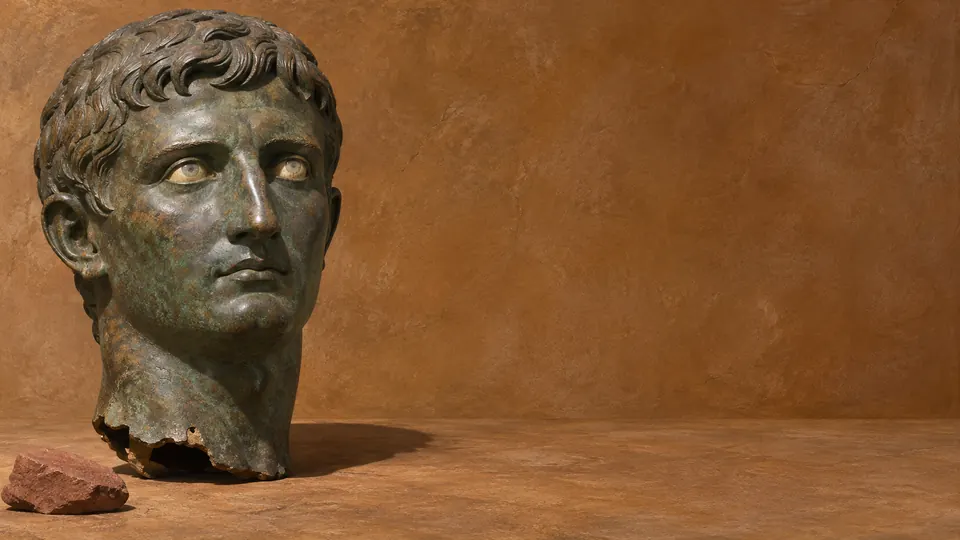
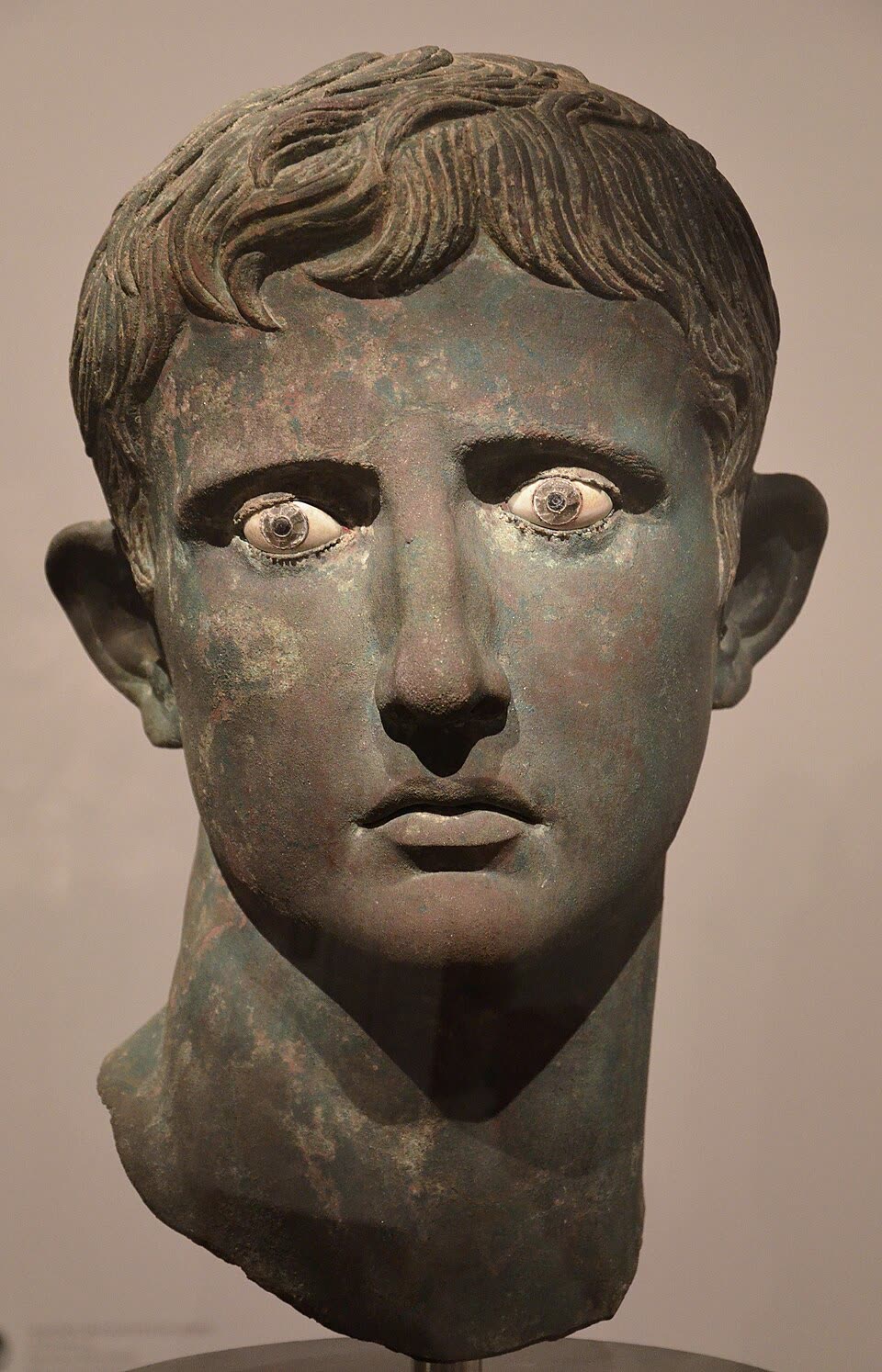
The bronze head pictured here was discovered at Meroe in present-day Sudan. It once belonged to a statue larger than a living person. The eyes are inlaid, the pupils with glass and the irises with calcite, and the neck is broken. The head was found at the entrance to a temple building in the Kushite capital. It is plausibly one of the imperial images removed during the raids Strabo describes, although the original location of this individual statue has not been established. Its placement at Meroe is often understood as a deliberate treatment of the defeated enemy’s image. The excavation gives that interpretation a physical setting and leaves the intentions of the people who put it there open to inference. [4] [6] [7]
The emperor represented as pharaoh
In the settlement’s aftermath, the Temple of Dendur was built on the Nubian stretch of the Nile under Augustus. Its reliefs show him dressed as an Egyptian pharaoh and offering to deities. In some scenes his name or designation appears as a Greek or Roman title written in Egyptian hieroglyphs. In others the oval name rings identify him simply as pharaoh. Isis of Philae is central to the temple. Two deified brothers, Pedesi and Pihor, appear in the reliefs, as do the Nubian gods Mandulis and Arsenuphis. Their presence makes the dedication specific to the region where the temple stood. One scene shows the emperor presenting the crowns of Upper and Lower Egypt to Isis. Another shows him burning incense and pouring a liquid offering for the brothers. The carvings present rule through the expected actions of a king within a local cult. [8]
In his own account for public commemoration, the emperor presents the Nile expedition as an extension of Roman power. At Dendur his image acts within an Egyptian ritualRitualAn organised or distinguished practice meaningful to a community; it may leave traces, but its form alone does not reveal an associated doctrine.Glossary · Click to read the explanation tradition that recognized local gods. At Meroe the same ruler’s likeness survived in a place chosen by the people who brought it to Kush. These are three settings in which Augustus’s authority was asserted, adapted or challenged, within a few years of the military and diplomatic exchanges that set the extent of Roman government south of Egypt. [1] [3] [7] [8]
References and notes (8)
- Augustus, Res Gestae Divi Augusti, F. W. Shipley edition §§26–27, campaign to the south and incorporation of Egypt Return to the text ↑
- Martina Minas-Nerpel and Stefan Pfeiffer, Establishing Roman Rule in Egypt, The Trilingual Stela of C. Cornelius Gallus from Philae pp. 265–270 and 285–290, the prefect, the three texts and the border settlement Return to the text ↑
- Audrey Eller, Borders and Frontiers of Ptolemaic and Roman Egypt, The Case of Lower Nubia pp. 68–71 and 75–77, military occupation, withdrawal and wider frontier Return to the text ↑
- Strabo, Geography, translated by H. L. Jones 17.1.54, the raids, Petronius’s advance, Samos and remission of tribute Return to the text ↑
- Cassius Dio, Roman History, translated by Earnest Cary 54.5.4–6 and 54.7.4, campaign and Augustus’s stay at Samos Return to the text ↑
- British Museum, Bronze Head of Augustus Object 1911,0901.1, Meroe, materials and preserved features Return to the text ↑
- Marc Bundi, Display and Displacement, The Bronze Head of Augustus from Meroe pp. 22–24, archaeological context and history of the excavation Return to the text ↑
- Metropolitan Museum of Art, The Temple’s Cult and Decoration Isis of Philae, regional gods and the cartouches and figures of Augustus at Dendur Return to the text ↑
Suggest a correction · Suggest a source for this record
Cite this record
IL Archive, «Augustus and the Egyptian-Nubian Frontier», https://ilarchive.com/en/people/augustus