Person · Figure
Ibbi-Sin, the Last King of the Third Dynasty of Ur
- Names
- Ibbi-Sin · Ibbi-Suen · Ibbī-Sîn
- Timeline
- From 2028 BCE to 2004 BCE
- Region
- Mesopotamia
Ibbi-Sin ruled as the authority of Ur gave way to rival powers, including Ishbi-Erra’s kingdom at Isin. His seals, surviving accounts and the later Sumerian lament preserve different evidence for the reign.
Estimated reading time: 5 min Published Last reviewed:
Share article
Text
Introduction
Ibbi-Sin was the last king of the Third Dynasty of Ur. In the conventional chronology used here, he reigned about 2028–2004 BCE. A cylinder sealCylinder sealSmall engraved cylinder rolled over soft clay to leave an extended image. Used to secure, document and identify administrative actions; its pictures do not automatically constitute writing.Glossary · Click to read the explanation names him as the powerful king of Ur and king of the four quarters. Documents from Nippur show how records once dated by his reign came to be dated by the reign of Ishbi-Erra of Isin. Ur itself was eventually captured by forces from Elam and their allies. [1][2][3]
The documents come from different settings. The seals and administrative tablets preserve names and transactions from the time of his rule. Letters in his name or addressed to him survive in copies made by later scribes. A Sumerian lament depicts him grieving in his palace and being taken away to Elam. Each form tells us something different about his reign and the memory of its end. [1][2][3][4]
The king on an official’s seal
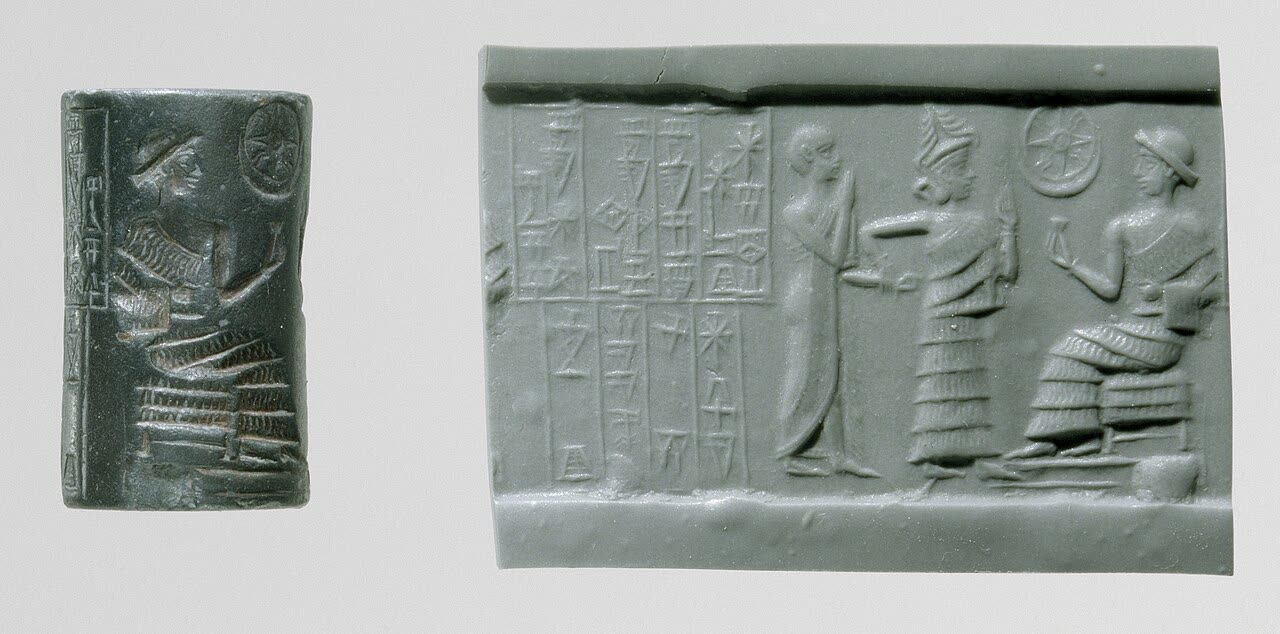
A hematite cylinder in the Metropolitan Museum of Art belonged, on the museum’s interpretation, to the overseer Ilum-bani. Its inscription names his father, Ili-ukin, and calls Ilum-bani the servant of Ibbi-Sin. The engraving was designed to be rolled across clay. In the modern impression shown beside the cylinder, a goddess leads a worshipper before a seated figure holding a cup. The museum identifies the seated figure tentatively as the deified king and points out that the written name of Ibbi-Sin carries a sign indicating divinity. The image and inscription present the official in relation to the ruler. [1]
A tablet from Puzrish-Dagan in the Ashmolean Museum gives a more routine example of the king’s name in the records. It is dated to month seven of his second year and records two grain-fed, long-fleeced sheep for the deities EnlilEnlilEnlil/Ellil: a major Mesopotamian god associated with destinies, kingship, and Ekur at Nippur, already prominent in third-millennium god lists. His name’s origin and cult beginnings remain debated.Glossary · Click to read the explanation and NinlilNinlilMesopotamian goddess and consort of Enlil, associated with Nippur, Tummal, destinies and royal ritual. Identified with Sud in literary tradition and known as Mulliltu/Mullissu in Akkadian and Assyrian contexts; her genealogies and roles vary by text and period.Glossary · Click to read the explanation. Nicholas Reid identifies the responsible official as Suen-Abushu, the king’s cupbearer. The tablet carries seal impressions on both faces. Parallels show that the scribe Nanna-maba’s seal had named the previous king, Shu-Sin, and was recut to name Ibbi-Sin. That change lets researchers follow the same official’s seal across the succession. [5]
Grain, letters and a rival at Isin
A literary letter addressed to Ibbi-Sin has Ishbi-Erra say that he was sent to Isin and Kazallu to buy grain. He reports gathering grain at Isin and says that the arrival of hostile groups called Martu made delivery difficult. He offers to take responsibility for Isin and Nippur. The request for authority over the two cities appears within a message about supplies and military pressure. In the Oxford edition, the shorter version ends after the request, while a longer one continues with assurances about Isin, Nippur and Ur. [2][6]
Piotr Michalowski notes that the surviving royal letters were copied long after the Third Dynasty. Some have markedly different versions. The Ashmolean tablet catalogued as one witness to the grain letter is Old Babylonian, and its place of discovery is uncertain. The story in the letter can be compared with dated administrative documents, with the two types of evidence carrying different weight. At Nippur, the latest dates in Ibbi-Sin’s name appear near the earliest dates in Ishbi-Erra’s. Michalowski identifies two tablets dated to the early months of Ibbi-Sin’s eighth year and discusses how the chronology might fit the new dating system. [2][7]
The new dating at Nippur is one sign of a shift in authority. Two later accounts from the InannaInanna / IshtarA prominent Mesopotamian goddess whose Sumerian name Inanna became associated with Akkadian Ishtar across diverse traditions. She was associated with desire, war, royal authority and Venus, while local forms and genealogies varied among texts.Glossary · Click to read the explanation temple there retain personnel known from the time of Ibbi-Sin, even though they are dated by Ishbi-Erra’s reign. This gives the political change a local context. Some of the people carrying out the temple’s administration stayed in place as the name used to date their records changed. [2]
The tablets found at Ur itself provide an uneven view of the reign. Michalowski discusses two groups identified in material from one season of excavation. One concentrates on the first eight years, especially years five to eight. The other is mostly from year fourteen, with some dated to years fifteen and sixteen. The tablets were recovered from disturbed deposits. The concentration of surviving accounts in particular years depends in part on which archives entered those deposits. [2]
Captivity and the memory of Ur
François Vallat describes an alliance led by Kindattu, king of Simashki, that included people of Susiana. In the chronology he adopts, it took Ur in 2004 BCE and brought Ibbi-Sin to Elam as a prisoner. The Sumerian Lament for Sumer and Ur gives the capture a place in a much wider disaster. At the opening, the gods determine the fate of the land, and the poem imagines roads deserted, fields going untended and households unable to care for their children. It singles out Ibbi-Sin for removal to Elam and compares his departure with that of a swallow flying away from its home. [3][4]
In another passage of the lament, Ibbi-Sin grieves alone in his palace while a great storm figures the ruin spreading across the land. The image of the solitary king belongs to the poem’s explanation of what it meant for Ur to lose kingship. The cylinder seal shows the ruler receiving an official, and the dated tablet shows a royal administration performing its work. The lament sets the same king within the loss of a city and its ordinary life. [1][4][5]
References and notes (7)
- Metropolitan Museum of Art, Cylinder seal: Seated Figure Approached by a Goddess Leading a Worshiper Read the description of the cylinder and impression, the Ilum-bani inscription, the dating and the tentative identification of the seated figure. Return to the text ↑
- Piotr Michalowski, The Correspondence of the Kings of Ur Read the opening discussion of the date of the witnesses and chapter 6 on the Isin succession, dating at Nippur, temple personnel, and variants in the Ibbi-Sin correspondence. Read the account of the two groups of tablets in disturbed deposits at Ur. Return to the text ↑
- François Vallat, Elam I: The History of Elam Read the Simashki section on the chronological convention, Kindattu’s alliance, the capture of Ur and Ibbi-Sin’s captivity. Return to the text ↑
- Electronic Text Corpus of Sumerian Literature, The Lament for Sumer and Urim, 2.2.3, English translation Read the opening fate of the land and the capture in lines 1–55, and the account of the king in the palace in lines 93–111. Return to the text ↑
- Nicholas Reid, Feeding Gods and Dogs: New Ur III and Old Babylonian Texts in the Ashmolean Museum Read §2.2, the edition of AN 2010-49, its date and transaction, and the comparison of Nanna-maba’s seal on related documents. Return to the text ↑
- Electronic Text Corpus of Sumerian Literature, Letter from Ishbi-Erra to Ibbi-Suen about the Purchase of Grain, 3.1.17, English translation Read lines 1–45, including the destination, delayed delivery, request for authority and the break between the shorter and longer versions. Return to the text ↑
- Cuneiform Digital Library Initiative, Literary 000557 exemplar 004, P345809 Read the date, uncertain provenance, material, collection number and identification of the witness to the grain letter. Return to the text ↑
Suggest a correction · Suggest a source for this record
Cite this record
IL Archive, «Ibbi-Sin, the Last King of the Third Dynasty of Ur», https://ilarchive.com/en/people/ibbi-sin