Person · Literary figure
Inaros in Demotic Literature
- Names
- Inaros · Inaros of Athribis
- Region
- Egypt
Egyptian tales remember Inaros of Athribis as a warrior whose armour becomes the prize in a dispute among his heirs. A damaged Assyrian inscription may preserve the name of a historical counterpart.
Estimated reading time: 5 min Published Last reviewed:
Share article
Text
Introduction
Inaros of Athribis is the hero of a group of Egyptian tales written in Demotic, an Egyptian script also used for everyday writing. Some stories follow him into battle. Others begin after he has died and make his children the protagonists. The best preserved of these, The Contest for the Armour of Inaros, sets rival groups of warriors against one another over the possession of his armour. The stories share characters and borrow from the political world of first-millennium BCE EgyptEgyptEgypt lies mainly in northeastern Africa and includes the Sinai Peninsula in AsiaGlossary · Click to read the explanation. They give Inaros a far fuller life on the page than he has in the surviving historical evidence. [1] [2] [3]
The prince from Athribis
The tales give Inaros a home in Athribis, in the Nile Delta, and a father named Bokennife, a ruler of that city. Tawny L. Holm points out another sign of belonging. The literary Inaros swears by Horus Khenty-Khety, the god of Athribis. His son Pami, whom Ian RutherfordIan RutherfordSpecialist in Greek literature and religion at the University of Reading, studying contacts with Anatolia and Egypt.Glossary · Click to read the explanation calls Pemu, is associated with HeliopolisHeliopolis, ancient IunuHeliopolis is the Greek name of Egyptian Iunu, at Matariya in northern present-day CairoGlossary · Click to read the explanation and calls on that city's god AtumAtumAtum is an Egyptian creator god associated with HeliopolisGlossary · Click to read the explanation. An oath in these stories can tell a reader which town and which divine patron a warrior claims as his own. [2] [3]
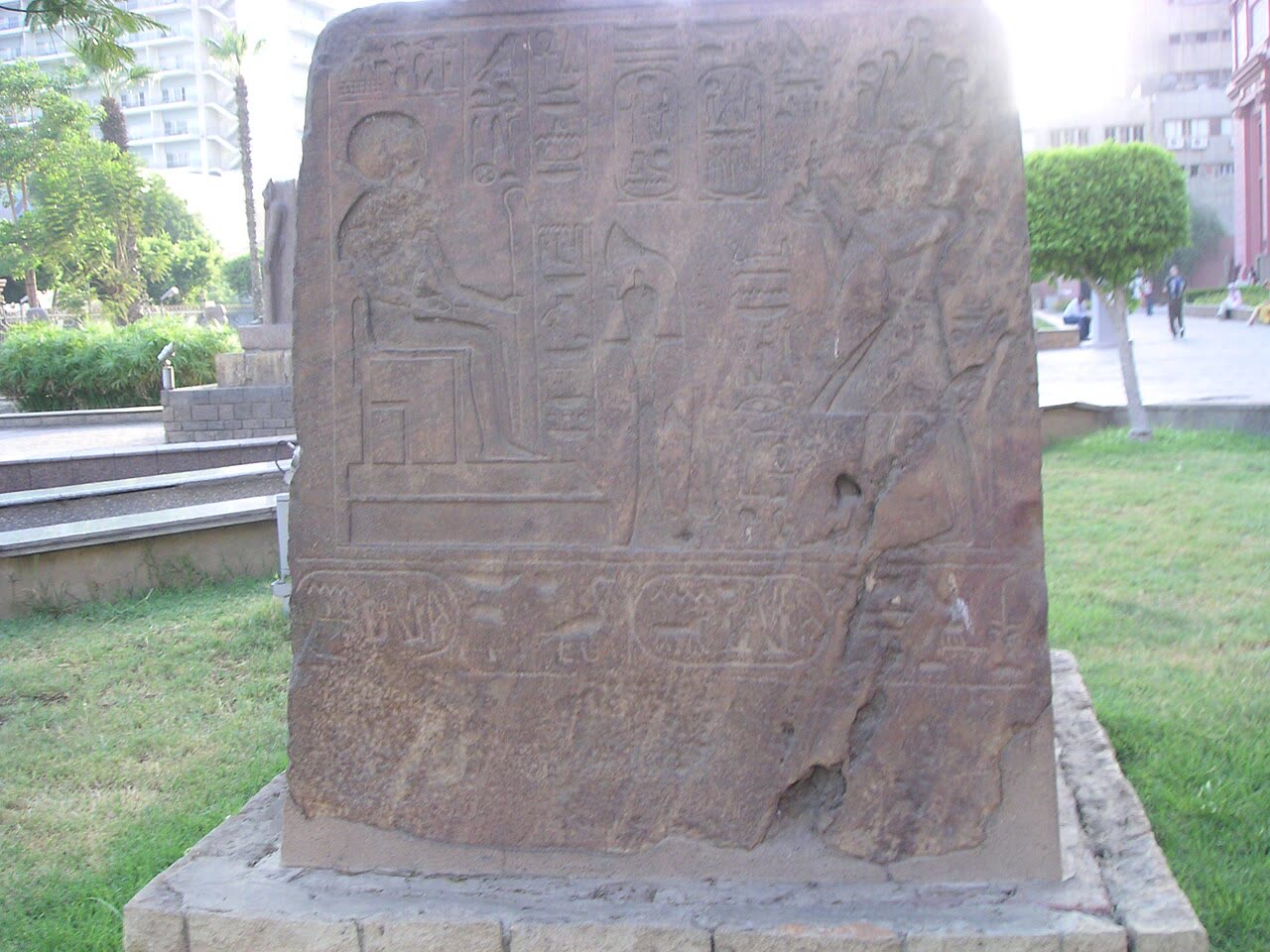
The obelisk base pictured here comes from the sanctuary of the god invoked by Inaros. The temple's pair of obelisks stood in front of the sanctuary. The Archaeological Museum in Poznań, which holds one of the shafts, records that one base was recovered at Athribis itself and the other was found reused at Fustat. Both came to the Egyptian Museum in Cairo. The Ramesside relief belongs to the city's cult centuries before the world of the Demotic tales. [4]
A fight over the armour
The surviving opening of The Contest for the Armour of Inaros is damaged. In Rutherford's account of the story OsirisOsirisOsiris was an ancient Egyptian deity associated with the dead, life after death, renewal, and kingship. His roles appear in changing funerary texts, rituals, and judgment scenes, notably the weighing of the heart.Glossary · Click to read the explanation, angered by an interruption to a rite, sets forces in motion that stir up a quarrel. Among the early scenes is a gathering of Pemu and the forty warriors associated with his father. Pemu learns that Wertiamonnut of Mendes has taken the armour and goes with his ally Pekrur to the pharaoh, Petubastis. Wertiamonnut denies the accusation when summoned to court. Even as people come from across Egypt for Inaros' funeral, his followers and their rivals fail to settle what should happen to his arms. [2] [3]
The champions converge on the Gazelle Lake, where their contingents match up for battle. Ankhhor, the pharaoh's son, supports Wertiamonnut. The arrivals and lists of ships show how a quarrel over one object draws in groups from several cities. Pemu comes close to killing Wertiamonnut before Monthbaal intervenes, and Petubastis prevents Pemu's ally Petekhonsis from killing Ankhhor. The armour goes back to Heliopolis. Minnemei, another son of Inaros, arrives from ElephantineElephantine / YebElephantine / Yeb, near Aswan at the Nile’s First Cataract, preserves a long-lived Egyptian town, temples of Khnum and Satet, and Persian-period garrisons. Aramaic papyri document several communities, including Judeans and Yaho’s temple, whose rebuilding was sought in 407 BCE; claims and archaeological interpretations must be distinguished.Glossary · Click to read the explanation with troops after the fighting has ended. A monument commemorates the events within the story. [2]
Other tales give Inaros adventures of his own, including an attack on Esarhaddon and a fight with a griffin. Still others carry the same cast into new disputes. In The Contest for the Benefice of Amun, a priestly office at Thebes is contested by the pharaoh's party and a priest from Buto. In that tale Minnemei again arrives late, but in time to fight. These recurrences let a reader recognize the characters while seeing how a different quarrel brings out different loyalties and gives different people the decisive role. [1] [2]
A story pieced together from several rolls
The fullest surviving copy of the armour story is Papyrus Krall in Vienna, P. Dem. Vindob. 6521–6609. The damage at its beginning leaves passages where the course of the story is difficult to follow. Kim Ryholt published fragments of a second copy, P. Carlsberg 456 and P. CtYBR 4513, which overlap with those early sections. The pieces from Copenhagen and Yale belong to one roll. Their text allows portions of the opening to be reconstructed by reading the two witnesses together. [5]
Friedhelm Hoffmann favors 137/138 CE for Papyrus Krall and considers 158/159 CE less likely. He suggests that the copy may have been made from a version of the story written in the Ptolemaic period. The archaeology adds another kind of evidence. Ilaria Cariddi identifies a further piece of the Copenhagen and Yale roll, SCA 7927.7, excavated in 2007 in a dump east of the temple at Tebtunis. She traces pieces of the same roll to different discoveries and considers several ways the scraps might have become dispersed. Taken together, the manuscripts document the copying and circulation of the tale long after the era in which its characters live. [6] [7]
The name outside the Demotic tales
A fragmentary Aramaic inscription at Sheikh Fadl may preserve a much earlier story about Inaros. Holm argues that the likely reading of the name and parallels such as the appearance of a band of forty men point toward the literary tradition known from the later Demotic texts. Hoffmann dates this early witness to the early fifth century BCE. Its language and preservation differ from those of the papyrus, and the comparison rests on shared names and motifs. [1] [3]
Holm also discusses Joachim Friedrich Quack's proposal that a damaged name in an inscription of AshurbanipalAshurbanipalAshurbanipal was an Assyrian king of the seventh century BCE, reigning about 668–631 BCEGlossary · Click to read the explanation can be restored as a form of Inaros. The Assyrian text identifies the bearer as a ruler of Athribis. The loss of part of the name leaves room for other readings. This proposed seventh-century BCE figure must be distinguished from the better documented Inaros who led a revolt against Persian rule in the fifth century BCE. For the Demotic hero, the strongest evidence remains the stories themselves and the many stages through which they were transmitted. [3]
References and notes (7)
- Friedhelm Hoffmann, Hieratic and Demotic Literature The Inaros and Petubastis Cycle, and the chapter's introductory discussion of the scripts. Return to the text ↑
- Ian Rutherford, The Earliest Cross-Cultural Reception of Homer? The Inaros-Narratives of Greco-Roman Egypt Section 1, The Inaros-Narratives, pp. 83–86, including the armour and benefice plots. Return to the text ↑
- Tawny L. Holm, The Sheikh Fadl Inscription in Its Literary and Historical Context Pp. 201–208 and 215–217, including the Aramaic name, the Athribis princes, the fifth-century namesake, and the thematic parallels. Return to the text ↑
- Archaeological Museum in Poznań, Obelisk The provenance of the Athribis obelisks, the temple of Khenti-kheti, and the finds and display of the bases. Return to the text ↑
- Kim Ryholt, A Parallel to the Inaros Story of P. Krall (P. Carlsberg 456 + P. CtYBR 4513) Abstract only, on the Vienna inventory, surviving fragments and partial reconstruction of the opening. Return to the text ↑
- Friedhelm Hoffmann, Die Entstehung der demotischen Erzählliteratur P. 373, entry Der Kampf um den Panzer des Inaros, on the dates of Papyrus Krall and the parallel witness. Return to the text ↑
- Ilaria Cariddi, Notes on the Archaeological Context of Literary and Para-Literary Greek and Egyptian PSI from the 1930s Italian Excavations in Tebtynis The manuscript joins and find contexts for PSI inv. D 59, PC 456, P.CtYBR inv. 4513 and SCA 7927.7. Return to the text ↑
Suggest a correction · Suggest a source for this record
Cite this record
IL Archive, «Inaros in Demotic Literature», https://ilarchive.com/en/people/inaros-literary-cycle