Site · City
Kutha and the Temple of Nergal
- Names
- Cutha · Kutha · Tell Ibrahim
- Region
- Mesopotamia
Kutha was a city in Babylonia and the home of Emeslam, the temple of Nergal. Akkadian and Assyrian inscriptions record the city’s cult, and a later legend places a king’s message there.
Estimated reading time: 5 min Published Last reviewed:
Share article
Text
Introduction
Kutha, also written Cutha, was a Babylonian city at modern Tell Ibrahim in IraqIraqIraq is a modern country encompassing much of ancient MesopotamiaGlossary · Click to read the explanation. An inscription of Naram-Sin names Nergal at Kutha. Centuries later, Assyrian texts describe work on Emeslam, the temple of the same god in the city. These records give the sanctuary a history that can be followed across different reigns. [1][2][3]
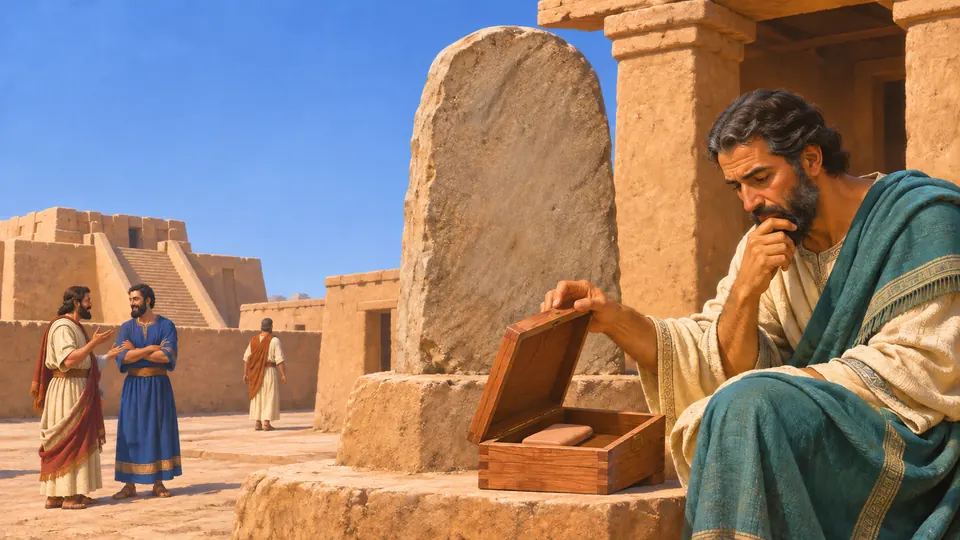
A later story gives Emeslam a different role. In the Cuthean Legend, Naram-Sin says he left an inscribed stone in Nergal’s shrine so that future rulers could learn from his mistakes. The city in the story is the same one the inscriptions name, and its temple is where the narrator entrusts his account to posterity. [3][4]
Tell Ibrahim and its finds
Hormuzd Rassam excavated the main mound at Tell Ibrahim for about four weeks, around March 1881. J. E. Reade, who studied his records, distinguishes the main mound where Rassam worked from a smaller mound to the west. The report describes a baked brick wall with a doorway and the mudbrick walls of eight or nine rooms. Among the finds Reade lists are bowls bearing incantations and a clay tablet, BM 42380, written at Kutha and dated to about 177 BCE. [1]
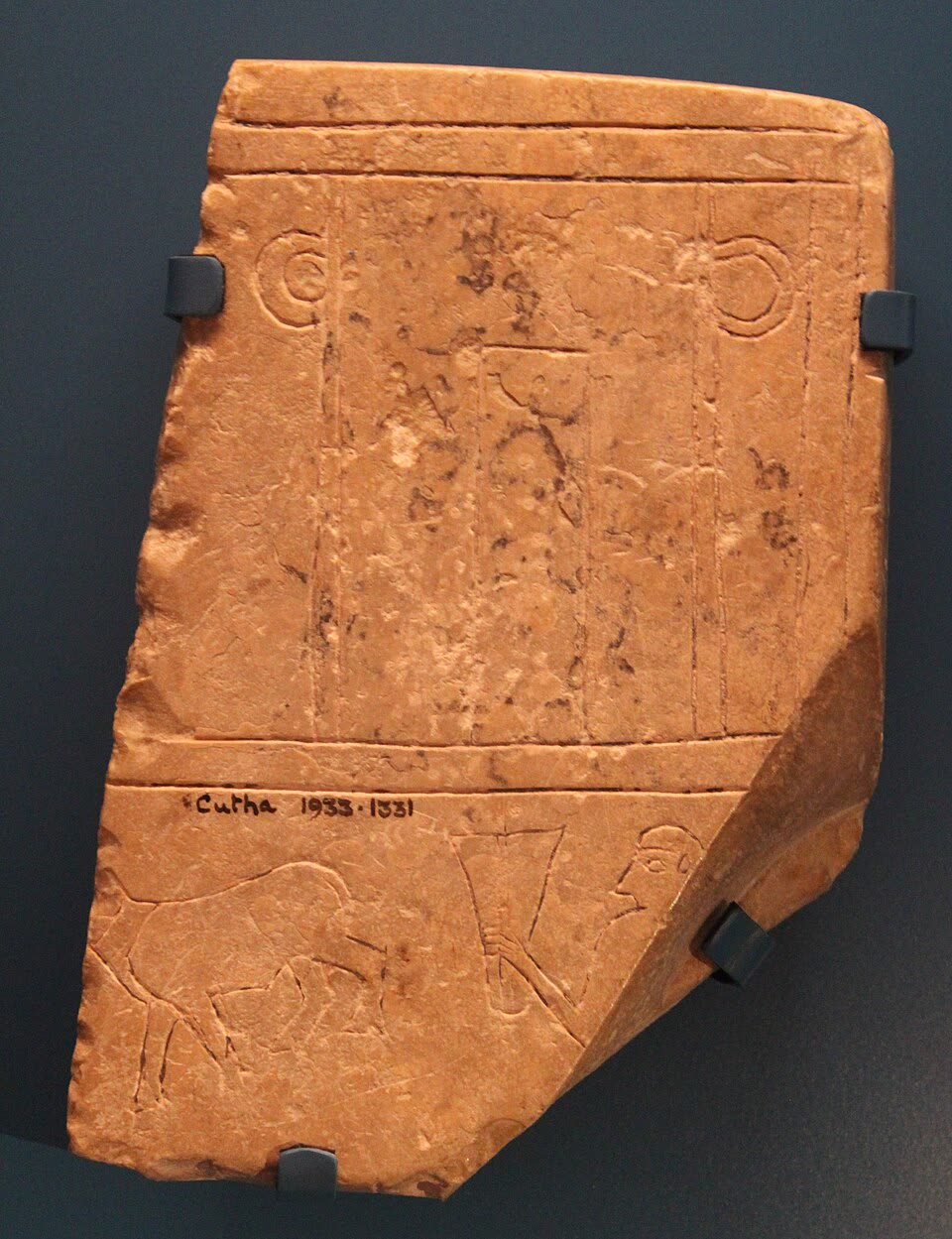
The cover shows a fragmentary plaque marked “Cutha” and catalogued at the Ashmolean Museum as AN1933.1331. The museum dates it to 2600–2500 BCE and records that it was purchased in 1933. A man and a sheep approach a shrine in the scene the museum describes. The plaque shows an act of offering. The museum’s description leaves the shrine and its deity unnamed. [5][6]
Nergal in the royal inscriptions
Naram-Sin’s Bassetki inscription lists Nergal in Kutha alongside gods in other cities, including Sin in Ur and ShamashShamashMesopotamian god of the sun and justice, shown before Hammurabi on an eighteenth-century BCE stele preserved in the Louvre.Glossary · Click to read the explanation in Sippar. In the inscription, the people of Agade ask these gods to make Naram-Sin the god of their city. Nergal is named with Kutha in that request. A later literary account of the revolt against Naram-Sin, preserved on an Old Babylonian tablet from Mari, also places Kutha among the named cities in its opening. That tablet is damaged. The editors restore part of Kutha’s name there and mark another possible mention further down as uncertain. [2][7]
One of AshurbanipalAshurbanipalAshurbanipal was an Assyrian king of the seventh century BCE, reigning about 668–631 BCEGlossary · Click to read the explanation’s inscriptions says that Emeslam was old and that parts of it had fallen. In the surviving tablet copy, the king says he cleared damaged sections and had the foundations put back into alignment. The account also describes cedar roofing beams and doors with bronze bands. It asks a future ruler to repair the temple again when it deteriorates. The copy was found at NinevehNineveh and KuyunjikNineveh is an ancient Assyrian city near Mosul in northern Iraq; Kuyunjik is one of its archaeological moundsGlossary · Click to read the explanation, and its account concerns work on a temple in Kutha. The inscription names Nergal and Laṣ as the city’s divine patrons. [3]
The message left in Emeslam
The Cuthean Legend takes the form of a message from Naram-Sin. The composition begins by asking its reader to open a tablet box and read the inscription. Near the end, the king addresses whoever the gods may call to rule, including a governor or a prince. He tells that future reader where to find what he has left. His directions name the city of Cutha, the temple of Emeslam and, within it, the shrine of Nergal. [4]
The stone described in the story belongs to its account of how the king meant his warning to reach another generation. In Ashurbanipal’s inscription, a future ruler inherits the responsibility to maintain the sanctuary. In the legend, a future ruler inherits a text to read there. Both accounts make the temple a place where kings could pass something on to their successors. [3][4]
The temple as a place to leave a record
The surviving copies refer to more than one way of leaving writing for the future. The editors of Ashurbanipal’s inscriptions identify one damaged tablet, their text no. 229, as the copy of a composition intended for clay cylinders or prisms deposited in the temple structure. Those small inscribed objects were placed as part of the construction. The tablets preserving that composition and the one that asks a successor to repair the building were found at Nineveh. Their survival there gives access to words originally meant for the sanctuary in another city. [3]
The editors place the rebuilding in Ashurbanipal’s third decade as king, while Kandalānu held the Babylonian throne. They suggest it began after objects from Emeslam were brought back from Susa and was probably completed between 642 and 640 BCE. The inscriptions describe laying the foundations on a day judged favourable and including deposits in the new work. They also speak of adding fragrant ingredients to some of the bricks and setting figures of lion-headed eagles near the god’s inner shrine. The proposed dates are a reconstruction from the inscriptions. The details of what was done come from the king’s account of how a sanctuary was rebuilt and furnished. [3][8]
The city’s mound is known, and the texts identify the sanctuary. Reade’s account of Rassam’s short excavation describes the walls he exposed without establishing them as the building named in the royal tablets. The archaeological report and the inscriptions therefore preserve different details of the place. [1][3]
References and notes (8)
- J. E. Reade, Rassam’s Excavations at Borsippa and Kutha, 1879–82, Iraq 48 (1986) Read the full-text scan’s Kutha (Tell Ibrahim) section, printed pp. 112–113, on the mounds, excavation date, exposed walls and selected finds. Return to the text ↑
- Cuneiform Digital Library Initiative, Bassetki statue inscription, RIME 2.01.04.10 ex. 01, P216558 Read the names and cities in column 2 and the request and temple construction in column 3. Return to the text ↑
- Joshua Jeffers and Jamie Novotny, The Royal Inscriptions of Ashurbanipal and Other Kings of Assyria, Part 2, RINAP 5/2 Read the introduction to nos. 227–230, the description and catalogue for no. 227, its reverse translation at lines 18–29 and 37–42, and the introductory description of no. 229’s intended foundation deposits, printed pp. 344–348 and 352. Return to the text ↑
- Sophus Helle, The First Authors: Narratives of Authorship in Ancient Iraq (2020) Read the introduction, translation and transliteration of the Standard Babylonian Cuthean Legend in appendix section 1.5, printed pp. 283–284, including lines 1–3 and 149–155. Return to the text ↑
- Ashmolean Museum, Ancient Middle East Gallery Case List, Kings and Gods 2800–2000 BCE Read the entry for AN1933.1331 and its photograph, including the date range, scene description and purchase record. Return to the text ↑
- Wikimedia Commons, Incised stone plaque Cutha AN1933.1331.jpg Read the subject description, creator credit and CC BY-SA 4.0 notice, and checked the visible Cutha marking and object number against the Ashmolean catalogue. Return to the text ↑
- Sources of Early Akkadian Literature, The Great Revolt against Narām-Sîn A, SEAL no. 1540 Read the text record and translation of the obverse, lines 1–17, checking the restorations and the provenance of tablet A 1252 + M. 8696. Return to the text ↑
- Jamie Novotny, Joshua Jeffers and Grant Frame, The Royal Inscriptions of Ashurbanipal and Other Kings of Assyria, Part 3, RINAP 5/3 Read the introduction’s Cutha section, printed pp. 22–23, on the rebuilding, foundation ceremony and proposed date and context of the work. Return to the text ↑
Suggest a correction · Suggest a source for this record
Cite this record
IL Archive, «Kutha and the Temple of Nergal», https://ilarchive.com/en/sites/kutha