Ancient text
The Pyramid Texts, Funerary Spells on the Walls of Saqqara
A text for line-by-line reading, with transliteration, translation, and resources.
- Names
- PT · Pyramid Texts
- Region
- Egypt
The Pyramid Texts first survive in the pyramid of Unas at Saqqara. Their placement on walls and passages helps explain what the words were meant to do for the dead.
Estimated reading time: 5 min Published Last reviewed:
Share article
Text
Introduction
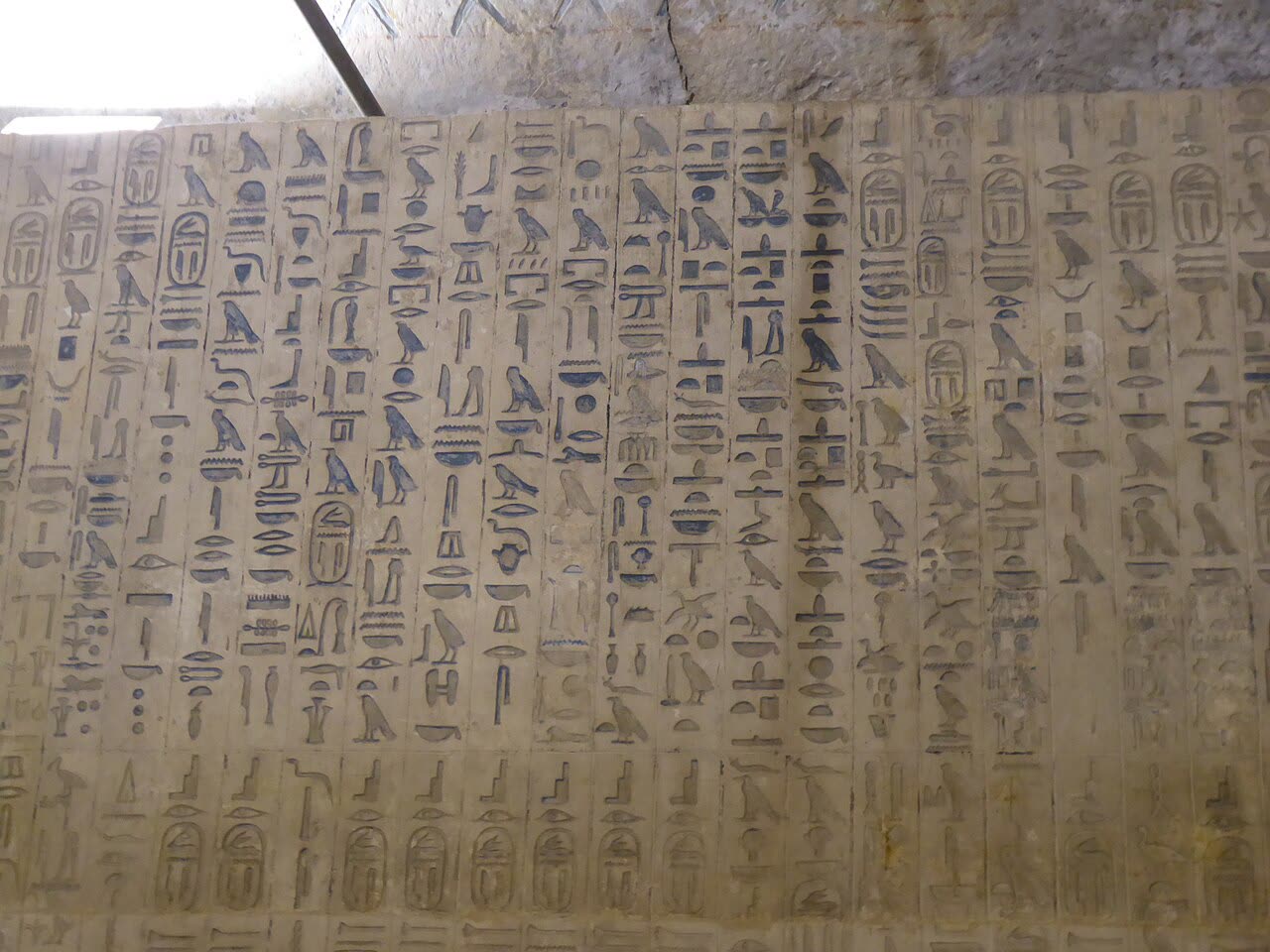
In the Fifth Dynasty pyramid of UnasUnasUnas was the last king of Egypt’s Fifth Dynasty, in the late third millennium BCEGlossary · Click to read the explanation at Saqqara, inscriptions above the stone coffin were meant to protect the king’s body. Elsewhere in the same pyramid, words accompanied offerings and guided the king’s spirit on its journey to the sky. These are the earliest surviving inscriptions of the collection now called the Pyramid Texts. The arrangement of the words helps explain why some of them stand beside the coffin while others line the way out. [1][2]
Later pyramids at Saqqara preserved other selections, including versions in the tombs of queens. Scholars compare the wording and position of the spells across the monuments. The place where a text was inscribed can clarify its purpose, and changes in placement from one pyramid to another show how people adapted the collection. [2][3]
From the coffin to the passage
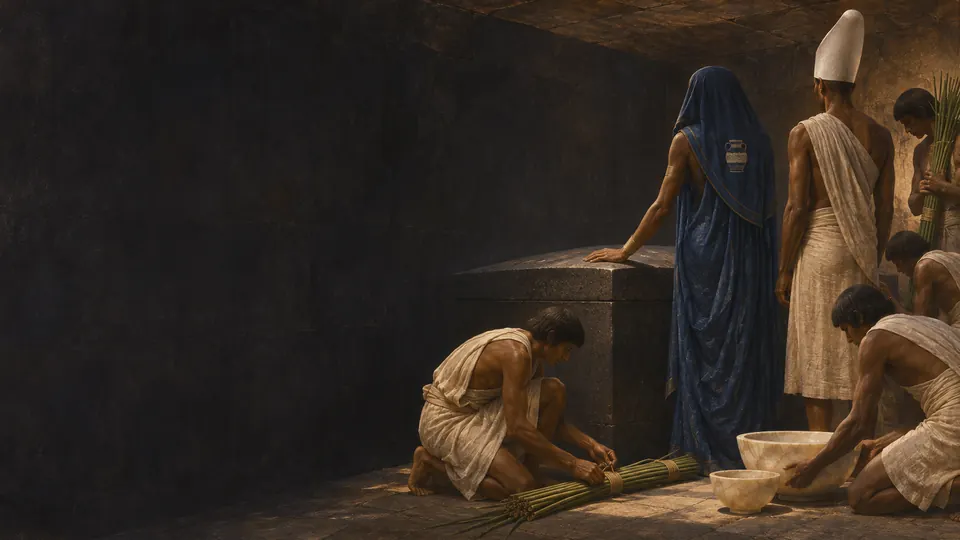
In Unas’s burial chamber, the coffin lies at the west end. Spells for its protection are carved above it in the triangular part of the wall beneath the roof, called a gable. The north side carries most of the Offering RitualRitualAn organised or distinguished practice meaningful to a community; it may leave traces, but its form alone does not reveal an associated doctrine.Glossary · Click to read the explanation, including words said over food and drink to sustain the king. The south side carries much of the Resurrection Ritual, intended to release the spirit so that it can begin its journey. Some of both groups extend beyond their main walls. Allen reads the extra surfaces as part of the same arrangement and suggests that limits on wall space help explain their use. [2]
A short passage leads to the next room, the antechamber. Its west gable begins with PT 247, a spell addressed to Unas as he emerges from the Duat, the region through which the sun was thought to travel at night. Allen connects the following spells to the king’s passage through the Akhet, the region associated with the sun’s emergence. Farther along the corridor, the words concern movement toward the sky. In Allen’s reading, the path through the rooms tracks successive stages of renewed life. [2]
Why the collections differ
Allen distinguishes spells in which someone addresses the king from spells composed for the king’s spirit to speak. He suggests that some pieces were recited during the funeral and carved in the pyramid so they could continue to act for the dead. Other spells ask for help with the hazards of the journey. Some texts survive in more than one pyramid, and in some cases later versions change who appears to speak. The date when a spell was first carved is therefore one part of its history. Allen finds evidence in the language and burial customs that many spells had been in use before the pyramid of Unas. [2]
Harold M. Hays finds that scribes often kept groups on the same wall as in an earlier pyramid but could change their order or put them elsewhere. He gives the example of a group he associates with keeping vigil. In Teti’s pyramid it appears on the west wall of the antechamber. Hays argues that inherited arrangements, practical limits and the purpose of the words all influenced placement. The surviving pyramids offer several arrangements that can be compared one monument at a time. [3]
How to follow a reference
A reference such as PT 247 gives the number of a spell in a modern edition. The numbers largely come from Kurt Sethe’s publication and do not generally reproduce the order of any one wall. For example, the opening spell in Allen’s presentation of Unas is PT 226. Allen arranges his translations by pyramid and refers readers to other copies when a spell occurs more than once. He records significant differences separately. A pyramid name, location and spell number together are more useful than the spell number on its own when checking how an inscription was used. [2]
Some spells were copied after the Old Kingdom on other funerary objects and monuments. Allen notes that later collections, including the Egyptian Book of the DeadEgyptian Book of the DeadA modern name for a variable collection of Egyptian funerary spells and images intended for the afterlife, not a single book with a fixed sequence.Glossary · Click to read the explanation, incorporated some of them. The Saqqara walls preserve an early stage in that longer history of copying. [2]
Comparing Teti and Pepy I
The entrance to Teti’s pyramid leads down a passage that levels out before reaching the antechamber. One side of that room opens toward three storage chambers meant for burial equipment. On its west side lies the burial chamber. The Egyptian Ministry of Tourism and Antiquities identifies Pyramid Texts at the end of the corridor and on the walls of the two main rooms. Above the burial chamber the painted stars give the ceiling a night sky, placing the written account of ascent inside a space furnished for the king’s burial. [4]
A surviving fragment from the pyramid of Pepy I at Saqqara shows how several spells could occupy a small area. The Petrie Museum identifies parts of three numbered texts on the fragment, PT 627B, PT 302 and PT 655. It describes words for ascent to heaven and a supply of food and drink for the king. The block preserves the name Pepy four times in a cartouche, an oval sign drawn around a royal name. The fragment is far too small to show anyone’s whole itinerary through the tomb, but gives a reader three passages to locate in an edition. It also preserves traces of green pigment in the cut signs. [5]
The same museum holds a fragment from Teti’s pyramid with that ruler’s cartouche. A numbered spell can be compared across different inscriptions, whereas the cartouche identifies the sovereign referred to on an individual wall. The two forms of identification are part of what makes small fragments useful. [2][5]
References and notes (5)
- Egyptian Ministry of Tourism and Antiquities, Pyramid of Unas Read the monument description, including the Saqqara location, Fifth Dynasty construction and earliest attestation of the inscriptions. Return to the text ↑
- James P. Allen, The Ancient Egyptian Pyramid Texts, 2nd ed. (2015) Read the Introduction, pp. 1–4, on witnesses, editions, spell numbering and earlier use, and pp. 6–11 on types of texts and their purpose and architectural setting. Read the opening of The Pyramid Texts of Unis, pp. 17–19, for PT 226, PT 247 and the main wall sequences. Return to the text ↑
- Harold M. Hays, Unreading the Pyramids, BIFAO 109 (2010) Read p. 195 on the symbolic meaning of tomb spaces and pp. 219–220 on inherited placement, the example of the vigil in Teti’s pyramid and the movement, addition and omission of texts. Return to the text ↑
- Egypt Ministry of Tourism and Antiquities, Pyramid Complex of Teti Read the description of the descending passage, adjoining rooms, west burial chamber, star ceiling and areas with Pyramid Texts. Return to the text ↑
- UCL Petrie Museum of Egyptian and Sudanese Archaeology, A pyramid text Read the entry and view of the Pepy I fragment, the four cartouches, the identification of PT 627B, 302 and 655 and the note on the Teti fragment. Return to the text ↑
Archive records may be reviewed and refined as better evidence or sources become available. Suggest a correction
Suggest a correction · Suggest a source for this record
Cite this record
IL Archive, «The Pyramid Texts, Funerary Spells on the Walls of Saqqara», https://ilarchive.com/en/texts/pyramid-texts