Entity · Manuscript
Dead Sea Scrolls
A reference page linking a name, group, or concept to the materials that discuss it.
- Timeline
- From 300 BCE to 70 CE
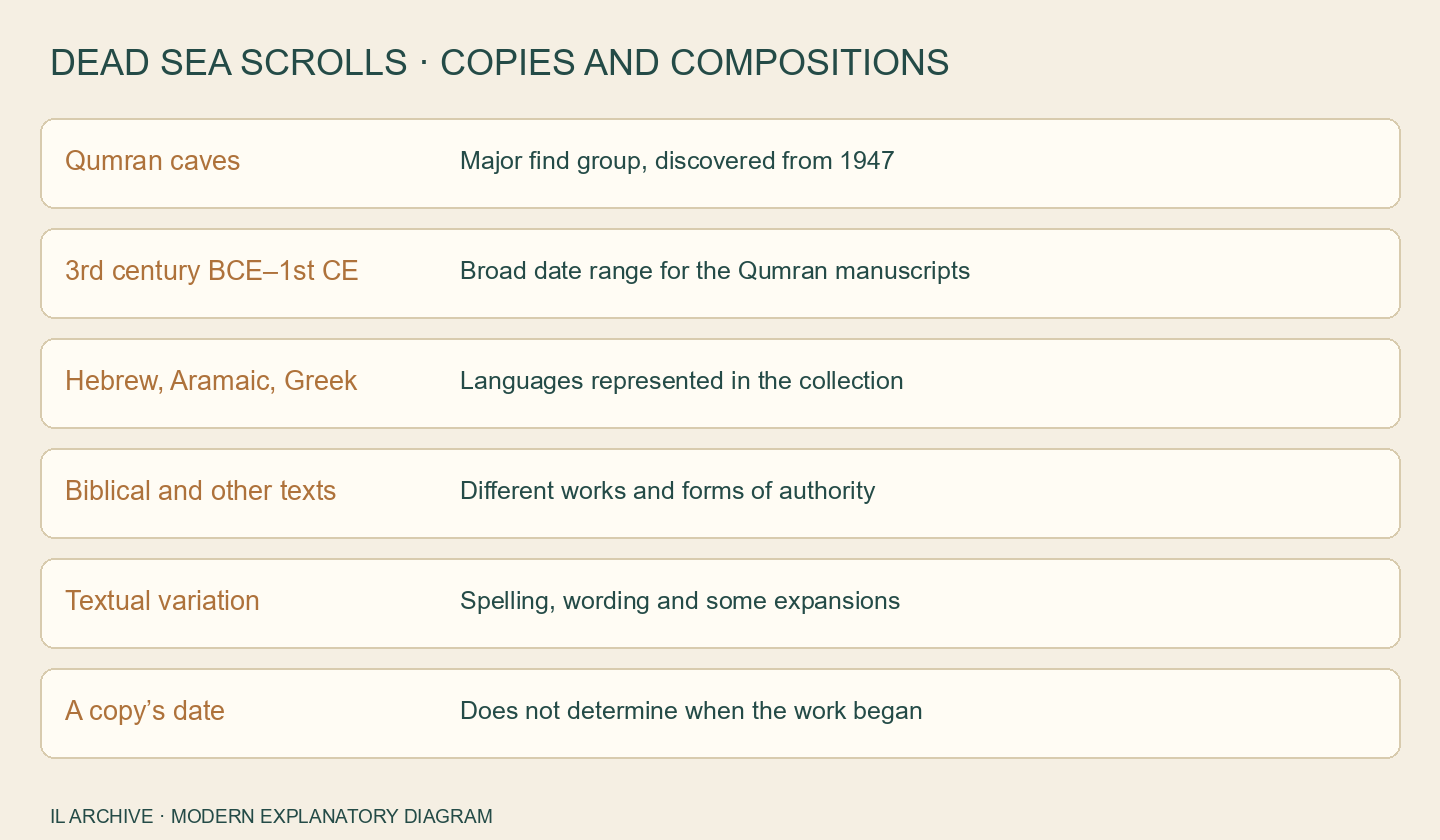
Judaean Desert manuscripts, especially Qumran cave finds. Biblical copies and other works reveal textual diversity; a copy’s age is not the work’s initial date.
Reading path
Links recorded in this entry.
Periods
When does it appear?
- From 300 BCE to 70 CE
Dates
Dates have distinct roles. The timeline uses creation, composition or historical coverage, rather than publication or discovery dates.
- Historical coverage
- Approximately From 300 BCE to 70 CE
Text
Scope
Qumran discoveries began in 1947. Its manuscripts generally span the third century BCE to the first CE; other Judaean Desert collections also exist. HebrewHebrewA Northwest Semitic language in the Canaanite group, with ancient and modern forms.Glossary · Click to read the explanation, AramaicAramaicA group of Northwest Semitic language varieties with a long history across the Near East.Glossary · Click to read the explanation and Greek represent biblical and non-biblical works.[1]
Evidence
Copies resembling the Masoretic textMasoretic TextA Hebrew textual transmission and reading tradition, compared in textual criticism with ancient manuscripts and translations.Glossary · Click to read the explanation and others with variant readings or expansions illuminate transmission. They do not form three closed families.[2] The diagram is modern, not a discovered manuscript.
References and notes
- Israel Antiquities Authority. The Dead Sea Scrolls: Introduction. Leon Levy Dead Sea Scrolls Digital Library. Qumran Caves Scrolls and Biblical Manuscripts: discovery, languages, date range, variation and authority. Other collections have other dates; Qumran’s range is not universal. Return to the text ↑
- Eugene Ulrich & Sidnie White Crawford (2025). The History of Textual Criticism of the Hebrew Bible from Antiquity to the Twentieth Century. The Oxford Handbook of Textual Criticism of the Bible, pp. 131–146. Qumran diversity and revised textual models. No three closed families inferred. Publisher abstract only; full chapter not read. Return to the text ↑
Research history
Substantive changes are retained here. Minor copy edits remain in the internal operational log.
-
Substantive record update
Suggest a correction · Suggest a source for this record
Cite this record
IL Archive, «Dead Sea Scrolls», Edition 2, https://ilarchive.com/en/entities/dead-sea-scrolls