Entity · Region
Midian
A reference page linking a name, group, or concept to the materials that discuss it.
Name for groups and a wilderness-associated landscape in Hebrew narratives; Moses’s link to its priest supports a hypothesis, not proof of Yahweh worship’s transfer.
Text
Narrative and hypothesis
Exodus places MosesMosesCentral figure in Exodus, Torah traditions and the Qur’an; childhood accounts differ in detail.Glossary · Click to read the explanation in Midian and connects him with a priestly family; he then tends Jethro’s flock and reaches Horeb. It does not state that Jethro worshipped YahwehYahwehThe divine proper name written YHWH in the Hebrew Bible.Glossary · Click to read the explanation before Moses. The Midianite-Kenite hypothesis interprets intersections among narrative, poetry and Egyptian evidence, rather than repeating an explicit statement in any one source.
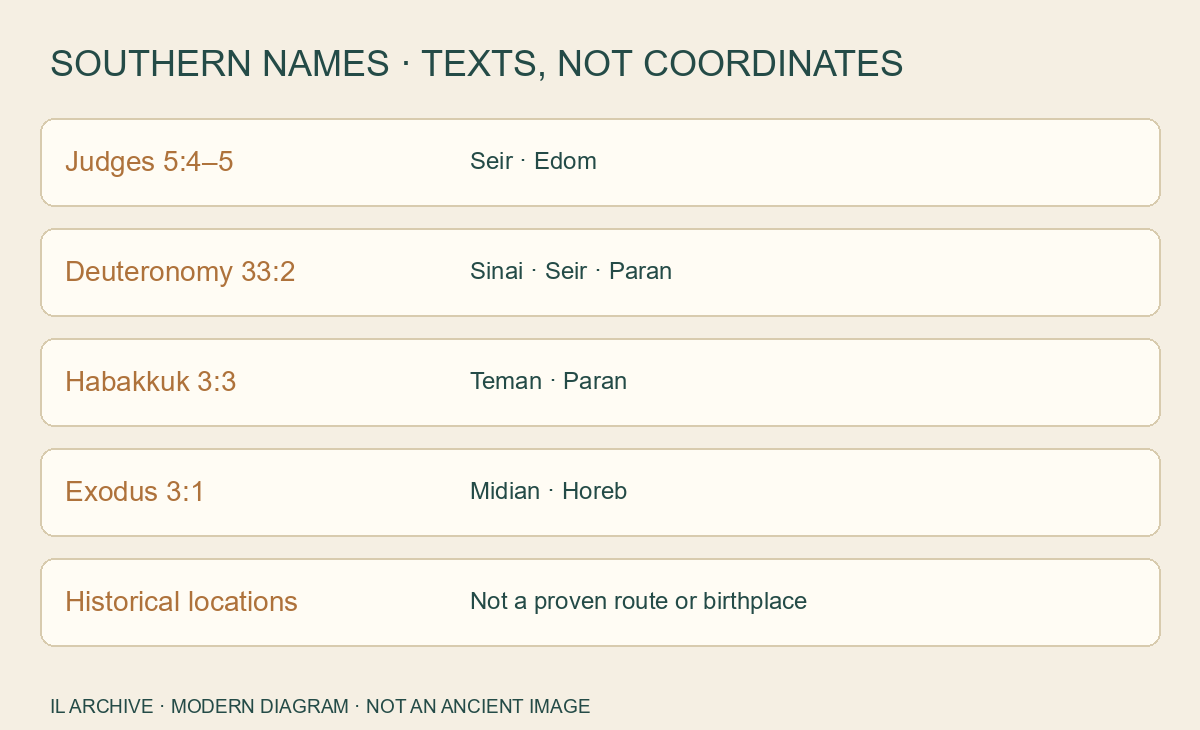
The modern diagram lists textual names, without drawing a fixed Midianite state or locating SinaiSinai: peninsula and biblical mountainSinai is a peninsula in eastern Egypt; in the Torah the name also denotes the mountain of revelation to MosesGlossary · Click to read the explanation/Paran. No coverage dates are imposed that would conflate the groups’ history with the edited narrative’s date. [1][2][3][4]
References and notes
- Hebrew Bible, Exodus 2:15–22. Mechon-Mamre Hebrew–English text. Flight to Midian, priest, Reuel and Zipporah. Narrative events not treated as a contemporary record of Moses. Return to the text ↑
- Hebrew Bible, Exodus 3:1, 13–15. Mechon-Mamre Hebrew–English text. 3:1 Jethro as priest of Midian and Horeb; 3:13–15 ehyeh and the name’s revelation. Textual interpretation distinguished from first etymology. Return to the text ↑
- Hebrew Bible, Exodus 18:10–12. Mechon-Mamre Hebrew–English text. Jethro’s blessing, acknowledgment and offerings after hearing of the Exodus; does not prove Yahweh worship before Moses. Return to the text ↑
- Daniel E. Fleming (2020). The Midianite Hypothesis: Moses and the Priest of Midian. Yahweh before Israel, chapter 3, pp. 67–110. doi:10.1017/9781108875479.004. Publisher summary: Egyptian evidence does not straightforwardly yield southern origin, Yhw not fixed in Seir/Edom, shift from prose toward poetry. Summary only; limits on identifying first worshippers also supported by chapter 5 summary. Return to the text ↑
Research history
Substantive changes are retained here. Minor copy edits remain in the internal operational log.
-
Substantive record update
Suggest a correction · Suggest a source for this record
Cite this record
IL Archive, «Midian», Edition 2, https://ilarchive.com/en/entities/midian