Entity · Concept
Onomastics
A reference page linking a name, group, or concept to the materials that discuss it.
The study of names, their origins, forms and contexts: evidence for language and religion, not a substitute for mythological or ritual texts.
Text
How to read a name
A name can preserve a divine element, action or kinship relationship. Analysis requires the document’s date and language and the inflection of its elements, distinguishing the name’s language from its host text. Gelb’s project assembled 6,662 Amorite names, excluding EblaEblaAn ancient city at Tell Mardikh in Syria, known for its third-millennium BCE tablet archive.Glossary · Click to read the explanation.
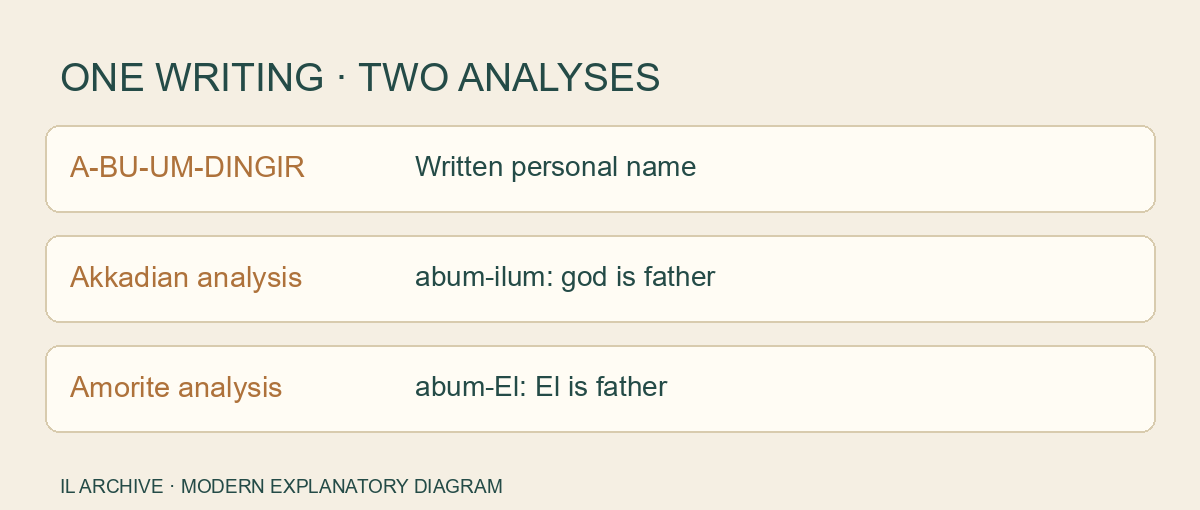
Buccellati gives A-BU-UM-DINGIR an AkkadianAkkadianAn ancient East Semitic language written in cuneiform in Mesopotamia.Glossary · Click to read the explanation analysis, “god is father,” and an Amorite one, “El is father.” The difference shows why similar spellings do not alone identify a deity or community. The illustration is a modern diagram, not a copy of tablet signs. [1][2]
References and notes
- Ignace J. Gelb et al. (1980). Computer-Aided Analysis of Amorite. Assyriological Studies 21, Oriental Institute, Chicago. Institutional collection description: 6,662 names, mainly Old Babylonian with Ur III material; Ebla excluded. Not all book entries read. Historical description of reliance on names is read with newer evidence in George and Krebernik (2022). Return to the text ↑
- Giorgio Buccellati (1966). The Amorites of the Ur III Period. Ricerche I, Naples: Istituto Orientale. Author/project-hosted Part 1. P. 129: A-BU-UM-DINGIR and the Akkadian/Amorite analyses, text and visual check. P. 164: A-ḫu-um-ma-DINGIR (ARM VII 190:2,7) cited for brotherhood language. Selected passages, not a full-book reading. Return to the text ↑
Research history
Substantive changes are retained here. Minor copy edits remain in the internal operational log.
-
Substantive record update
Suggest a correction · Suggest a source for this record
Cite this record
IL Archive, «Onomastics», Edition 2, https://ilarchive.com/en/entities/onomastics