Entity · Deity
Namtar, the vizier of the underworld
A reference page linking a name, group, or concept to the materials that discuss it.
- Names
- Namtar · Namtaru
- Region
- Mesopotamia
Namtar carries Ereškigal's orders in Akkadian stories and is associated with fate and illness. Sumerian poetry and healing incantations give him roles that extend beyond the underworld court.
Estimated reading time: 5 min Published Last reviewed:
Share article
Text
Introduction
Namtar is a Mesopotamian divine figure associated with fate, disease and the government of the dead. In AkkadianAkkadianAn ancient East Semitic language written in cuneiform from the third millennium BCE; its varieties include Babylonian and Assyrian, and it served in international diplomacy.Glossary · Click to read the explanation stories he appears as Ereškigal's vizier, crossing between heaven and the underworld on the queen's business. A Sumerian poem gives him his own palace and names his wife. Incantations treat him as a cause of sickness and can also appeal to him for help. These roles come from texts written for different occasions over a long span of Mesopotamian history. [1] [2] [3]
A place at the banquet
In the AmarnaAmarna / AkhetatenAmarna is the archaeological site of Akhetaten, Akhenaten’s fourteenth-century BCE capital in Middle Egypt, preserving royal boundary stelae, temples, houses and cemeteries.Glossary · Click to read the explanation version of Nergal and Ereškigal, the gods prepare a banquet and send word to their sister Ereškigal. They explain that they cannot come down to her and she cannot come up to them. They ask her to send for her portion. The queen dispatches Namtar, whom the text calls her sukkallu, or vizier. He goes up to the highest heaven and enters the assembly. The account makes the separation between the realms clear while giving Ereškigal a representative who can cross it. [2]
The gods stand for the envoy, but one fails to rise. Part of the encounter is broken on the tablet. The later exchange shows that Ereškigal takes the omission seriously and wants the offender brought to her. Namtar returns and counts the gods to identify him. The last god he sees is bald, and he reports that the one who offended him is absent. The story eventually brings Nergal to Ereškigal's gates and then to her chamber, where she offers him marriage and kingship. In this version, proper reception of a messenger is the matter that sets the conflict in motion. [2]
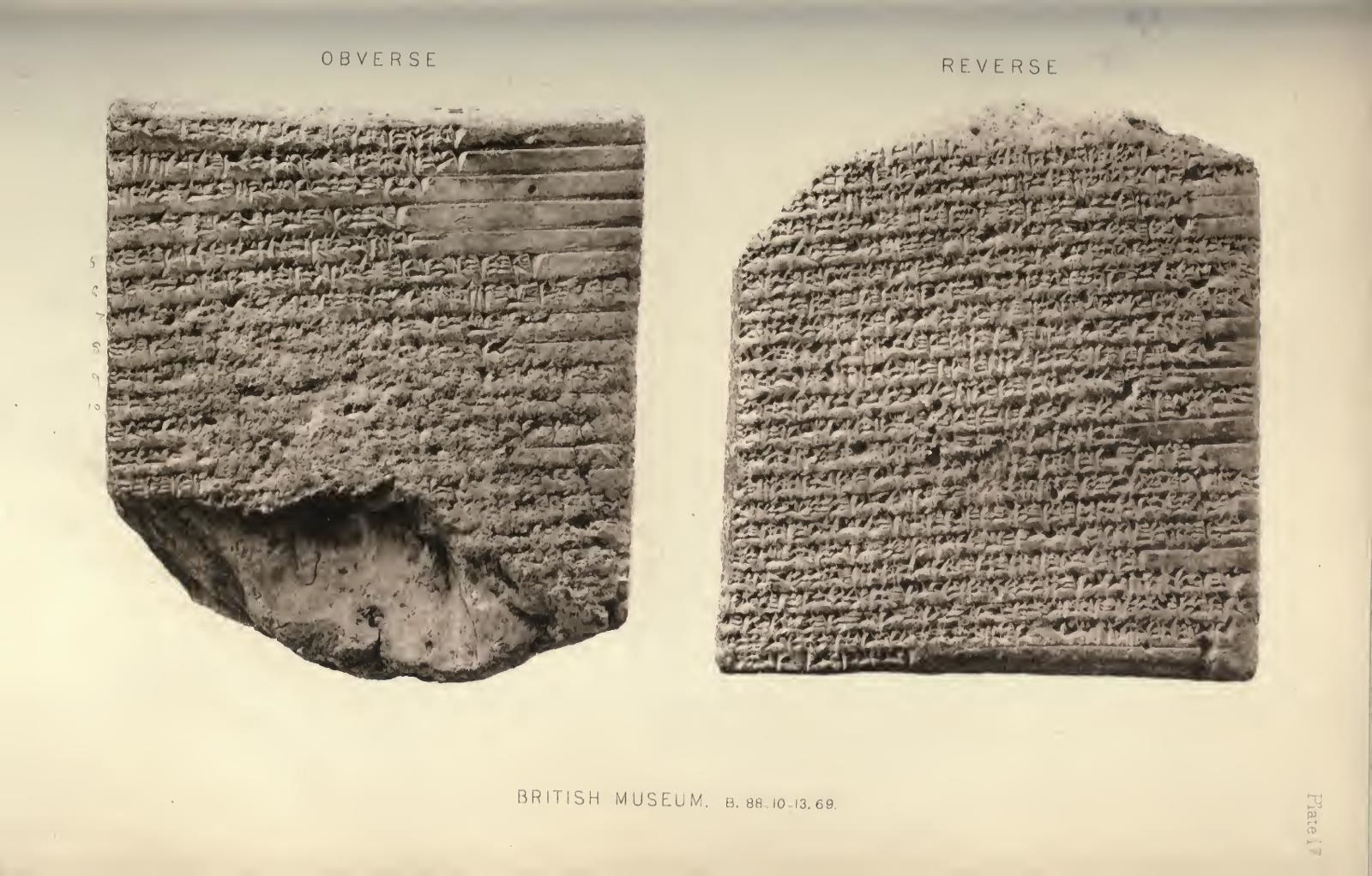
The tablet with this version was found at Akhetaten, modern Amarna in Egypt. Its surviving fragments are divided between the British Museum and the Vorderasiatisches Museum in Berlin. Shlomo Izre'el's edition describes a nearly complete tablet assembled in the study from six fragments. It also records red points written at intervals and comments on the mix of scribal features in the text. The copy places an Akkadian literary story about the underworld in an Egyptian archive known especially for international correspondence. The photograph in the nineteenth-century edition records the London piece of that witness. [2] [4] [5]
Two orders concerning Ištar
In the Akkadian Descent of IštarInanna / IshtarA prominent Mesopotamian goddess whose Sumerian name Inanna became associated with Akkadian Ishtar across diverse traditions. She was associated with desire, war, royal authority and Venus, while local forms and genealogies varied among texts.Glossary · Click to read the explanation, Namtar's authority is exercised inside the underworld as well. Ištar gives up items of dress or adornment at successive gates and confronts Ereškigal at the end of the descent. The queen calls Namtar her vizier and instructs him to confine Ištar and direct illnesses against her. The lines name several parts of the body in succession, including eyes, sides and feet. The affliction has the force of an order delivered at court. [6]
The same official carries out a second order that reverses the first. Between the two commands, the poem depicts mating ceasing in the world above, and EaEnkiMesopotamian deity also known as Ea, linked with Eridu and the Abzu (deep fresh waters), wisdom, incantations, and narratives of creation and cosmic order. Later written attestations do not identify the deity of Eridu’s earliest layers.Glossary · Click to read the explanation devising a way to intervene by sending a specially created envoy. Ereškigal instructs Namtar to prepare the thresholds, bring out the AnunnakiAnunna / AnunnakiAnunna/Anunnaki is a collective designation for Mesopotamian gods whose scope varies by text and period; it is not a group with one fixed membership or number.Glossary · Click to read the explanation and seat them on golden thrones. He sprinkles Ištar with the water of life and takes her away. On the return through the gates her items are restored in sequence. The queen also makes Ištar's release conditional on a substitute. The two assignments give Namtar a hand in both the threat to Ištar's body and her departure under the rules of the underworld. [6]
Fate and the court of the dead
Namtar has a place in the Sumerian Death of Ur-Namma as one of the figures to whom the dead king presents offerings. He appears in his palace and is credited with decreeing fates. Among the gifts are finely worked ornaments and carnelian. His wife Hušbiša receives her own gifts in a palace of her own in the poem, including objects for dressing the hair. The Susa version preserves a parallel sequence, with some differences in the description of the gifts. These details place Namtar within an ordered society, where the dead king acknowledges the standing of its residents with carefully specified presents. [3]
The role of a figure who determines fates is consistent with the name's association with the Sumerian word for fate. Jonathan Beltz's study gathers attestations from the third millennium through the end of the first millennium BCE and sorts them by the kinds of texts in which they occur. Royal poetry supplies one kind of evidence, narratives another, and incantations and ritualsRitualAn organised or distinguished practice meaningful to a community; it may leave traces, but its form alone does not reveal an associated doctrine.Glossary · Click to read the explanation add a much larger body of passages about dealings with sickness. Beltz argues that Namtar's rank within divine society makes him a god, while many of the ways people invoke or ward him off resemble their dealings with demons. [1] [3] [7]
A name on healing amulets
András Bácskay and Zoltán Niederreiter describe an inscribed clay cylinder from Nippur whose incantation addresses Namtar as Nergal's vizier. They also discuss a tablet-shaped stone amulet on which he is invoked alongside Nergal, Ereškigal and Hušbiša. A fever ritual brings him into company with Asakku and calls for a substitute figure of Namtar. These texts attest to different ways in which a person seeking relief could encounter his name. Placement within a protective appeal, association with other underworld powers and the use of a substitute belong to the particular objects or procedures the editors identify. [7] [8]
The link between court service and sickness is especially clear in the Descent of Ištar. There an official carries an order into effect through bodily affliction and, at the queen's direction, can help bring the stricken goddess out again. The gifts in The Death of Ur-Namma approach that same figure through his rank and his power over fates. These are among the reasons Namtar can appear as a frightening power and as a formally honoured member of the underworld court. [1] [3] [6]
References and notes (8)
- Jonathan Beltz, Namtar: Deity, Demon, Agent of Fate Yale University dissertation, 2023. Read the author's abstract on the chronology, genres and argument about rank and ritual treatment. Return to the text ↑
- Shlomo Izre'el, The Amarna Scholarly Tablets EA 357, pp. 50–55. Read the translation, fragment inventory and comments on the written text. Return to the text ↑
- Electronic Text Corpus of Sumerian Literature, The death of Ur-Namma Oxford translation 2.4.1.1, main text 88–128 and Susa recension 29–56. Return to the text ↑
- Cuneiform Digital Library Initiative, EA 357 (P270856) Object record, date, findspot and identifying details of the literary tablet. Return to the text ↑
- Carl Bezold and E. A. Wallis Budge, The Tell el-Amarna Tablets in the British Museum 1892, text no. 82 and plate 17. Early publication of the London fragment. Return to the text ↑
- E. A. Speiser, Descent of Ishtar to the Nether World Translation in Ancient Near Eastern Texts Relating to the Old Testament, pp. 106–109. Read the confinement and release episodes. Return to the text ↑
- Reallexikon der Assyriologie, Namtar Vol. 9 deity entry. Read the name forms and discussion of literary and incantation contexts. Return to the text ↑
- András Bácskay and Zoltán Niederreiter, Clay Cylindrical Amulets Inscribed with Incantations Journal des Médecines Cunéiformes 40, Nippur amulets 3–4 and note on the stone amulet and the fever ritual. Return to the text ↑
Suggest a correction · Suggest a source for this record
Cite this record
IL Archive, «Namtar, the vizier of the underworld», https://ilarchive.com/en/entities/namtar