Entity · Deity
Ullikummi, the Stone Challenger
A reference page linking a name, group, or concept to the materials that discuss it.
- Region
- Hittite Anatolia (present-day Türkiye)
Kumarbi raised a child of stone to seize the storm god’s throne in a Hurrian myth preserved at Hattusa. The gods turned to a tool from the making of the world to break his hold.
Estimated reading time: 5 min Published Last reviewed:
Share article
Text
Introduction
KumarbiKumarbiHurrian god in Hittite songs from Hattusha; he overthrows Anu and carries the storm god. A study of CTH 344, contested genealogy, and Greek parallels.Glossary · Click to read the explanation holds a newborn on his knees and gives him the task of overthrowing the storm god. The child, Ullikummi, will grow into a figure of stone whose body reaches the dwellings of the gods. His story survives at Hattusa in fragmentary copies of a Hittite composition based on Hurrian tradition. The clay preserves the plan to cut him from his foundation and the storm god’s return to battle. The outcome of that encounter is lost. [1] [2]
A name and a place to grow
The first tablet connects the birth with a great rock beside water. The exact wording around the delivery is damaged. The scene becomes clearer when the fate and mother goddesses place the child on Kumarbi’s knees. The father rocks him and gives him his name. The TITUS edition glosses Ullikummi as an instruction to destroy Kumme. In the speech that follows, Kumarbi calls on his son to ascend to kingship, crush Kummiya, and drive the other gods from heaven. He singles out the storm god and his attendant TashmishuTashmishuDivine figure named in Kumarbi’s pregnancy with the storm god and the river Aranzah.Glossary · Click to read the explanation. [2]
Kumarbi worries aloud that the gods will see the newborn before he is ready. He sends Impaluri to summon the Irsirra deities and tells them to take the child into the dark earth. His instructions specify the right shoulder of Upelluri as the place to set him, and they describe the child’s growth in units of a day and a month. The Irsirra carry Ullikummi against their chests and first set him on EnlilEnlilEnlil/Ellil: a major Mesopotamian god associated with destinies, kingship, and Ekur at Nippur, already prominent in third-millennium god lists. His name’s origin and cult beginnings remain debated.Glossary · Click to read the explanation’s knees. Seeing the body made of stone, rendered as diorite in the edition, Enlil recognizes what Kumarbi has made. The deities then set the child on Upelluri’s shoulder like a spear. [2]
A figure in the sea
By the fifteenth day, the stone has grown so far that he emerges from the water. The sea reaches his waist, where the narrator compares it to a garment. The spear image used for the infant on Upelluri’s shoulder returns in the description of the figure in the water. The repeated image connects the hidden child with the form now visible above the surface. [2]
The sun god eventually sees an unfamiliar figure in the water. He goes to the sea to look, then descends to the storm god. Tashmishu takes the visit as the sign of a grave affair. The storm god has a seat, table, and drink set out for the visitor. The sun god leaves the seat empty, the meal untouched, and the cup untasted. The storm god asks about each refusal in turn. The scene gives the discovery time to reach the household through the behavior of its guest. [2]
The second tablet gives one of the most vivid accounts of the stone figure’s nature. The goddess called IshtarInanna / IshtarA prominent Mesopotamian goddess whose Sumerian name Inanna became associated with Akkadian Ishtar across diverse traditions. She was associated with desire, war, royal authority and Venus, while local forms and genealogies varied among texts.Glossary · Click to read the explanation in the Hittite version takes instruments, burns cedar, and sings. The text describes heaven and earth answering her. A wave rises from the sea and tells her that Ullikummi can neither hear her singing nor see her. The wave urges her to find her brother while she can. She puts out the cedar and throws away the instruments. The association with NinevehNineveh and KuyunjikNineveh is an ancient Assyrian city near Mosul in northern Iraq; Kuyunjik is one of its archaeological moundsGlossary · Click to read the explanation in this passage and the Hurrian name Shaushka in the wider tradition help identify the goddess across languages. [3] [1]
The shoulder in the dark earth
In the third tablet Ashtabi and seventy gods fall into the sea. Ullikummi reaches the divine dwellings and stands like a spear at the gate of Kummiya. Hebat, confined in her temple, asks her messenger Takiti for news of her husband. The storm god and Tashmishu go to EaEnkiMesopotamian deity also known as Ea, linked with Eridu and the Abzu (deep fresh waters), wisdom, incantations, and narratives of creation and cosmic order. Later written attestations do not identify the deity of Eridu’s earliest layers.Glossary · Click to read the explanation in Abzuwa to seek help. Tashmishu proposes asking for the tablets of ancient words. When Ea reaches Upelluri, he learns that heaven and earth were built on him, then cut apart, without his feeling either event. His right shoulder now hurts. Ea turns it and sees Ullikummi planted there. [4]
Ea asks the old gods to open their ancestral sealed storehouses and bring out the implement used to separate heaven and earth. The TITUS translation calls it a saw in this passage, and Hans Gustav Güterbock’s English translation calls it a knife. Both identify the same function. Ea proposes cutting Ullikummi away under his feet. Damage intervenes before Ea tells Tashmishu that he has struck the stone and sends the gods back to fight. Güterbock interprets this as breaking Ullikummi’s power at its base. The renewed battle is preserved in outline. Ullikummi still speaks, acknowledges Ea at the storm god’s side, and declares that he intends to take Kummiya and kingship in heaven. His final speech is damaged and the result remains uncertain. [4] [5]
The tablets at Hattusa
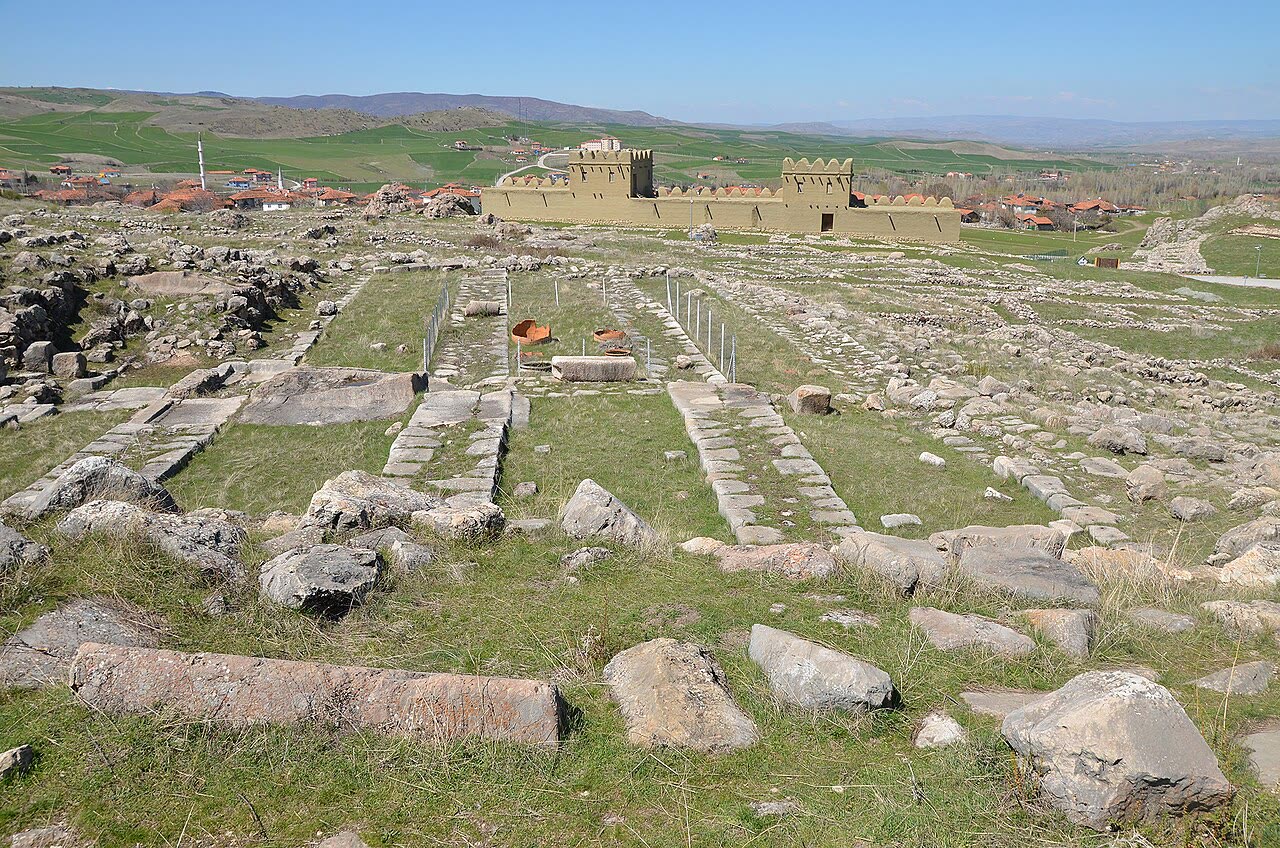
The clay fragments preserve portions of multiple copies. Güterbock observed that there is variation among them in handwriting size, wording, and the points at which the text passes from one tablet to the next. The Hittite CuneiformCuneiformWriting with wedge-shaped signs, developed from Mesopotamian recording traditions and used for several languages from the third millennium BCE.Glossary · Click to read the explanation Tablets Concordance records findspots for several fragments in the Great Temple complex. First-tablet witness KBo 26.60 came from upper debris in storeroom 24, and fragment KBo 26.99 came from upper debris in storeroom 11. KBo 58.4, used in the edition of the third tablet, was found in fallen debris on the north street in front of storeroom 25. These locations tie surviving pieces of the song to particular excavation contexts in the temple precinct. The storerooms pictured here belong to that complex. [1] [6]
References and notes (6)
- Hans Gustav Güterbock, The Song of Ullikummi: Revised Text of the Hittite Version of a Hurrian Myth JCS 5.4 (1951), pp. 135–137, introduction, manuscript divisions, and n. 14 on Hurrian and Hittite divine names Return to the text ↑
- TITUS, Corpus of Hittite Mythological Texts, Song of Ullikummi, Tablet I Lines 20–36, 88–190, 191–253, the rock by water, birth, naming, installation, discovery, and colophon Return to the text ↑
- TITUS, Corpus of Hittite Mythological Texts, Song of Ullikummi, Tablet II Lines 82–110, Ishtar’s instruments and the warning of the wave Return to the text ↑
- TITUS, Corpus of Hittite Mythological Texts, Song of Ullikummi, Tablet III Lines 6–112 and 192–301, ascent, approach to Ea, tool, and renewed battle Return to the text ↑
- Hans Gustav Güterbock, The Hittite Version of the Hurrian Kumarbi Myths Reprint in Perspectives on Hittite Civilization, pp. 44–45, Ea’s intervention and the lacuna at the end Return to the text ↑
- Silvin Košak, Konkordanz der hethitischen Keilschrifttafeln, CTH 345 Findspot and witness entries for 499/z (KBo 58.4), 644/z (KBo 26.60), and 1112/z (KBo 26.99) Return to the text ↑
Suggest a correction · Suggest a source for this record
Cite this record
IL Archive, «Ullikummi, the Stone Challenger», https://ilarchive.com/en/entities/ullikummi
Continue reading