Reading path
What Can Temple Documents Establish? From Petition to Decree
- Names
- What Can Temple Documents Establish? From Petition to Decree
A three-stop path (Elephantine, Taymāʾ, the Rosetta Stone) distinguishing a temple-rebuilding petition, the granting of its resources and a decree honouring the king, and testing the limits of inferring implementation.
Estimated reading time: 7 min Published Last reviewed:
Share article
Text
Introduction
What happens when temple personnel ask for a sanctuary to be rebuilt, a stele assigns resources to a priest, or a priestly council orders statues and festivals? All three are “temple documents,” but they do not perform the same act. A petition seeks authorization; a grant inscription defines or affirms a benefit; a decree prescribes activities. The distance between a written prescription and what happened in the sanctuary cannot be closed by eloquent language alone.
This path visits three actual objects: the ElephantineElephantine / YebElephantine / Yeb, near Aswan at the Nile’s First Cataract, preserves a long-lived Egyptian town, temples of Khnum and Satet, and Persian-period garrisons. Aramaic papyri document several communities, including Judeans and Yaho’s temple, whose rebuilding was sought in 407 BCE; claims and archaeological interpretations must be distinguished.Glossary · Click to read the explanation petition in Persian-period Egypt, the Taymāʾ Stele in north-west Arabia, and the Rosetta Stone in Ptolemaic Egypt. The order is pedagogical, not chronological. We are not reconstructing a shared law, or a line of religious influence among their institutions. At each stop, ask who is speaking, what their document does, who benefits, and what other evidence could establish whether its terms were carried out. Each stop can be read independently of the archive’s existing paths on textual witnesses and royal victory rhetoric.
Before the first stop: four questions for one document
First identify the speaker: an interested petitioner, deities credited with an endowment, or a council issuing a decree? Next classify the documentary act, identify the beneficiary and resource, and ask for independent evidence of implementation. That final question does not presume ancient texts are false. It prevents the language of a request or legal entitlement from being mistaken for a full account of subsequent events. Later evidence may be persuasive without answering every question.
Stop one: Elephantine — what can a petition achieve?
Question: What do sanctuary personnel request from the administration, and what changes when their request is compared with a later memorandum? Open the Elephantine temple-rebuilding petition and focus on verso V6–V9 of Berlin P.13495, TAD A4.7. Written in 407 BCE, the text has Jedaniah and his colleagues ask Bagohi to send a letter authorizing Yaho’s temple to be rebuilt; they promise to resume meal, incense and burnt offerings. A request for assistance is not a record that reconstruction took place. The surviving papyrus is catalogued as a copy of a petition, and its presence does not establish that this exact sheet was dispatched. [1]
In that entry, turn to the separate P.13497 / TAD A4.9 memorandum of what Bagohi and Delaiah reportedly said. Recto R8–R11 refer to restoring the altar-house at its former site and offering meal offerings and incense, without the burnt offerings requested in the petition. We have moved from the interested party’s request to evidence of qualified support; but the memorandum is not a surviving sealed imperial edict or a construction-completion report. Its omission of burnt offerings, by itself, cannot establish a rule governing all later worship everywhere. [2]
What is known, and what needs testing? We know the requested intervention and the terms reported by the memorandum. The building’s later condition requires different evidence. A house-sale deed from 402 BCE, TAD B3.12, recto R18–R19, names Yaho’s temple as a landmark on a property boundary. This supplies comparatively independent evidence for the sanctuary’s continued or renewed presence—or possibly the survival of its site-name—but not an invoice for rebuilding or a definitive reopening date. Carry to Taymāʾ the distinction between a written entitlement and sustained enjoyment of its benefits. [3]
Stop two: Taymāʾ — who receives resources, and who protects them?
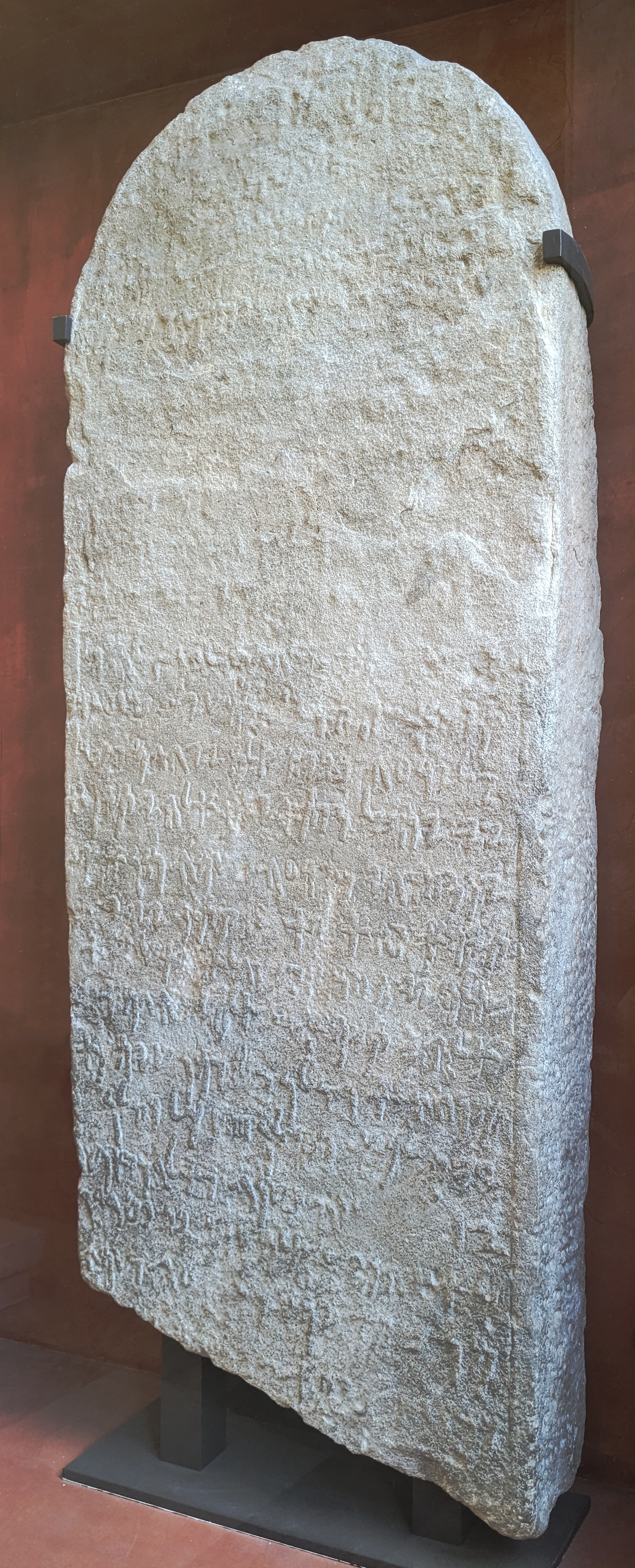
Question: How does an inscription assign priestly service and its resources to a person and descendants? Read The Taymāʾ Stele: Priesthood, Endowment, and Local Cult. Its Aramaic inscription on AO 1505 attributes a grant by local deities benefiting ṢLMŠZB son of Petosiris and his descendants at the sanctuary of ṢLM of HGM. In the Louvre’s displayed edition, the grant is accompanied by a curse against damaging the stele and language protecting the beneficiary and descendants from removal. The curse is a device meant to safeguard the claimed arrangement, not evidence that a punishment actually befell anyone. [4]
The photograph shows only the front of the Taymāʾ Stele. It illustrates this single stop; it is not a composite image of all three documents. The stone’s form and inscription layout help explain how a grant was publicly displayed, but its damaged signs must be assessed through editions, not deciphered independently from this photograph. The resource is itself a reminder of editorial limits: the Louvre presents Stein’s 2025 reading with a total of 21 date palms, while qualifying parts of its figures; DEAPS displays a different division of figures in Donner and Röllig’s version. Combining those two readings into a new convenient total would falsify the evidence. [4][5]
What is known, and what needs testing? The stele records a protected priestly succession and a stated allocation of resources. It is not a series of annual accounts showing delivery of the palm produce, nor a continuous record of the sanctuary’s operation. Later accounts, land or revenue records, or material evidence securely connected with the sanctuary would be valuable if found. Carry to Rosetta the need to distinguish the stated authorizing authority, the beneficiary, and the mechanism used to proclaim a decision.
Stop three: Rosetta — who issues a decree, and who implements it?
Question: What does a priestly council enact after recounting a king’s favors to temples? Read The Rosetta Stone: Priestly Decree and Royal Cult. EA24 carries a decree issued by priests meeting at Memphis in 196 BCE. In the published Demotic translation attributed to Simpson, the council recounts the king’s grants of money and grain, reductions in obligations and the safeguarding of temple endowments. In response it prescribes statues of the king near local deities, cultic service, festivals and processions. This is a prescription of honors, framed by royal benefactions; it is not a comprehensive receipt proving that every temple got the funds or installed each statue. [6][7]
A brief example: the end of the Demotic translation orders the decree to be inscribed on hard stone in sacred, documentary and Greek writing and displayed in temples of different ranks. That is an instruction to publish. The Rosetta Stone and other surviving copies demonstrate dissemination to more than one location, but do not by themselves document every prescribed statue, festival, or copy in every temple. Egyptian appears in hieroglyphic and Demotic scripts alongside Greek: two languages and three scripts, not three languages or three word-for-word identical versions. The example is from a published Demotic translation, not a fresh reading of Greek signs. [6][7]
What is known, and what needs testing? The text lets us identify the stated decision-making body and its cultic program. Verifying local performance would require dated temple records, statues, festival documentation, or other securely identified traces, not merely additional copies of the order. This differs from Taymāʾ in authority and political setting, and from Elephantine because it is a decree, not a petition.
Comparing acts without merging institutions
At Elephantine a priestly community petitions a provincial governor, and a separate memorandum narrows the possible approval. At Taymāʾ an inscribed local allocation protects a priestly line by invoking local deities. At Rosetta a council connects royal privileges with cultic honors for the king. These are not successive stages of one law, and similarities do not establish transmission between them. The productive comparison concerns what each document does, not supposed identity of its religion or institution.
Documentary wording can establish that a claim, grant, or injunction was articulated, and help identify the interests and authority behind it. It differs from an independent record of implementation. When separate evidence appears, ask about its date, provenance, and genre: a property boundary is not a construction log, a curse is not a revenue ledger, and a published decree is not a record of festivals actually celebrated.
Reader’s exercise: four fields, no preset answer
Choose one claim from any stop. Consult its local note and fill in these four fields without assuming the outcome:
- Speaker — who speaks, or to whom is the decree attributed?
- Documentary act — a request, allocation, command, or report of an event?
- Beneficiary or resource — which person, institution, property, or ritualRitualAn organised or distinguished practice meaningful to a community; it may leave traces, but its form alone does not reveal an associated doctrine.Glossary · Click to read the explanation is involved?
- Independent evidence of implementation — what distinct witness should be sought, and what could it establish or leave unresolved?
Finish with one sentence contrasting “the text says that …” and “independent evidence shows that …”. The fourth field may remain unanswered: knowing what evidence is missing is itself a valid historical finding.
References and notes
- Elephantine Texts & Scripts project, Berlin P.13495, TAD A4.7, “Copy of a Petition of Yedanyah and the Priests to the Governor of Judah”; petition’s identity and requested action. Object metadata and translation of verso V6–V9, with V4–V5 on offerings; passages read on the project page, without autopsy of the original ink. Return to the text ↑
- Elephantine project, Berlin P.13497, TAD A4.9, “Memorandum. Re Sacrifices on the Altar of the God of Heaven”; document distinct from the petition. Recto R1–R11 read in transcription and published translation, especially R8–R11 for rebuilding and the meal/incense offerings; no independent papyrus autopsy. Return to the text ↑
- James D. Moore, DEAPS edition of Brooklyn Museum 47.218.94, house-sale deed TAD B3.12; independent document citing Yaho’s temple as a boundary landmark. Dating metadata (13 December 402 BCE) and recto R17–R20 in the published translation, especially R18–R19; not an independent Aramaic reading. Return to the text ↑
- Louvre Museum, “Stèle de Teima,” AO 1505; displayed Peter Stein (2025) rendering of the endowment and protection clauses, not evidence that the provisions were implemented. “Inscriptions,” face A, lines 11–22 in the Louvre display, notably 18–21 for qualified figures; French rendering consulted, without independent sign reading. Return to the text ↑
- Ohio State University DEAPS, Louvre AO 1505, default text and translation credited to Herbert Donner and Wolfgang Röllig; distinct from Stein’s Louvre presentation. Default “Text and Translation,” face A, especially lines 11–23 on beneficiaries, curse and palm resources; German rendering inspected with display typos, not the full printed KAI edition. Return to the text ↑
- Translation attributed on the PDF header to R. R. Simpson, but its closing credit prints R. S. Simpson; “Translation of the Demotic Text on the Rosetta Stone / The Memphite Decree,” from Demotic Grammar in the Ptolemaic Sacerdotal Decrees (1996). Five-page PDF, PDF pp. 2–5, especially p. 2 (benefactions) and pp. 4–5 (royal cult and publication order); extracted text read, pp. 2 and 5 visually inspected. This is a Demotic translation, not a Greek collation. Return to the text ↑
- British Museum object EA24, “The Rosetta Stone”; institutional description of the priestly decree, 196 BCE, and three scripts on the incomplete stela. Object record “Description,” “Inscriptions,” and “Museum number” consulted; the books appearing in its bibliography were not thereby read. Return to the text ↑
Suggest a correction · Suggest a source for this record
Cite this record
IL Archive, «What Can Temple Documents Establish? From Petition to Decree», https://ilarchive.com/en/paths/temple-claims-and-evidence