Person · Figure
Adad-guppi
- Names
- Adad-guppi · Adad-gūppī · Adda-guppi · Hadad-ḥappī
- Timeline
- From 649 BCE to 547 BCE
- Region
- Mesopotamia
Adad-guppi was the mother of Nabonidus, king of Babylon. Two steles from Harran tell of her devotion to Sîn and her son’s rise, while a Babylonian chronicle records her death in 547 BCE.
Estimated reading time: 5 min Published Last reviewed:
Share article
Text
Introduction
On a stone found at HarranHarranHistoric city in southeastern Türkiye, south of Şanlıurfa; Genesis places Abraham’s family there on its journey towards Canaan.Glossary · Click to read the explanation, Adad-guppi says she kept her eyesight, her strength and her pleasure in food and drink into exceptional old age. She credits the moon god SînNanna / Su’en / SinMesopotamian moon god known as Nanna, Su’en and Sîn/Sin. Worshipped especially at Ur and Harran, he is associated with the crescent and lunar cycle; names and myths have different histories.Glossary · Click to read the explanation with granting her 104 good years. Then the voice on the stone changes. Someone else tells how she died and how her son Nabonidus, king of BabylonBabylonBabylon is an ancient city in central present-day Iraq, south of BaghdadGlossary · Click to read the explanation, prepared her for burial. That shift makes the monument both an account told in her name and a record of how the court chose to remember her. [1]
Two stones and one account
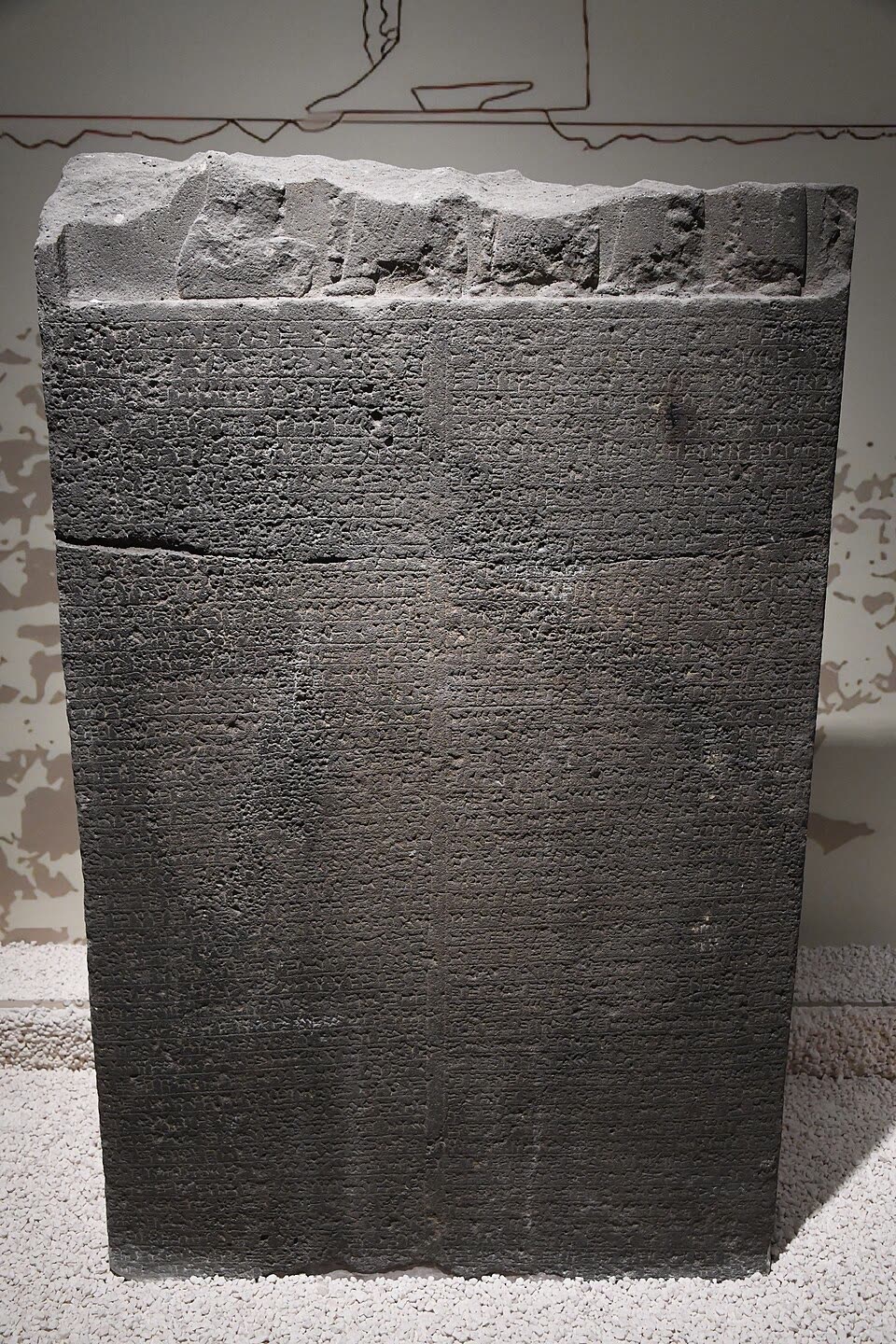
The AkkadianAkkadianAn ancient East Semitic language written in cuneiform from the third millennium BCE; its varieties include Babylonian and Assyrian, and it served in international diplomacy.Glossary · Click to read the explanation inscription survives on two steles, upright stones originally made to display writing and carving. Henri Pognon’s more fragmentary copy, known as H1 A, was found in 1906 at Eski Harran, where it had become a doorstep. David Storm Rice found the better-preserved H1 B in 1956, set into the paving at the north entrance of the Great Mosque at Harran. Both had been reused, so their discovery places are evidence of where the stones ended up. Their association with the rebuilt temple of Sîn is a scholarly reconstruction. The editors suggest that the inscription may belong with Nabonidus’s own Harran steles, perhaps made in his fourteenth or fifteenth year while the rebuilding was under way. That would put the carving several years after the death it commemorates. [1] [2]
The stone from the mosque preserves part of an image above the inscription. Four figures appear to have been moving toward a low stand. Little survives of their upper bodies, and the identification of the leading pair as Nabonidus and his mother is a proposal. The stone does give her name in its opening lines. She identifies herself as the king’s mother and as a devotee of four deities, Sîn, Ningal, Nusku and Sadarnunna. Those are the descriptions the inscription supplies. The view that she held a formal office as high priestess of the moon god goes beyond them. [1] [2] [3] [4]
The prayer for Harran
In Adad-guppi’s account, the ruin of her city follows the anger and departure of Sîn in Nabopolassar’s sixteenth year, 610 BCE. The introduction to the modern edition places the city’s conquest in that year during the war against Assyria. The inscription tells what the catastrophe meant to a worshipper. She repeats that she attended to the god day and night, gave back the good things she had received and prayed for him to come home. Fine wool, perfume, oil and ornaments of gold and silver give way, in her telling, to torn clothing and sackcloth. [1] [5]
The text takes the reader from a prayer for the city to a promise for her son. After recounting her years of service, Adad-guppi says Sîn chose Nabonidus to rule. She asks the god to remember Ehulhul, his sanctuary at Harran. In a dream, he tells her that Nabonidus will rebuild it and bring the four deities back. The account then repeats the promise as something accomplished, with Nabonidus bringing the divine images from Babylon and installing them in the sanctuary amid celebrations. Sungduk Yun reads the recurring exchanges of prayer and answer as the structure that links her devotion, her son’s kingship and the temple’s return to use. [1] [6]
Her place at court
The first-person account gives Adad-guppi a role in presenting her son to Nebuchadnezzar IINebuchadnezzar IIBabylonian king, 605–562 BCE, appearing in Daniel and independently attested in inscriptions and building remains.Glossary · Click to read the explanation and Neriglissar. It says she placed Nabonidus in their service and that they treated her like a daughter. She also claims to have continued making monthly offerings to the dead kings after others had ceased. The list includes bread, fruit, oil, wine and livestock. These details show how the monument ties her family to earlier rulers through both service during their lives and remembrance after their deaths. They offer limited grounds for reconstructing the actual steps by which Nabonidus became king. [1] [4] [6]
The birth date inferred from the stele comes from the twentieth year of AshurbanipalAshurbanipalAshurbanipal was an Assyrian king of the seventh century BCE, reigning about 668–631 BCEGlossary · Click to read the explanation, about 649–648 BCE. Her death in 547 BCE puts her age at roughly 101 or 102 by that reckoning. The stele’s 104 is its own stated figure and accompanies a description of unusually good health and the delight of seeing several generations of descendants. Both the numerical discrepancy and the texture of that passage matter. The compiler is interested in how a long life could be understood as a gift from Sîn. [1] [3] [6]
The ninth year
The stele says that Nabonidus dressed his mother for burial in fine garments and precious adornments, gathered mourners from Babylon, Borsippa and farther afield, and held seven days and nights of mourning. The Nabonidus Chronicle fixes the death to the fifth day of Nisannu in 547 BCE at Dūr-karašu, upstream from Sippar on the Euphrates. It places the king at Tema that year and mentions three days of mourning by the heir and his troops, followed by an official ceremony in a later month. The stele and the chronicle describe different aspects of the mourning, and the chronicle gives the place of death while the place of burial remains unknown. The inscription’s final address turns to a future ruler and asks him to honor the gods. The monument ends by asking its next reader to continue the acts of devotion with which Adad-guppi’s account began. [1] [3] [5]
References and notes (6)
- Frauke Weiershäuser and Jamie Novotny, RINBE 2, Nabonidus 2001 pp. 223–229, H1 A and H1 B, lines i 1–ii 59 and iii 1–56 Return to the text ↑
- C. J. Gadd, The Harran Inscriptions of Nabonidus pp. 35–38 and 89–92, finds, reuse and carved remains Return to the text ↑
- Paul-Alain Beaulieu, The Reign of Nabonidus, King of Babylon 556–539 B.C. pp. 67–73, Adad-guppi’s titles, court position and dates Return to the text ↑
- Wolfgang Schramm, Das königliche Ich pp. 94–96, comparative analysis of the inscription’s form, relief and final address Return to the text ↑
- Nabonidus Chronicle, BM 35382, in RINBE 2 pp. 4 and 26, historical introduction and chronicle ii 10–15a Return to the text ↑
- Sungduk Yun, Mother of Her Son, The Literary Scheme of the Adad-guppi Stele pp. 279–283, formal analysis of the prayer, dream and mourning episodes Return to the text ↑
Suggest a correction · Suggest a source for this record
Cite this record
IL Archive, «Adad-guppi», https://ilarchive.com/en/people/adad-guppi
Continue reading