Person · Literary figure
Etana of Kish and the Flight to Heaven
- Names
- Etana
- Region
- Mesopotamia
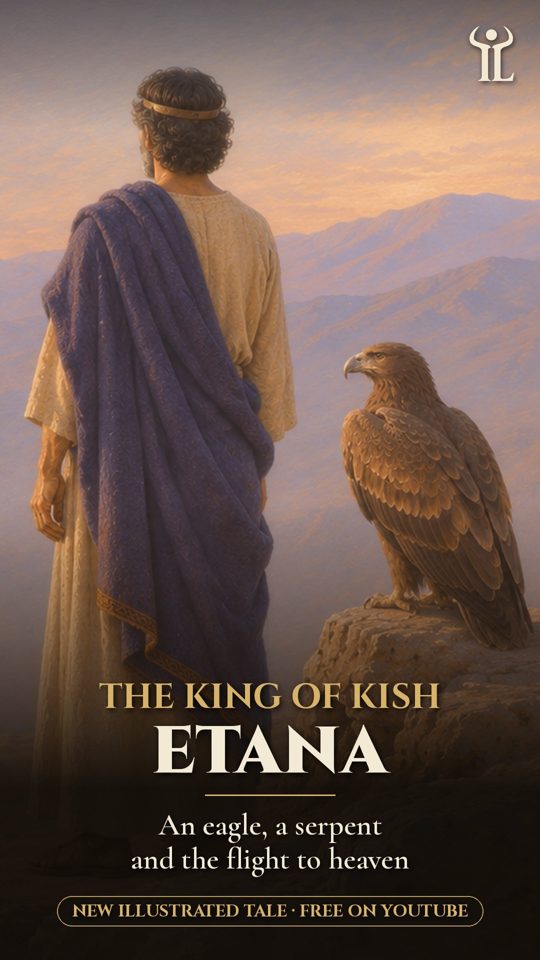
Etana is a legendary king of Kish whose search for an heir takes him into the sky on an eagle. The Sumerian King List names his son Balih. The surviving epic leaves the outcome of the quest open.
Estimated reading time: 5 min Published Last reviewed:
Share article
Video
Etana: An eagle, a serpent and the flight to heaven
An eagle, a serpent and the flight to heaven. The whole story in two illustrated chapters, told from the ancient clay tablets; where the tablets are broken, the narration says so. Illustrations, narration voice and visual effects were created with AI tools by IL Archive; the text is a faithful retelling based on the ancient tablets.
The YouTube player loads only when you press play. Watch on YouTube
Text
Introduction
Etana is a legendary king of Kish in MesopotamiaMesopotamiaHistorical region associated with the Tigris and Euphrates: Uruk, Ur, Eridu, cuneiform, Sumer, Akkad, Babylon and Assyria, their languages and cults, and the limits of archaeological evidence.Glossary · Click to read the explanation. The Sumerian King List calls him a shepherd, remembers his ascent to heaven and places his son Balih after him. The AkkadianAkkadianAn ancient East Semitic language written in cuneiform from the third millennium BCE; its varieties include Babylonian and Assyrian, and it served in international diplomacy.Glossary · Click to read the explanation Epic of Etana gives the journey a motive. Etana wants a child and asks the sun-god ShamashShamashMesopotamian god of the sun and justice, shown before Hammurabi on an eighteenth-century BCE stele preserved in the Louvre.Glossary · Click to read the explanation for a plant associated with childbirth. An eagle whose life he saves carries him towards the dwelling of the gods. [1][2]
The epic survives in Old Babylonian, Middle Assyrian and later Assyrian witnesses. The versions differ in wording and all survive in fragments. An Akkadian-period seal from Girsu in the Louvre is identified as showing a scene from the story. The figure of a man carried by an eagle belongs to an earlier body of visual evidence than the surviving copies of the poem. [2][3][4]
The shepherd on the king list
After the Flood, the Sumerian King List places the first seat of kingship at Kish. Etana comes well into its sequence of Kish rulers. The text singles him out for his ascent and for bringing foreign lands under control, as the Oxford translation reads the passage. It credits him with a reign of 1,500 years, with a variant of 635 years in another witness. The figures are part of the list’s account of a distant age. The witnesses even disagree on the length of Balih’s reign. What they share in this passage is the placement of son after father. The entry supplies neither a dated record of a reign nor details of a flight. [1]
The poem also considers kingship at Kish. Its opening looks back to a time when the office and its attributes had yet to be established on earth. Eli Tadmor studies two couplets in an Old Babylonian witness, including a reference to deliberation in the absence of kingship. He reads the lines as an argument that the office can be burdensome and necessary at the same time. In the story that follows, securing a successor is a problem the ruler cannot resolve through his office alone. [2][3]
A promise in the branches
The eagle and the serpent first appear as neighbours. The serpent lives at the base of a tree and the eagle has its nest in the branches. They swear an oath of friendship before Shamash and share what they hunt with one another’s young. The arrangement lasts until the eagle eats the serpent’s offspring, despite a warning. The serpent appeals to Shamash, the god who witnessed the oath. [2][5]
Shamash tells the serpent how to catch the eagle using the carcass of a wild bull. The eagle is overpowered and cast into a pit. Etana’s appeal for a child brings the two parts of the story together. Shamash directs him to the pit, and Etana helps the eagle recover. The episode gives the eagle a reason to aid a human king and gives Etana a companion who can take him where people cannot go on their own. [2][5]
Two flights in the reconstructed epic
As the pair rise, the eagle asks Etana to describe the land and sea below. Details shrink as the distance increases, and the questioning gives the ascent a rhythm. In Jamie Novotny’s arrangement of the Standard Babylonian fragments, Etana loses courage and asks to return to the ground during the first flight. What follows is damaged, with several fragmentary reports of dreams. [2]
In one dream, Etana and the eagle pass through gates associated with groups of gods. Etana sees a goddess on a throne, with lions close by. He wakes when they approach him. The eagle treats the dream as an encouraging sign and proposes a new flight. In Novotny’s reconstruction the two eventually pass through the divine gates, but the text breaks off. The edition discusses alternative placements of the damaged episodes, so the sequence depends in part on how the pieces are assembled. [2]
The King List names Balih as Etana’s son and successor. That gives the lists and the epic a point of contact, and the surviving poem leaves open both the birth of an heir and the outcome of the search for the plant. The list’s short entry and the poem’s damaged ending preserve different information about the same ruler. [1][2][5]
Reading the flight on seals
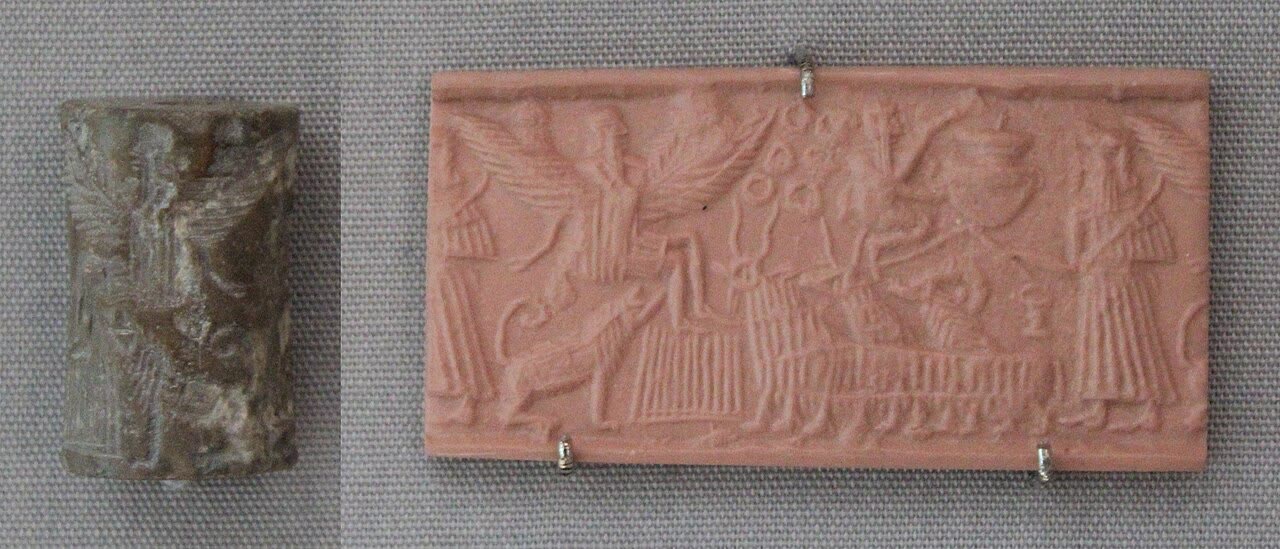
On the pictured limestone cylinder sealCylinder sealSmall engraved cylinder rolled over soft clay to leave an extended image. Used to secure, document and identify administrative actions; its pictures do not automatically constitute writing.Glossary · Click to read the explanation and its impression, the rider and eagle occupy the left part of a larger scene. A dog looks towards the ascent. To the right, a shepherd and animals continue the scene on the ground. An early handbook of Mesopotamian archaeology describes a British Museum seal with this composition (a dog gazing up, a shepherd and animals on the ground) and identifies the scene as the flight of Etana. The figure’s height above a recognizable scene of herding helps suggest the distance described in the poem. [2][6][7]
The Louvre records another Etana seal, engraved on shell and excavated at Girsu, with its own version of the ascent. The flight could be recognized as a single scene on a small surface, while the tablets take time to develop the oath, the animal’s punishment, and the king’s hopes for a child. The visual works and the surviving texts preserve different parts of the tradition by which Etana was remembered. [2][4]
References and notes (7)
- Electronic Text Corpus of Sumerian Literature, The Sumerian King List Read the opening of the post-Flood Kish sequence, the Etana and Balih entries and their manuscript variants. Return to the text ↑
- Jamie R. Novotny, The Standard Babylonian Etana Epic Read the edition’s introduction on surviving witnesses, the oath and trap, Etana’s search and rescue, the sequence of the flights and dreams, the lost ending and the problem of arranging the fragments. Return to the text ↑
- Eli Tadmor, The Pain and Necessity of Kingship in Old Babylonian Etana Read the introduction on the three versions and the analysis of the early couplets on the world before kingship and the absence of deliberation. Return to the text ↑
- Musée du Louvre, Sceau-cylindre : ascension du roi Etana sur un aigle Read the collection record, including the identification of the scene, the engraved shell material and findspot at Girsu. Return to the text ↑
- British Museum, Cuneiform Tablet Telling the Legend of Etana Read the museum’s account of the animal oath, trap, rescue and the uncertain outcome of the flights. Return to the text ↑
- Percy S. P. Handcock, Mesopotamian Archaeology, Chapter IX, Cylinder-Seals Read the published description of the Etana ascent in the British Museum seal reproduced in figure 62, with its dog, shepherd and animals. Return to the text ↑
- Wikimedia Commons, Limestone Cylinder Seal BM 89767 Read the photograph’s identification and caption and checked the scene and its credit against the CC BY-SA 4.0 licence. Return to the text ↑
Suggest a correction · Suggest a source for this record
Cite this record
IL Archive, «Etana of Kish and the Flight to Heaven», https://ilarchive.com/en/people/etana
Continue reading