Person
Khidr
- Names
- Khidr · al-Khiḍr
Khidr in Islamic tradition: al-Kahf’s unnamed servant, hadith identification, debates over prophethood, sainthood and immortality, and Sufi and literary reception.
Estimated reading time: 9 min Published Last reviewed:
Share article

Text
Introduction
Khidr (al-Khiḍr, “the Green One”) is the name given in Islamic reports to the servant encountered by MosesMosesCentral figure in Exodus, Torah traditions and the Qur’an; childhood accounts differ in detail.Glossary · Click to read the explanation in Surat al-Kahf. The Qur’anThe QuranThe central scripture of Islam, consisting of 114 Arabic surahs; its study distinguishes Quranic discourse from manuscript history, reading traditions, and historical inference.Glossary · Click to read the explanation does not name that servant in the passage. This entry asks how an unnamed teacher became a figure in hadith, exegesis, Sufism, literature and local traditions, and what can actually be established when he is compared with Elijah and stories of the Water of Life. Distinguishing the text from the recording and later reception of its explanations is essential. [1] [3]
The unnamed servant in al-Kahf
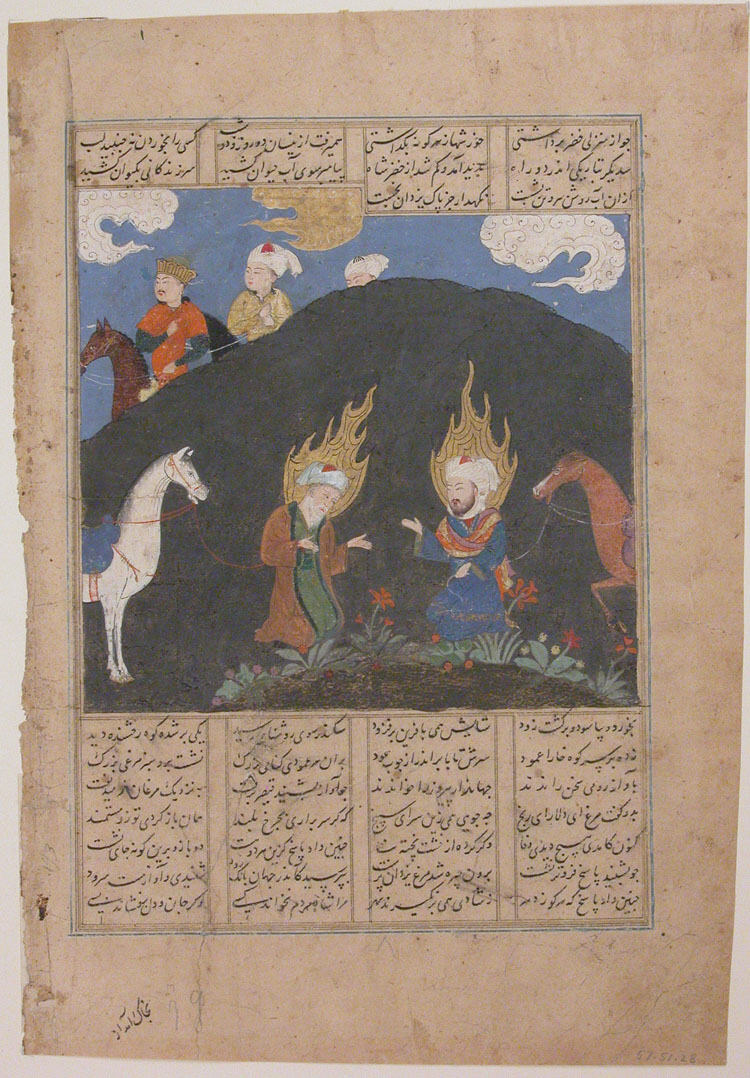
The journey begins at Qur’an 18:60–64: Moses tells his young attendant that he will reach the meeting of the two seas. Their fish makes its way into the sea near a rock, and they retrace their steps to where it was lost. Neither the attendant nor the man subsequently encountered is named in these verses. The latter is described as a servant granted mercy and knowledge by God. Verse 18:65 reads: [1]
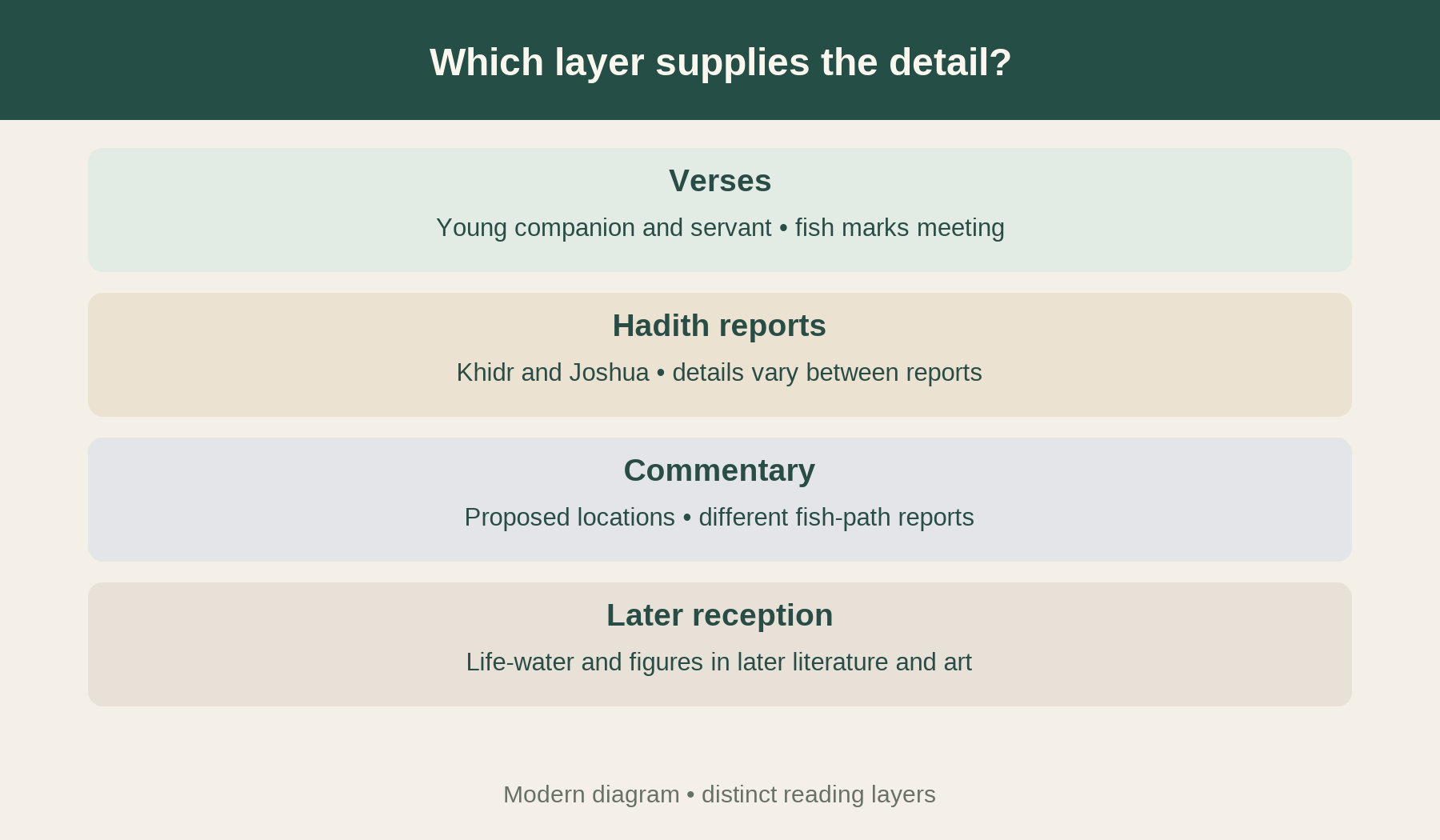
In our translation, “They found one of Our servants to whom We had given mercy from Us and taught knowledge from Our presence.” The narrative locates his knowledge in divine teaching, but gives no name, genealogy, age or geographically identifiable meeting place. It does not announce that he will remain alive until the end of time. “Khidr,” the attendant’s name “Joshua son of Nun,” and proposed locations of the meeting belong to other layers of transmission. Even “salted” or “cooked” as descriptions of the fish in 18:61 come from reports or explanatory translations, not from the Arabic verse itself. [1] [3] [4]
Moses asks to accompany the servant and learn sound guidance. The servant agrees on condition that Moses not question his actions before he himself explains them. Three actions provoke Moses’s objections: damaging a boat, killing a boy and rebuilding a wall for people who refused them hospitality. At parting, the servant explains that the damage was intended to protect a poor crew’s boat from a confiscating king; the boy’s believing parents were at risk of being burdened by his defiance and unbelief; and the wall concealed a treasure for two orphans until they matured. He closes by saying: [2]
“I did not do it on my own initiative” is our concise rendering. Within the story these exceptional acts are attributed to a command beyond the servant’s personal judgment. The killing scene is not a general permission to harm children by claiming hidden knowledge: it creates a problem of knowledge and moral justification within a specific narrative, which expressly includes Moses’s objections to apparent wrongdoing. This is one reason exegetes debated whether the servant was a prophet or a friend of God, rather than treating his actions as ordinary precedents for human conduct. [2] [7]
Naming Khidr in hadith and commentary
Sahih al-Bukhari, compiled in the third Islamic/ninth Common Era century, preserves a report transmitted through Ubayy ibn Kaʿb about Moses’s question concerning who was most knowledgeable and his journey with his attendant. It names the man al-Khidr and the attendant Joshua son of Nun. Khidr tells Moses that each possesses knowledge God has taught him that the other does not possess. The story thereby becomes a lesson in epistemic humility, not an argument that Moses lacked prophetic standing. Sahih Muslim 2380c gives a related version which, at its outset, mentions a salted fish. These are witnesses to hadith transmission and its understanding in extant compilations, not additional words in the Qur’anic passage. Both collections have canonical standing in Sunni hadith scholarship, but that does not place every additional detail on the same chain, nor does this entry claim to have performed an independent evaluation of each narrator. [3] [4]
Another report in al-Bukhari, numbered 3402 and transmitted from Abu Hurayra, explains the name through the colour of vegetation: [5]
In our rendering, he “was called al-Khidr because he sat on a bare white patch of ground, and it became green behind him.” This is a transmitted explanation of a name, not evidence from which a continuous historical biography can be reconstructed. The name has several Arabic vocalizations and spellings in other languages. [5] [8]
The famous “Spring of Life” illustrates why narrational qualifications matter. In al-Bukhari 4727, Sufyan ibn ʿUyayna introduces the detail of a spring beside the rock whose water revives the fish, but expressly attributes it to a report other than that of ʿAmr ibn Dinar. It is therefore not presented as an unqualified element of the main route he is transmitting. Muslim 2380c narrates the fish moving in the water without establishing the full spring account. Neither passage by itself demonstrates that Khidr drank from such a spring or survived without dying into modern times. [3] [4]
In his commentary on 18:65, al-TabariAl-TabariAbbasid-era historian and Qur'anic exegete (c. 839–923 CE). His commentary records competing views on Abraham's son, then favors Isaac.Glossary · Click to read the explanation (d. 310 AH/923 CE) records multiple explanations of why Moses set out. In one he is corrected for supposing he possessed the greatest knowledge; in another he seeks an additional teacher. He also preserves differing reports about the rock and fish. These are collected transmitted interpretations, not pieces to be silently fused into a single uniform historical narrative. [6]
Prophet, saint or immortal?
Writing on 18:65, al-Qurtubi (d. 671 AH/1273 CE) says that Khidr is considered a prophet by the majority, while recording the views that he was a righteous non-prophet or an angel. He favours prophethood, arguing that such acts must rest on revelation, especially given the servant’s statement that he did not act by his own command. This is an exegetical argument within Muslim thought; the Qur’an itself nowhere explicitly names “Khidr the prophet” in these verses. The resulting legal question is serious: could a non-prophetic friend of God (wali) invoke private knowledge to overrule public norms? Reading the actions as a special prophetic mandate prevents that inference; mystical readings, by contrast, explored his gift of knowledge and guidance. [7] [9]
Khidr’s prolonged life and meetings with saints across the centuries are themes of hagiography and spiritual experience, disputed by Muslim scholars. Sufi sources tell of him guiding seekers and conferring the khirqa, a robe signifying spiritual affiliation or authorization. Research distinguishes belief in his continued personal existence from his literary and spiritual role as a guide who appears in moments of need. Qur’an 18:60–82 specifies neither his lifespan nor his drinking of the Water of Life. These passages alone cannot establish continuing bodily survival as an independently verified historical fact. [8] [9] [12]
A spiritual guide and a literary visitor
Sufi interpretation treats the encounter as a pattern for the relationship between master and disciple: the student learns patience and the limits of immediate perception, while ʿilm ladunni designates knowledge received as a gift. Hugh Talat Halman’s 2013 study examines Sufi interpretations by three authors from different periods: al-Qushayri (eleventh century), Ruzbihan al-Baqli (twelfth century) and ʿAbd al-Razzaq al-Qashani (fourteenth century). In this tradition, companionship and spiritual formation matter beyond solving three narrative riddles. Our account of this book is based on an academic review, not on a reading of Halman’s complete monograph or a fresh collation of those three commentaries. [10]
Beyond learned commentary, Khidr becomes a rescuer of travellers, helper in distress and visitor to revered locations. A review of Patrick Franke’s research describes a substantial corpus of “encounters with Khidr” spanning the ninth through twentieth centuries. Such accounts are evidence for varied social, devotional and symbolic uses of the figure, not episodes in one securely datable biography. In modern writing, Shawkat M. Toorawa has studied novelistic reworkings of the mysterious visitor and teacher whose identity changes across languages and literary settings. [9] [11]
Elijah, Alexander and the Water of Life
Khidr has been compared with Elijah of Jewish and Christian traditions: both can appear in later stories as a helper or guide, and some shrines and local practices in the LevantThe LevantThe Levant is a regional name for lands along the eastern MediterraneanGlossary · Click to read the explanation associate Khidr, Elijah and Saint George. Later Jewish stories also describe Elijah acting in bewildering ways before explaining himself to a companion. These are meaningful structural analogies about instruction and delayed understanding. But the differing dates and transmission histories of the individual versions do not establish a single original or a particular direction of borrowing without further evidence. [8] [11]
Literature about Alexander the GreatAlexander the GreatMacedonian king who lived from 356 to 323 BCE and became a hero of stories in different languages and traditions after his death.Glossary · Click to read the explanation and the “Water of Life” includes revivified fish and seekers after a spring conferring life. Versions of the Alexander story feature a companion who finds or reaches that water; later Muslim narratives sometimes connect Khidr to Alexander or Dhu al-Qarnayn. The Qur’anic account of Dhu al-Qarnayn follows the Moses–servant story in the same surah, making comparison understandable. Yet adjacency does not identify Khidr as Alexander, nor prove literary borrowingLiterary borrowingUse of verbal or narrative material from an earlier text or tradition in a later work, distinguishing evidence of transfer from mere resemblance.Glossary · Click to read the explanation from a specific work. The SyriacSyriacAn Aramaic literary language rooted in Edessa, first attested in non-Christian inscriptions and later prominent in Christian writing, scholarship, translation and liturgy.Glossary · Click to read the explanation Alexander traditions have multiple versions and their manuscript witnesses must be dated separately from the possible composition and earlier development of their motifs. [8] [11]
A chronology of texts, not a single lifespan
- Narrated time: The encounter belongs to the world of Moses within the story; the passage does not supply an independently verifiable year or precise geographical location.
- Seventh century CE: The Qur’anic text belongs to early Islam and leaves the servant unnamed. The formation and material transmission of the text are different historical questions from the period in which its story is set. [1]
- Ninth century CE: The extant compilations of al-Bukhari and Muslim preserve hadith chains and versions identifying Khidr and expanding the journey; the compilation date is not the event date. [3] [4]
- Tenth to thirteenth centuries: Al-Tabari gathered exegetical accounts, and al-Qurtubi later discussed the servant’s prophetic status; Sufi interpretations developed across overlapping centuries. [6] [7] [10]
- Later centuries to the present: Encounter reports, pictorial and literary representations, and local devotions accumulated in settings with their own histories. [9] [11]
Khidr is best approached as the point of intersection of a specific Qur’anic narrative, transmitted accounts supplying names and episodes, theological debates over knowledge and authority, and later practices and literature. Textually, the Qur’anic verses do not give his name, whereas the consulted hadith sources do name Khidr. His exact geographical setting, immortality and the direction of every proposed cross-cultural connection remain separate questions with different kinds and strengths of evidence. [1] [3] [8]
References and notes (12)
- The Qur’an, Surat al-Kahf 60–65: the journey, the fish and the unnamed servant, in Arabic with immediate context. Qur’an 18:60–65; the verses do not name the man. Return to the text ↑
- The Qur’an, Surat al-Kahf 66–82: the condition of patience, three acts, their explanations and the closing disclaimer of personal initiative. Qur’an 18:66–82, especially 18:71, 18:74 and 18:78–82. Return to the text ↑
- Sahih al-Bukhari, Qur’an commentary, report 4727 through Saʿid ibn Jubayr, Ibn ʿAbbas and Ubayy: naming and the fish; Sufyan attributes the Spring of Life detail to a report other than ʿAmr’s. Al-Bukhari 4727, long report; Sufyan’s qualification before the fish departs. Return to the text ↑
- Sahih Muslim, Book of Virtues, 2380c: Moses, Khidr and the salted fish; compared through the published English rendering, not a fresh Arabic collation. Muslim 2380c, Ubayy ibn Kaʿb narrative, from departure to explanations. Return to the text ↑
- Sahih al-Bukhari, Prophets, report 3402, from Abu Hurayra: the name is explained through a patch of ground turning green. Al-Bukhari 3402, complete short Arabic report. Return to the text ↑
- Muhammad ibn Jarir al-Tabari, Jamiʿ al-bayan on al-Kahf 18:65: competing explanations of Moses’s journey and variants about the rock and fish. The online text supplies no fixed print-edition pagination. Commentary on 18:65, the paragraphs starting “the reason for Moses’s journey” and “others said”. Return to the text ↑
- Muhammad al-Qurtubi, al-Jamiʿ li-ahkam al-Qurʾan, on al-Kahf 18:65: his statement that most consider Khidr a prophet and the competing views and argument. Commentary on 18:65, paragraphs identifying the servant and debating prophethood. Return to the text ↑
- Hugh Talat Halman, “Khidr, Al-,” Encyclopedia of Islam and the Muslim World, online entry on Sufi, Elijah, Alexander and Water of Life traditions. Entry “Khidr, Al-,” narrative, comparative and Sufi paragraphs. Return to the text ↑
- Published review of Patrick Franke, Begegnung mit Khidr (2000), on debates over prophetic status, sainthood, longevity and encounter narratives. Review only; the monograph itself was not read. Dirassat book review dated 16 July 2011, summary of chapters and 173 accounts. Return to the text ↑
- Brannon Wheeler’s review of Hugh Talat Halman, Where the Two Seas Meet (Fons Vitae, 2013), Journal of the American Oriental Society 136/3 (2016), pp. 649–650, identifying three exegetes and the book’s limitations; the book itself was not read. Complete review reproduced by Fons Vitae, print pages 649–650. Return to the text ↑
- Shawkat M. Toorawa, “The Modern Literary (After)Lives of al-Khiḍr,” Journal of Qur’anic Studies 16/3 (2014), pp. 174–195, DOI 10.3366/jqs.2014.0172; consulted introductory Khidr sections, conclusion and comparative notes, not the entire article. Print pp. 175–176 and 188–190 (PDF pages 2–3 and 15–17, plus page 174 header). Return to the text ↑
- Muhammad Asad Latif, review of Irfan A. Omar, Prophet al-Khiḍr: Between the Qur’anic Text and Islamic Contexts (Lexington, 2022), American Journal of Islam and Society 42/3–4, pp. 148–151. Consulted the review, not Omar’s book. Review pp. 148–151 (PDF pages 1–4). Return to the text ↑
Suggest a correction · Suggest a source for this record
Cite this record
IL Archive, «Khidr», https://ilarchive.com/en/people/khidr
Continue reading