Person
Plutarch
- Names
- Mestrios Ploutarchos · Plutarch · Plutarch of Chaeronea · Πλούταρχος
- Region
- Boeotia, the ancient Greek world
Greek biographer, Platonist, and priest of Apollo at Delphi under Roman rule. His essay On Isis and Osiris preserves versions of an Egyptian story and asks how myths, rites, and symbols convey knowledge about the divine.
Estimated reading time: 5 min Published Last reviewed:
Share article
Text
Introduction
Plutarch lived in the first and early second centuries CE and spent much of his life in Chaeronea and at Delphi. Readers often meet him through his paired lives of Greeks and Romans. In On Isis and OsirisOsirisOsiris was an ancient Egyptian deity associated with the dead, life after death, renewal, and kingship. His roles appear in changing funerary texts, rituals, and judgment scenes, notably the weighing of the heart.Glossary · Click to read the explanation, he addresses a woman connected with the cults of Dionysus and Osiris and asks what a story about divine kingship, death, and recovery can teach its readers about the gods. [1] [2] [3]
A priest from Chaeronea
Chaeronea was Plutarch’s home in Boeotia. He studied with Ammonius in Athens, and references in his writing attest to travel to Rome and Alexandria. His account of a conversation at Alexandria in the Table Talk is evidence for his presence in the city. The sources of the particular Egyptian traditions he uses in On Isis and Osiris remain a separate question. In the essay he names Greek writers such as Eudoxus and also reports traditions attributed collectively to priests or to Egyptians. [1] [3]
Plutarch refers to his own service for ApolloApolloGod of music and prophecy in Greek traditions, also participating in the Iliad’s events.Glossary · Click to read the explanation in an essay on whether an older person should remain active in public affairs. In Angelo Casanova’s reading, his examples of sacrificing, joining processions, and dancing in choruses evoke a priesthood that involved repeated participation in the sanctuary’s public life. A Greek inscription from Delphi supplies an independent witness. It calls him Mestrios Plutarch and identifies him as a priest overseeing the erection of a statue of Hadrian on behalf of the Amphictyons. [4]
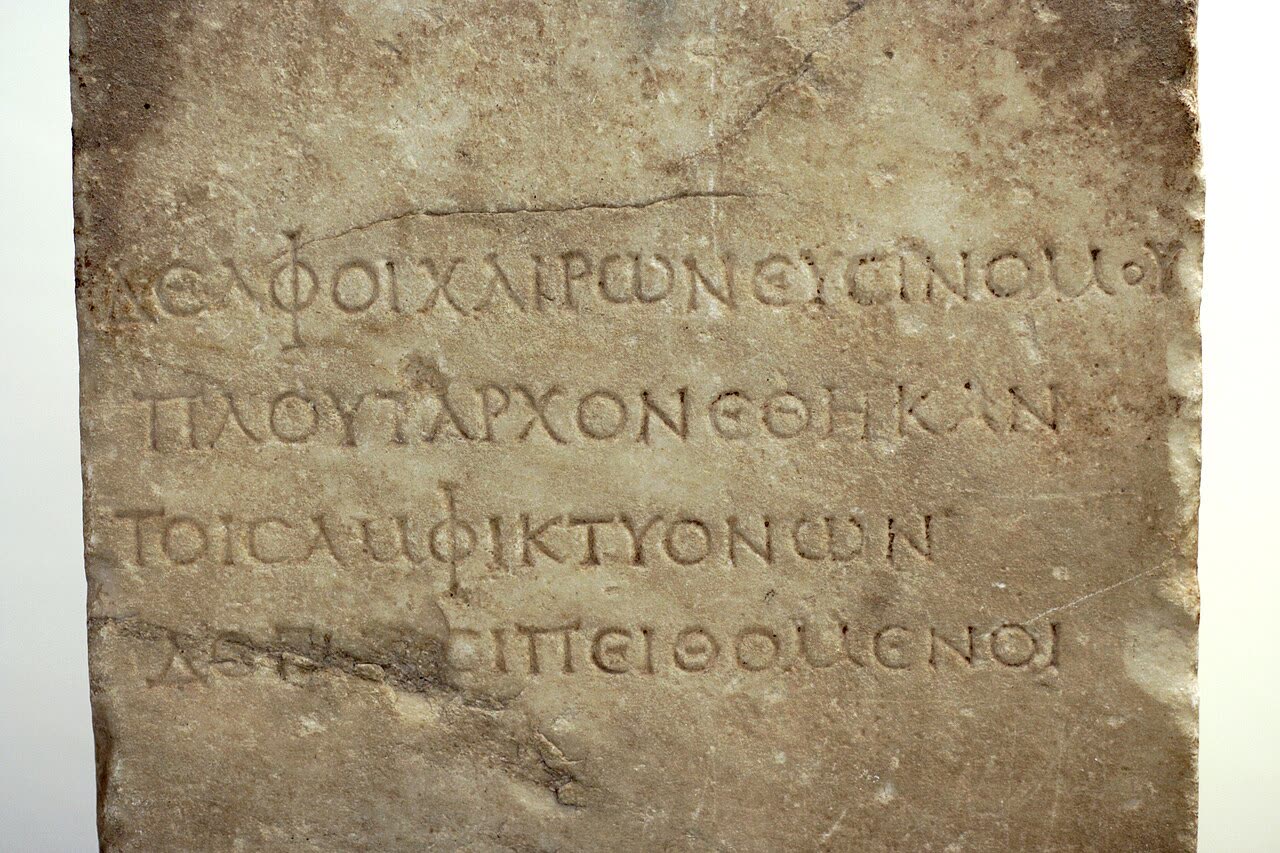
A second monument, pictured here, records an honor for Plutarch himself. Its Greek inscription says that the Delphians and Chaeroneans set up his image in accordance with a decision of the Amphictyons. Casanova suggests it may have been erected shortly after Plutarch’s death. The shaft survives, and the Archaeological Museum of Delphi identifies a nearby head as the portrait of a philosopher formerly associated with the writer. The inscription supplies the secure identification of the person honored. [4] [5]
An essay for Clea
The opening address names Clea, and a later passage explains why she is a fitting reader. Plutarch identifies her as a leader of the Thyiads at Delphi and as someone consecrated in the sacred rites of Osiris through her family. Gregory Nagy emphasizes that this gives her a position within both ritualRitualAn organised or distinguished practice meaningful to a community; it may leave traces, but its form alone does not reveal an associated doctrine.Glossary · Click to read the explanation traditions. Plutarch can invoke the Greek identification of Osiris with Dionysus with a reader whose connection to the two cults is part of the argument. His opening image of Isis’s devotees bearing sacred teachings within their souls uses the visible equipment of worship to express an inward responsibility. [3] [6]
The story and its competing versions
In sections 12–19 of the essay, Osiris rules Egypt, introduces cultivation and laws, and teaches reverence for the gods. TyphonTyphon / TyphoeusTyphon (Typhoeus), a serpentine adversary of Zeus in Greek myth; his defeat and punishment vary across Hesiod, Pindar, and the later Library.Glossary · Click to read the explanation, Plutarch’s Greek name for Seth in this account, plots his death. Isis sets out in mourning and learns that the chest containing Osiris has passed into the sea. At Byblos it becomes enclosed by a tree, which the king has made into a pillar for his palace. Isis makes her way into the household and recovers the chest. The narrative later brings her back to Egypt and relates a second search after Typhon scatters Osiris’s remains. [3] [6]
Plutarch gives distinct accounts of why several places claimed a tomb of Osiris. One says that Isis buried the parts where she found them. Another says she made and distributed images, increasing the places where Osiris received honors and concealing the location of his burial. In the following chapters Plutarch reports that Eudoxus placed the body in Busiris. He also describes the desire of prominent Egyptians to be buried by Osiris at Abydos. The sequence preserves a set of local claims and proposed explanations, with their differences still visible. [3]
Reading cult and story together
Plutarch compares the stories to a rainbow, in which the observer sees light by looking toward a cloud. In his analogy, the narrative directs the reader toward a truth that requires interpretation. He looks for indications in mourning sacrifices, in the spaces of temples, and in traditions about burial places. Elsewhere he interprets injury to the eye of Horus through the moon’s waning and eclipse. He draws on PlatoPlatoPlato (approximately 427–347 BCE) was a Greek philosopher who explored goodness, justice and cosmic order through philosophical dialogues.Glossary · Click to read the explanation’s account of form, matter, and the resulting cosmos when discussing Osiris, Isis, and Horus. These passages make clear that the story is doing philosophical work within the essay. [1] [3]
In section 67, Plutarch connects differences in divine names and forms of worship with the customs of particular peoples. He treats consecrated symbols as ways of guiding thought about divine powers. He warns of two possible failures of judgment, superstition and the loss of belief in the divine. His account of Egyptian religion thus also gives evidence for his own interest in how ritual and reasoning belong together. [3]
An older Egyptian witness
The Eighteenth Dynasty stela of Imenmes in the Louvre makes a useful comparison. Its hymn calls Osiris a king, connects his will with the production of food, and praises Isis for searching in grief until she found her brother. It then credits her with burial rites for him. The stela puts parts of the story on record in an Egyptian funerary setting many centuries before Plutarch. Reading the texts together shows the long life of those themes and the different work that each text asks them to do. The stela offers praise in a commemorative setting. Plutarch makes the search and its associated rites the subject of a conversation about interpretation. [3] [7]
References and notes (7)
- George Karamanolis, Plutarch, Stanford Encyclopedia of Philosophy §1 Life and Works, with Athens, Alexandria, Chaeronea, Delphi, and the division of the works Return to the text ↑
- Frances B. Titchener and Alexei V. Zadorojnyi, Introduction, The Cambridge Companion to Plutarch pp. 1–6, paired biographies, Chaeronea, Delphi, and the biographical evidence Return to the text ↑
- Plutarch, Isis and Osiris, trans. Frank Cole Babbitt, Loeb Classical Library §§1–3, 11–22, 35, 53–58, and 66–67, opened in Parts 1, 2, and 4 of the edition Return to the text ↑
- Angelo Casanova, Plutarch as Apollo’s Priest at Delphi, Firenze University Press pp. 141–145, priesthood references and distinction between the Hadrian dedication and Syll.³ 843A Return to the text ↑
- Archaeological Museum of Delphi, Selected Exhibits Head of a philosopher and hermaic stele of Plutarch, CID 4.151 and the identification history Return to the text ↑
- Gregory Nagy, Comments on Plutarch’s Essay On Isis and Osiris, Harvard DASH §§1–3, 18, and 55, including Clea’s ritual affiliations and the Seth–Typhon identification Return to the text ↑
- Musée du Louvre, Stela of Imenmes, C 286 Inscription and dating, including the French rendering of the Osiris hymn Return to the text ↑
Suggest a correction · Suggest a source for this record
Cite this record
IL Archive, «Plutarch», https://ilarchive.com/en/people/plutarch
Continue reading