Site · Region
Alashiya
- Names
- Alashia · Alashiya · Alasiya · Alašiya
- Region
- قبرص، شرق البحر المتوسط
Alashiya was a Late Bronze Age polity associated with Cyprus. Diplomatic letters describe copper shipments, and analysis of their clay places the scribes near the Troodos Mountains.
Estimated reading time: 5 min Published Last reviewed:
Share article
Text
Introduction
Alashiya was a Late Bronze AgeLate Bronze AgeAn archaeological period around 1600–1200 BCE in much of the Near East, with international diplomacy, exchange and religious diversity; its endpoints vary by region.Glossary · Click to read the explanation polity named in diplomatic letters from Egypt and UgaritUgaritAncient city and kingdom at Ras Shamra on the Syrian coast, flourishing between the fourteenth and early twelfth centuries BCE and preserving multilingual archives.Glossary · Click to read the explanation. The correspondence found at AmarnaAmarna / AkhetatenAmarna is the archaeological site of Akhetaten, Akhenaten’s fourteenth-century BCE capital in Middle Egypt, preserving royal boundary stelae, temples, houses and cemeteries.Glossary · Click to read the explanation includes letters from a ruler who addresses the pharaoh as a brother and sends copper. Analysis of the tablets themselves links the senders to Cyprus. The identification of the island is much firmer than the identification of a capital or the extent of the ruler's authority. The wording of the correspondence and the composition of its clay address different parts of that question. [1][2]
Copper and the language of gifts
The group of tablets numbered EAEnkiMesopotamian deity also known as Ea, linked with Eridu and the Abzu (deep fresh waters), wisdom, incantations, and narratives of creation and cosmic order. Later written attestations do not identify the deity of Eridu’s earliest layers.Glossary · Click to read the explanation 33–40 preserves the correspondence between Egypt and Alashiya at Amarna. One letter begins from the news that the Egyptian ruler has taken his father's throne. In EA 33, the sender responds to a request for two hundred talents of copper and reports sending ten talents of fine copper in the passage that survives. In EA 34 the Alashiyan ruler reports sending one hundred talents together with oil. His requests in return include a chariot and horses. The goods travel in the same exchanges as formal greetings and messengers. The letters give evidence for both a royal relationship and negotiations over the quantities and kinds of goods moving through it. [1][3][4]
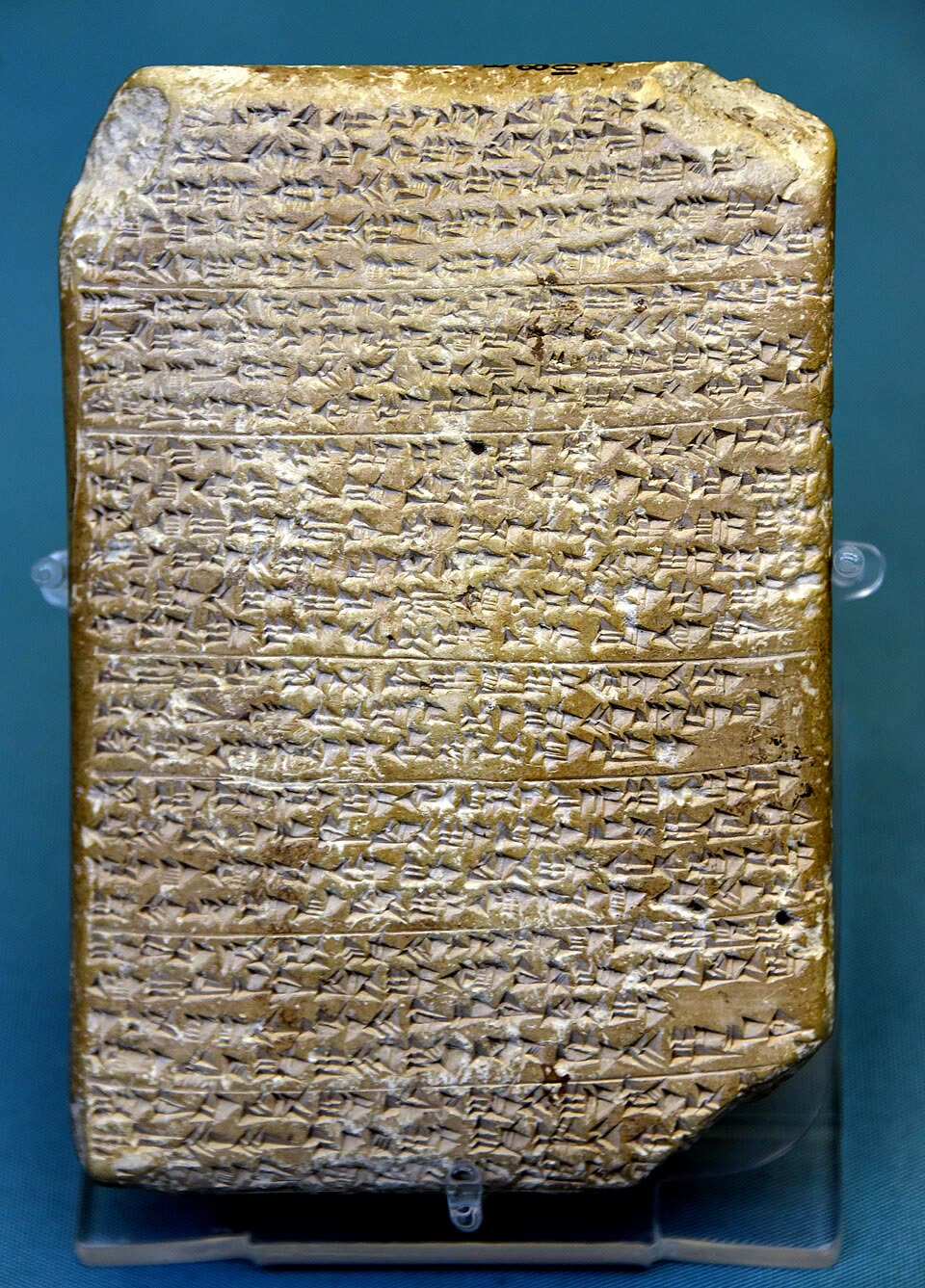
EA 35 is the letter pictured here. The tablet was found at Amarna and is now in the British Museum. In William Moran's translation the king of Alashiya reports sending five hundred talents of copper and asks his Egyptian counterpart to excuse the scale of the shipment. He attributes a shortage of copper workers to the hand of the god Nergal. The passage gives his stated explanation for the shortage. The letter also asks for silver, oil and an expert in interpreting signs from vultures. It requests payment due for timber and asks that the belongings of an Alashiyan who died in Egypt be handed to the messenger, as the man's wife and son were in Alashiya. The requests show a ruler attending to the affairs of people from his land as well as to the exchange of metal. [1][5]
Clay as evidence for a route
The Egyptian findspot establishes where the letter ended its journey. To ask where it began, Yuval Goren and colleagues examined the fabrics of tablets from Amarna and Ugarit and compared them with an assemblage of Cypro-Minoan texts. Their petrographic and chemical results traced the clay of the Alashiyan letters to the margin of the Troodos Mountains. They argue that the material was obtained locally to the scribes. They identify the areas around Kalavasos-Ayios Dhimitrios and Alassa-Paliotaverna and Pano Manadilaris as candidates. The clay can narrow a search for the people who prepared the documents. It cannot identify the location of every royal residence or establish which ports answered to the ruler. [2]
Copper itself supplies another line of evidence. A Cypriot copper ingot in the Metropolitan Museum, formed in an open mold, weighs about sixty-three pounds. The Uluburun wreck off southwestern AnatoliaAnatoliaAnatolia is the region occupying the Asian part of present-day TurkeyGlossary · Click to read the explanation carried over ten tons of Cypriot copper ingots, showing how much raw metal a single shipment could carry. These finds establish the scale and routes of a trade to which the letters also attest. The surviving texts report particular gifts, deliveries and claims for payment. The wreck and the museum ingot are independent evidence for how bulk copper circulated in the Late Bronze Age. [1][6]
How far did the king rule?
The ruler's dealings with foreign courts can be traced beyond Egypt. In correspondence preserved at Ugarit, rulers of that city address the king of Alashiya as father. One letter discusses payment for oil, and another reports attacks along the coast while Ugarit lacks ships and troops at home. The form of address shows that the king of Alashiya could occupy a position of seniority in a particular relationship. It leaves room for different interpretations of the political structure on Cyprus. [7]
Enkomi has often been considered a candidate for an important seat of power. Its monumental buildings, imported goods, cylinder sealsCylinder sealSmall engraved cylinder rolled over soft clay to leave an extended image. Used to secure, document and identify administrative actions; its pictures do not automatically constitute writing.Glossary · Click to read the explanation and evidence for metallurgy indicate a substantial center with connections abroad. Those finds can be weighed against the clay evidence pointing farther west and the distribution of other centers of production and exchange across the island. Mantzourani, Kopanias and Voskos argue that regional elites probably retained substantial power even if one ruler could represent Alashiya in diplomacy. The contemporary documents show how individual courts addressed that ruler. The archaeology bears more directly on the independence of settlements and the resources they could control. [2][7]
The landfall of Wenamun
Alashiya also appears in the surviving conclusion of the Egyptian narrative of Wenamun. Driven there by the wind, the envoy finds townspeople threatening his life. He approaches a local ruler named Hatiba and looks for someone who can interpret his Egyptian speech. His appeal refers to the reputation of Alashiya for justice and asks for her intervention. The papyrus breaks off without a full account of the rest of his journey. Its opening places events around the transition from the Twentieth to the Twenty-First Dynasty, although scholars debate when the work was composed and how it relates to an actual report. That uncertainty limits what the passage can establish about the island's political arrangements after the age of the Amarna letters. [8][9]
References and notes (9)
- William L. Moran, The Amarna Letters EA 33–40, pp. 104–113, including EA 35 and its numbered passages Return to the text ↑
- Yuval Goren, Shlomo Bunimovitz, Israel Finkelstein and Nadav Na’aman, The Location of Alashiya Abstract, materials examined and two candidate source areas Return to the text ↑
- Heidi Hilliker, Cuneiform Digital Library Initiative, Alliance Coming EA 33 with the translated opening and copper request Return to the text ↑
- Cyprus Department of Antiquities, Ancient Cyprus: Cultures in Dialogue Catalogue entry 153, letter EA 34 and its contents Return to the text ↑
- Cuneiform Digital Library Initiative, EA 035 (P270891) Tablet record, excavation provenance and British Museum number Return to the text ↑
- The Metropolitan Museum of Art, Copper Ingot Object 11.140.7, manufacture, weight and the comparison with Uluburun Return to the text ↑
- Eleni Mantzourani, Konstantinos Kopanias and Ioannis Voskos, A Great King of Alašiya? Sections 4.3 and 5, diplomatic address, Enkomi and models of territorial control Return to the text ↑
- Christian Casey, Late Egyptian Workbook Wenamun translation, §§96–108, arrival and appeal to Hatiba Return to the text ↑
- Benjamin Sass, Wenamun and His Levant — 1075 BC or 925 BC? Introduction and §1, manuscript, narrative date and genres proposed Return to the text ↑
Suggest a correction · Suggest a source for this record
Cite this record
IL Archive, «Alashiya», https://ilarchive.com/en/sites/alashiya