Site
Deir el-Bahari
- Names
- Dayr al-Bahri · Deir el-Bahari · Deir el-Bahri
- Timeline
- 2055 BCE
- Region
- Egypt
A bay in the cliffs of western Thebes where Egyptian kings built terraced temples, from Mentuhotep II to Hatshepsut and Thutmose III. It later held a monastery and a hidden cache of royal mummies.
Estimated reading time: 6 min Published Last reviewed:
Share article
Text
Introduction
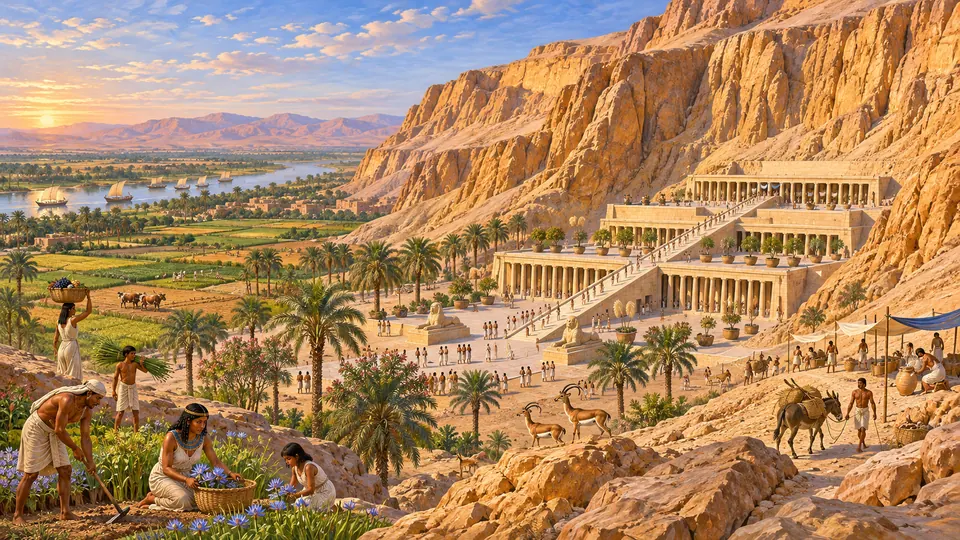
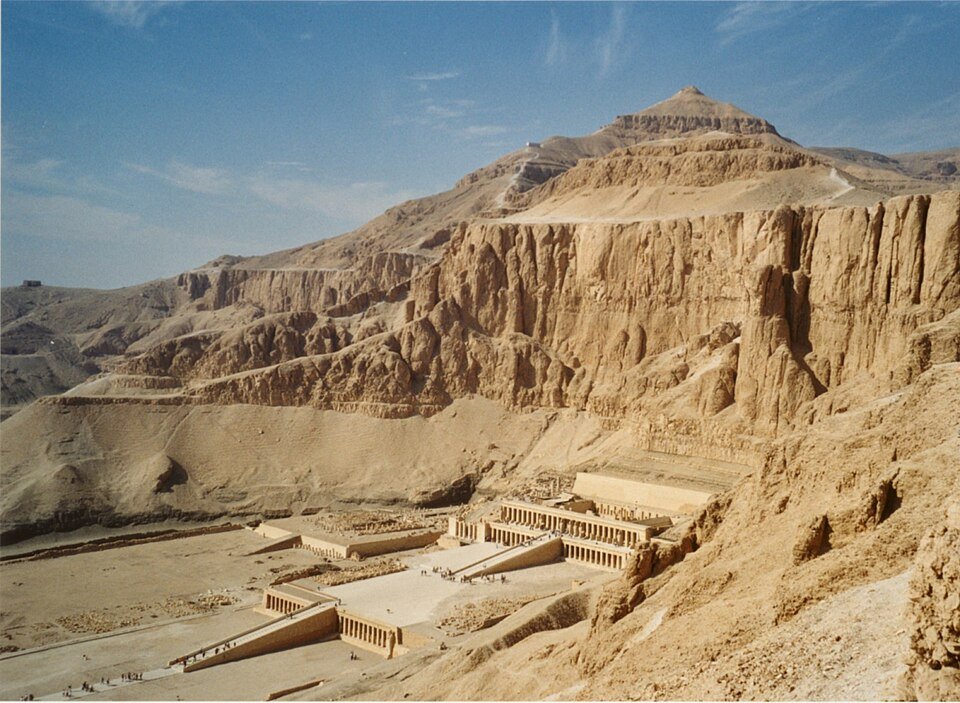
Deir el-Bahari is a deep bay in the limestone cliffs on the west bank of the Nile, opposite modern Luxor. In ancient times this was the western side of ThebesThebes, EgyptThebes, Egyptian Waset, was an ancient Egyptian city in the area of modern Luxor, with monuments on both banks of the Nile.Glossary · Click to read the explanation, the side of tombs and temples for the dead. Three rulers built temples here: Mentuhotep II around 2000 BCE, Hatshepsut about five centuries later, and Thutmose III soon after her. Only Hatshepsut's temple still stands to any height. [1][2][3]
The name is not ancient. It is Arabic for "the Monastery of the North", because Christian monks later lived in the ruins. This entry sets out what the three temples were, what survives, and where the evidence is incomplete. [4]
A bay for the dead
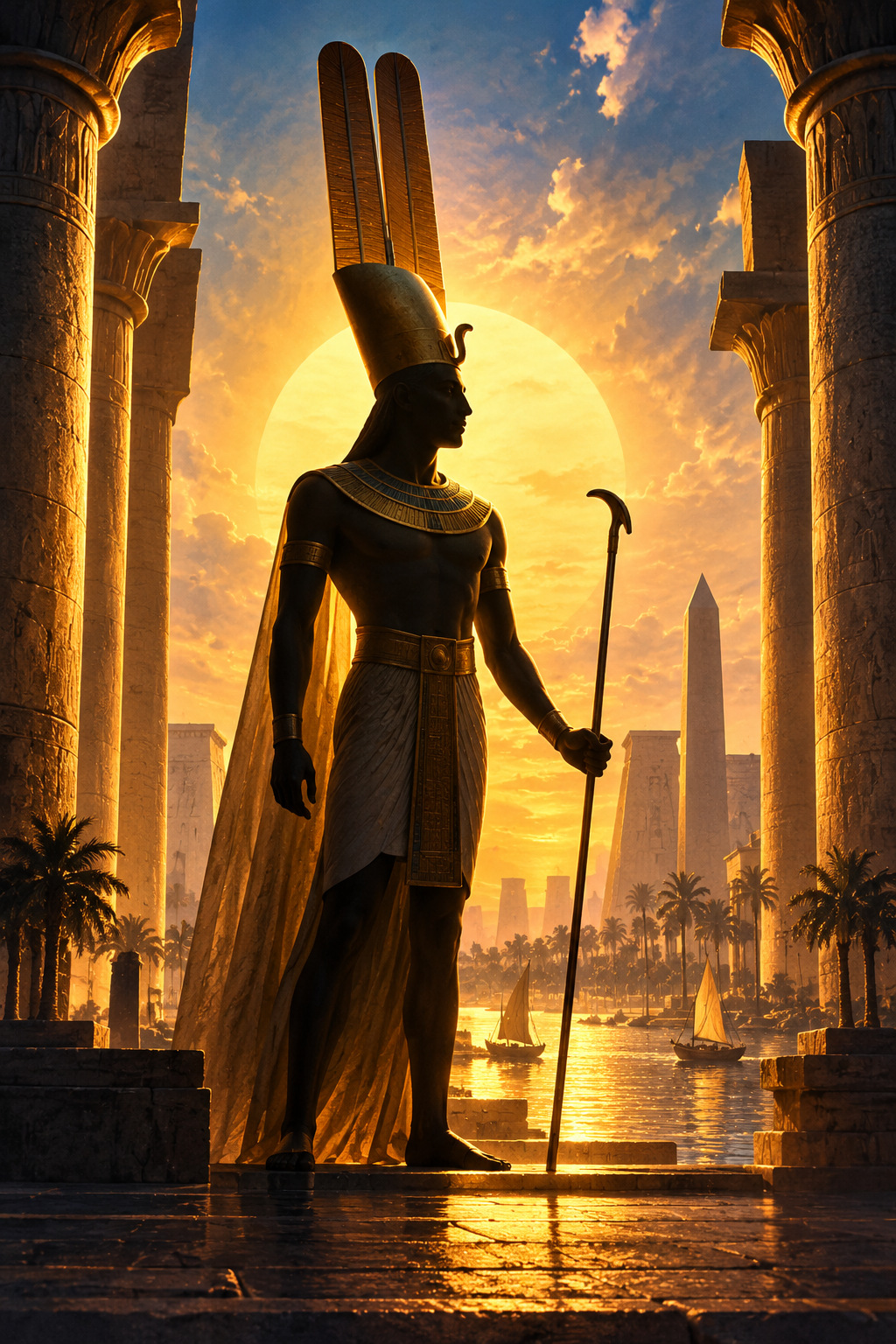
The Egyptians placed temples for dead kings on the west bank because the sun sets in the west. Sunset was seen as the sun god's daily death before his rebirth in the east, a little like a sleeper who goes to bed in order to wake again. Deir el-Bahari faces Karnak, the great temple of AmunAmunAmun is an Egyptian deity centered on Thebes and Karnak, the “hidden one,” also worshipped as Amun-Re. His names and images were targeted under Akhenaten before royal support resumed.Glossary · Click to read the explanation, across the river. [1][2]
The hills behind the bay belonged to the goddess Hathor, who was thought to nurse each king. Stelae (inscribed standing stones) found here show her as a cow coming out of the mountain. Each year the statues of Amun, his wife Mut and their son Khonsu crossed the river for the Beautiful Feast of the Valley and visited the royal temples of the west bank. [1][3]
The first temple: Mentuhotep II
The first king to build here was Nebhepetre Mentuhotep II, who reigned about 2055–2004 BCE. He chose the head of the bay for his tomb and his temple. [1][5]
The Swiss scholar Édouard Naville finished excavating it in the winter of 1906–7. Most of the temple stood inside a rectangle cut into the mountain, with rock walls on three sides. From an inner court a sloping passage ran deep under the cliff, while above it the temple went on into a hall of eighty columns. [5]
The great block at the centre of the main terrace is the most discussed part. Naville's team restored it as a pyramid ringed by colonnades. The Egyptian Ministry of Tourism and Antiquities notes that others see it as a flat-topped tomb structure. With so little left above the foundations, its shape is still debated. [1][5]
Hatshepsut's terraces
About six hundred years later, Hatshepsut (reigned about 1473–1458 BCE) built her temple beside Mentuhotep's. Its ancient name, Djeser-djeseru, means "Holy of HoliesHoly of HoliesMost sacred inner zone of the biblical sanctuary. Kings places the Ark beneath its cherubim; Leviticus regulates approach behind the curtain. Wilderness and Jerusalem temple traditions describe distinct settings.Glossary · Click to read the explanation", and the Ministry names Senenmut, chief steward of Amun, as its designer. It rises in three terraces joined by ramps, each fronted by a row of pillars. Somers Clarke, the architect of Naville's team, thought its builders borrowed much from the older temple next door. [2][5]
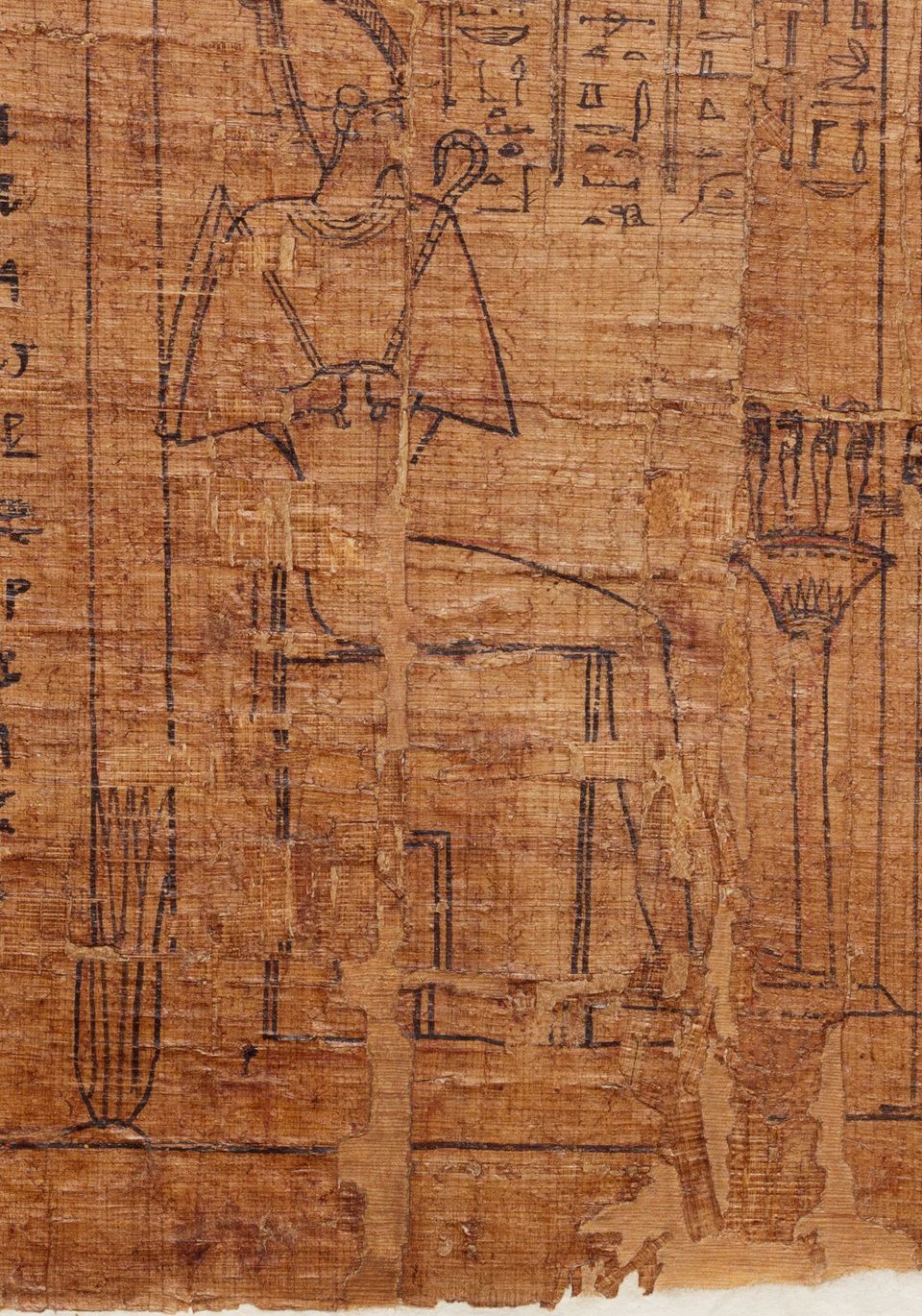
The temple kept the cult of Hatshepsut after her death and of her father, Thutmose I. Amun had the place of honour, with a sanctuary cut into the rock at the back of the upper terrace. Other parts were given to Hathor, to AnubisAnubisAnubis is an Egyptian deity associated with the dead and the balance in heart-weighing scenes.Glossary · Click to read the explanation, god of embalming, and to the sun god Ra-Horakhty, who had an altar open to the sky. Statues of Hatshepsut in the wrapped form of OsirisOsirisOsiris was an ancient Egyptian deity associated with the dead, life after death, renewal, and kingship. His roles appear in changing funerary texts, rituals, and judgment scenes, notably the weighing of the heart.Glossary · Click to read the explanation stood against the pillars of the upper court. [2]
The Punt portico and the birth reliefs
The middle terrace holds the most famous reliefs. In the northern portico, scenes present Hatshepsut as the child of Amun and as the heir chosen by her father. In the southern portico, the walls tell the story of a sea expedition to Punt, a distant land that Egyptian ships reached by the Red Sea. [2][6]
The Polish mission at the temple dates the expedition to the ninth regnal year of Thutmose III, when he shared the throne with Hatshepsut. The scenes show the fleet arriving, the leader Nehes meeting the rulers of Punt, Parehu and his wife Iti, the ships loaded with myrrh trees, ebony, ivory and animals, and the goods weighed and offered to Amun. [6]
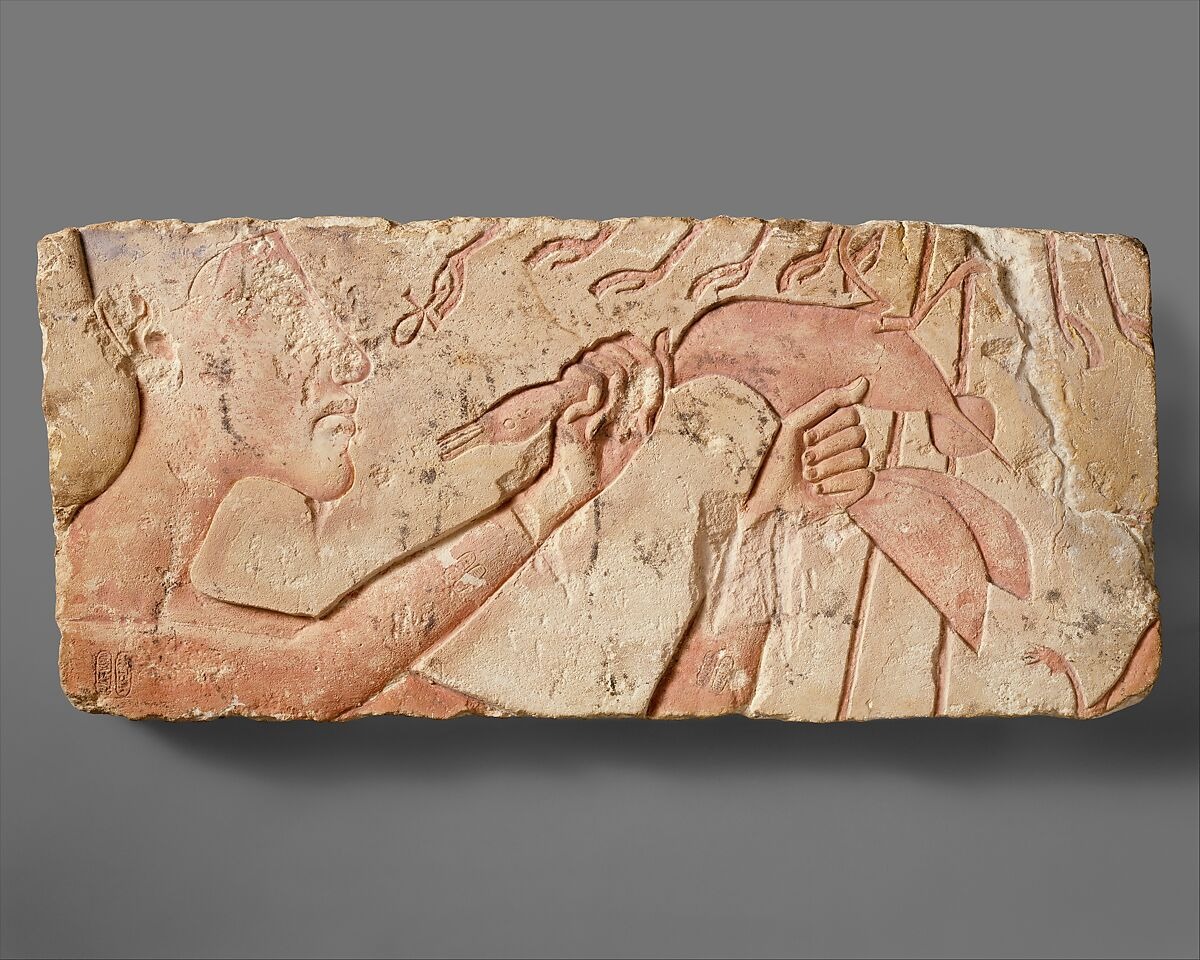
These walls have had a hard history. On the orders of Thutmose III, Hatshepsut's figures and some of her texts were hacked out. Under AkhenatenAkhenatenEgyptian eighteenth-dynasty king, formerly Amenhotep IV, who reorganized royal religion around Aten and founded Akhetaten.Glossary · Click to read the explanation the image of Amun was destroyed; it was restored under Ramesses II. In modern times blocks were stolen from the south wall. Some are now in Cairo, London and Brussels, and some were never recovered. [6]
The lost temple of Thutmose III
In 1961 a Polish–Egyptian team began work to reconstruct Hatshepsut's temple. Kazimierz Michałowski had a great heap of rubble cleared beside its upper terrace, and early in 1962 the workers found column bases, broken statues and painted relief fragments of an unknown temple of Thutmose III. [3]
Its name was Djeser-akhet, "Holy of the Horizon". It was built about 1435–1425 BCE, under the vizier Rekhmire, on a narrow slope between the two older temples, raised on an artificial platform above both. An earthquake at the end of the New Kingdom brought much of it down, and stonecutters later took its blocks. The ruins gave thousands of fragments with unusually fresh colours, and an enthroned statue of the king almost two metres tall. Its shrine of Hathor, with a statue of the goddess as a cow, had been found in 1906 and is now in the Egyptian Museum in Cairo. [3]
Monks, explorers and a hidden cache
In Christian times a Coptic monastery stood on part of Hatshepsut's temple. Its monks built walls from the temple's carved blocks and covered a granite doorway with plaster painted with saints. [4]
Modern work began with the French scholar Auguste Mariette, who dug here in 1858, 1862 and 1866 and found the Punt reliefs. Naville cleared Hatshepsut's temple in the 1890s, and his plates, partly drawn by Howard Carter, remain a basic record of its reliefs. The Polish mission still works there today. [4][6]
In 1881 a hidden burial pit at Deir el-Bahari gave up one of the great finds of Egyptology: a cache of royal mummies. Among them were the kings Seqenenre, Ahmose I, Thutmose III, Seti I and Ramesses II, and later priests of Amun such as Pinedjem II. Several bodies show damage done by ancient tomb robbers. According to the French Egyptologist Gaston Maspero, priests rewrapped them and finally hid the coffins together in this pit. [7]
What we know and what we don't
Deir el-Bahari is part of the UNESCO World Heritage site of Ancient Thebes with its Necropolis, listed in 1979, whose description names Hatshepsut's terraced temple and its reliefs of Punt. [8]
Much of what we see, however, is rebuilt from fragments. The shape of Mentuhotep's central block is uncertain, Thutmose III's temple survives mostly as foundations and broken stones, and parts of the Punt scenes are known only from early drawings. The excavators' plans and publications matter as much as the stones themselves. [3][5][6]
References and notes (8)
- Egyptian Ministry of Tourism and Antiquities, “Deir al-Bahari”, archaeological site page Whole page: the three terraces below the cliffs, the pyramid-shaped hills facing the Valley of the Kings, the west-bank setting opposite Karnak and the setting sun, Hathor in the hills and her stelae as a cow, the Beautiful Feast of the Valley, the tomb-temple of Nebhepetre Mentuhotep (c. 2055–2004 BC) about 600 years before Hatshepsut, and its central structure that some take for a mastaba. Return to the text ↑
- Egyptian Ministry of Tourism and Antiquities, “Hatshepsut Temple”, monument page Whole page: Hatshepsut (c. 1473–1458 BC), the name Djeser-djeseru, Senenmut as designer, the three levels, the cults of Thutmose I, Hathor, Anubis, Ra-Horakhty and Amun, the Osiride statues of the upper court, and the Punt and divine-birth reliefs of the middle portico. Return to the text ↑
- Jadwiga Lipińska, “Deir el-Bahari: Temple of Tuthmosis III,” in Seventy Years of Polish Archaeology in Egypt (Warsaw: Polish Centre of Mediterranean Archaeology, University of Warsaw, 2007), pp. 105–114 Whole chapter, pp. 105–114: the 1961 clearance and the discovery early in 1962, the name Djeser-akhet, date c. 1435–1425 BC and Rekhmire, the platform between the two older temples, the earthquake and the stonecutters, the hall, the painted fragments and statues, the Hathor shrine found in 1906, the Beautiful Feast of the Valley and the Coptic burials. Return to the text ↑
- Édouard Naville, The Temple of Deir el Bahari: Its Plan, Its Founders, and Its First Explorers. Introductory Memoir (Twelfth Memoir of the Egypt Exploration Fund, London, 1894) The chapters on the early travellers and on Mariette: the name Deir el Bahari, “Convent of the North”, Wilkinson's description, the plastered and painted granite doorway, Mariette's three campaigns (1858, 1862, 1866) and the Punt reliefs, and the Coptic convent built with blocks from the temple. Return to the text ↑
- Édouard Naville, with Somers Clarke, The XIth Dynasty Temple at Deir el-Bahari, Part II (Thirtieth Memoir of the Egypt Exploration Fund, London, 1910) Preface; chapter I (the western part of the temple: the season of 1906–7, the rock-cut rectangle, the sloping passage and the hall of eighty columns); chapter IV by Somers Clarke (the position of the temple, the restored central pyramid, and the comparison with Hatshepsut's temple). Return to the text ↑
- Filip Taterka, “Middle Portico South (Portico of Punt),” Polish-Egyptian Archaeological and Conservation Expedition to the Temple of Hatshepsut at Deir el-Bahari, Polish Centre of Mediterranean Archaeology, University of Warsaw Whole page: the scenes wall by wall, regnal year 9 of Thutmose III, Nehes, Parehu and Iti, the goods and their weighing, the offering to Amun, the hacking out under Thutmose III, the Amarna damage and Ramesside restoration, the stolen blocks in Cairo, London and Brussels, and the publications by Mariette (1877) and Naville (1898, drawings by Howard Carter). Return to the text ↑
- G. Elliot Smith, The Royal Mummies, Catalogue général des antiquités égyptiennes du Musée du Caire, nos 61051–61100 (Cairo: Institut français d'archéologie orientale, 1912) Entries 61051 (Seqenenre: found at Deir el-Bahari in 1881), 61057 (Ahmose I), 61068 (Thutmose III, with Maspero's account of its plundering and reburial), 61077 (Seti I), 61078 (Ramesses II), 61083 (Maspero on the priests who hid the royal coffins at Deir el-Bahari) and 61094 (Pinedjem II). Return to the text ↑
- UNESCO World Heritage Centre, “Ancient Thebes with its Necropolis,” site record 87 Brief synthesis, criteria (i) and (vi) and inscription date (1979): Deir el-Bahari and the temple of Hatshepsut with its terraces and its Punt reliefs. Return to the text ↑
Suggest a correction · Suggest a source for this record
Cite this record
IL Archive, «Deir el-Bahari», https://ilarchive.com/en/sites/deir-el-bahari
Continue reading
Related readings