Site · Region
Mount Ebih in Sumerian Literature
- Names
- Abiḫ · Ebih · Ebiḫ
- Region
- Mesopotamia
Ebih is the mountain range that Inana confronts and defeats in a Sumerian poem. Mesopotamian sources also name Ebih as a deity, and scholars have proposed identifying it with Jebel Hamrin.
Estimated reading time: 5 min Published Last reviewed:
Share article
Text
Introduction
Ebih is the mountain range challenged by the goddess InanaInanna / IshtarA prominent Mesopotamian goddess whose Sumerian name Inanna became associated with Akkadian Ishtar across diverse traditions. She was associated with desire, war, royal authority and Venus, while local forms and genealogies varied among texts.Glossary · Click to read the explanation in the Sumerian poem Inana and Ebih. Its slopes have forests, waterways and abundant animals. Its height and radiance draw the attention of the god An, while Inana speaks of it as an opponent capable of showing or withholding respect. The poem’s account of its defeat depends on both ways of describing the mountain. [1][2]
The name also occurs in cuneiformCuneiformWriting with wedge-shaped signs, developed from Mesopotamian recording traditions and used for several languages from the third millennium BCE.Glossary · Click to read the explanation sources outside the story, including god listsGod ListsTexts collecting divine names for preservation, teaching and classification, with varying theological organization.Glossary · Click to read the explanation and ritualRitualAn organised or distinguished practice meaningful to a community; it may leave traces, but its form alone does not reveal an associated doctrine.Glossary · Click to read the explanation texts. Anna Perdibon discusses a proposed identification with Jebel Hamrin, an outlying range of the Zagros. The geographical proposal concerns an ancient name. The particular landscape described in the poem also bears the marks of the speeches in which it appears. [1][2]
The mountain in Inana’s account of her travels
Inana places her approach to Ebih within a larger journey. She names Elam and Subir and the mountains of Lulubi, as well as heaven and earth. When she turns into the mountains, Ebih fails to show her the deference she expects. She describes that failure with the gestures of someone who could put a nose to the ground or rub lips in the dust. The surrounding place names give the encounter a broader setting, but the sequence is a report by the goddess within the poem. [1][2]
Inana’s response makes the encounter sound like a campaign against a fortified place. She speaks of bringing battering rams against the sides of the mountain and compares what she wants to do with what happens to a city cursed by a god. She also names the mountain’s forests and watercourses as targets. Images of siege and environmental damage belong to the same threat. When Inana later addresses Ebih after defeating it, she again brings together its height, beauty and failure to bow. [1]
What An sees on the mountain
Inana takes her grievance to An and repeats several of her threats. An replies with questions about what she is undertaking and tells her she cannot oppose the mountain. His speech gives the fullest view of Ebih’s terrain. Fruit grows in its gardens, lions shelter beneath trees and deer live among cypresses. Grass supports wild bulls, and wild rams and stags are abundant. An also describes a fearsome radiance that makes the range difficult to face. [1][2]
The description of a flourishing landscape comes from a god counseling against the attack. Inana sees insubordination in the mountain’s conduct. An dwells on its abundance and power. Perdibon notes that the text can give Ebih grammatical features associated with an animate being while also describing its trees, the shape of its slopes and its watercourses. That range of language helps explain how the poem can make a landscape the subject of a dispute about deference. [1][2]
A body of stone and a name in ritual
In the attack, the narrative joins the material and personal features of Ebih even more closely. Inana takes hold of its neck and uses her blade against it. Rocks scatter down its slopes from what the poem calls the mountain’s body. The text goes on to describe drought and fire destroying trees and smoke covering the flanks. When Inana speaks to Ebih again, the height and beauty she recognizes are bound up with what she considers its refusal to submit. [1][2]
Inana’s next speech turns to things established after the victory. She says she has set a throne in place and secured its foundation. She names several kinds of cult performers and the implements or dress she has assigned to them. The poem gives the outcome a ceremonial setting before returning to the praise of Inana’s victory over Ebih. [1][2]
Perdibon places this portrayal beside evidence from other genres. Ebih is named in an Old Babylonian god list from Nippur and appears in later Assyrian rituals among other gods. She also discusses a list from NinevehNineveh and KuyunjikNineveh is an ancient Assyrian city near Mosul in northern Iraq; Kuyunjik is one of its archaeological moundsGlossary · Click to read the explanation where the name appears with a sign for a deity in two entries and with the sign for a mountain in another. This distribution gives the divine and geographical readings a basis outside the battle poem, where both are present in the portrayal of a single adversary. [2]
Reading Ebih on clay
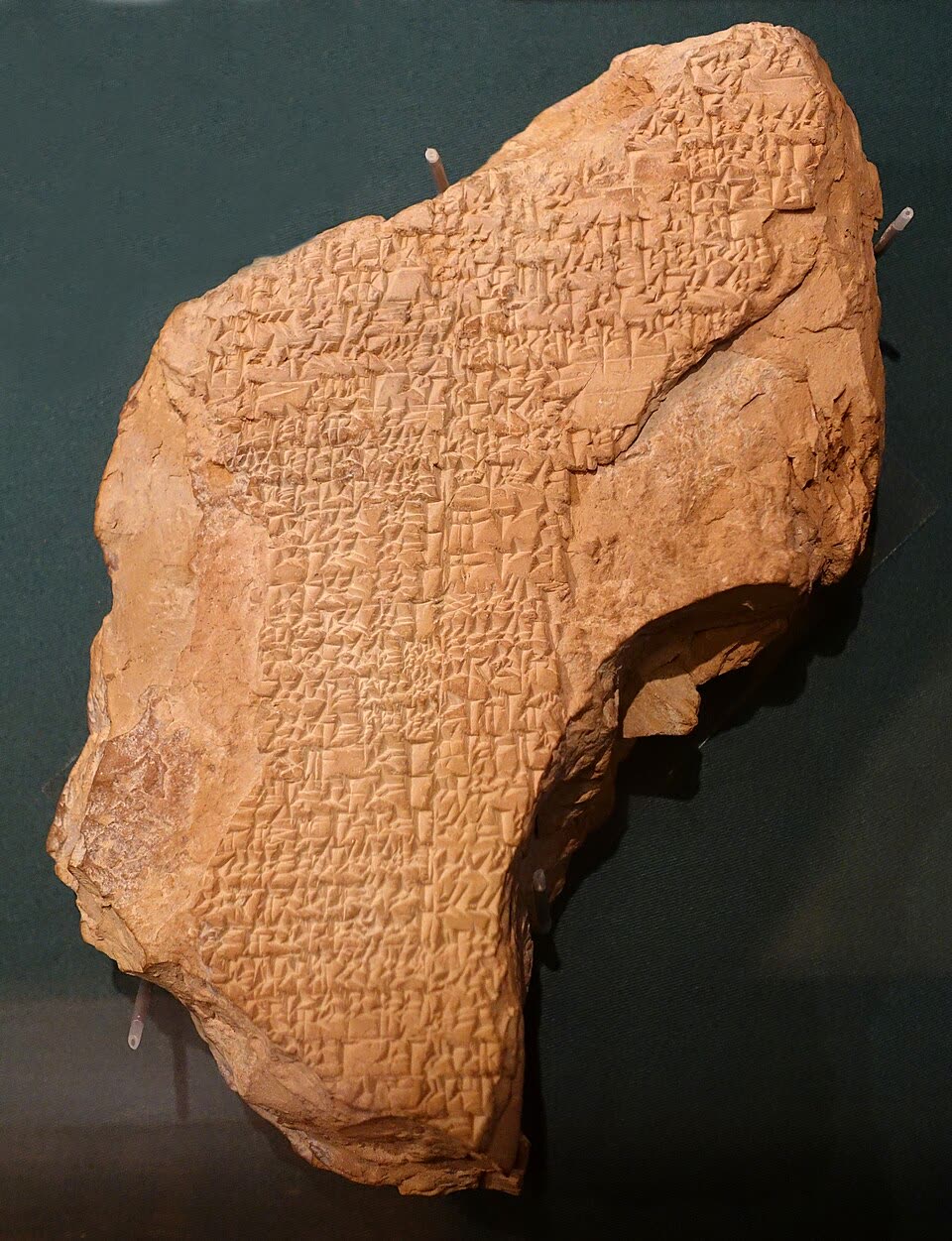
Several surviving clay copies preserve different parts of the story. One witness catalogued by the Cuneiform Digital Library Initiative preserves lines around Inana’s address to the mountain after the attack. It includes her reference to Ebih’s height and part of the later declaration of victory. The Oxford translation presents a continuous reading assembled from witnesses. The separate clay fragment lets a reader see where some of the wording can be checked and where the written surface has broken away. [1][3][4]
Paul Delnero places the poem within the literary training of Old Babylonian scribes. He discusses its position among ten compositions known as the Decad and compares evidence from Nippur and Ur. In that setting, scribes encountered Ebih by copying and studying Sumerian. The spread of the poem through teaching helps account for why its dramatic speeches are known through a collection of manuscripts. It also allows a modern edition to compare the wording of copies made in separate settings. [3][4]
The photograph shows a clay witness displayed at the Oriental Institute Museum in Chicago. The writing is the physical evidence for the mountain’s place in the poem. The modern range proposed for Ebih and the extraordinary landscape in An’s account are questions a reader can pursue separately through the geographical and literary evidence. [1][2][5]
References and notes (5)
- Electronic Text Corpus of Sumerian Literature, Inana and Ebiḫ Read the complete English translation, with particular attention to the journey, gestures of deference, An’s description, destruction and final speeches. Return to the text ↑
- Anna Perdibon, The Case of Ebiḫ: Mountain, Person and God Read the section on the proposed Jebel Hamrin identification, grammar and description of the mountain, and the Old Babylonian and first-millennium cult evidence. Return to the text ↑
- Cuneiform Digital Library Initiative, Inanna and Ebih, witness P346102 Read the witness identification and the preserved parts of the speech to Ebih and the declaration of victory. Return to the text ↑
- Paul Delnero, Inana and Ebih and the Scribal Tradition Read the discussion of the witnesses, the Decad in the advanced curriculum and the comparisons between groups of tablets from Nippur and Ur. Return to the text ↑
- Wikimedia Commons, Tablet describing Inanna’s battle with the mountain Ebih, DSC07117 Read the tablet identification, the Oriental Institute Museum display setting, image dimensions and Daderot’s CC0 dedication. Return to the text ↑
Suggest a correction · Suggest a source for this record
Cite this record
IL Archive, «Mount Ebih in Sumerian Literature», https://ilarchive.com/en/sites/ebih
Continue reading