Site
Esikil in the Sargon Legend
- Names
- E-sikil · Esikil · E₂-sikil
- Region
- Mesopotamia
Esikil is the holy house to which Ur-Zababa sends Sargon in a Sumerian story. Inanna stops Sargon before he enters, and he meets the king’s smith at its gate.
Estimated reading time: 5 min Published Last reviewed:
Share article
Text
Introduction
Esikil appears in the Sumerian story Sargon and Ur-Zababa, where it is the place to which the king of Kish sends his cupbearer Sargon on an errand. The king has privately instructed his chief smith to kill Sargon there. On the way, InannaInanna / IshtarA prominent Mesopotamian goddess whose Sumerian name Inanna became associated with Akkadian Ishtar across diverse traditions. She was associated with desire, war, royal authority and Venus, while local forms and genealogies varied among texts.Glossary · Click to read the explanation bars Sargon from entering the holy house. He meets the smith at the gate and survives. The sanctuary’s boundary has an immediate consequence for the story. [1][2]
The episode is preserved in a clay manuscript found at Nippur. It describes an approach to the sanctuary, the prohibited crossing and the meeting at the gate. Those details allow the movements of the characters to be followed in the text. The name also occurs in evidence for a different temple at Eshnunna, where an inscription identifies its patron and builder. [1][2][3]
A royal errand after a dream
At the court of Ur-Zababa, Sargon receives responsibility for the royal drink supplies and becomes cupbearer. He later dreams that a woman, whom the narrator identifies as Inanna, drowns the king in a river of blood. When Ur-Zababa hears Sargon’s distress, he summons him and asks about the dream. Sargon tells him what he saw. The audience hears an account of the danger to the king before the king plans a danger to Sargon. [1]
Ur-Zababa calls his chief smith, Beliš-tikal, and directs him to prepare for the cupbearer’s arrival at Esikil. The king names a bronze object that the Oxford translation tentatively identifies as a hand mirror. Sargon is to deliver it, and the smith is meant to cast both the object and the cupbearer into the mould. The smith prepares the moulds. Ur-Zababa then tells Sargon only the part of the errand that concerns delivering the object. [1]
The road, the gate and the holy house
The narrator follows Sargon out of the palace and towards Esikil. As he nears the place, Inanna turns to face him and blocks his path. The text specifies a distance in a unit called the nindan. Inanna calls Esikil a holy house and says a person polluted with blood must stay out. Sargon meets the smith at the gate and hands over the bronze object there. The next surviving words describe the object being thrown into the mould. [1][4]
The effect of the intervention depends on where the meeting takes place. Inanna stops the cupbearer before the intended encounter inside the building, but he can still deliver the object from where he is allowed to go. Blood, which was part of the threatening dream, enters the story again as the subject of the goddess’s rule about access. The narrator gives Sargon a way to fulfill the visible part of the errand and escape the concealed plan. [1][4]
After an interval of several days, Sargon returns to the palace and is again before Ur-Zababa. The king’s fear returns, and in the next episode he sends Sargon to Lugal-zage-si in UrukUrukAncient city at Warka in southern Iraq, a major urban centre around 3200 BCE that preserved early writing and accounting tablets.Glossary · Click to read the explanation with a written message concerning Sargon’s death. The messenger leaves the king’s presence a second time carrying something whose purpose is different from the one a court errand might suggest. In the Esikil episode the object passes across a boundary while the messenger remains outside. [1][4]
The tablets and the place name
The Nippur tablet is registered as IM 58430 in Baghdad and is dated in the CuneiformCuneiformWriting with wedge-shaped signs, developed from Mesopotamian recording traditions and used for several languages from the third millennium BCE.Glossary · Click to read the explanation Digital Library Initiative to the Old Babylonian period. Maurizio Viano distinguishes it from the Sumerian tablet AO 7673 from Uruk, which preserves other segments. He also discusses a short bilingual tablet from BabylonBabylonBabylon is an ancient city in central present-day Iraq, south of BaghdadGlossary · Click to read the explanation with lines about Sargon’s departure from the palace. The surviving witnesses show how portions of a story set at Kish were copied in several Mesopotamian cities. [2][5]
The Babylon tablet has only three lines and is inscribed on one face. It puts Sumerian and AkkadianAkkadianAn ancient East Semitic language written in cuneiform from the third millennium BCE; its varieties include Babylonian and Assyrian, and it served in international diplomacy.Glossary · Click to read the explanation into corresponding lines and describes Sargon near a garden canal. Viano points out that the three lines do not duplicate part of either of the older copies. He reads them as a possible continuation of the story preserved by the Nippur manuscript. For the visit to Esikil, the Nippur witness remains the record that gives the order of the warning, the meeting and the delivery. [2][5]
The Louvre holds a foundation brick naming a building called Esikil in Eshnunna. Its inscription credits the governor Bilalama with building it for the god Tishpak. It supplies an independent occurrence of the name with a stated city, ruler and deity. In the Sargon story, the goddess speaks about the holiness of Esikil and sets the condition for entry. The passage gives its place in the journey from the palace and the position of the meeting at the gate, leaving the identification of a specific building open. [1][3]
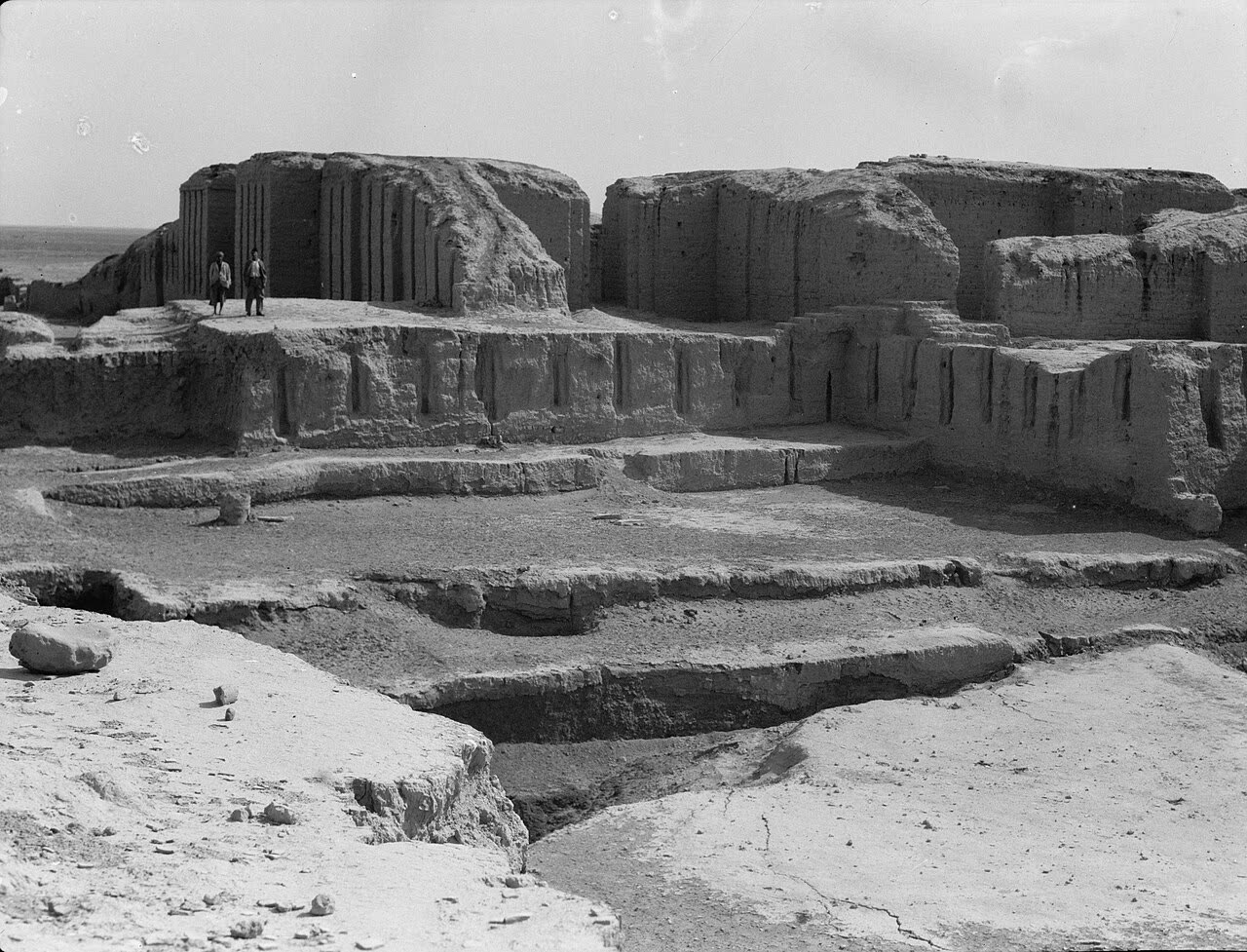
Kish occupied an extensive archaeological site where the Field Museum and Oxford University excavated a number of mounds in the early twentieth century. The photograph shows the remains at Tell al-Uhaymir, part of the city named in the story. The image gives the setting at the scale of the archaeological site. The map of Sargon’s particular errand comes from the clay witnesses, which describe the palace, the route out, the approach to Esikil and the gate where he stops. [1][2][5][6][7]
References and notes (7)
- Electronic Text Corpus of Sumerian Literature, Sargon and Ur-Zababa Read the translation, especially segment B lines 1–56 on the appointment, the dream, the commission to the smith, the warning and the second dispatch. Return to the text ↑
- Cuneiform Digital Library Initiative, Sargon and Ur-Zababa, witness P356628 Read the record for IM 58430, including excavation at Nippur, Old Babylonian dating, present collection and relationship to the composite. Return to the text ↑
- Musée du Louvre, Foundation Brick, Esikil of Tishpak Read the inscription translation and the identification of Bilalama, Tishpak and the temple at Eshnunna. Return to the text ↑
- Cuneiform Digital Library Initiative, Sargon and Ur-Zababa, composite P469678 Read the Esikil passage in transliteration and English, including the distance, condition of entry, gate, delivery and aftermath. Return to the text ↑
- Maurizio Viano, The Reception of Sumerian Literature in the Western Periphery Read section 1.1.2.1 on the Uruk, Nippur and Babylon witnesses, the bilingual extract’s form and its relation to the older manuscripts. Return to the text ↑
- Field Museum, The Kish Collection Read the site overview and account of the Oxford and Field Museum excavations across several of its mounds. Return to the text ↑
- Wikimedia Commons, Kish at Tell al-Uhaymir, Matson Collection photograph Read the place identification, source collection and public-domain statement for the photograph of the ruins. Return to the text ↑
Suggest a correction · Suggest a source for this record
Cite this record
IL Archive, «Esikil in the Sargon Legend», https://ilarchive.com/en/sites/esikil