Site · City
Kish, the First Seat of Kingship After the Flood in the Sumerian King List
- Names
- Kic · Kish · Kiš
- Region
- Mesopotamia
Kish was an early city on the Euphrates floodplain, now an archaeological site spread across many mounds. The Sumerian King List places it first after the flood and returns to it in later dynasties.
Estimated reading time: 5 min Published Last reviewed:
Share article
Text
Introduction
Kish was a city on the floodplain of the Euphrates. Its remains lie about eighty kilometres south of modern Baghdad. The Field Museum dates occupation at the site from at least as early as 3200 BCE through the seventh century CE. Excavations have traced the development of the early city across a group of mounds. [1][2]
In the Sumerian King List, Kish is where kingship comes to earth after a great flood. Later in the list, kingship returns to the city more than once, and a woman named Kug-Bau becomes its ruler. Other works give individual kings of Kish roles in stories about rival cities. [3][4]
A city across several mounds
Between 1923 and 1933, a joint Field Museum and Oxford University expedition explored many of the site's forty mounds. The Field Museum describes a complex covering about twenty-four square kilometres. The excavators never published a final account of all those seasons. Federico Zaina's study revisits the evidence from Tell Ingharra, in the eastern part of Kish, using excavation notes and surviving plans to reconstruct the order of building and occupation. [1][2]
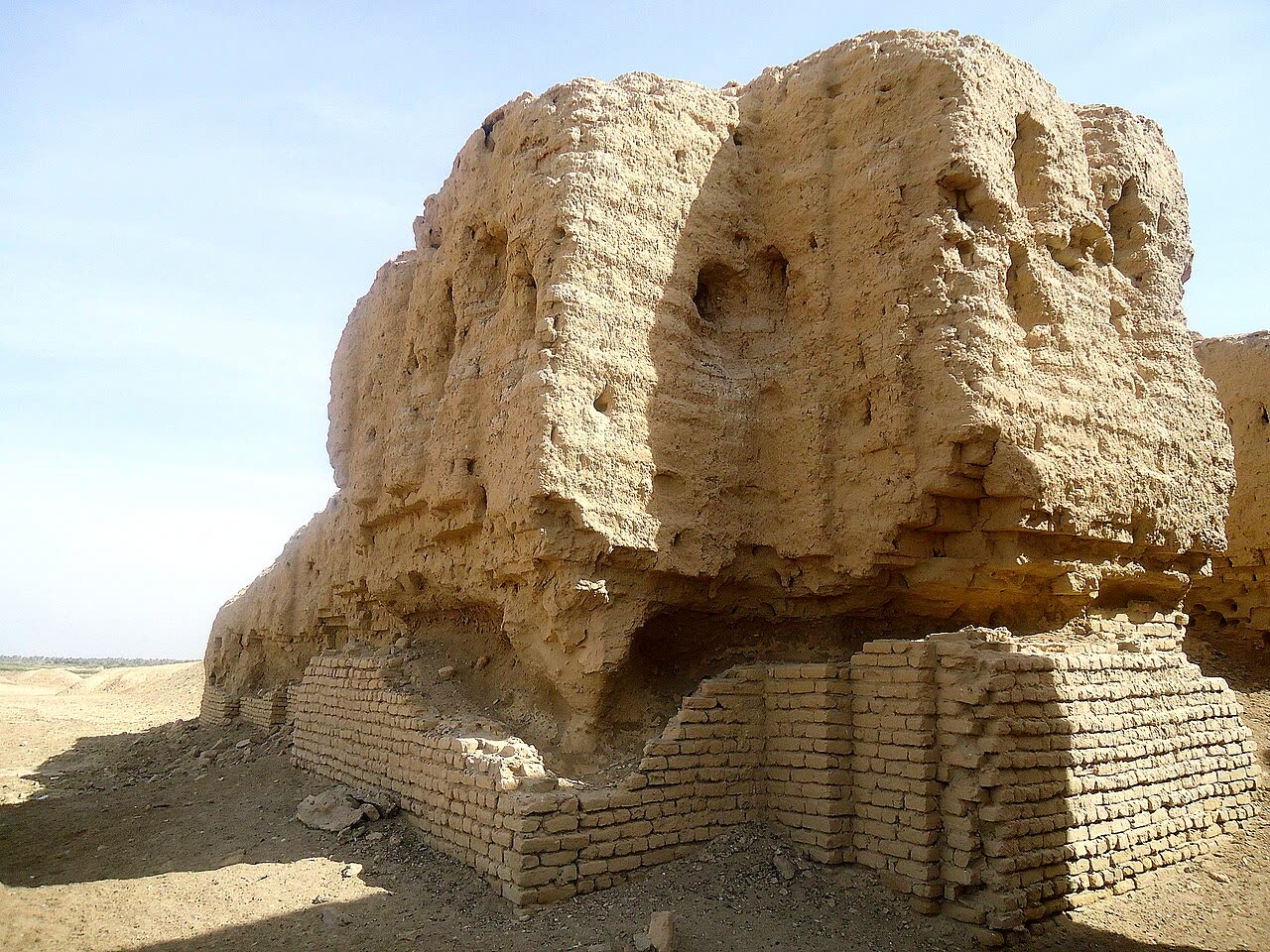
In the Early Dynastic III period, in the middle centuries of the third millennium BCE, Kish spread as far as Tell Uhaimir, one of its principal mounds. At Tell Ingharra, Zaina notes that a zigguratZigguratZiggurat: a monumental stepped or terraced cult structure of ancient Mesopotamia. Not every raised temple platform was a ziggurat, and the form and specific use of lost upper stages often remain uncertain.Glossary · Click to read the explanation, streets and nearby buildings had much the same orientation. He reads that alignment as evidence of deliberate planning. The Plano-Convex Building and a residential area show a similar alignment. The photograph below shows ruins at Tell al-Uhaymir, the other main mound discussed in that study. [2][5]
How Palace A grew
Palace A at Tell A, in the southern part of the Ingharra area, began as a rectangular building with double walls. It acquired a monumental entrance and rooms to the east. A southern annex had a porch supported by pillars. Zaina identifies these additions from the excavation records and allows for a further phase in the annex based on an excavator's note about a second pavement. [2]
After the complex was destroyed near the end of Early Dynastic III, parts of the mound were used for houses and graves. The records leave open whether the houses and graves occupied the mound at the same time. The sequence that can be reconstructed shows the same ground used first for an elite building and later for domestic buildings and burial. [2]
Who ruled from Kish?
In the Oxford translation of the Sumerian King List, Kish appears as Kic. The list gives Kish twenty-three rulers in its first dynasty after the flood. It ends that dynasty with Enmebaragesi and his son Aga, then says Kish fell and kingship went to EannaEanna at UrukAn archaeological precinct and institutional centre at Uruk associated with Inanna; its name does not fix every early building’s function.Glossary · Click to read the explanation, at UrukUrukAncient city at Warka in southern Iraq, a major urban centre around 3200 BCE that preserved early writing and accounting tablets.Glossary · Click to read the explanation. In a later section the list credits Kug-Bau, a tavern-keeper, with making the city's foundations firm and gives her a reign of one hundred years. [3]
One manuscript of the list, a four-sided clay prism in the Ashmolean Museum, was probably made in Larsa around 1800 BCE. It sets out a succession of rulers and gives the lengths of their reigns. The Ashmolean interprets that ordering as a way of presenting divinely granted dominion as the right of one city at a time. The list gives the earliest rulers extraordinarily long lives on the throne and associates Kish with the renewal of kingship. [3][6]
The Sumerian composition Gilgamesh and Aga gives the last king of that dynasty a story of his own. Aga sends envoys from Kish to Uruk. Uruk's elders favour submission, while its able-bodied men support Gilgamesh in resisting. Aga lays siege to the city and is taken captive. Gilgamesh recalls an earlier kindness and allows him to return to Kish. The two cities' rivalry and the obligation between their rulers both shape the poem's ending. [4]
What the excavated objects tell us
The objects from Kish include records of work and exchange. The Ashmolean Museum lists a clay ration tablet, AN1928.16, and a piece of inscribed stone recording a transfer of land, AN1928.423. Both were allocated by the Oxford and Field Museum expedition in 1928. The museum dates the land record to about 2600–2500 BCE and the ration tablet to about 2500–2340 BCE. Another object from the expedition, a small cylinder sealCylinder sealSmall engraved cylinder rolled over soft clay to leave an extended image. Used to secure, document and identify administrative actions; its pictures do not automatically constitute writing.Glossary · Click to read the explanation, carries scenes of human activity. These objects concern the affairs of the city on a different scale from the buildings. The stone and clay texts record transactions or allocations, and the seal preserves scenes a carver chose to put on a portable object. [1][7]
Material evidence for a ruler named in the list sometimes comes from elsewhere. An alabaster vessel fragment found at Tutub, modern Khafaje, preserves part of the name Mebaragesi. The CuneiformCuneiformWriting with wedge-shaped signs, developed from Mesopotamian recording traditions and used for several languages from the third millennium BCE.Glossary · Click to read the explanation Digital Library Initiative assigns it to the Early Dynastic IIIb period and catalogues it as a witness associated with that king. The broken vessel carries a much shorter record than the King List. Its preserved name can be compared with Enmebaragesi in the list, while the account of the king’s deeds and long reign belongs to the later composition. The broken vessel, the writings found at Kish and the stories of its first kings each answer a different question about the city. [3][8]
References and notes (8)
- Field Museum, The Kish Collection Read the collection introduction on the occupation range, the city’s location, the 1923–1933 expedition and the number and extent of the mounds. Return to the text ↑
- Federico Zaina, The Urban Archaeology of Early Kish: 3rd Millennium BCE Levels at Tell Ingharra (2020) Read the title, contents, urban trajectories discussion on printed pp. 145–146, and the Tell A sequence in appendix 2, pp. 175–176. Return to the text ↑
- Electronic Text Corpus of Sumerian Literature, The Sumerian King List, 2.1.1, English translation Read lines 1–133 on the flood, the first dynasty of Kish and the transfer to Eanna, and lines 211–265 on the later dynasties and Kug-Bau. Return to the text ↑
- Electronic Text Corpus of Sumerian Literature, Gilgamesh and Aga, 1.8.1.1, English translation Read lines 1–115, including Aga’s embassy, the two assemblies, the siege and the release. Return to the text ↑
- Wikimedia Commons, ruins at Tell al-Uhaymir, photograph by Osama Shukir Muhammed Amin Read the photograph identification, creator credit and licence. The filename and description both identify Tell al-Uhaymir, although they differ on the structure pictured. Return to the text ↑
- Ashmolean Museum, Sumerian King List, AN1923.444 Read the object description, probable provenance and dating, and the discussion of succession among cities. Return to the text ↑
- Ashmolean Museum, Ancient Middle East Gallery Case List, Kings and Gods 2800–2000 BCE Read the entries for objects allocated by the Kish expedition, including AN1928.16, AN1928.423 and AN1930.111. Return to the text ↑
- Cuneiform Digital Library Initiative, RIME 1.07.22.01 ex. 01, P222738 Read the text, object material and preservation, Tutub provenance and attribution to Mebaragesi. Return to the text ↑
Suggest a correction · Suggest a source for this record
Cite this record
IL Archive, «Kish, the First Seat of Kingship After the Flood in the Sumerian King List», https://ilarchive.com/en/sites/kish