Site · Region
Mount Mashu and the Path of the Sun
- Names
- Mashu · Mašu · Mount Mashu · Mount Māšu
- Region
- Mesopotamia
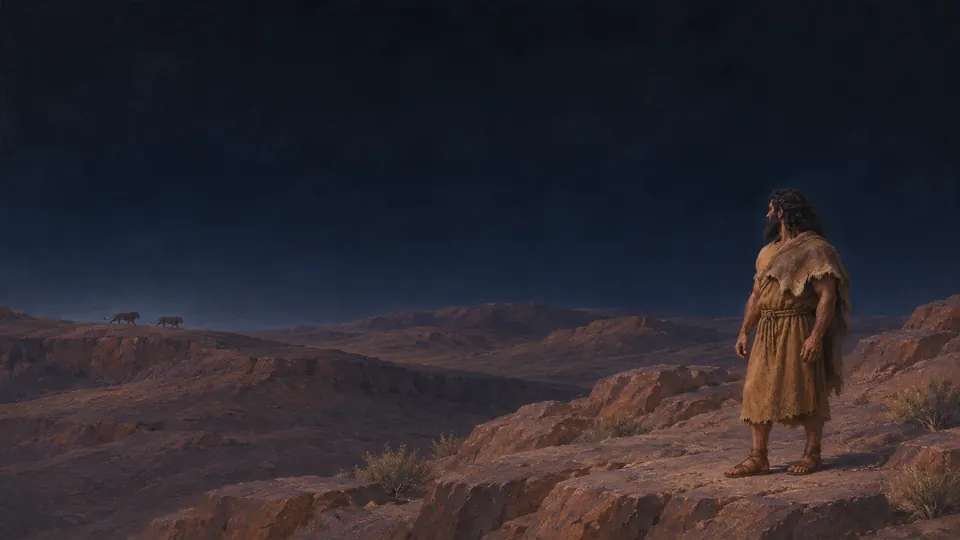
Gilgamesh reaches Mount Mashu while searching for the flood survivor Uta-napishti. Scorpion guardians admit him to a dark passage that the poem calls the path of the sun.
Estimated reading time: 5 min Published Last reviewed:
Share article
Text
Introduction
When Gilgamesh reaches the mythical Mount Mashu, the mountain's heights touch heaven and its base reaches the underworld. A scorpion man and his mate keep watch at the gate where the sun rises and sets. They recognize that Gilgamesh is partly divine and hear why he wants to cross. He then enters a darkness that lasts through a series of measured stages. The place belongs to the geography of the Epic of Gilgamesh, where it marks a crossing from the wild country into a region inhabited and traversed by extraordinary beings. [1][2]
The grief that brings him there
Tablet IX begins with Gilgamesh weeping for Enkidu. His friend's death has made his own mortality impossible to ignore. He sets out to find Uta-napishtiUtnapishtimThe flood hero of Standard Babylonian Gilgamesh, granted exceptional life with his wife by the gods. He tells Gilgamesh how he survived; his name overlaps with Atrahasis and Ziusudra traditions without making their narratives identical.Glossary · Click to read the explanation, the one man he believes can tell him about life and death. The first episode takes place in a mountain pass at night, where he is afraid of lions and prays to the moon god Sin. Part of the account is lost. In his translation Andrew George uses an earlier Old Babylonian witness to supply some related lines, and marks the point at which the Standard Babylonian text resumes with Gilgamesh arriving at Mashu. The older witness helps a reader follow the story across the break. [1]
George renders Mashu as twin mountains. The poem gives them a vertical reach from the underworld up to the fabric of heaven and sets them in relation to the sun's movements. Wayne Horowitz compares a description in Sargon IISargon IISargon II was an Assyrian king of the late eighth century BCE; ORACC dates his reign about 721–705 BCEGlossary · Click to read the explanation's account of a campaign, which similarly makes the height of Mount Simirriya reach heaven and its roots the underworld. The royal inscription and the epic use comparable language to picture enormous mountains. The epic gives Mashu the further property of a gate kept by beings who monitor the passage of the sun. [1][3]
The guardians at the gate
The two guardians are formidable even before either one speaks. Their radiance fills the mountains, and their gaze is described as deadly. Gilgamesh covers his face before gathering himself and approaching. The male guardian sees divinity in him. His mate qualifies the observation by identifying the human third of his nature. The exchange speaks directly to Gilgamesh's reason for travelling. His closeness to the gods lets him undertake an exceptional journey, and the death of his friend forces him to ask what it means that he is human as well. [1]
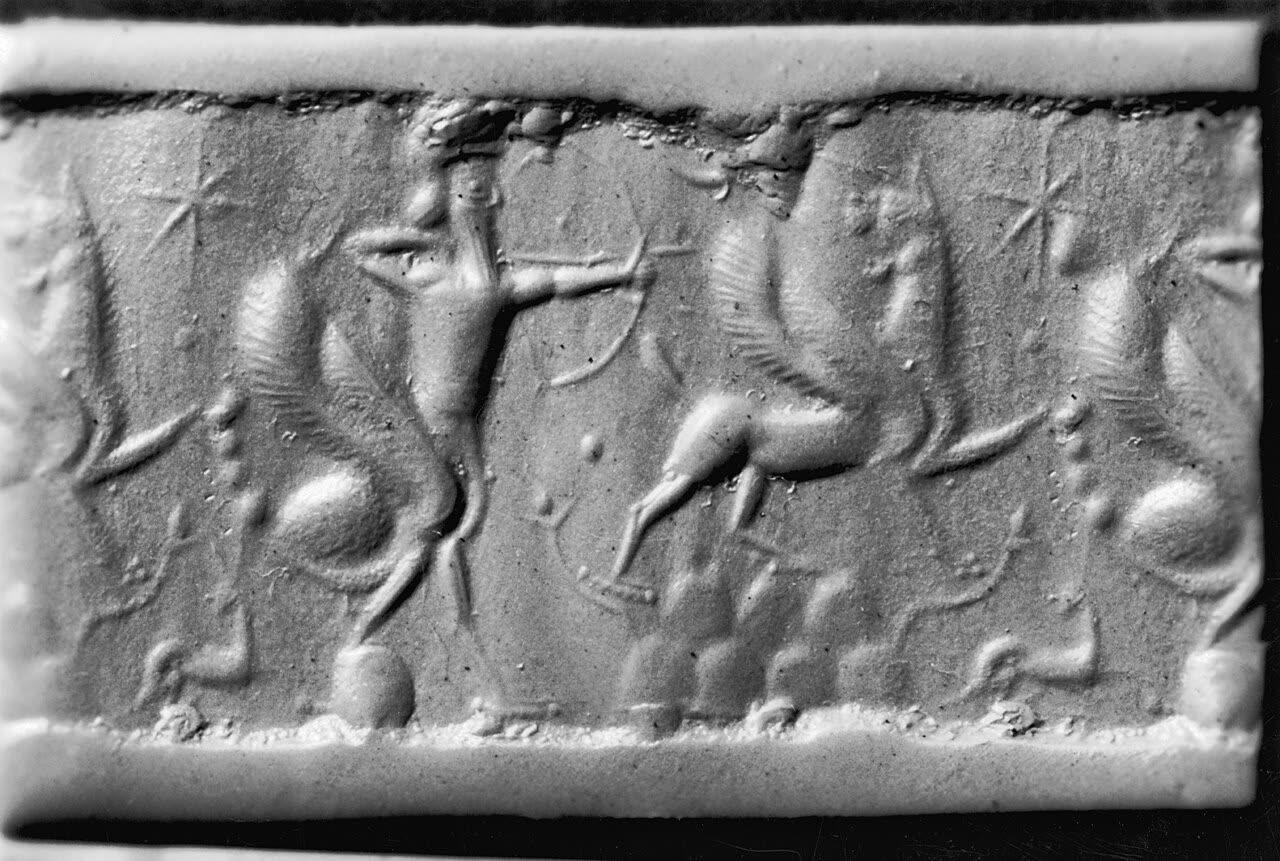
Images of men with scorpion features appear outside illustrations of the epic. A Middle Assyrian cylinder sealCylinder sealSmall engraved cylinder rolled over soft clay to leave an extended image. Used to secure, document and identify administrative actions; its pictures do not automatically constitute writing.Glossary · Click to read the explanation in the Walters Art Museum shows a figure with a scorpion tail in a contest with a winged lion-griffin on a mound. The composition offers a comparison for the use of composite bodies. Its action and the particular form of the creature belong to the seal's own scene. The epic gives its pair the distinct work of guarding the mountain and questioning the traveller. The male guardian warns Gilgamesh of a path seldom or never travelled, then eventually tells him to go through. A break in the tablet takes away part of the conversation between the warning and permission. [1][4]
Measuring the darkness
The warning gives the interior a length of twelve double-hours in George's translation. Once Gilgamesh enters, the poem counts successive double-hours and repeats that darkness keeps him from seeing. Small variations emerge against that pattern. Around the ninth stage the north wind appears in a damaged line. Near the end the repetitions give way to his emergence and the sight of trees. The repetitive lines help an editor offer restorations for partially lost passages. They also let a reader keep track of progress across a landscape whose details the traveller cannot see. [1][2]
The exit is difficult to reconstruct precisely. Alexander Heidel puts the emergence before sunrise at the eleventh double-hour and light at the twelfth, with brackets supplying missing words. George places the exit ahead of the sun at the twelfth double-hour in his translation. The number and the movement toward light survive strongly enough to follow the episode. The exact timing of dawn relative to the traveller depends on how the broken phrases are restored and read. [1][2]
The garden and the sea
The trees after the darkness bear carnelian fruit and lapis-lazuli foliage. Further lines include a cedar with stone leaf-stems, although much of the description is broken. Horowitz connects such imagery with the distant places from which MesopotamiaMesopotamiaHistorical region associated with the Tigris and Euphrates: Uruk, Ur, Eridu, cuneiform, Sumer, Akkad, Babylon and Assyria, their languages and cults, and the limits of archaeological evidence.Glossary · Click to read the explanation acquired gemstones. A line at the end of the tablet anticipates Shiduri, who lives beside the sea. At the start of Tablet X she sees Gilgamesh approaching in a pelt, bars her gate and asks about his journey. The crossing of Mashu has brought him to her shore. He still has water to cross before he can speak to Uta-napishti. [1][2][3]
The relationship of Mashu to the sun has prompted several readings. Horowitz considers explanations for the darkness, including a tunnel. Christopher Woods proposes that the hero goes eastward through a region beyond the mountain of sunrise and completes the crossing before the next dawn. Noel Weeks points out the tension between the hero appearing to travel east and the suggestion that the sun is behind him. What the episode consistently supplies is a gate with guardians, an interval of darkness and a new landscape on the way to the flood survivor. The path works in the story even though its direction and the sun's position resist a single reconstruction. [3][5][6]
References and notes (6)
- Andrew George, The Epic of Gilgamesh Read Tablet IX and the start of X, pp. 70–77, including the Old Babylonian insertion, the gate, the crossing, the trees and Shiduri. Return to the text ↑
- Alexander Heidel, The Gilgamesh Epic and Old Testament Parallels Read Tablet IX, pp. 65–68, especially columns ii, v and vi, including the guardian, the translations at the eleventh and twelfth stages, and the catchline. Return to the text ↑
- Wayne Horowitz, Mesopotamian Cosmic Geography Read chapter 5, pp. 96–103, on the description of Mashu, Mount Simirriya, the alternatives for the region of darkness and the gem-bearing grove. Return to the text ↑
- Walters Art Museum, Cylinder Seal with a Contest Scene, 42.807 Read the date, material, iconography and curatorial description of the composite figure and its opponent. Return to the text ↑
- Christopher Woods, At the Edge of the World Read pp. 195–199 on the summit, rising sun, Path of the Sun and the author's proposed eastward crossing and timing. Return to the text ↑
- Noel K. Weeks, Systematisation in Ancient Mesopotamian Religion Read pp. 33–34, including the analysis of the incompatibilities in reading the passage as a consistent itinerary. Return to the text ↑
Suggest a correction · Suggest a source for this record
Cite this record
IL Archive, «Mount Mashu and the Path of the Sun», https://ilarchive.com/en/sites/mount-mashu