Entity · Concept
El Elyon
A reference page linking a name, group, or concept to the materials that discuss it.
A name or title meaning “God Most High,” joined to Yahweh in Hebrew Genesis 14. Elyon does not always designate an independent deity.
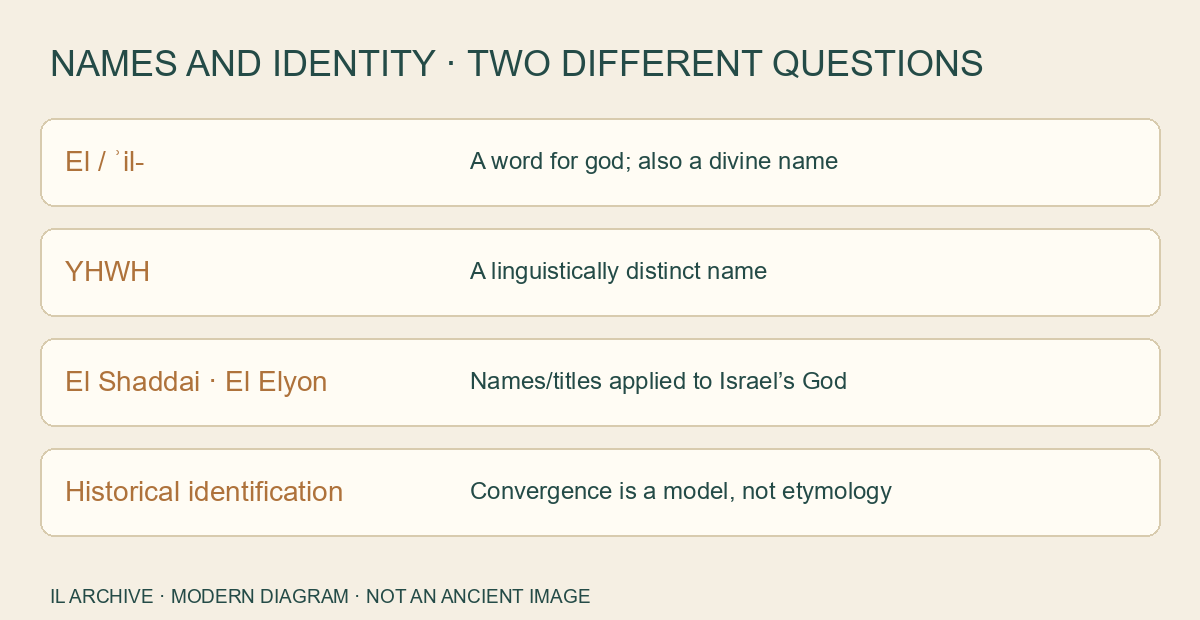
Text
Name and title
El Elyon combines El with “Most High.” El can be a deity’s name or the noun “god,” while Elyon can express supreme rank rather than name a separate figure. Context determines the reading.[1]
Genesis 14
Melchizedek appears as priest of El Elyon in Genesis 14:18–22. In verse 22 Abraham’s oath joins YahwehYahwehThe divine proper name written YHWH in the Hebrew Bible.Glossary · Click to read the explanation and El Elyon, associated with heaven and earth. This is an identification in the received HebrewHebrewA Northwest Semitic language in the Canaanite group, with ancient and modern forms.Glossary · Click to read the explanation text; it does not by itself date the tradition or establish that every occurrence of Elyon once named another god.[2]
Deuteronomy 32
Scholars disagree about the Most High in Deuteronomy 32:8–9: El distinct from Yahweh, or Yahweh’s own title? This disagreement must remain separate from the manuscript reading “sons of GodSons of GodA Hebrew expression for heavenly beings in texts such as Job; context determines its meaning, rather than biological descent or a fixed angelic roster.Glossary · Click to read the explanation.”[3]
The accompanying diagram is a modern explanation, not an artifact proving a deity’s identity in a particular period.
References and notes
- Heath D. Dewrell & Andrew M. Garbarino (2023). Names of God in the Hebrew Bible. Oxford Bibliographies. doi:10.1093/obo/9780195393361-0318. Open introductory extract: El as noun or deity, compound El names, convergence and local-manifestation models. Full article and bibliography not read. Return to the text ↑
- Hebrew Bible / Bible hébraïque — Genesis 14:18–22. Mechon-Mamre, Hebrew text with JPS 1917 English translation. Verses 18–22, especially YHWH and El Elyon together in v. 22. Received Hebrew text, not proof that Elyon always names an independent deity. Return to the text ↑
- Michael S. Heiser (2006). Are Yahweh and El Distinct Deities in Deut. 32:8–9 and Psalm 82? Hiphil 3, pp. 1–9; selected pp. 6–7. Repository metadata and pp. 6–7 read in the open reprint: https://www.dburnett.com/wp-content/uploads/2011/07/Heiser-on-Deut-32-Ps-82.pdf . Context and Elyon-title objections to necessary separation. Not presented as consensus. Return to the text ↑
Research history
Substantive changes are retained here. Minor copy edits remain in the internal operational log.
-
Substantive record update
Suggest a correction · Suggest a source for this record
Cite this record
IL Archive, «El Elyon», Edition 2, https://ilarchive.com/en/entities/el-elyon