Entity · person
Philo of Alexandria
A reference page linking a name, group, or concept to the materials that discuss it.
- Timeline
- From 1 CE to 50 CE
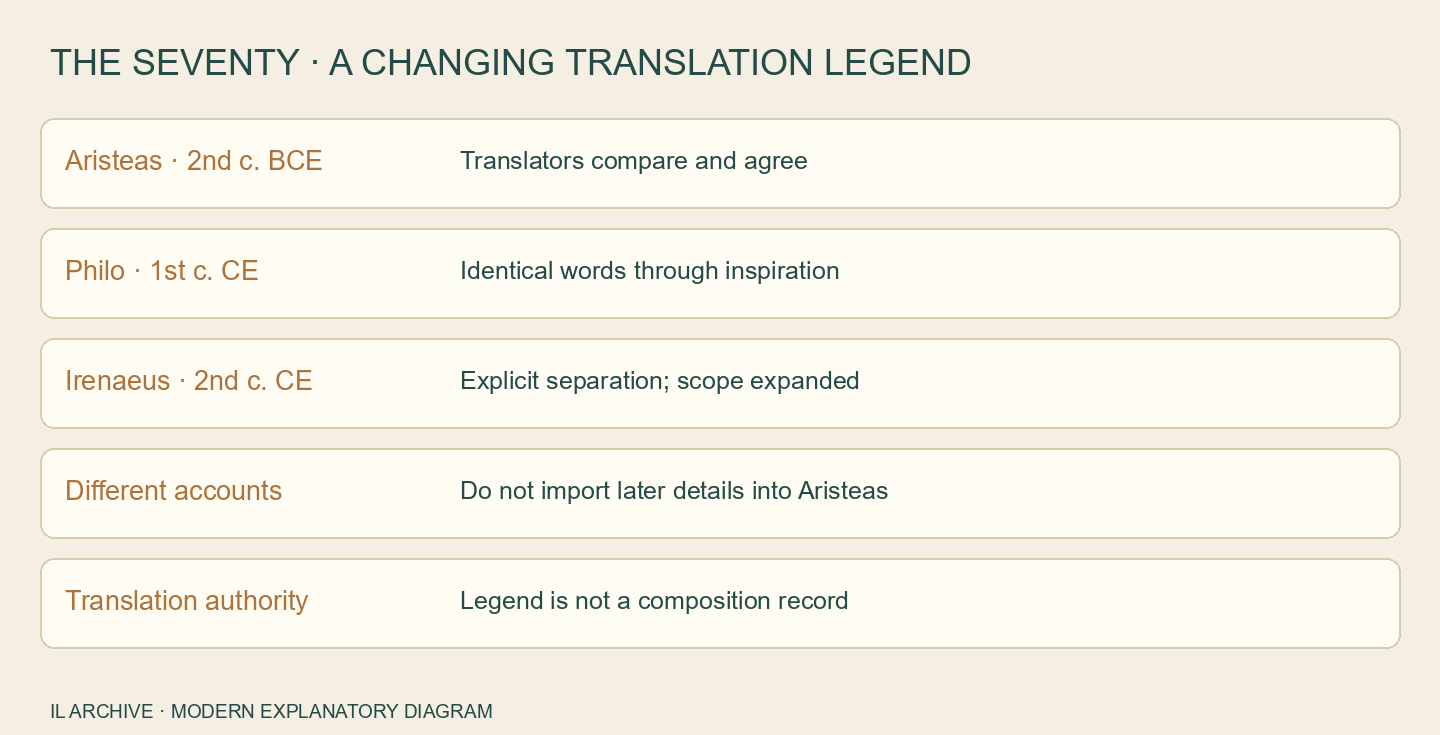
First-century CE Alexandrian Jewish author. In Life of Moses he presents Greek translation as inspired; the passage does not explicitly assign a separate room to each translator.
Text
Witness to the tradition
Life of MosesMosesCentral figure in Exodus, Torah traditions and the Qur’an; childhood accounts differ in detail.Glossary · Click to read the explanation II.25–44, especially 37–40, emphasizes inspired agreement in Greek nouns and verbs. It does not explicitly imprison each translator separately.[1]
Significance
This differs from collaborative comparison in AristeasLetter of AristeasHellenistic Jewish account, commonly dated to the second century BCE, of 72 elders translating Hebrew law in Egypt. Not contemporary minutes or a Torah-composition account.Glossary · Click to read the explanation.[2] Explicit separation appears later in Irenaeus.[3] The diagram compares accounts, without portraying Philo or proving every detail’s origin.
References and notes
- Philo of Alexandria, On the Life of Moses II.25–44; C. D. Yonge translation, CCEL. Especially II.37–40: inspired verbal agreement; no explicit separate room for each translator in this passage. Return to the text ↑
- Letter of Aristeas, §§301–311, on Pharos, comparison, completion and communal approval. Collaborative comparison, 72 days, reading, approval and prohibition on changes, as claims of the letter. Return to the text ↑
- Irenaeus of Lyons, Against Heresies III.21.2; Alexander Roberts and William Rambaut translation, New Advent. Explicit separation and identical translations with expanded scope; king called Ptolemy son of Lagus. Evidence of changing legend, not a historical correction. Return to the text ↑
Research history
Substantive changes are retained here. Minor copy edits remain in the internal operational log.
-
Substantive record update
Suggest a correction · Suggest a source for this record
Cite this record
IL Archive, «Philo of Alexandria», Edition 2, https://ilarchive.com/en/entities/philo-of-alexandria