Artifact
The Phoenician Inscription of Kilamuwa at Zincirli (KAI 24)
An object record bringing together its image, metadata, rights, and context.
- Timeline
- From 850 BCE to 800 BCE
- Region
- Anatolia and the eastern Mediterranean
A ruler at Zincirli set his portrait beside sixteen lines of Phoenician. He listed his predecessors, claimed to have improved his subjects’ lives and called on the dynasty’s gods to protect the inscription.
Estimated reading time: 4 min Published Last reviewed:
Share article
Photograph
Photograph by Osama Shukir Muhammed Amin, via Wikimedia Commons. Image resized. CC BY-SA 4.0.
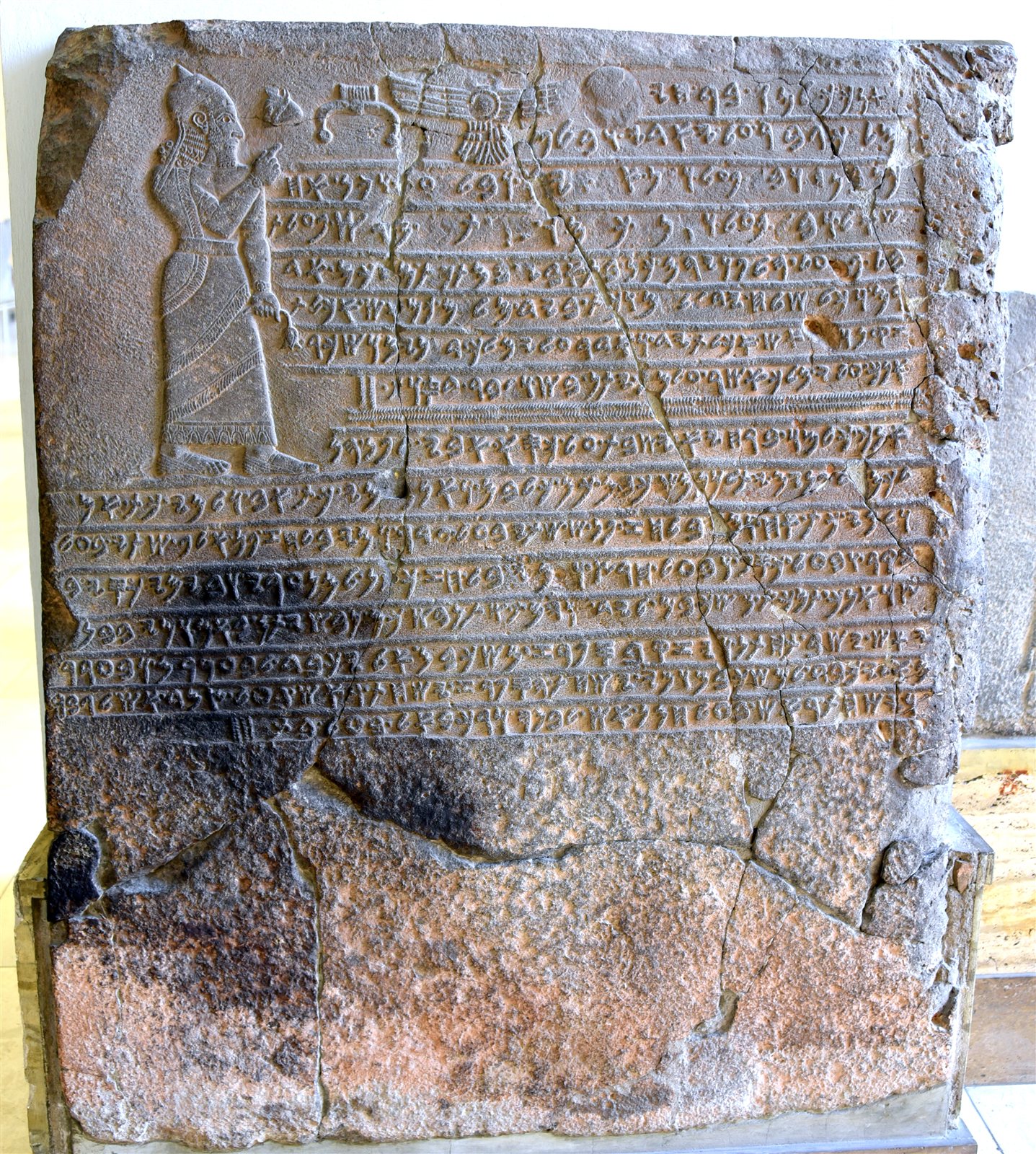
The basalt monument of Kilamuwa, Vorderasiatisches Museum S 06579. The relief of the ruler and the divine emblems occupies the upper left of the inscribed face
License · Image sourceObject details
- Title
- The Phoenician Inscription of Kilamuwa at Zincirli (KAI 24)
- Timeline
- From 850 BCE to 800 BCE
- Region
- Anatolia and the eastern Mediterranean
- Rights
- CC BY-SA
Text
Introduction
On a basalt slab from Sam’al, at modern Zincirli in southern TürkiyeTurkeyTurkey is a modern country including Anatolia and territory in southeastern EuropeGlossary · Click to read the explanation, a ruler appears in profile beside an alphabetic inscription. The text identifies him as Kilamuwa, son of Hayya, and tells what he claimed to have done for his kingdom. It was written in Phoenician, though other royal inscriptions from Sam’al use different forms of writing and language. The portrait, the unusually prominent location and the choice of language all help explain how this king presented himself. [1][2][3][4][5]
A slab at the palace entrance
Berlin’s Vorderasiatisches Museum catalogues the stone as S 06579 and dates it to the second half of the 9th century BCE. The catalogue identifies the material as basalt and records a height of 157 cm, a width of 136 cm and a thickness of 43 cm. The caption to figure 10 in Erhan Tamur’s study gives 156 cm in height, 130 cm in width and 37 cm in thickness. The excavators found the slab at Zincirli in 1902. Tamur places it on the northwestern side of the main entrance to Building J, where the stone stood on a base. Its architectural role was that of an orthostat, an upright slab set against a wall or at an entrance. [1][2][4]
The relief shows a robed figure with one arm bent and raised toward a group of divine emblems. The figure and the inscription share the same stone. The sixteen lines were cut in relief, so the raised letters are part of the sculpted surface. At a palace entrance, the portrait and writing addressed people approaching the building. The monument provides evidence for the setting of the message, while the inscription gives no account of how visitors read it or had it explained to them. [2][3][4]
The king’s account of his deeds
The opening names four earlier rulers, Gabbar, Bamah, Hayya and Shail. Kilamuwa treats them as predecessors and repeatedly claims that they achieved nothing. He then describes the dangers from neighbouring kings and says that he enlisted the king of Assyria against the ruler of the Danunians. The Assyrian ruler is unnamed in this passage. The list and the repeated formula set up a comparison controlled by the author of the monument. They provide few details about the predecessors’ own actions. [3][4]
Kilamuwa claims to have supported people called mškbm and presents himself as a father, mother or brother to them. He describes changes in their access to livestock, precious metals and clothing. The group called bʿrrm appears in the closing curse. The exact social standing and composition of these groups remain uncertain. The language of family and material provision is clear enough to show how the king wanted this part of his rule to be remembered. [3][4]
A local word in a Phoenician inscription
The edition catalogues the inscription under KAI 24 and identifies the language as Phoenician. Robert S. D. Crellin draws attention to the word br, meaning “son,” in lines 1 and 9. That form is also found in AramaicAramaicNorthwest Semitic language varieties documented since the early first millennium BCE, including Old and Imperial Aramaic, Syriac, Jewish dialects, and living Neo-Aramaic forms.Glossary · Click to read the explanation, while other Phoenician texts use bn. He also notes the small points that divide units of writing. The combination lets readers see a local linguistic feature within a text written in the Phoenician alphabet. [3][5]
Later documents from Sam’al include royal texts in Sam’alian and Aramaic. For Kilamuwa’s monument, the choice of Phoenician belongs to this setting of several written traditions. The inscription provides a secure example of what this court used on a particular monument. What people ordinarily spoke in every part of the kingdom is a broader question than this artifact can answer. [4][5]
How the text protects itself
The closing lines address the case of a descendant of Kilamuwa who takes the throne and damages the inscription. One consequence would be that the two named groups would cease to honour one another. The text also asks Baal Ṣemed, Baal Hammon and Rakkab-El, identified there as lord of the dynasty, to punish whoever destroys the writing. The first two divine names are attached to Gabbar and Bamah, whom the reader meets at the beginning of the text. The curses connect the protection of the stone to the lasting order that Kilamuwa claimed to have established. The palace visitor encountered the names of past rulers, the king’s account of his care for his people and the sanction that was meant to preserve that account. [3][4]
References and notes
- Staatliche Museen zu Berlin, Vorderasiatisches Museum, “Stele des Fürsten Kilamuwa,” S 06579, object 1744119 Inventory, findspot, period, basalt and catalogue measurements. Return to the text ↑
- Erhan Tamur, “Style, Ethnicity and the Archaeology of the Aramaeans: The Problem of Ethnic Markers in the Art of the Syro-Anatolian Region in the Iron Age,” Forum Kritische Archäologie 6, 2017 Building J, p. 28 and figure 10, on the palace entrance, base, portrait and the Phoenician inscription. Return to the text ↑
- Digital Editions of Aramaic and Phoenician Sources (DEAPS), “KAI 024: Inscription of Kilamuwa,” Donner and Röllig edition, updated by James D. Moore Metadata and the Donner and Röllig text, especially lines 1–4, 6–9 and 10–16. Read the presented readings of the letters and word dividers. Return to the text ↑
- West Semitic Research Project, University of Southern California Dornsife, “Kilamuwa and the Kings of Sam’al” Introduction and “Description” through the passages on the royal predecessors, court rhetoric, social groups, curses and later royal inscriptions. Return to the text ↑
- Robert S. D. Crellin, The Semantics of Word Division in Northwest Semitic Writing Systems: Ugaritic, Phoenician, Hebrew, Moabite and Greek, Oxbow Books, 2022 Section 2.3.2, pp. 61–62, on the entry’s date and language, br in lines 1 and 9, and the points that mark divisions. Return to the text ↑
Archive records may be reviewed and refined as better evidence or sources become available. Suggest a correction
Suggest a correction · Suggest a source for this record
Cite this record
IL Archive, «The Phoenician Inscription of Kilamuwa at Zincirli (KAI 24)», https://ilarchive.com/en/artifacts/kilamuwa-inscription
Continue reading