Artifact
The Early Alphabetic Potsherd from Lachish
An object record bringing together its image, metadata, rights, and context.
- Timeline
- From 1485 BCE to 1425 BCE
- Region
- The Levant
A few ink letters survive on the rim of a bowl found at Lachish. Charred barley from beside the sherd helps date its burial to the mid-15th century BCE, even though the words themselves remain uncertain.
Estimated reading time: 4 min Published Last reviewed:
Share article
Photograph
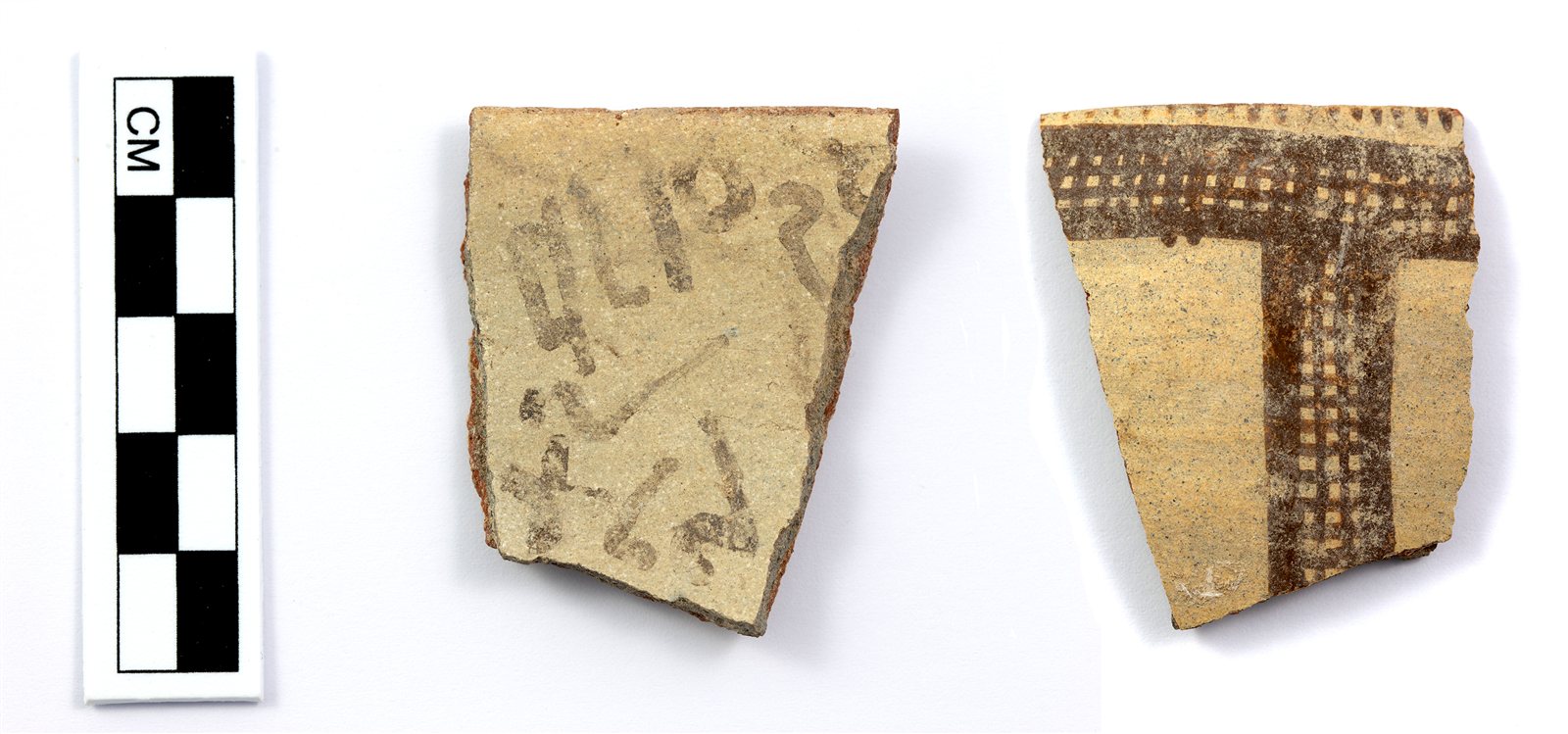
Figure by J. Dye (Austrian Academy of Sciences), in Höflmayer, Misgav, Webster and Streit, Antiquity (2021), fig. 7. CC BY 4.0.
The inscribed inner face and decorated outer face of the same bowl-rim sherd from Tel Lachish. The scale is in centimeters
License · Related reference · Image sourceVideo
The First Letter: How a Picture of an Ox Became Your Alphabet
The letter A began as a picture: the head of an ox, scratched into the rock of the Sinai desert perhaps close to four thousand years ago. Along the way we say plainly which answers are firm and which are still argued: when the alphabet was born, and whether miners or scribes made it. Some scenes are AI-generated illustrations.
The YouTube player loads only when you press play. Watch on YouTube
Object details
- Title
- The Early Alphabetic Potsherd from Lachish
- Timeline
- From 1485 BCE to 1425 BCE
- Region
- The Levant
- Rights
- CC BY
Text
Introduction
In 2018, excavators at Tel Lachish found a fragment of a bowl with a few dark ink marks on its inner rim. The first editors identified two short rows. The arrangement and reading of the signs remain disputed, but the soil around the sherd helps put it in time. Barley from a burnt patch beside it places the deposit near the middle of the 15th century BCE. The find gives us a rare point of reference for the use of alphabetic writing in the southern LevantThe LevantThe Levant is a regional name for lands along the eastern MediterraneanGlossary · Click to read the explanation during the Late Bronze AgeLate Bronze AgeAn archaeological period around 1600–1200 BCE in much of the Near East, with international diplomacy, exchange and religious diversity; its endpoints vary by region.Glossary · Click to read the explanation. [1][2][4]
A bowl rim from the western slope
The fragment measures about 40 × 35 mm. It comes from the rim of a Cypriot White Slip II bowl, a type conventionally called a milk bowl. That label describes the pottery type. The fragment preserves no evidence of what this particular bowl contained. The ink was applied diagonally to the inner surface of the rim, so the writing lay on the inside of the vessel. The excavators published a close photograph as figure 7 of their report on the inscription. [1]
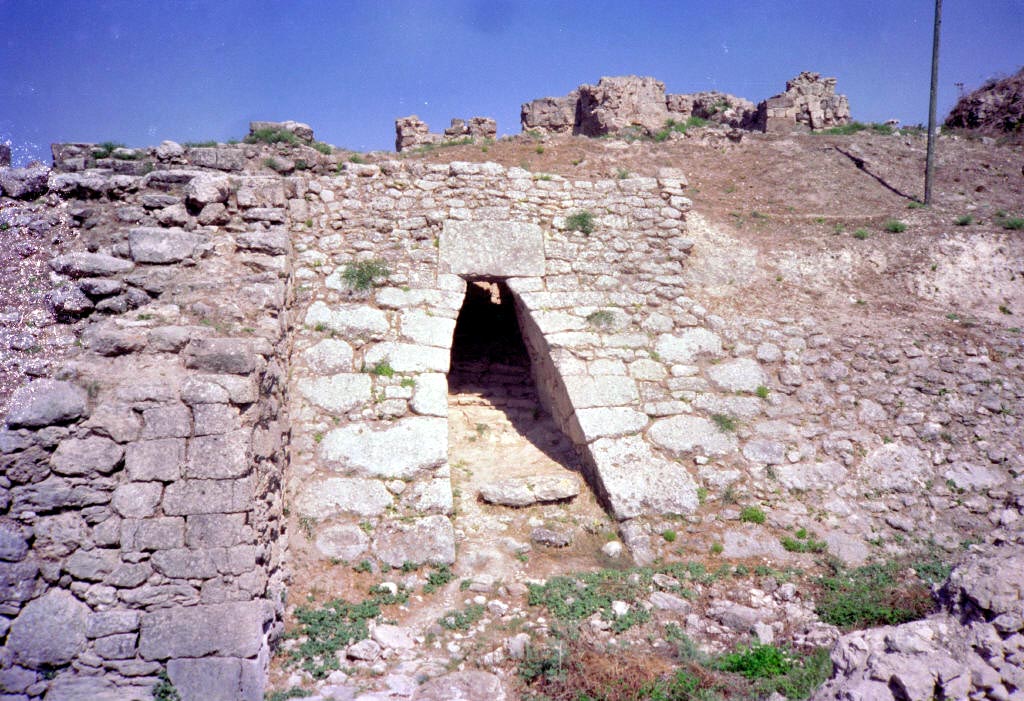
The Austrian–Israeli expedition found the sherd in Area S, on the western slope of the mound, near a large structure known as Building 100. Smaller structures abutted its southern wall, and parts of the adjacent masonry may have formed a fortification. The sherd came from a fill assigned to phase S-3b. Later walls lay above its findspot. This puts the fragment in a sequence of construction and deposits that can be compared with other finds from the same slope. [1][2]
What the barley dates
The sherd lay against a patch of burnt sediment. The excavators sampled two barley grains from that patch and sent them to different radiocarbon laboratories. Both measurements place the samples in the 15th century BCE. The team then combined the measurements with the order of the surrounding layers. Their model constrains the sherd's find context to about 1460–1430 BCE in its narrower range and 1485–1425 BCE in its broader range. [1]
The ink could have been applied earlier, while the bowl was in use. The deposit dates the sherd's burial and gives a latest likely period by which the lettering was already present. A separate radiocarbon study of Area S had also moved the dating of some of these layers about a century earlier. Its revised sequence placed substantial building activity at Lachish in the 15th century BCE, during a period for which the site had previously seemed less well represented in the excavated record. [1][3]
Reading the surviving strokes
The first editors identify two rows of three signs, with additional marks beside and between them. Reading the upper row from right to left, they propose ʿayin, bet and dalet. They relate the shapes to an eye, a house and a door, respectively, comparing them with Egyptian signs. The proposed consonants ʿbd may carry the sense of a servant or an enslaved person, or form part of a personal name. The missing context prevents a choice between those possibilities. [1]
The lower row is less straightforward. Read from right to left, it may give npt. The editors compare the sequence with a HebrewHebrewA Northwest Semitic language of the Canaanite group, encompassing Iron Age epigraphy, Biblical, Rabbinic, medieval and Modern Hebrew; its scripts and pronunciations changed over time.Glossary · Click to read the explanation word for honey or nectar. Reading in the other direction gives tpn, which they connect tentatively with a verb meaning “to turn” or with a name. Stefan Jakob Wimmer proposed turning the sherd counter-clockwise and reading the signs continuously from left to right. On his reading, the text may refer to honey or nectar offered voluntarily. [1][4]
What the find adds to the history of writing
The early inscriptions of Serabit el-Khadim and Wadi el-Hol offer comparisons for the letter forms. At Lachish itself, a dagger from an earlier burial bears signs whose identification as alphabetic is debated. In 2024, Stefan Jakob Wimmer treated the sherd as the earliest securely dated and uncontested alphabetic example in Canaan and set its use of ink alongside local examples of Egyptian hieratic, a cursive form of Egyptian writing. That comparison concerns writing practices. The few marks on the bowl cannot identify the writer or the circumstances in which the letters were learned. [1][4]
The Cypriot ceramic, the alphabetic lettering and the local layer each tell a different part of the object's history. The pottery type traces the vessel to a tradition associated with Cyprus. The ink attests to a practice of writing. The deposit anchors the fragment at Lachish by the middle of the 15th century BCE. Together they give the southern Levant a dated example of early alphabetic writing. The route by which that way of writing reached Lachish and the intended message on the bowl remain open questions. [1][2][4]
References and notes
- Felix Höflmayer, Haggai Misgav, Lyndelle Webster and Katharina Streit, “Early alphabetic writing in the ancient Near East: the ‘missing link’ from Tel Lachish,” Antiquity 95 (381), 2021, 705–719 Archaeological context and dating, including figures 2–6, inscription and reading, including figure 7, and the historical discussion and conclusions. Return to the text ↑
- Katharina Streit and Felix Höflmayer, “Tel Lakhish (Tel Lachish),” Hadashot Arkheologiyot – Excavations and Surveys in Israel 134, 2022 Area S, Stratum S-3, especially phase S-3b and the notice of the ostracon near the burnt sediment in square C12. Return to the text ↑
- Lyndelle Webster, Katharina Streit, Michael Dee, Irka Hajdas and Felix Höflmayer, “New Radiocarbon-based assessment Supports the Prominence of Tel Lachish during late Bronze age IB-IIA,” Radiocarbon 61 (6), 2019, 1711–1727 Site stratigraphy and radiocarbon sampling, followed by the discussion and conclusion on the revised age of Level S-3 and the beginning of Level S-2. Return to the text ↑
- Stefan Jakob Wimmer, “The ‘Scribal Turn’ from Egyptian Hieratic to the Alphabet,” Jerusalem Journal of Archaeology 7, 2024, 127–139 Sections 4–5, especially p. 130 and fig. 2 for Wimmer’s alternative reading, and pp. 131–132 for the comparison with hieratic. Return to the text ↑
Archive records may be reviewed and refined as better evidence or sources become available. Suggest a correction
Suggest a correction · Suggest a source for this record
Cite this record
IL Archive, «The Early Alphabetic Potsherd from Lachish», https://ilarchive.com/en/artifacts/lachish-early-alphabet-sherd
Continue reading