Entity · Figure
Anzu, the Lion-Headed Bird
A reference page linking a name, group, or concept to the materials that discuss it.
- Names
- Anzu · Anzud · Anzû · Imdugud
- Region
- Mesopotamia
Anzu is a lion-headed bird in Mesopotamian art and literature. An Akkadian epic tells of his theft of the Tablet of Destinies. Sumerian poems also give him roles as a parent, helper and emblem.
Estimated reading time: 4 min Published Last reviewed:
Share article
Video
Lugalbanda: The mountain cave, the Anzud bird and the road to Kulaba
The mountain cave, the Anzud bird and the road to Kulaba. The whole story in two illustrated chapters, told from the ancient clay tablets; where the tablets are broken, the narration says so. Illustrations, narration voice and visual effects were created with AI tools by IL Archive; the text is a faithful retelling based on the ancient tablets.
The YouTube player loads only when you press play. Watch on YouTube
Text
Introduction
Anzu, called Anzud in Sumerian sources, is a composite bird associated with the head of a lion. The AkkadianAkkadianAn ancient East Semitic language written in cuneiform from the third millennium BCE; its varieties include Babylonian and Assyrian, and it served in international diplomacy.Glossary · Click to read the explanation Epic of Anzu tells how he steals the Tablet of Destinies and retreats to the mountains. A Sumerian poem about Lugalbanda shows the bird protecting its young and helping a man who tends its nest. Both stories give the bird a place in mountainous country. Its relationship to humans and gods depends on the particular telling. [1][2][3]
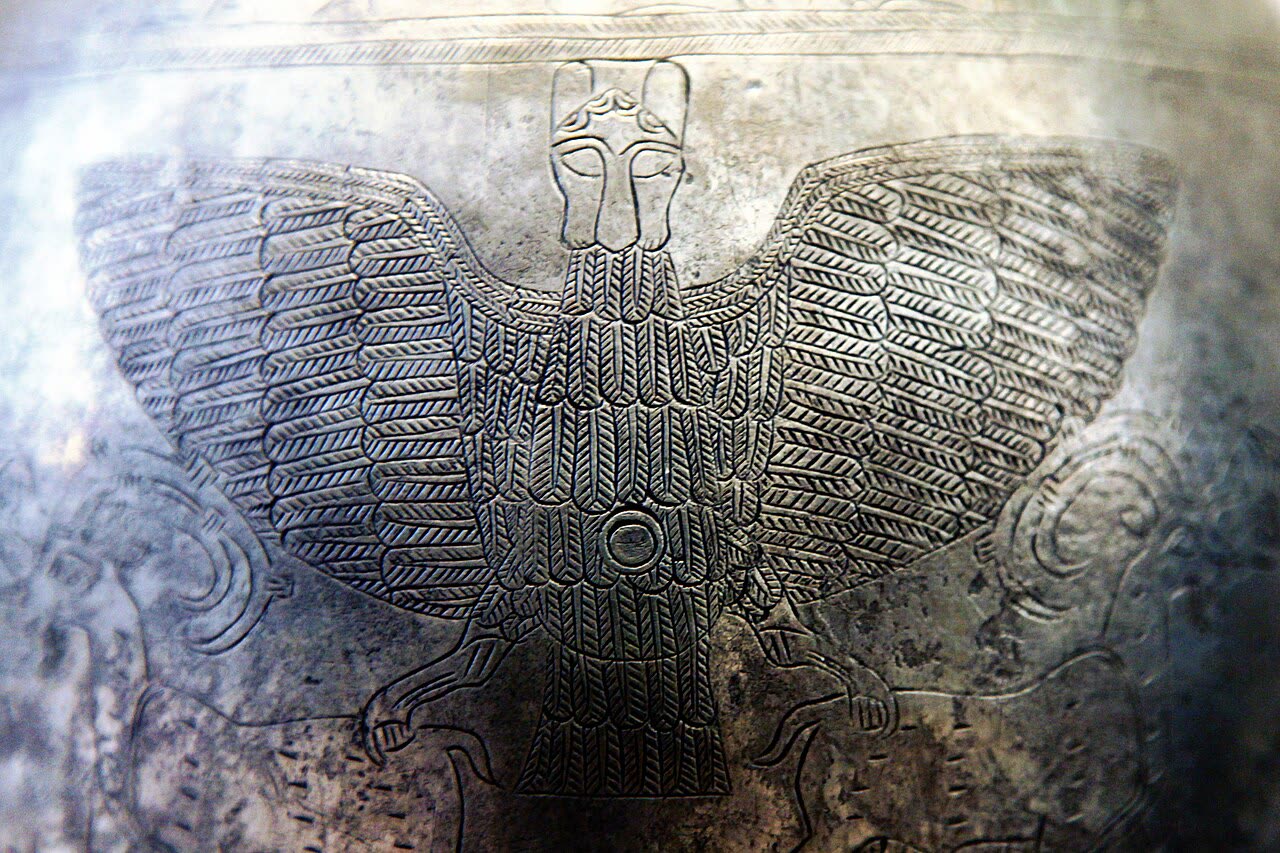
The figure also occurs in art. The Louvre identifies four lion-headed eagles on an Early Dynastic silver vessel as Imdugud, a name used for the lion-headed bird. A dedication on the vessel connects it with Ningirsu, the god of Lagash. The design belongs to a tradition of showing the eagle with its wings spread, holding animals in its talons. [1][2][4]
The theft of a divine office
In the Standard Babylonian epic, Anzu is a doorkeeper of EnlilEnlilEnlil/Ellil: a major Mesopotamian god associated with destinies, kingship, and Ekur at Nippur, already prominent in third-millennium god lists. His name’s origin and cult beginnings remain debated.Glossary · Click to read the explanation. He steals the Tablet of Destinies and takes it away to a mountain. Glynnis Maynard reads the object as a sign of legitimate divine rule. The theft puts the authority to determine destinies into question, and the gods need someone who can face the guardian who has taken it. Adad, Girra and Shara are approached before Ninurta accepts the task. The refusals give the bird a measure of his power before the two opponents meet. [1][2]
Anzu can turn back Ninurta’s first attack while he still has the tablet. The account associates the course of the fight with the power of his words. Ninurta eventually brings the wind to bear on the bird’s wings and overcomes him. Recovering the tablet gives the gods back the object through which their authority has been challenged. An early version of the poem features Ningirsu as the champion. The Standard Babylonian version names Ninurta. That difference matters when reading the story alongside objects whose inscriptions name specific gods. [1][2]
A bird who can grant a gift
In Lugalbanda and the Anzud Bird, Lugalbanda is alone in the Zabu mountains and wants help finding the men he travelled with. He finds the bird’s young and tends the nestling. He feeds it meat and cakes and puts kohl around its eyes. Anzud returns from herding wild bulls in the mountains. When the chick fails to answer his calls, the parent fears something has happened to it. At the nest he finds the young bird safe and the place adorned. The narrative gives space to his fear and relief before he and Lugalbanda agree on a reward. [3]
Anzud offers a series of rewards. Lugalbanda declines them and asks for strength and the ability to run without tiring. The bird grants this wish in a speech closely echoing Lugalbanda’s own words. [3]
The two then follow the army’s trail. The bird flies above while Lugalbanda moves on the ground. From above Anzud sees the troops, while Lugalbanda can see the dust they raise. Before returning to its nest, Anzud tells Lugalbanda to keep the source of his new ability to himself. The episode joins the bird’s perspective from the air to its ability to assign a destiny, this time in response to an act of care. [3]
In Gilgamesh, Enkidu and the Netherworld, Anzud has settled its young in the branches of InannaInanna / IshtarA prominent Mesopotamian goddess whose Sumerian name Inanna became associated with Akkadian Ishtar across diverse traditions. She was associated with desire, war, royal authority and Venus, while local forms and genealogies varied among texts.Glossary · Click to read the explanation’s tree. A snake occupies the roots and a phantom maid the trunk. Gilgamesh strikes the snake. The bird takes its young away to the mountains, and the tree can then be used for Inanna’s furniture. Here the nest belongs to the history of a single tree, and the birds withdraw when Gilgamesh intervenes. [5]
The bird on a vessel for Ningirsu
The pictured engraving is on the silver vase of Enmetena from Girsu. The Louvre records a complete register of four lion-headed birds, each clasping a pair of animals. It identifies lions, ibexes and deer in the repeating sequence. Another register shows seven recumbent heifers. The dedication on the neck associates the vessel with the table service of Ningirsu and names the priest Dudu. The pattern places the bird within the furnishing of a god’s service. [4]
In the Sumerian account of GudeaGudeaRuler of Lagash in the late third millennium BCE, whose inscriptions document temple construction and the name Anunna.Glossary · Click to read the explanation building Ningirsu’s temple, the E-ninnu is called the white Anzud bird. One passage pictures the temple as a great mountain and the bird spreading its talons upon the mountain land. The comparison uses the bird to convey the height and reach of the sacred building. Another early image, the relief from Tell al-Ubaid, places the spread-winged figure within the decoration of a temple of Ninhursag. [1][2][6]
Later Assyrian art could make the bird a combatant again. Maynard examines a doorway relief at the temple of Ninurta at Nimrud and seals on which the composite creature twists to face its opponent. She compares the poses on the seals with figures in Assyrian royal hunts. Anzu carries different meanings according to his position in a scene. The vase places the bird at the centre of an ordered pair of animals. The epic uses his theft to disrupt the rule of the gods. [1][4]
References and notes (6)
- Glynnis Maynard, The Intervisuality of Anzû in Neo-Assyrian Mythologies of Kingship Read the description of the Akkadian versions, the theft and fight, the earlier Imdugud images, and the discussion of the Nimrud relief and seals. Return to the text ↑
- Amar Annus, Anzu Read the discussion of the names, the Sumerian and Akkadian narrative roles, the association with Ningirsu and the theft and recovery of the tablet. Return to the text ↑
- Electronic Text Corpus of Sumerian Literature, Lugalbanda and the Anzud Bird Read lines 1–89 on the nest and the gift of food and lines 160–219 on the blessing, the tracks of the troops and the bird’s departure. Return to the text ↑
- Musée du Louvre, Vase d’Enmetena, AO 2674 Read the material, findspot, engraved registers, identification of the creatures and text of the museum’s description of the dedication. Return to the text ↑
- Electronic Text Corpus of Sumerian Literature, Gilgamesh, Enkidu and the Netherworld Read the passage on the tree’s arrival, nesting places, Gilgamesh’s intervention and the flight of the Anzud bird and its young. Return to the text ↑
- Electronic Text Corpus of Sumerian Literature, The Building of Ningirsu’s Temple Read the temple’s name and the comparison with the bird spreading its talons, including lines 820–823. Return to the text ↑
Suggest a correction · Suggest a source for this record
Cite this record
IL Archive, «Anzu, the Lion-Headed Bird», https://ilarchive.com/en/entities/anzu-bird
Continue reading
Related readings