Entity · Concept
Bi-lā kayf
A reference page linking a name, group, or concept to the materials that discuss it.
A formula in Islamic theology for accepting scriptural descriptions of divine attributes without specifying their modality; theologians differ over what their words mean and what is left unknown.
Estimated reading time: 8 min Published Last reviewed:
Share article

Text
Introduction
Why did some Muslim theologians say that divine attributes should be accepted “without asking how” (bi-lā kayf)? This article examines what the formula does, how it became associated with reports about Mālik ibn Anas, and why affirmation, suspension of judgment and figurative interpretation were not understood in the same way by all schools. The aim is historical explanation, not adjudication between confessional positions.
The question is more precise than whether scripture is “literal.” It concerns what a reader can know from words used of God and what remains unknown about the reality of an attribute, in a scripture that also denies any likeness between God and creation. [1]
Reading guide
- The formula and the Qurʾānic and hadith passages that prompted the debate.
- Accounts attributed to Mālik, their transmission, and the spread of bi-lā kayf.
- The distinction between deferring meaning and deferring modality, and differences among theological approaches.
- Ibn Taymiyya as a test case, followed by the limits of the evidence.
What does bi-lā kayf mean?
The Arabic kayf asks about a thing’s manner, configuration or “how.” In debates over divine attributes, bi-lā kayf means that one does not specify the modality of an attribute named in revelation. It is also expressed as rejecting takyīf (assigning a how), often alongside rejection of any resemblance between God and creatures. The phrase is neither itself a Qurʾānic verse nor the exclusive name of a theological school. Its scope varies by writer.
When a text uses terms such as hand, face or establishment over the throne (istiwāʾ), the disagreement is not over the existence of those words but over what they convey. Can a general meaning be understood while the divine modality remains unknown? Or should interpretation of the intended meaning also be withheld? Others defended context-sensitive non-bodily interpretations, which their opponents sometimes regarded as an unwarranted departure from transmitted wording. [1]
Scriptural passages at issue
QurʾānThe QuranThe central scripture of Islam, consisting of 114 Arabic surahs; its study distinguishes Quranic discourse from manuscript history, reading traditions, and historical inference.Glossary · Click to read the explanation 20:5 states that the MercifulAl-RaḥmānQuranic divine designation co-referring with Allah.Glossary · Click to read the explanation istawā over the throne. Rendering the verb simply as “sat,” “was established,” or “assumed authority” can build one disputed interpretation into the translation; the Arabic wording alone does not settle every subsequent theological claim. [2]
Qurʾān 48:10 refers to “the hand of God” above the hands of those making a pledge, while 55:27 says that the “face” of the Lord remains. The setting of an oath of allegiance in the first case, and the passing-away of created things in the second, are crucial contextual clues. Neither expression can safely be treated as a straightforward anatomical description without an argument. [3] [4]
A further passage, 42:11, declares that nothing resembles God while also naming God as hearing and seeing. Opponents in the dispute could cite the same verse to support very different ways of combining transcendence with positive descriptions. [5]
The tradition of God's descent to the lowest heaven during the final third of the night appears in the report attributed to Abū Hurayra collected in Ṣaḥīḥ al-Bukhārī, no. 7494. This is an identifiable hadith witness, not a hadith that itself defines the later technical expression bi-lā kayf. The disagreement concerns how the report should be understood as well as its role in theological argument. [6]
Mālik ibn Anas and the problem of transmission
An influential response is attributed to Mālik ibn Anas, the Medinan jurist (d. 179 AH/795 CE), when a questioner asked how God was established over the throne. In Abū Bakr al-Bayhaqī’s (d. 458 AH/1066 CE) al-Asmāʾ wa-l-ṣifāt, a report transmitted through Yaḥyā ibn Yaḥyā gives his reply in the form “establishment is not unknown; the how is not rationally graspable; belief in it is obligatory; asking about it is innovation.” Al-Bayhaqī also mentions a comparable attribution to Mālik’s teacher Rabīʿa ibn Abī ʿAbd al-Raḥmān. [7]
Elsewhere in the same collection, a report gives a different wording: God established Himself as He described Himself; the question “how?” is not to be asked. The formulas are not verbally identical. Moreover, al-Bayhaqī compiled reports some three centuries after Mālik, with chains of transmission. The life date of the person reported, the date of the surviving compilation and a scholar’s evaluation of each chain are distinct matters. The account helps explain a remembered limit on speculative questioning; it cannot be treated as a surviving doctrinal treatise written by Mālik. [8]
From a cautionary expression to a doctrine
Binyamin Abrahamov’s 1995 study examined the development of the bi-lā kayfa doctrine in Islamic theologyKalāmDiverse traditions of argument about Islamic doctrine, addressing scripture, divine attributes, justice, prophecy and human agency, with shifting relations to law and philosophy.Glossary · Click to read the explanation. Its published abstract presents two functions of the arguments: resisting anthropomorphic likeness to creatures and resisting figurative interpretations that some traditionalists thought emptied the revealed wording of its import. The doctrine also articulated a limit to knowing God’s essence and attributes. That is an argument about a historical development, not evidence that every author using the words agreed on all details. [9]
The formula therefore does not answer every metaphysical question about divine will, speech, knowledge or action. Its most characteristic use concerns how a reader receives descriptions of attributes that seem human-like, especially when rival accounts of linguistic meaning and transcendence are at stake.
Meaning, modality and interpretation
To defer modality is to decline to describe how an attribute exists in God; doing so need not prevent recognition of a general linguistic meaning. To defer meaning, in one historical form, is also to refrain from determining the precise divine intention of an apparently anthropomorphic expression. Taʾwīl can instead mean giving a defensible, non-bodily account grounded in Arabic usage, context and doctrinal reasoning—for instance, reading “hand” in some contexts as power or support.
These are useful analytical distinctions, not fixed labels that can be pasted onto every medieval text. “Transmit it as it came” may coexist with deliberate silence about meaning in one author, and with the affirmation of intelligible meaning but unknown reality in another. What counts as the “plain meaning” of a theological statement is itself disputed. [10]
Schools and disagreements within them
Muʿtazilite theologians emphasized divine unity and dissimilarity from creation. Many explained apparently bodily terms through linguistic or negative readings; they also disputed whether the divine attributes are eternal items really distinct from the divine self. It would be misleading to say that they merely denied all attributes: their arguments concerned what affirming an attribute amounts to. [10]
Ashʿarī and Māturīdī traditions of Sunnī dialectical theologyKalāmDiverse traditions of argument about Islamic doctrine, addressing scripture, divine attributes, justice, prophecy and human agency, with shifting relations to law and philosophy.Glossary · Click to read the explanation commonly upheld attributes such as knowledge, power and will while denying resemblance to creaturely attributes. Approaches to hand, throne and descent still differed between authors and periods, including interpretations, suspensions of judgment and various forms of non-assimilating affirmation. Neither tradition can be captured by a timeless one-method-per-school table. [11]
Within traditions of hadith scholars and Ḥanbalī theologians, too, positions ranged from suspending inquiry into both meaning and modality to allowing an intelligible meaning while withholding knowledge of its concrete reality. A school designation cannot substitute for reading the author’s own text and understanding whom it addresses. [12]
Ibn Taymiyya: intelligible language, unknown how
Ibn TaymiyyaIbn TaymiyyaHanbali Muslim scholar (1263–1328) based in Damascus, who wrote on interpretation, law and theology; modern research considers his influence on identifying Abraham's son in the sacrifice story.Glossary · Click to read the explanation (661–728 AH/1263–1328 CE) illustrates the last distinction particularly clearly. As John Hoover explains in the Stanford Encyclopedia of Philosophy, Ibn Taymiyya opposes the view that the very meanings of all the divine attributes are inaccessible. In his account, terms carry intelligible, contextually determined meanings, but the divine attributes’ modality and ultimate ontological reality remain unknown to human beings. Sharing a word or an abstract concept does not imply that God and a creature share the same mode of being. [12]
His position may therefore share the words bi-lā kayf with other accounts while sharply disagreeing about maʿnā (meaning) or the legitimacy of taʾwīl. Carl Sharif El-Tobgui’s study of Ibn Taymiyya’s approach to reason and revelation likewise locates the issue within a wider dispute about language, reality and theological cognition, not within the formula alone. [1]
Ambiguous verses and the limits of interpretation
Qurʾān 3:7 contrasts clear and ambiguous verses and discusses the pursuit of taʾwīl. Commentators disputed how to pause around “none knows its interpretation except God” and what taʾwīl means. Invoking the verse is therefore part of the history of the debate about who can know a text’s ultimate import; it does not automatically settle the position of every scholar on divine attributes. [13]
Nor is bi-lā kayf identical by itself to philosophical divine incorporealityDivine incorporealityThe denial that divine essence is an extended body with parts or spatial occupation; distinct from invisibility and simplicity, with the meaning of body and place varying by school.Glossary · Click to read the explanation, or a guarantee of bodily belief. Claims about corporeality, extension, direction and place need to be evaluated from a writer’s broader arguments. The related question of anthropomorphic language for GodDivine anthropomorphismAttribution of human features or feelings, such as hands, face and anger, to God. Language, visions, interpretation and beliefs about corporeality require separate analysis.Glossary · Click to read the explanation cannot be answered from a two-word formula alone.
Reading the explanatory diagram
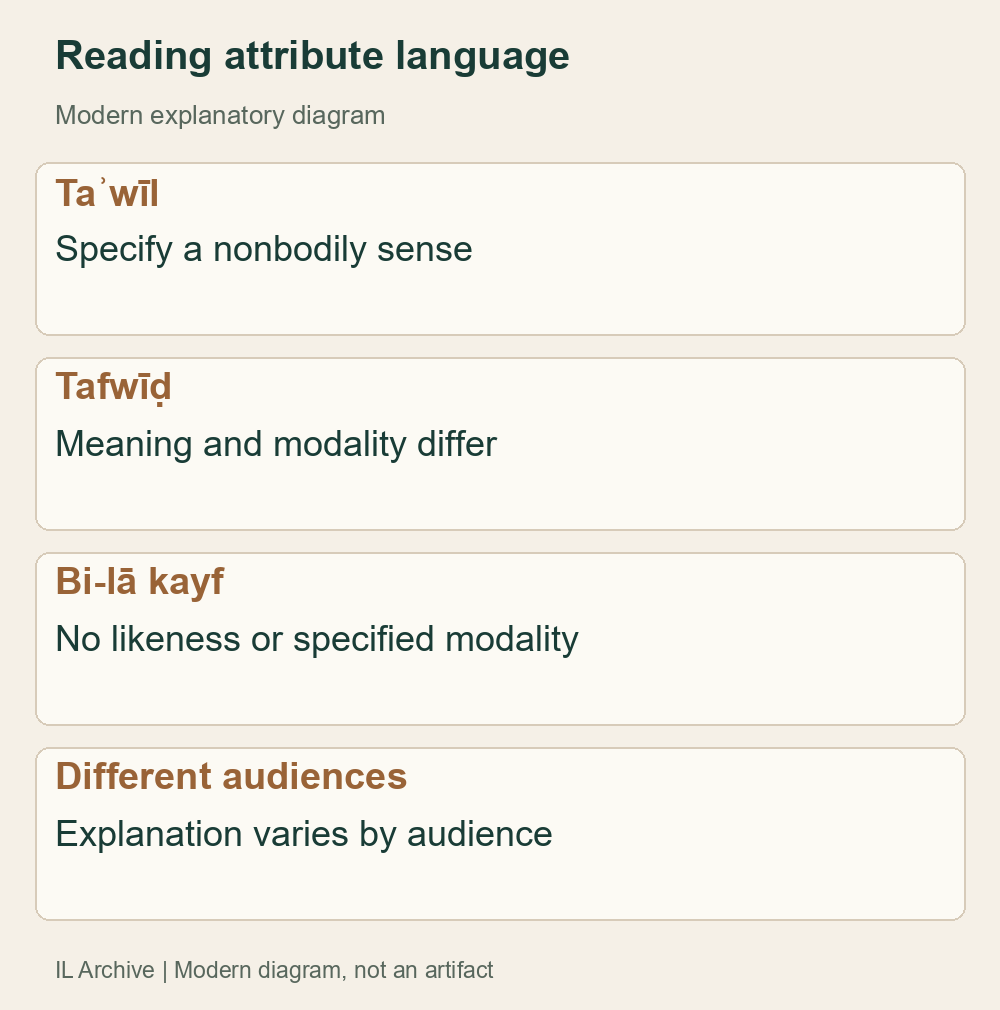
This retained modern editorial diagram illustrates possible approaches; it is not a manuscript image or a historical roster of schools. Its categories—taʾwīl, tafwīḍ and bi-lā kayf—may overlap and change with author, period and context. Scholarship on divine essence and attributes shows that the controversy concerned theories of language and knowledge as much as dictionary meanings. [14]
What the evidence establishes
The cited Qurʾānic and hadith passages have inspectable wording and contexts; Mālik’s reported answer is preserved in later compilations that can be compared; and bi-lā kayf became a consequential formula in Islamic intellectual history. Repetition of the formula across texts, however, is not proof that the authors held an identical theory of meaning or that every later dispute was already contained in an early reported exchange.
The enduring question is what can responsibly be understood when human language describes God, and what a theologian leaves beyond human description. Its answer varies with the author and the source. That is why the history of bi-lā kayf requires interpretation rather than a slogan.
References and notes (14)
- Carl Sharif El-Tobgui, “Glossary of Arabic Terms,” in Ibn Taymiyya on Reason and Revelation (Brill, 2020). Entry “kayfiyya” / “bi-lā kayf,” in the glossary, pp. 323–346; consulted entries only. Return to the text ↑
- Qurʾān 20:5, Arabic wording and translations, Quranic Arabic Corpus, University of Leeds. Verse 20:5; the throne/istiwāʾ phrase and parallel translations. Return to the text ↑
- Qurʾān 48:10, Quranic Arabic Corpus, University of Leeds. Verse 48:10, the pledge and “hand of God.” Return to the text ↑
- Qurʾān 55:27, Quranic Arabic Corpus, University of Leeds. Verse 55:27, “face of your Lord” and translations. Return to the text ↑
- Qurʾān 42:11, Quranic Arabic Corpus, University of Leeds. Verse 42:11, dissimilarity and hearing/seeing. Return to the text ↑
- Al-Bukhārī, Ṣaḥīḥ, Book of Tawḥīd, hadith 7494, Arabic and English on Sunnah.com. Hadith no. 7494, Arabic text, transmission chain and English rendering. Return to the text ↑
- Al-Bayhaqī, al-Asmāʾ wa-l-ṣifāt, chapter on Qurʾān 20:5, report 867. Vol. 2, p. 306 in the online edition; Yaḥyā ibn Yaḥyā account and reference to Rabīʿa, not the full book. Return to the text ↑
- Al-Bayhaqī, al-Asmāʾ wa-l-ṣifāt, ed. ʿAbd al-Raḥmān ʿUmayra (Dār al-Jīl, 1417 AH), online page 560. The Ibn Wahb variant alongside the Yaḥyā account; passage only; pagination differs by edition. Return to the text ↑
- Binyamin Abrahamov, “The Bi-Lā Kayfa Doctrine and Its Foundations in Islamic Theology,” Arabica 42/3 (1995): 365–379. Publisher bibliography and published abstract only; full article not accessed. Return to the text ↑
- “Arabic and Islamic Philosophy of Religion,” Stanford Encyclopedia of Philosophy, §6.2.1. Read §6.2.1 on Muʿtazilite attributes and divine unity; not the entire entry. Return to the text ↑
- “Arabic and Islamic Philosophy of Religion,” Stanford Encyclopedia of Philosophy, §6.2.2. Read §6.2.2 on Ashʿarī and Māturīdī approaches; not the full entry. Return to the text ↑
- Jon Hoover, “Ibn Taymiyya,” Stanford Encyclopedia of Philosophy (2024), §4.1 “Theological Language.” Read §4.1 and relevant biographical paragraphs on meaning, modality and noncognitivism. Return to the text ↑
- Qurʾān 3:7, Quranic Arabic Corpus, University of Leeds. Verse 3:7 and rendering of the clause on who knows its taʾwīl. Return to the text ↑
- Nader El-Bizri, “God: Essence and Attributes,” in The Cambridge Companion to Classical Islamic Theology, ed. Tim Winter (Cambridge, 2008). Publisher chapter abstract only; full chapter not accessed. Return to the text ↑
Suggest a correction · Suggest a source for this record
Cite this record
IL Archive, «Bi-lā kayf», https://ilarchive.com/en/entities/bila-kayf
Continue reading