Entity · Deity
Nikkal in the Songs and Rituals of Ugarit
A reference page linking a name, group, or concept to the materials that discuss it.
- Names
- Nikkal · Nikkal-wa-Ib · Nikkal-wa-Ibbu
- Region
- Ugarit (Ras Shamra), Syrian coast
At Late Bronze Age Ugarit, Nikkal appears in a wedding poem, an offering text and a Hurrian song with musical notation. The tablets preserve different ways of naming, addressing and writing about a goddess linked to Mesopotamian Ningal.
Estimated reading time: 5 min Published Last reviewed:
Share article
Text
Introduction
Nikkal appears in several kinds of writing from Late Bronze AgeLate Bronze AgeAn archaeological period around 1600–1200 BCE in much of the Near East, with international diplomacy, exchange and religious diversity; its endpoints vary by region.Glossary · Click to read the explanation UgaritUgaritAncient city and kingdom at Ras Shamra on the Syrian coast, flourishing between the fourteenth and early twelfth centuries BCE and preserving multilingual archives.Glossary · Click to read the explanation, present-day Ras Shamra in Syria. A poem in Ugaritic makes her the bride of the moon god Yarikh. A ritualRitualAn organised or distinguished practice meaningful to a community; it may leave traces, but its form alone does not reveal an associated doctrine.Glossary · Click to read the explanation text names her among the gods receiving offerings, and a separate tablet preserves a song addressed to her in Hurrian with musical instructions. The name connects her to Mesopotamian Ningal, whose Sumerian name means Great Lady. At Ugarit, the different texts give that inherited name a place in local poetry and worship. [1] [2] [3] [4]
The wedding on a clay tablet
The Louvre holds the wedding poem as AO 19995, excavation number RS 5.194. It was found on the Ras Shamra acropolis in 1933. The museum dates the clay tablet to 1400–1200 BCE and identifies its writing as Ugaritic. Editions cite the composition as KTU 1.24. These numbers identify one written witness through its excavation, its museum inventory and its place in the modern collection of alphabetic cuneiformUgaritic alphabetAlphabetic cuneiform system of Late Bronze Age Ugarit, using thirty chiefly consonantal written signs, distinct from Akkadian syllabic cuneiform.Glossary · Click to read the explanation texts. [1]
The poem introduces Nikkal with Ib in her name. Yarikh, described as a light of the heavens, seeks her through a message to Harhab. His offer evokes silver, gold and lapis lazuli, then turns to images of land made fruitful as vineyards and orchards. Harhab proposes other matches, including Pidray, a daughter of Baal. Yarikh remains fixed on Nikkal. The poem thus gives the marriage a setting of negotiations and relationships among divine households. The orchard imagery belongs to the language of the bridegroom's offer. [2]
Harhab's exact position is difficult to establish. One of his titles contains a word that has often been translated as summer. Robert Allan argues for a different reading connected with a rite associated with marriage. Allan also points out that, in the part of the exchange that survives, it is Yarikh or his messenger who makes the approach, while Harhab offers to arrange an alternative match. The proposed interpretation changes the part Harhab plays in the scene and illustrates how much turns on a short, obscure expression. [2] [5]
The tablets also give the bride's name in different ways. The combined form belongs to the wedding text, while the ritual uses Nikkal in its list of recipients. The setting and the spelling together help determine how far an interpretation of one passage can be applied to another. [2] [3]
The goddesses at the end of the poem
A horizontal line sets off the last section of the tablet. It invokes the Kotharat, also called Kathirat in modern scholarship, goddesses whom Klaas Spronk associates with marriage. They are pictured as birds settling in trees and are called by name. Nicolas Wyatt suggests that the wedding story and its closing invocation had a place at weddings. The hypothesis makes sense of the movement from a divine marriage to invoked goddesses. The surviving tablet supplies the composition and its division, and the occasion of performance is an inference. [2] [6]
A separate bilingual ritual, RS 24.255, places Nikkal among recipients of sacrifice and prescribes an offering for Yarikh. Its later section concerns another divine betrothal. Dennis Pardee distinguishes that rite from the matching of Yarikh and Nikkal in the poem and reads Nikkal-wa-Ibbu as evidence that Nikkal was in part assimilated to a deity called Ibbu. The ritual's list gives independent evidence of Nikkal's place in the cult, and the name in the poem shows the extent to which local usage complicates a simple equivalence with Ningal. [2] [3]
A Hurrian song with notation
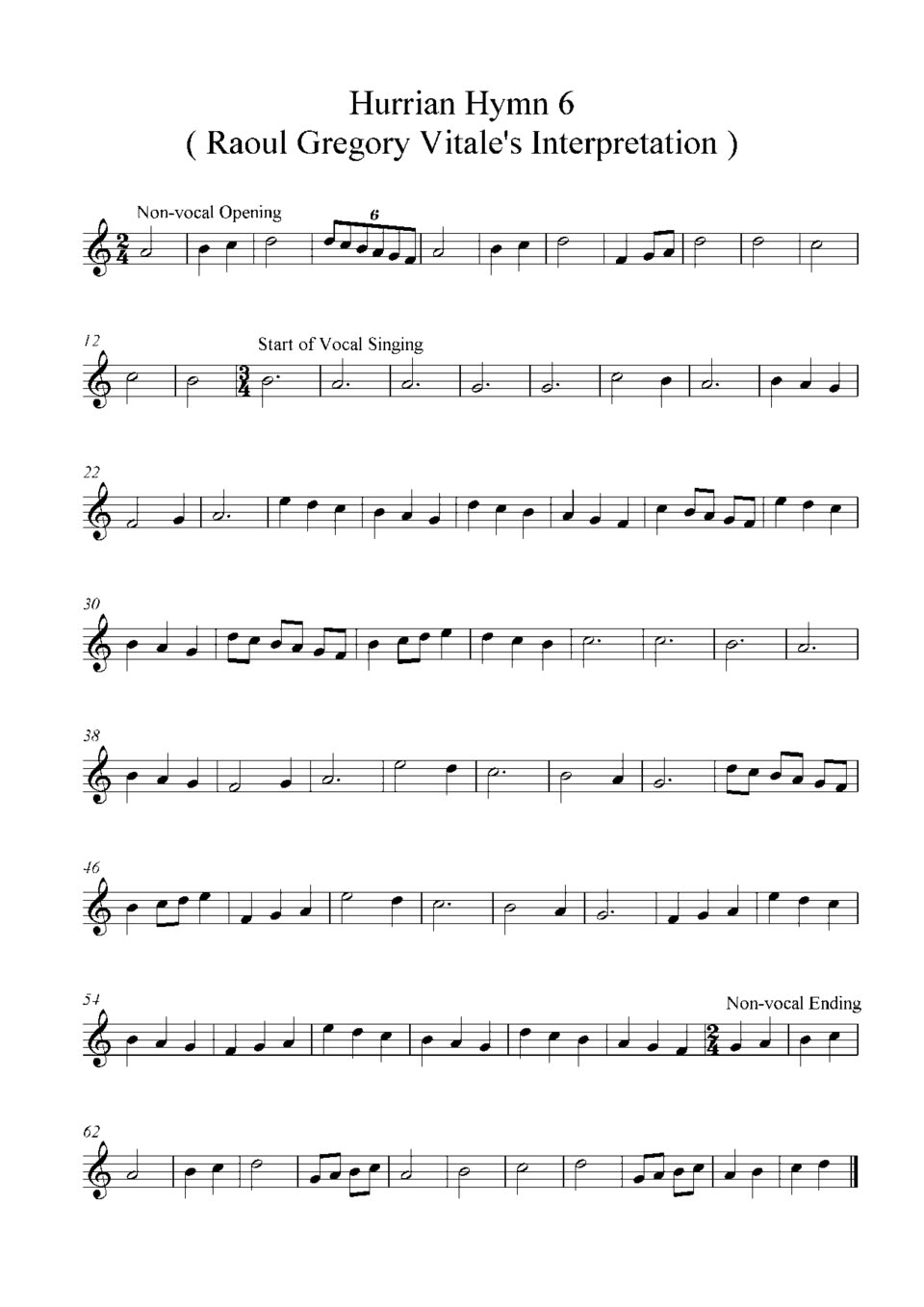
The song conventionally called h.6 is on a separate tablet reconstructed from three fragments, RS 15.30, 15.49 and 17.387. The words addressed to Nikkal are in Hurrian. Below a double ruling are groups of musical terms and numbers. The names of intervals draw on AkkadianAkkadianAn ancient East Semitic language written in cuneiform from the third millennium BCE; its varieties include Babylonian and Assyrian, and it served in international diplomacy.Glossary · Click to read the explanation technical vocabulary, adapted in the notation, and the closing scribal label uses Akkadian. It identifies the piece as a song and names a tuning or mode. One clay object thus brings together language for addressing a goddess, technical instructions for music and a scribal description of the piece. [4] [7]
The words are only partly understood. One interpretation takes the poem as a prayer by a woman who has been unable to have a child. The difficulty of the Hurrian makes the wording and the full course of the prayer uncertain. The relation between the notation and the voice is also disputed. Some readings treat the figures as evidence for both instrumental and vocal lines, while another proposal treats them as an accompaniment to a melody the singer already knew. The groups of terms and numbers are written apart from the words, a layout that leaves their alignment open to interpretation. [4] [7]
The modern score shown here makes Raoul Gregory Vitale's reading visible in staff notation. Other scholars have reconstructed the piece differently, including versions for a single melodic line and versions with simultaneous notes. The reconstruction is therefore evidence of one way of reading the tablet, whose surviving notation attests a musical dimension of the cult without fixing every detail of a performance. Read alongside the Ugaritic wedding poem and the offering list, the song shows that scribes at Ugarit gave Nikkal several distinct settings, from marriage negotiation to the offerings of ritual and the language of sung prayer. [2] [3] [4]
References and notes (7)
- Musée du Louvre, Clay tablet AO 19995 Object record, material, language, excavation, date and bibliography identifying KTU³ 1.24. Return to the text ↑
- Nicolas Wyatt, Religious Texts from Ugarit KTU 1.24, introduction, translation and notes on the divine marriage and closing invocation. Return to the text ↑
- Dennis Pardee, Ritual and Cult at Ugarit Text 26, RS 24.255, pp. 90–94, commentary and translation distinguishing Nikkal-wa-Ibbu from the second divine betrothal. Return to the text ↑
- Daniel Sánchez Muñoz, Analysis of Two Terms Related to Music in Ancient Mesopotamia § 1.1, pp. 1–2 and notes 1–8, on h.6, its fragments, languages and differing reconstructions. Return to the text ↑
- Robert Allan, Now That Summer's Gone: Understanding Qz in KTU 1.24 Discussion of Harhab's titles, the proposals for his role and the sequence of the negotiation. Return to the text ↑
- Klaas Spronk, The Incantations Page 285, reading of KTU 1.24 lines 40–50 as an invocation to the Kathirat. Return to the text ↑
- Biblical Archaeology Society Library, Anne Draffkorn Kilmer's Ugarit song tablet image and description Object commentary on ruling, language, notation, colophon and translation limits. Used for the description of the tablet. Return to the text ↑
Suggest a correction · Suggest a source for this record
Cite this record
IL Archive, «Nikkal in the Songs and Rituals of Ugarit», https://ilarchive.com/en/entities/nikkal
Continue reading