Entity · Deity
Ninimma, Scribe and Counselor of the Gods
A reference page linking a name, group, or concept to the materials that discuss it.
- Names
- Nin-imma · Ninimma
- Region
- Mesopotamia — Nippur (Nuffar, present-day Iraq)
Sumerian hymns praise Ninimma as a heavenly scribe, keeper of seals and counselor at Enlil's temple in Nippur. Creation narratives give her other roles, including attendance at a divine birth and a place in one version of Uttu's genealogy.
Estimated reading time: 5 min Published Last reviewed:
Share article
Text
Introduction
Ninimma is a Sumerian goddess associated with EnlilEnlilEnlil/Ellil: a major Mesopotamian god associated with destinies, kingship, and Ekur at Nippur, already prominent in third-millennium god lists. His name’s origin and cult beginnings remain debated.Glossary · Click to read the explanation's sanctuary at Nippur. In one hymn she is a heavenly scribe who handles a seal and a surveyor's tools. A second hymn chiefly praises the wisdom with which she serves and advises other gods. Sumerian narratives give her a place among the attendants at the creation of humankind and, in one manuscript of a separate poem, in a series of divine births. Her role depends on which composition and sometimes which copy a reader is consulting. [1] [2] [3] [4]
The heavenly scribe
The composition known as Ninimma A survives with gaps. Its opening addresses the goddess as a keeper of the treasury's seal and as caretaker of the great gods. It calls her a scribe of heaven, then mentions a tablet of life in a damaged sentence. The poem gives her a surveyor's line and measuring rod and praises the grain she brings. Those details group writing with securing stores and measuring land. They make the skills of a sanctuary part of the goddess's praise. [1]
A later section calls her a light filling an exalted sanctuary and praises her knowledge and fitness for purification rites. Nippur's EkurEkur: Enlil’s Temple at NippurEkur (“Mountain House”) was Enlil’s chief sanctuary at Nippur, present-day Iraq; the name may extend to its precinct. Hymns and royal inscriptions attest to its prestige and rebuilding across periods; it is not simply the ziggurat.Glossary · Click to read the explanation, the temple of Enlil, is named in both surviving sections. The missing and unclear lines leave some of the surrounding descriptions uncertain. Enough survives to connect her with both the care of temple resources and the rites carried out there. A study of Early Dynastic lists observes that her name and field-related expressions appear together in some much earlier scholarly manuscripts. The study compares those expressions with the measuring tools assigned to her in the hymn, suggesting a link across documents of different periods. [1] [5]
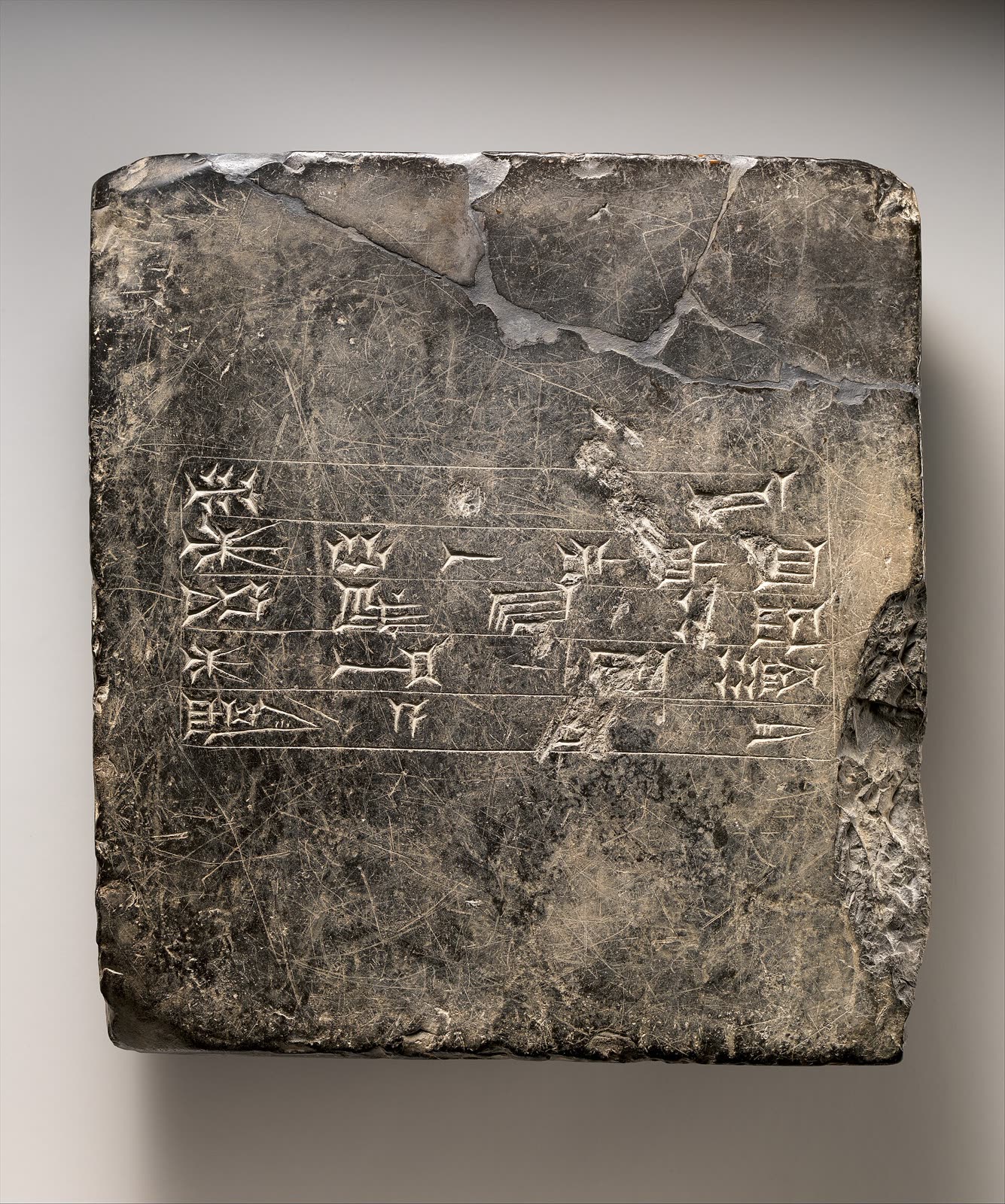
The stone dedication pictured here concerns the Ekur itself. It comes from the Kassite period, and the Metropolitan Museum identifies its inscription as a gift for the sanctuary of Enlil from a donor named Hashmar-galshu. The dedication gives a material example from the institution that the hymns place at the center of Ninimma's work. It dates later than the Old Babylonian hymnic manuscripts, and its few lines name Enlil and the donor. [1] [2] [6]
A counselor in several sanctuaries
A different hymn was published by Christopher Metcalf from tablet MS 2700. Its surviving passages give Ninimma work at several places. She advises her father in EriduEriduEridu (Abu Shahrain), a multi-mound site in southern Iraq occupied since the Ubaid, later home to a religious precinct associated with Enki. Its eighteen sounding levels are not proof that every early building was a temple.Glossary · Click to read the explanation, identified in the edition as EnkiEnkiMesopotamian deity also known as Ea, linked with Eridu and the Abzu (deep fresh waters), wisdom, incantations, and narratives of creation and cosmic order. Later written attestations do not identify the deity of Eridu’s earliest layers.Glossary · Click to read the explanation, performs a purification role at Kish and counsels Enlil at the Ekur. The poem also pictures her preparing a bed for Uta-ulu, understood here as a name of Ninurta. That scene gives her a domestic relationship as well as the public functions expressed by the descriptions of her wisdom. [2]
The composer often leaves the great gods to be identified by a title, place or alternative name. The Nippur setting makes sense of Enlil's role even where the hymn initially calls him the Great Mountain. Such language can presuppose a reader who already knows the divine households. Metcalf suggests a learned composition from Nippur and points out that the tablet offers no clear sign of a performance setting. The prayer for a shepherd called Nanni resembles prayers for a ruler, although his identification with a figure well known from older literary traditions remains an interpretation. [2]
The prayer asks for a peaceful dwelling, a prosperous rule and abundant years. Metcalf compares the figure it names with the Nanni credited in the Tummal Chronicle with making a garden for Enlil at Nippur. On that reading, the hymn borrows the form of a prayer for a ruler and places a figure from inherited literature in the role of the petitioner. [2]
Two stories about birth
In Enki and NinmaḫEnki and NinmahSumerian work on humanity’s creation to relieve the gods’ labour, and Enki and Ninmaḫ’s contest over bodies, destinies and sustenance; with manuscript evidence, variant readings and dating limits.Glossary · Click to read the explanation, the lesser gods toil at digging canals and complain. NammaNammaNamma, also traditionally read Nammu, is a Sumerian goddess and mother of Enki who helps initiate human creation in Enki and Ninmah; a royal inscription records her temple.Glossary · Click to read the explanation asks her son Enki to create a being who can take on the work. He urges her to fashion it from clay, with NinmaḫNinmahSumerian mother goddess who assists human creation and contests Enki over the fates of different fashioned bodies; later Babylonian inscriptions also attest her worship.Glossary · Click to read the explanation and a group of named goddesses at hand. Ninimma is one of those invited to stand by as Namma gives birth. The action is collective, and the text gives Namma the principal part. MS 2700 also associates Ninimma with a birth at the creation of life, this time through her assistance to Aruru and her presence at the cutting of the cord. [2] [3]
Enki and Ninḫursaĝa assigns Ninimma a place in a genealogy in a group of lines preserved on a manuscript of unknown origin. In that sequence, Ninkura gives birth to Ninimma, and Ninimma later gives birth to Uttu, another deity in the story. Oxford's edition marks the extra lines at the point where they can be inserted. In its main sequence, Ninkura gives birth directly to Uttu. Ninimma's place in this family therefore belongs to a particular telling of the story. [4]
The name also figures in the editors' discussion of a much later Babylonian incantation. They consider whether a damaged or unusual divine name may refer to Ninimma and recall her connection with Enki through Ninkura. They also consider Namma as a possible reading. The two names would make sense of the passage in different ways, so the identification remains qualified. The hymns make a more direct statement about Ninimma's own office and abilities. Together with the birth texts, they show a goddess whose knowledge is expressed through practical responsibility, counsel and assistance in the work of other gods. [1] [2] [4] [7]
References and notes (7)
- Electronic Text Corpus of Sumerian Literature, A Hymn to Ninimma (Ninimma A) Composition 4.21.1, Segments A–C and preserved titles, instruments and rites. Return to the text ↑
- Christopher Metcalf, Sumerian Literary Texts in the Schøyen Collection, Volume I Text 5, pp. 46–51, edition of MS 2700 and interpretation of the setting, divine epithets and prayer. Return to the text ↑
- Electronic Text Corpus of Sumerian Literature, Enki and Ninmaḫ Composition 1.1.2, lines 1–37, especially Enki's speech naming Ninimma among the attendants. Return to the text ↑
- Electronic Text Corpus of Sumerian Literature, Enki and Ninḫursaĝa Composition 1.1.1, lines 108–127 and the inserted manuscript variant at 126A–126CC. Return to the text ↑
- J. Cale Johnson, The Origins of Scholastic Commentary in Mesopotamia Thematic Unit 1, observations on the spelling of Ninimma and comparisons between early lists and Ninimma A. Return to the text ↑
- The Metropolitan Museum of Art, Sumerian Dedicatory Inscription from Ekur Object 41.160.187, Kassite date, description, translation, and note about Nippur and the Ekur. Return to the text ↑
- Krisztián Simkó and Henry Stadhouders, How to Manage the Hallow Art of Crafting Strings of Amulet Beads? Commentary on the divine names in the late Babylonian incantation, including the possibility of Ninimma. Return to the text ↑
Suggest a correction · Suggest a source for this record
Cite this record
IL Archive, «Ninimma, Scribe and Counselor of the Gods», https://ilarchive.com/en/entities/ninimma