Entity
Ninmah
A reference page linking a name, group, or concept to the materials that discuss it.
- Region
- Mesopotamia
Ninmaḫ is a Mesopotamian mother goddess who assists human creation and contests the assigning of fates in a Sumerian poem; later Babylonian records also attest her cult.
Estimated reading time: 6 min Published Last reviewed:
Share article
Text
Introduction
Ninmaḫ, whose Sumerian name roughly means “Exalted Lady,” belongs to the Mesopotamian sphere of motherhood, birth and the assignment of destinies. Her best-known literary role is in Enki and NinmaḫEnki and NinmahSumerian work on humanity’s creation to relieve the gods’ labour, and Enki and Ninmaḫ’s contest over bodies, destinies and sustenance; with manuscript evidence, variant readings and dating limits.Glossary · Click to read the explanation. To understand this goddess, however, we must distinguish the poem from evidence for worship, and historical names from modern reconstructions of a single “mother goddess.” [1][3]
Her name and related mother goddesses
The Sumerian name Ninmaḫ can be rendered “Exalted Lady” or “Magnificent Lady.” God listsGod ListsTexts collecting divine names for preservation, teaching and classification, with varying theological organization.Glossary · Click to read the explanation and modern scholarship place her among deities whose roles in pregnancy, birth and creation significantly overlap, notably NinḫursaĝaNinhursaga, birth and healing goddessMesopotamian goddess central to the births and Enki’s healing in Enki and Ninhursaga.Glossary · Click to read the explanation, NintuNintu, birth goddess in AtrahasisBirth goddess in Atrahasis, grieving for humanity, blaming the flood decision and involved in regulating future births.Glossary · Click to read the explanation (also written Nintur or Nintud), Mami and Bēlet-ilī. Grouping these names for study does not make them interchangeable in every period and locality: a title, theological equation and character named in a particular composition are different forms of evidence. [3]
Most importantly, Ninmaḫ is not NammaNammaNamma, also traditionally read Nammu, is a Sumerian goddess and mother of Enki who helps initiate human creation in Enki and Ninmah; a royal inscription records her temple.Glossary · Click to read the explanation. In Enki and Ninmaḫ, Namma is the primeval mother of EnkiEnkiMesopotamian deity also known as Ea, linked with Eridu and the Abzu (deep fresh waters), wisdom, incantations, and narratives of creation and cosmic order. Later written attestations do not identify the deity of Eridu’s earliest layers.Glossary · Click to read the explanation who conveys the gods’ complaints to her son and urges him to find a remedy. Ninmaḫ has an assigned part in the making of people and subsequently competes with Enki. Their distinct appearances together in lines 17–37 rule out identifying them as one character in that passage. [1][8]
Divine work and the making of humanity
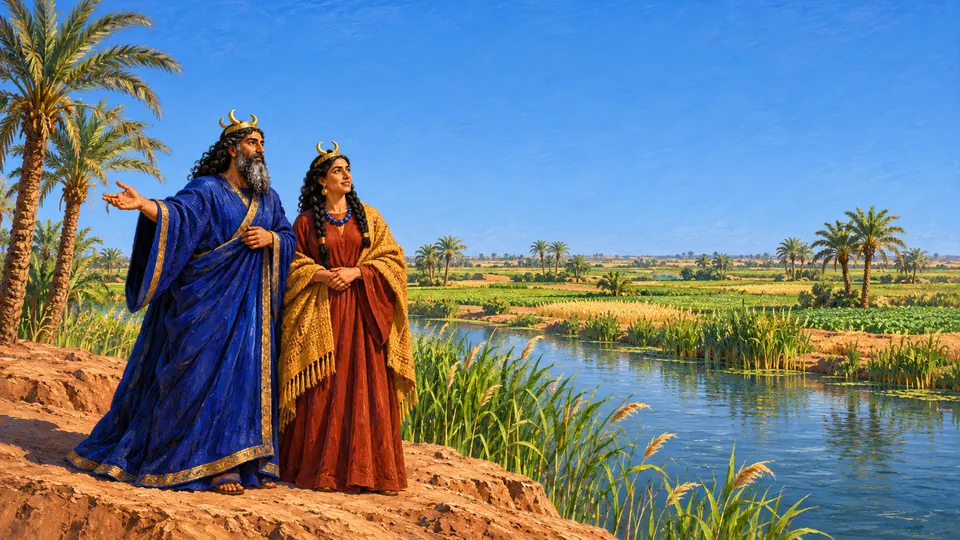
The poem begins in mythical time, before the ordinary human order: lesser gods dig canals, pile up silt and complain about exhausting labour. Namma brings their distress to Enki, a god of wisdom and subterranean fresh water, known as Ea in AkkadianAkkadianAn ancient East Semitic language written in cuneiform from the third millennium BCE; its varieties include Babylonian and Assyrian, and it served in international diplomacy.Glossary · Click to read the explanation. Enki proposes humans as the workers who will carry the baskets. Birth goddesses are brought into the undertaking, and clay is to be taken from the top of the Abzu, the deep freshwater realm in Mesopotamian cosmology. [1]
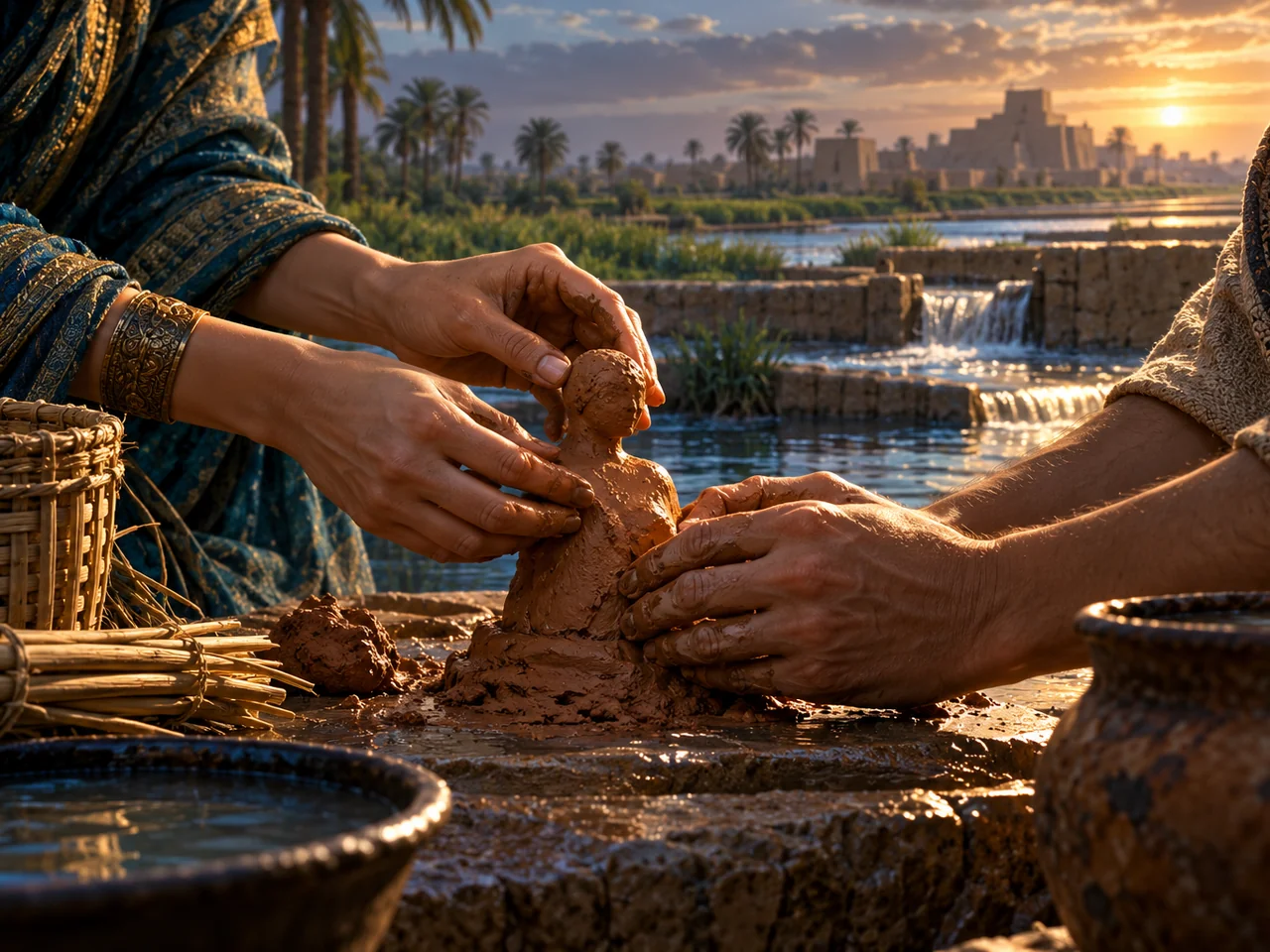
In Enki’s speech to Namma in lines 29–37, the mother is to give the creature its shape alongside the birth goddesses; Ninmaḫ assists and then assigns the basket-carrying labour after destiny has been set. This is a distribution of activities within the story, not a claim that Ninmaḫ single-handedly creates humankind. Lines 38–43 are broken, so the actual birth scene cannot be supplied as though it survived complete. A feast follows in honour of Namma, Ninmaḫ and the other gods. [1]
A contest over bodies and fates
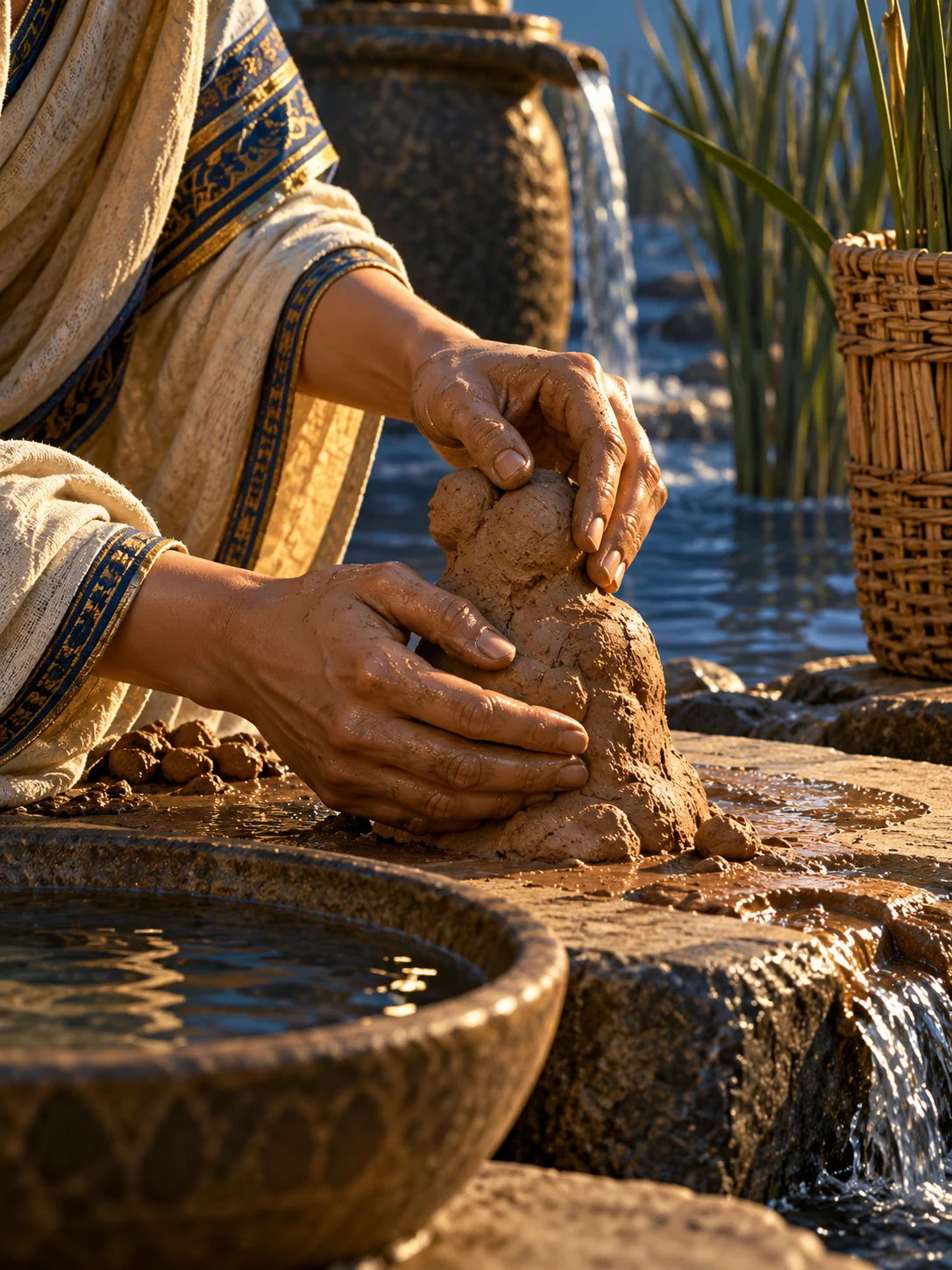
Following the feast and drinking, Ninmaḫ declares that she can produce a body of either favourable or unfavourable condition, and Enki replies that he can assign a destiny to whatever she makes. In lines 56–61 Ninmaḫ takes clay and fashions the first person, unable to bend outstretched hands; Enki assigns service at the royal court. Other individuals in the sequence are described in terms of sight, movement, urinary control, childbearing, or bodily sexual characteristics. Enki proposes roles at court, other livelihoods, or a ritualRitualAn organised or distinguished practice meaningful to a community; it may leave traces, but its form alone does not reveal an associated doctrine.Glossary · Click to read the explanation intervention. These literary descriptions should not be converted into present-day medical diagnoses. [1][9]
The following short Sumerian transliteration of line 58 comes from Oxford’s composite text. The English sentence beneath it is our concise rendering following Oxford’s translation and gloss, not an independent reading of a particular tablet. [4]
The witnesses disagree in consequential places. Lines 66–68 describe damaged feet in one reading but give a different description and role for the third person in another manuscript. There are also variants concerning the fate of the woman unable to bear children in lines 72–74; even the designation “Nibru eunuch” in lines 75–78 carries a question mark in Oxford’s translation. This is not a fixed catalogue of diagnoses or precisely established administrative offices. [1]
Enki then reverses the challenge and creates a being called Umul, portrayed as profoundly weak, unable to speak or reach bread unaided. Ninmaḫ is asked to provide for this being and says it cannot sustain itself. Enki counters that he found bread and destinies for each of her creatures; the final lines present her as unable to rival him. Yet lines 109–139 are extensively damaged and include a lament about a ruined city and house and a captive child. That complaint cannot be turned into a securely dated historical event or confidently restored speech. [1]
Two readings partly converge: the narrative explores finding a place and subsistence for different bodies while also establishing Enki’s superiority in a literary exchange with satirical possibilities. The publisher’s summary of Manuel Ceccarelli’s critical edition stresses the contest and its humour; the abstract of Therese Rodin’s thesis studies the two mother-goddess myths in relation to work and power. These are interpretations of a narrative, not direct records of social policy throughout ancient Sumer. [9][10]
Worship and visual identification
Mother-goddess traditions, under several names, are documented from early Sumerian periods into the first millennium BCE. The city of Keš (not Kiš) figures among centres of mother-goddess worship, but that general description does not demonstrate equal use of every name there. A firmer later witness for Ninmaḫ in BabylonBabylonBabylon is an ancient city in central present-day Iraq, south of BaghdadGlossary · Click to read the explanation comes from royal building texts associated with Nebuchadnezzar IINebuchadnezzar IIBabylonian king, 605–562 BCE, appearing in Daniel and independently attested in inscriptions and building remains.Glossary · Click to read the explanation in the sixth century BCE: they record the restoration of Emaḫ, her temple near the IshtarInanna / IshtarA prominent Mesopotamian goddess whose Sumerian name Inanna became associated with Akkadian Ishtar across diverse traditions. She was associated with desire, war, royal authority and Venus, while local forms and genealogies varied among texts.Glossary · Click to read the explanation Gate, with related Ninmaḫ/Bēlet-ilī spellings. Such inscriptions document cult and building works, independently of the poem’s original date of composition. [3][7]
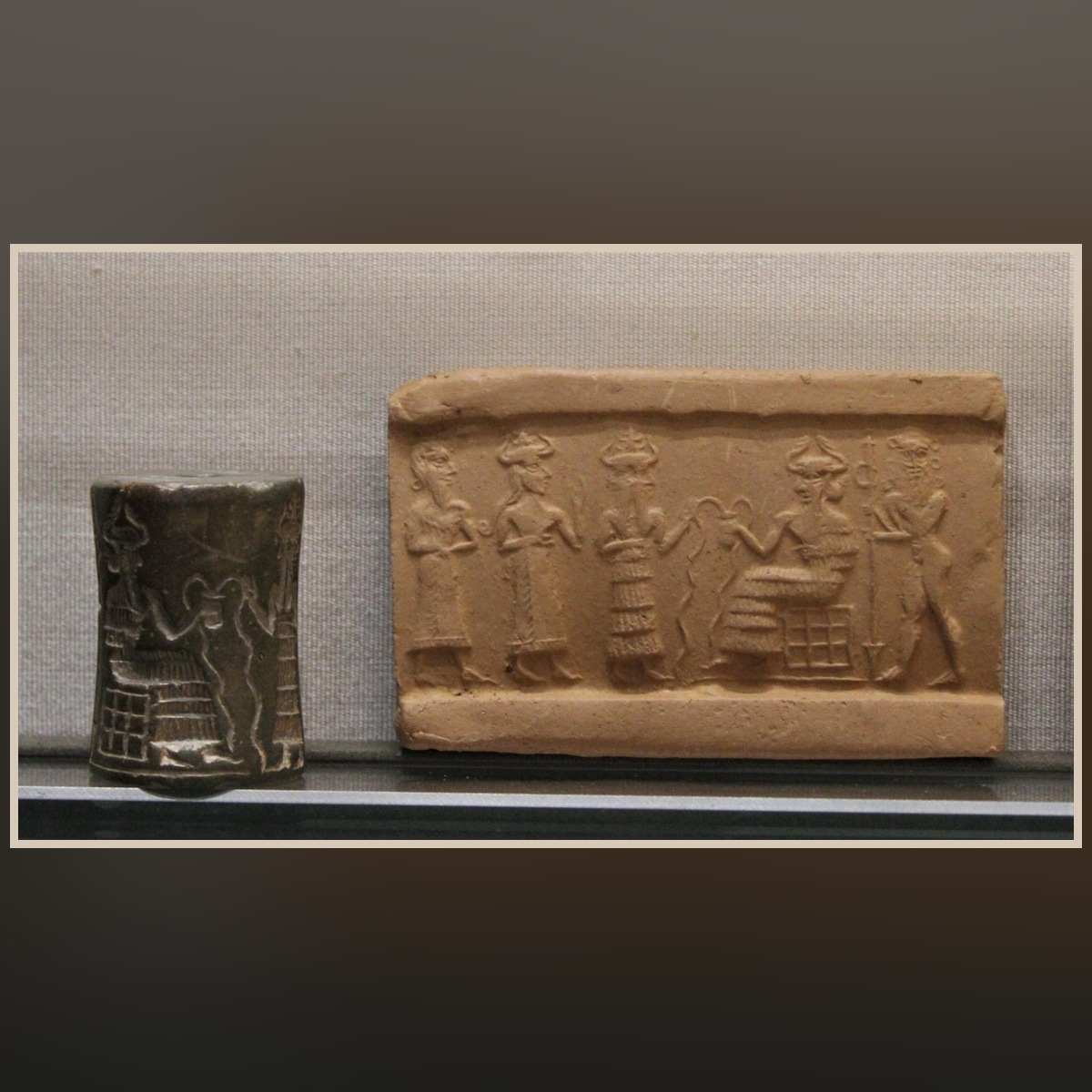
The Ω-shaped sign, sometimes accompanied by what has been understood as a birth-related cutting tool, is associated with the mother-goddess complex. Identifying an unlabelled anthropomorphic representation specifically as Ninmaḫ remains much harder. An object or figure is not made hers simply by a modern visual analogy. [3]
Mythic time and the surviving manuscripts
- Time within the story is mythical, accounting for the origin of human labour; it is not a datable historical year.
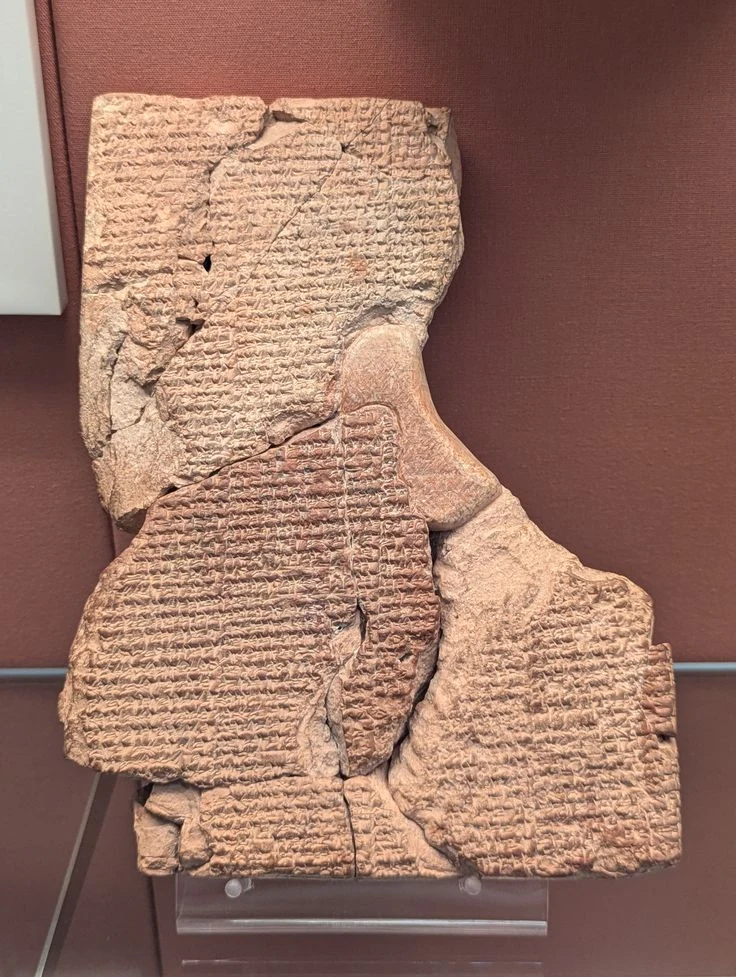
- Old Babylonian witnesses, broadly c. 1900–1600 BCE, include fragments from NippurNippur / NuffarAncient Nippur (modern Nuffar, Iraq), major cult centre of Enlil and Ekur; excavations revealed sanctuaries, houses and thousands of cuneiform tablets across many periods.Glossary · Click to read the explanation now at the Penn Museum. The Louvre’s tablet AO 7036 is dated by its catalogue to approximately 1800–1700 BCE. These are dates of objects, not a proven date when the entire poem was first composed. [5][6]
- Later witnesses include Assyrian copies from NinevehNineveh and KuyunjikNineveh is an ancient Assyrian city near Mosul in northern Iraq; Kuyunjik is one of its archaeological moundsGlossary · Click to read the explanation and a Neo-Babylonian tablet in the first millennium BCE, illustrating subsequent copying or transmission. The precise initial formation of all parts remains uncertain. [5]
The published continuous wording is consequently a composite edition built from multiple witnesses, not a verbatim transcription of one tablet preserving every line. The Louvre object is a genuine material witness to Enki and Ninmaḫ; the separate question of permission to reproduce a modern photograph of it cannot be settled by its ancient date. [4][5][6]
Comparison with Atraḫasīs
Both the Sumerian poem and Akkadian AtraḫasīsAtrahasis: Epic and HeroAkkadian narrative on human creation, relations with the gods and the flood, named for its survivor warned by Enki. Its surviving manuscripts differ in date and preservation; its hero must not be equated uncritically with every Utnapishtim version.Glossary · Click to read the explanation connect complaints about divine labour with the making of humans from clay to relieve the gods. Their detailed procedures differ. In Atraḫasīs Tablet I, lines 208–230 in SEAL’s composite edition, a god is killed and his flesh and blood figure in clay mixed by the birth goddess Nintu/Mami. The extant Sumerian creation scene does not describe this mixing of divine blood. The Akkadian text also describes divided lumps of clay and birth arrangements around lines 249–260. [2]
The comparison reveals a shared question about the origins of human work but different actions, divine names and narrative structures. Similarity alone cannot identify a particular author’s source or establish a route of borrowing. Ninmaḫ therefore belongs first to her attested Sumerian contexts rather than functioning as an unrestricted synonym for every Akkadian birth goddess. [1][2][3]
References and notes (10)
- University of Oxford, ETCSL, “Enki and Ninmaḫ” (1.1.2), composite English translation, including lacunae and variants; this is not a single tablet. ETCSL 1.1.2, lines 1–141 (esp. 17–37, 38–51, 52–82, 83–141) Return to the text ↑
- Hebrew University, SEAL, “Atraḫasis I (all periods)”, composite text, English translation and selected manuscript variants; only relevant passages on work and creation checked. Tablet I, lines 185–270 and notes on 223–260; not Tablets II–III Return to the text ↑
- ORACC, “Mother Goddess (Ninmah, Nintud/r, Belet-ili)”, consulted available sections on names, functions, cult and iconography; the entry aggregates related names. Sections “Functions”, “Name and Spellings”, “Cult Place(s)”, “Iconography” Return to the text ↑
- Oxford ETCSL, Sumerian transliteration and lexical gloss for line 58, checked against the corpus transliteration and its English translation; not an independent autopsy of cuneiform. Enki and Ninmaḫ 1.1.2, line 58; comparison with lines 29–37, 52–82 and 83–141 Return to the text ↑
- CDLI, composite catalogue Q000333 and witness records, including Nippur P259234 and later Assyrian/Babylonian tablets; catalogue metadata only, not restricted images. P469515/Q000333; P259234; P357080; P283736 Return to the text ↑
- Musée du Louvre, AO 7036 (T 2120; TCL 16,71), inventory and proposed dating of a witness to Enki and Ninmah; catalogue metadata, not a decipherment of the photograph. AO 7036 collection entry, description, inventory and date c. 1800–1700 BCE Return to the text ↑
- ORACC/RIBO, commentary to Nebuchadnezzar II royal inscriptions, especially the notes on Emaḫ temple and the Ninmaḫ/Bēlet-ilī name, with cited inscription references. Q005473, commentary paragraphs 21–22 and references to Nbk. 29–32 Return to the text ↑
- ORACC, “Namma”, available indexed paragraphs on her status as Enki’s mother and her role in Enki and Ninmaḫ; distinguished from Ninmaḫ. “Namma”, Functions; reference to ETCSL 1.1.2 line 17 Return to the text ↑
- Manuel Ceccarelli, Enki und Ninmaḫ (Mohr Siebeck, 2016): publisher’s abstract and bibliographic information only, not the 269-page edition. Publisher’s synopsis and bibliographic entry; DOI 10.1628/978-3-16-154692-1 Return to the text ↑
- Therese Rodin, The World of the Sumerian Mother Goddess (PhD thesis, Uppsala, 2014): university catalogue abstract only; the 350-page thesis itself was not read. 2014 dissertation abstract and catalogue metadata Return to the text ↑
Suggest a correction · Suggest a source for this record
Cite this record
IL Archive, «Ninmah», https://ilarchive.com/en/entities/ninmah
Continue reading