Entity · Deity
Ninsun, the Mother Who Counsels Gilgamesh
A reference page linking a name, group, or concept to the materials that discuss it.
- Names
- Ninsumun · Ninsun · Ninsunna
- Region
- Mesopotamia
Ninsun interprets her son Gilgamesh's dreams, appeals to Shamash for his safety and brings Enkidu into his family. A votive plaque and Sumerian royal hymns attest her role in Mesopotamian religious and royal traditions.
Estimated reading time: 5 min Published Last reviewed:
Share article
Text
Introduction
Ninsun, also written Ninsumun, is the goddess whom Gilgamesh calls his mother. The Babylonian epic gives her an active role in the early adventures. She explains his dreams of a companion, seeks divine protection for his expedition and receives Enkidu as a son. Sumerian royal praise also presents her as a king's divine mother, and a surviving stone relief bears her name in a dedication. These sources put the goddess at the center of several accounts of kinship, from an epic friendship to a king's claim to have been born into a divine family. [1] [2] [3]
The companion in the dreams
Tablet I of the Standard Babylonian epic relates Gilgamesh's dreams in a conversation between Shamhat and Enkidu. Before Enkidu arrives in UrukUrukAncient city at Warka in southern Iraq, a major urban centre around 3200 BCE that preserved early writing and accounting tablets.Glossary · Click to read the explanation, Gilgamesh has seen something fall from the sky. It is heavy like a great stone, and a crowd gathers around it. Later he dreams of an axe lying in a street, also surrounded by people. In each account he sets the object at his mother's feet and describes his extraordinary affection for it. The dreams give Gilgamesh images of an attachment whose object he has yet to recognize. [1]
Ninsun interprets both images as signs of a powerful companion. She says the newcomer will be Gilgamesh's equal, and her words connect his strength with the weight of the stone he could scarcely move. Her interpretation also anticipates that the friend will come to his aid. The scene repeatedly describes her wisdom and calls her Wild-Cow Ninsun. Karen Sonik reads her among the figures whose judgment and ability to give counsel matter to a ruler repeatedly driven by strong feeling. [1] [4]
Prayer before the journey
In Tablet III, Gilgamesh and Enkidu seek Ninsun's counsel before traveling to the Cedar Forest. Gilgamesh speaks of an unknown road and asks his mother for a blessing that will let him return to Uruk in safety. She listens in sorrow. The text describes her washing, putting on ceremonial dress and going up to the roof. There she sets up a censer, scatters incense and raises her arms to ShamashShamashMesopotamian god of the sun and justice, shown before Hammurabi on an eighteenth-century BCE stele preserved in the Louvre.Glossary · Click to read the explanation, the sun god. The preparations give her intervention an extended ritualRitualAn organised or distinguished practice meaningful to a community; it may leave traces, but its form alone does not reveal an associated doctrine.Glossary · Click to read the explanation setting within the poem. [1] [5]
Her first question attributes Gilgamesh's restlessness to Shamash. She then asks the god to watch over the journey and calls on his consort Aya to remind him to place Gilgamesh in the care of the night watches. Parts of the speech are damaged, but the surviving passages vary the request as the sun travels, daylight gives way to darkness and the expedition draws closer to the forest. The rooftop scene makes the risk to her son the subject of a sustained appeal to the divine powers responsible for protecting him. [1] [5]
After the prayer she descends and calls Enkidu to her. Andrew George's translation has her acknowledge that she did not bear him, place symbols around his neck and take him as a son. Enkidu thus enters a family relationship with Gilgamesh, reinforcing the companionship anticipated in the dreams. An older translation by Alexander Heidel also reads adoption in the damaged passage, marking the word as uncertain. The difference illustrates the need to consider which witnesses and reconstructions underlie a translation of this part of Tablet III. [1] [4] [5]
The mother of heroes and kings
In the Sumerian Gilgameš and Ḫuwawa, Gilgameš invokes the lives of his mother Ninsumun and his father Lugalbanda while addressing the guardian of the mountains. Some copies preserve a longer sequence of repeated speeches. In this telling, the goddess's name is part of the hero's oath and the declaration of his own lineage. The AkkadianAkkadianAn ancient East Semitic language written in cuneiform from the third millennium BCE; its varieties include Babylonian and Assyrian, and it served in international diplomacy.Glossary · Click to read the explanation epic brings the mother into direct conversation with the hero and his friend. [1] [6]
Divine motherhood also figures in royal praise. In Šulgi D, Ninsun bears Šulgi, Lugalbanda fashions him, Nintur tends him and An gives him a name. Satsuki Ando's study of the hymns connects this language with an earlier practice of Ur-Namma, who referred to Ninsun as his divine mother and Gilgameš as his brother. The royal poetry gives a historical king a place in a divine household and uses its various members to explain his exceptional qualities and authority. [2] [7]
In the same hymn An is said to write a tablet and decree Šulgi's destiny, and EnlilEnlilEnlil/Ellil: a major Mesopotamian god associated with destinies, kingship, and Ekur at Nippur, already prominent in third-millennium god lists. His name’s origin and cult beginnings remain debated.Glossary · Click to read the explanation gives him shepherdship of the homeland. The praise thus places Ninsun at the beginning of a sequence that runs from the king's birth to the conferral of his office. [2]
A dedication with a surviving name
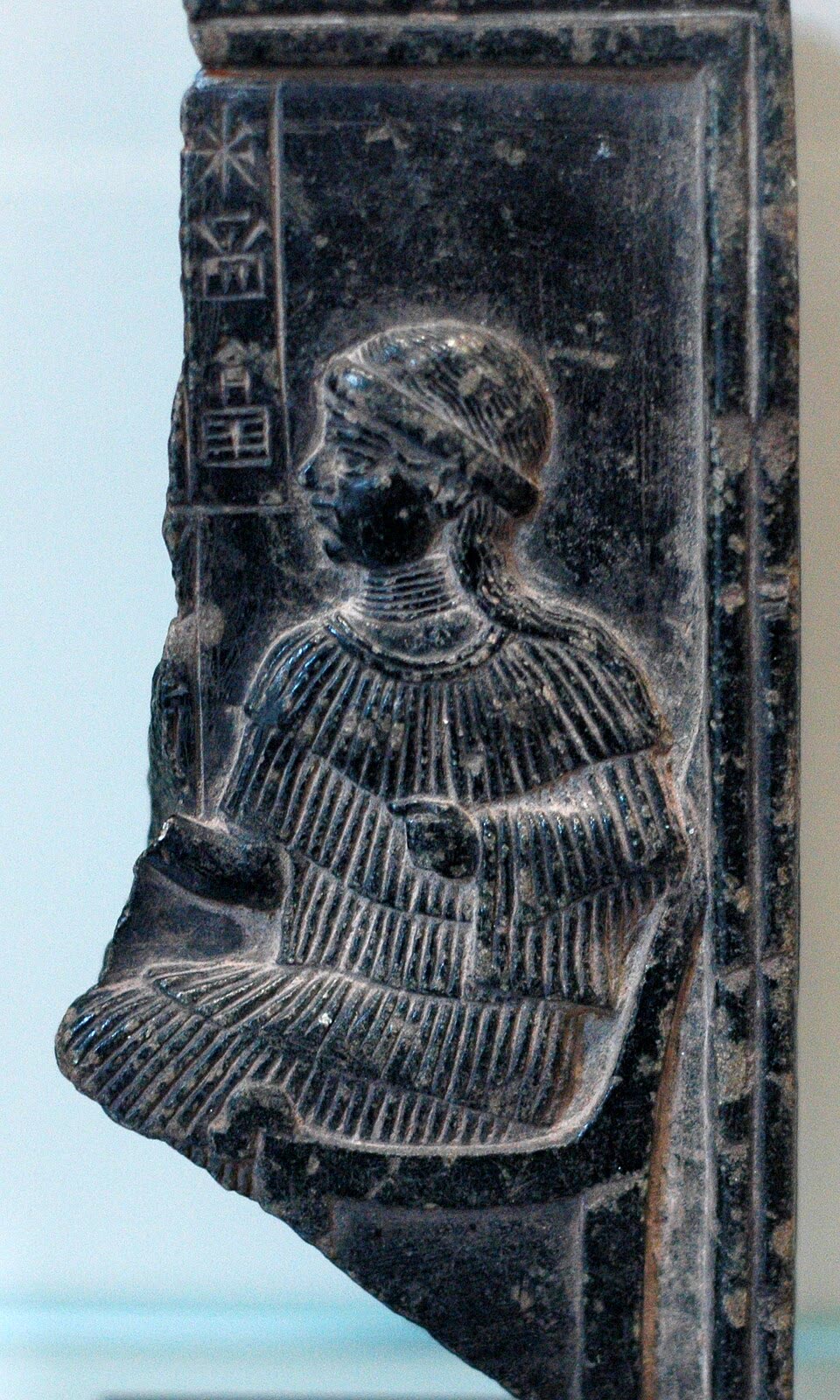
A fragment in the Louvre preserves another sort of witness. The museum identifies AO 2761 as a Neo-Sumerian steatite relief, fourteen centimeters high, with a votive inscription for Ninsun. The surviving carving shows a seated figure in a tiered garment with a circlet across her hair. The Louvre describes the figure as possibly a priestess. Claudia Suter interprets the surviving name as the beginning of a dedication and compares the figure's dress with other representations of high priestesses. [3] [8]
The missing part of the relief leaves the original scene open to interpretation. A hypothesis discussed in the exhibition catalogue She Who Wrote is that the figure took part in a banquet with Ninsun on the lost side of the plaque. The name still visible gives independent evidence of a dedication to the goddess, whose remembered relationships in epic and royal praise belong to their respective texts. [1] [2] [3] [8] [9]
References and notes (9)
- Andrew George, The Epic of Gilgamesh Standard Babylonian Tablets I and III, especially I 244–291 and III 14–128, and introduction on the adoption scene. Return to the text ↑
- Cuneiform Digital Library Initiative, Šulgi D Composite edition P429779, lines 36–46, Ninsun and the child's divine relationships. Return to the text ↑
- Musée du Louvre, Fragment de bas-relief : prêtresse (?) Object AO 2761, dedication, material, dimensions and Neo-Sumerian date. Return to the text ↑
- Karen Sonik, Gilgamesh and Emotional Excess Pages 395 and 398–399 on counsel, dreams, prayer and Enkidu's relationship with Ninsun. Return to the text ↑
- Alexander Heidel, The Gilgamesh Epic and Old Testament Parallels Second edition, pp. 41–42, Tablet III, rooftop speech and fragmentary adoption passage. Return to the text ↑
- Electronic Text Corpus of Sumerian Literature, Gilgameš and Ḫuwawa (Version A) Composition 1.8.1.5, lines 136–148 and manuscript variants. Return to the text ↑
- Satsuki Ando, Relationships between Gods and Kings in the Sumerian Royal Hymns Abstract, the familial language of the hymns of Ur-Namma and Šulgi. Return to the text ↑
- Claudia E. Suter, Between Human and Divine Discussion at Figure 14, identification of the seated figure, and reading of the votive inscription. Return to the text ↑
- She Who Wrote: Enheduanna and Women of Mesopotamia Catalogue entry 89, its discussion of the putative priestess and possible banquet scene. Return to the text ↑
Suggest a correction · Suggest a source for this record
Cite this record
IL Archive, «Ninsun, the Mother Who Counsels Gilgamesh», https://ilarchive.com/en/entities/ninsun