Entity · Deity
Nuska, Enlil's Vizier and God of the Lamp
A reference page linking a name, group, or concept to the materials that discuss it.
- Names
- Nuska · Nusku
- Region
- Mesopotamia: Ur in southern Iraq and Harran in its historical north
Nuska carries messages between Enlil and the protesting gods in Atraḫasīs. Mesopotamian monuments mark him with a lamp, and prayers appeal to him for judgment and protection during the night.
Estimated reading time: 5 min Published Last reviewed:
Share article
Text
Introduction
Nuska, also called Nusku, is a Mesopotamian god of fire and light and a minister of EnlilEnlilEnlil/Ellil: a major Mesopotamian god associated with destinies, kingship, and Ekur at Nippur, already prominent in third-millennium god lists. His name’s origin and cult beginnings remain debated.Glossary · Click to read the explanation. In the AkkadianAkkadianAn ancient East Semitic language written in cuneiform from the third millennium BCE; its varieties include Babylonian and Assyrian, and it served in international diplomacy.Glossary · Click to read the explanation epic Atraḫasīs, he wakes his master during a night crisis, advises him to summon other gods and goes out to hear a grievance. On Babylonian stone monuments, a lamp can stand for him among the emblems of other gods. In an Akkadian prayer about a troubling dream, he is addressed as a judge and companion of the sun god ShamashShamashMesopotamian god of the sun and justice, shown before Hammurabi on an eighteenth-century BCE stele preserved in the Louvre.Glossary · Click to read the explanation. [1] [2] [3]
A mediator at the gate
The Old Babylonian version of Atraḫasīs from Sippar begins with labor divided among gods. The IgigiIgigiCollective of deities called Igigi or Igigū in Akkadian sources from the Old Babylonian period onward. They labour and rebel in Atrahasis; their numbers and relation to the Anunnaki vary by text.Glossary · Click to read the explanation do the work, grow exhausted and assemble outside Enlil's house. The episode takes place in the middle of a watch of the night. The gatekeeper discovers the gathering and wakes Nuska, who then wakes Enlil. Claus Wilcke's edition and reading preserve the sequence of actions at the gate and Nuska's speech to his master. [1]
Nuska describes the gods at the gate as Enlil's own children and asks why Enlil fears them. He advises calling Anu and EnkiEnkiMesopotamian deity also known as Ea, linked with Eridu and the Abzu (deep fresh waters), wisdom, incantations, and narratives of creation and cosmic order. Later written attestations do not identify the deity of Eridu’s earliest layers.Glossary · Click to read the explanation, and they come to a council. When the assembly seeks the cause of the gathering, Anu proposes sending Nuska to ask. In the Standard Babylonian version from the Sippar library, Nuska comes out, kneels and stands before delivering his instructions. The poem repeats the questions as first entrusted to him and then spoken at the assembly. The repetition presents him as a messenger whose duty is to convey the words of the council faithfully. [1] [4]
The workers' answer is collective. They say the whole group rebelled because the burden of labor had become unbearable. Nuska returns with the same account. The report leads into the gods' discussion of how to relieve the workers and their decision to have humankind take over the burden. Nuska's place in these exchanges is that of a close servant who can also offer counsel and carry an unwelcome answer into his master's presence. [1] [4] [5]
The lamp on a land grant
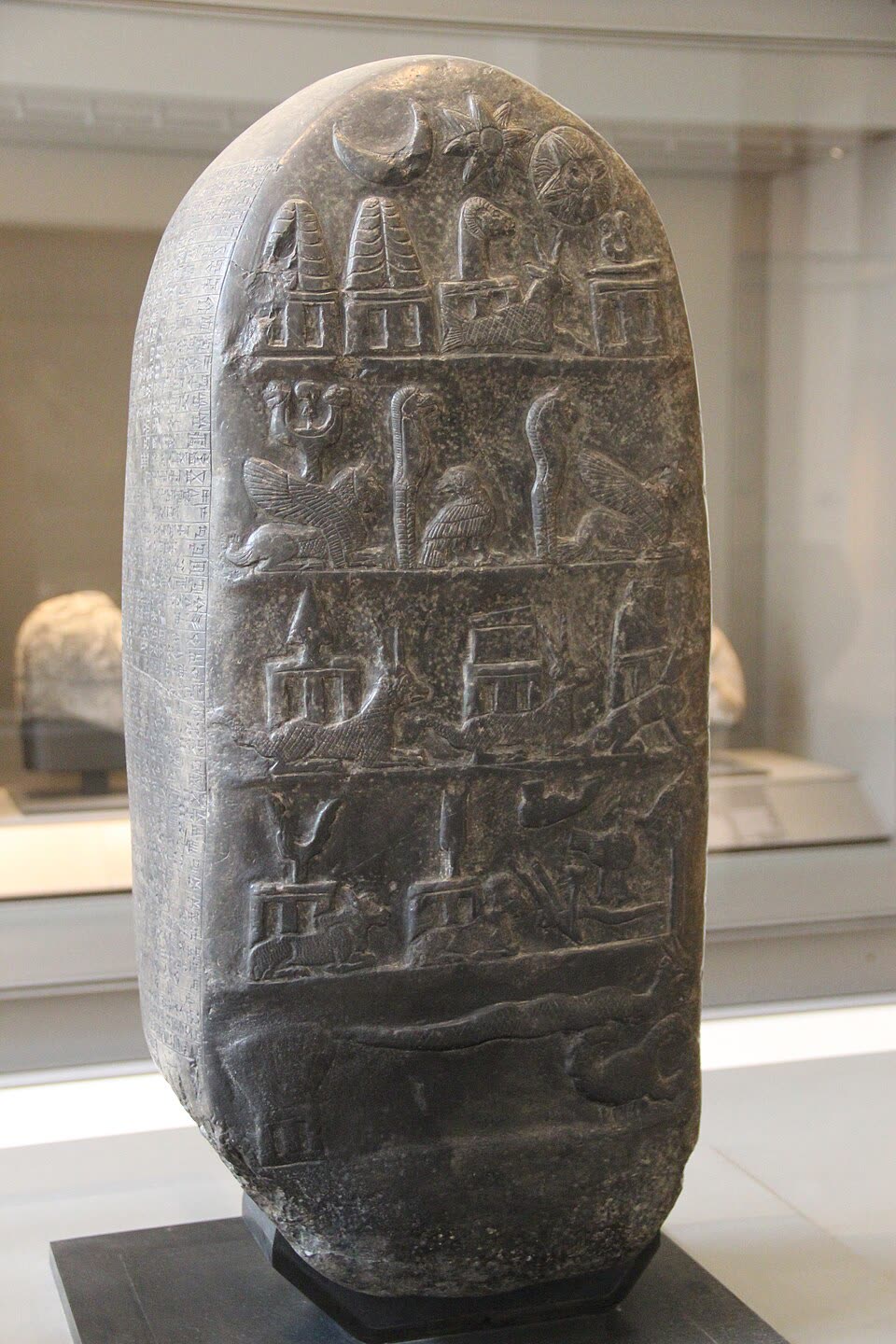
The limestone kudurru of Meli-Shipak in the Louvre, SB 22, records the king's grant of land to his son Marduk-apla-iddina. Carved registers display emblems of the gods. Among them are the crescent of Sin, the solar disk of Shamash and the lamp assigned to Nusku. The object's cuneiformCuneiformWriting with wedge-shaped signs, developed from Mesopotamian recording traditions and used for several languages from the third millennium BCE.Glossary · Click to read the explanation text records the transfer, while the sculpted field places it among divine presences. The object was made in Babylonia and excavated at Susa, where it had been taken in antiquity. [2]
The identification of the lamp also rests on inscriptions. The Louvre's separate fragment SB 783 preserves names beside several emblems, among them Nusku beside the lamp and Ningirsu beside a plough. Tallay Ornan traces lamps from the kudurru tradition to smaller stamp sealsStamp sealA small engraved implement pressed into soft clay to leave an impression, unlike a rolled cylinder seal. Its uses are investigated through sealings, find contexts and wear; imagery alone establishes neither writing nor belief.Glossary · Click to read the explanation, where some examples stand high on a tripod. She connects the design of those tripods to objects used to hold real lamps. A lamp on a land grant and a lamp on a seal reflect different ways of placing the same god's emblem into an arrangement of signs. [6] [7]
Judgment during the night
The composition edited by Duane Smith as Nusku 12 begins by naming the god as the companion of Shamash. The speaker calls him a judge and asks him to decide the case of a dream. The prayer mentions successive night watches, giving the troubled dream a time in which Nusku's power as a guardian of darkness is relevant. The petitioner asks to receive any good outcome and to escape harm if the dream means ill. Smith favors the reading that the speaker knows the dream and is unsure of its significance. [3]
The surviving ritualRitualAn organised or distinguished practice meaningful to a community; it may leave traces, but its form alone does not reveal an associated doctrine.Glossary · Click to read the explanation instructions around the prayer connect the request with a physical lamp. Smith explains that the associated actions are only partly preserved and that the placement of the prayer in a particular ancient series is uncertain. In this setting the lamp is part of the rite itself. The petitioner addresses the god through the object associated with his light, while his title as companion of Shamash brings to mind the sun god's association with judgment. [3]
Temples and divine family
Nippur, the city of Enlil, was a center of Nuska's worship. An iconographic survey identifies two temples there and records a place for him within the temple of Sin at Harran. In that northern tradition Nuska was called the son of the moon god. Other texts associate his parentage with Enlil or An, and the protective incantations of Maqlû invoke him with more than one such relationship. This evidence records different ways of relating the god to the authority of a major deity in a local cult or a ritual. [3] [8]
The connections overlap with the roles of Girra, also called Gibil, a fire god with similar powers in some incantations. One inscribed seal has been read as attaching a group of flames to Nuska, although its archaeological origin is uncertain. The labeled stone fragment offers firmer evidence for the lamp. Taken together, the literary scene at Enlil's gate, the prayer spoken at night and the emblems show where the god was expected to act, who sought his help and how a craftsman could give him a place on a monument. [1] [3] [6] [8]
References and notes (8)
- Claus Wilcke, Atramḫasīs, Old Babylonian version from Sippar Tablet I, columns i–iii, transliteration and translation of the labor crisis and Nuska's commission. Return to the text ↑
- Musée du Louvre, Kudurru de Meli-Shipak SB 22, object description, list of emblems, inscription and provenance. Return to the text ↑
- Duane Smith, An Incantation-Prayer: Nusku 12 In Reading Akkadian Prayers and Hymns, pp. 179–184, translation and discussion of the petition, its language and surviving context. Return to the text ↑
- A. R. George and F. N. H. Al-Rawi, Tablets from the Sippar Library VI: Atra-ḫasīs Introduction and editions of Standard Babylonian Tablets I–II, the uprising and Nuska's delivery of the message. Return to the text ↑
- Sources of Early Akkadian Literature, Atraḫasis I (all periods) Comparative translation, lines 125–190, the collective reply, Nuska's report and the proposal to create humankind. Return to the text ↑
- Musée du Louvre, Kudurru fragment SB 783 Object description listing named emblems, including the lamp of Nusku. Return to the text ↑
- Tallay Ornan, The Triumph of the Symbol § 5.2.1.3, the lamp on the kudurrus and Babylonian seals, tripods and context of the cult at Harran. Return to the text ↑
- Sebastian Hageneuer, Nusku Iconography of Deities and Demons, §§ I–II, names, parentage, temples and proposed emblems. Return to the text ↑
Suggest a correction · Suggest a source for this record
Cite this record
IL Archive, «Nuska, Enlil's Vizier and God of the Lamp», https://ilarchive.com/en/entities/nuska