Person
Gregory of Tours
- Timeline
- From 538 CE to 594 CE
Bishop of Tours (573–594) and Gallo-Roman historian, author of ten books of Histories. He rendered the Ephesian Sleepers tale into Latin with a Syrian interpreter; its source language and path of influence remain under study.
Estimated reading time: 9 min Published Last reviewed:
Share article

Text
Introduction
Gregory of Tours (Georgius Florentius Gregorius, c. 538/539–594) was bishop of Tours in Gaul from 573 and one of the principal Latin witnesses to the sixth-century Frankish kingdoms. He lived through much of the political turbulence he described, but did not write a neutral state chronicle: kings, churches and saints form a Christian account shaped by episcopal responsibilities. His links with the Christian East are especially visible in his Latin rendering of the Seven Sleepers of Ephesus, produced with the help of a Syrian intermediary. This entry distinguishes narrated events, composition dates and surviving manuscripts. It treats miracle stories as evidence of beliefs, literary aims and social relations, not as automatically verified supernatural events.
The geographical setting here is Gaul, particularly Auvergne and Tours, in present-day France.
From Auvergne to the bishopric of Tours
Born Georgius Florentius near Clermont in Auvergne, Gregory belonged to a Gallo-Roman family connected with urban and ecclesiastical elites. His parents were Florentius and Armentaria; his relatives included bishops such as Gallus of Clermont and Nicetius of Lyon. His accounts of his ancestry and education are themselves partly products of his self-presentation, but his documented career involved ecclesiastical service before his appointment to Tours in 573. He died in 594, conventionally dated to 17 November. Later accounts of his sanctity belong to the history of his posthumous reputation rather than independently verifying every detail of his biography. [1]
Tours was a centre of devotion to Martin of Tours, the fourth-century bishop whose tomb and basilica attracted pilgrims and endowed the city with unusual influence. Gregory's appointment occurred while rival Merovingian kings disputed territories; the city was important politically as well as religiously. His own Histories recount conflicts over asylum at Martin's church, episcopal authority and civic privileges. His office was not confined to preaching or writing: at the end of the Histories he recalls rebuilding the cathedral and restoring the decoration of Martin's basilica after earlier fires. A recent scholarly reading connects such building works to the preservation of the see's institutional memory and rights. That is an interpretation supported by evidence about buildings and archives, not a single explicit statement of his intentions. [2]
Ten Books of Histories, not merely a national history
His best-known work is the Decem libri historiarum ('Ten Books of Histories'), often called Historia Francorum or 'History of the Franks' in subsequent reception and editions. The latter title is convenient but narrower than the work: it begins with creation, biblical history and the Church, and moves toward Gaul, Frankish kings, bishops, urban communities, wars and disputes up to around 591. The pace slows as Gregory approaches events within his experience, but this does not turn the text into neutral minutes. His preface makes the conduct of rulers, the righteous and wrongdoers parts of a morally charged Christian history. [3] [5]
At the opening of Book I, after the general preface, he sets out his Christian creed and declares his intention to write of kings at war with peoples, martyrs against pagans and churches against heretics. These categories help explain both his selection of material and the placement of events. In the general preface he also laments the decay of literary culture in Gallic cities: an argument for recording the deeds of his age, not a statistical description of schooling. [3]
Our translation of this fragment from the first preface is 'As the culture of the liberal arts receded from the cities of Gaul, or rather was almost perishing.' The Latin follows the edited text of Krusch and Levison, not a claimed direct transcription from an individually examined manuscript folio. [3]
The bishop's account of himself and his books
The Histories end in Book X, chapter 31, with a succession of bishops of Tours culminating in Gregory himself. He lists his church-building works and writings, and urges his successors not to abridge or rewrite his books by selecting some parts and omitting others. This is the request of an author aware of the vulnerability of texts in transmission; it also defends the memory and standing of the church of Tours. [4]
That is, 'I wrote ten books of histories, seven of miracles and one on the lives of the fathers.' He next mentions a work on the Psalter and another concerning the scheduling of ecclesiastical offices. These figures express Gregory's own grouping of his writings: the seven miracle books must not be confused with all eight hagiographical books once Vita Patrum is counted separately. [4] [6]
Miracle collections and saints' lives are central
The seven miracle books comprise Gloria martyrum ('Glory of the Martyrs'), Virtutes Iuliani (miracles of Julian of Brioude), four books of Virtutes Martini (miracles of Martin of Tours) and Gloria confessorum ('Glory of the Confessors'). A separate Vita Patrum collects lives of holy men and women of the Gallic religious milieu. Further short texts have also been attributed to Gregory, including traditions of the apostle Andrew and a work on observing the stars to regulate hours of prayer; not every attribution or survival status is equally secure. [6]
In healing stories and reports of relics and shrines, Gregory supplies no independent measurements proving supernatural events. He does, however, provide valuable evidence about supplicants, episcopal authority, visitors, gifts and the standing of holy places in urban society. His proximity makes some accounts of his own times especially significant; for earlier events he often depended on previous records and oral reports. Each episode needs testing against whatever other documents or accounts survive. [2] [14]
The Seven Sleepers and an identifiable interpreter
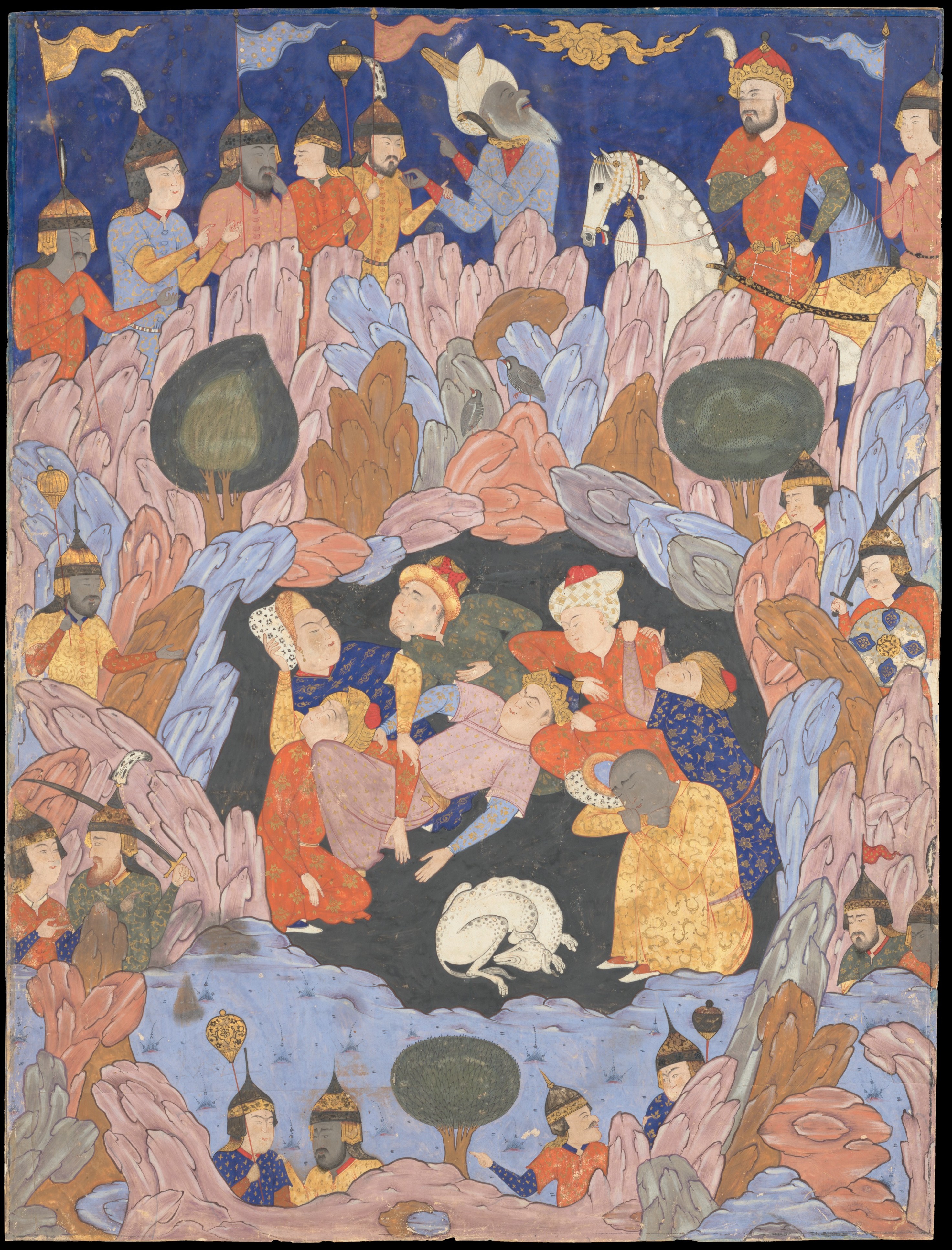
A notable instance of eastern Christian narrative reaching Gaul is the story of seven Christian youths at EphesusEphesusAncient city in western Türkiye with major Roman and early Christian phases.Glossary · Click to read the explanation who, in the story's chronology, flee persecution under the emperor Decius (249–251) and awaken in the reign of Theodosius II (408–450). Gregory gives a summary in Gloria martyrum, chapter 94; a longer text in twelve chapters is transmitted under his name as the Passio sanctorum martyrum septem dormientium apud Ephesum. The reigns within the tale are not dates for composing the Latin version and do not independently establish that the wondrous sleep occurred. [7] [9]
At the end of chapter 94 Gregory makes this declaration in Latin, as quoted by Oxford's specialist record
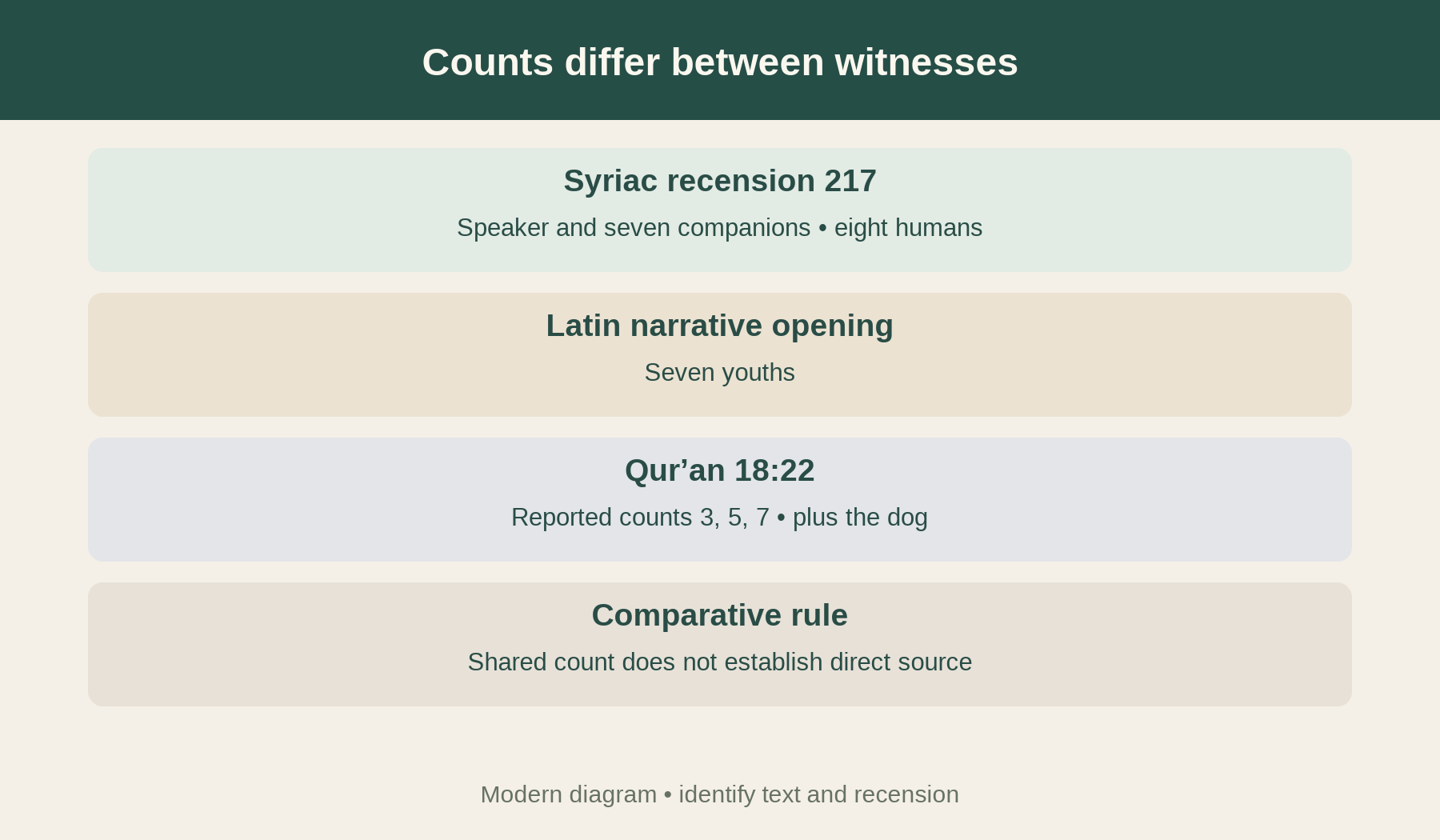
Our translation is 'Their account of suffering sets this out more fully, which we rendered into Latin with the interpretation of a certain Syrian.' This is a specific claim about a translation process and distinguishes the brief retelling from a longer version. The ending of the longer Passio names the intermediary John the SyrianJohn the Syrian, Gregory's interpreterInterpreter named in the ending of the Latin Sleepers of Ephesus account, dated to the sixth century CE.Glossary · Click to read the explanation, using interpretante Iohanne Syro. For that ending we rely on the wording transcribed in the Oxford record with reference to Krusch's edition; we have not collated all surviving manuscripts of the Passio or read the critical apparatus in full. [7] [8] [9]
Oxford's evidence database generally places the long translation between 573 and 587. Gloria martyrum was compiled in Gregory's later sixth-century working life and may reflect collection and revision over time. Calling John 'Syrian' establishes a named intermediary in the Latin witness, but does not by itself decide whether their immediate written or oral source was in SyriacSyriacAn Aramaic literary language rooted in Edessa, first attested in non-Christian inscriptions and later prominent in Christian writing, scholarship, translation and liturgy.Glossary · Click to read the explanation or Greek, let alone show that this man conveyed the same text to other communities. [8] [9]
Eastern and Qur'anic parallels: what they do and do not show
Versions of the Sleepers' tale circulated in Syriac before or around Gregory's lifetime. In the poetic homily attributed to Jacob of SerughJacob of SerughJacob of Serugh (c. 451–521), Syriac poet, preacher, and bishop of Batnae, known for biblical metrical homilies, letters, and an attributed homily on the youths of Ephesus.Glossary · Click to read the explanation (d. c. 521), eight young Christians feature in the narrative, whereas Gregory's longer Latin narrative begins with seven. The Qur'anThe QuranThe central scripture of Islam, consisting of 114 Arabic surahs; its study distinguishes Quranic discourse from manuscript history, reading traditions, and historical inference.Glossary · Click to read the explanation, in Sura 18:22, reports proposed counts of three, five and seven youths, each with a dog added to the stated number. The verse does not resolve the number simply by reporting these proposals. Shared themes of cave, long absence and awakening establish a related narrative environment; they do not alone make Gregory's Latin text a direct source for the Qur'an, still less identify John himself as the conduit. [10] [11]
Three different chronologies and the manuscripts
- 249–251 and 408–450: Decius and Theodosius II within the story's time, not securely dated historic sleep.
- Late fifth to early sixth century: circulation and writing of eastern Christian forms, including the Syriac homily attributed to Jacob of Serugh.
- Approximately 573–587: a proposed window for Gregory's longer Latin translation, not a fixed year for every line.
- Approximately 575–594: a broad composition/revision horizon for the Ten Books of Histories, whose final events reach about 591; Gloria martyrum is a different work from the later sixth century.
- Late seventh century onwards: surviving manuscripts of the Histories, including Paris, Bibliothèque nationale de France, Latin 17655, fol. 2, from a witness containing the first six books; Carolingian and later copies show omissions and rearrangement. The date of a surviving folio is not Gregory's date of composition. [5] [8] [10] [12] [13]
Research into the transmission of the Histories shows that abbreviated or selected copies of Books I–VI circulated beside the complete ten-book tradition. Carolingian compilations later rearranged material and joined it to continuations by other historians. Thus a manuscript bearing the conventional title 'History of the Franks' need not contain the original ten-book structure, and its changes must not automatically be attributed to Gregory. [12]
The worth and limits of his testimony
Two complementary scholarly approaches explain the need for critical reading. Heinzelmann examines the work's literary design and Christian model of society, while Merrington reads writing, church restoration and archival repair together as forms of episcopal action. Yet identifying pedagogical or political purposes does not prove that every event was invented. More useful is to distinguish what Gregory witnessed, what he collected from others and what is attested only by his account, then weigh independent evidence and narrative placement. [2] [14]
Nor does his self-description as writing in a 'rustic' manner prove that he lacked education or that sixth-century Latin had ceased to follow rules. His preference for a speech intelligible to many coexists with rhetorical devices and biblical allusion. His references to plain language are evidence for choices of register, not an automatic diagnosis of linguistic incompetence. [3] [15]
Gregory matters in two ways: he is an indispensable witness to sixth-century Gallic politics, religion and institutions, and an author with purposes that require analysis. His naming of a Syrian interpreter for an Ephesian story most securely attests a particular Latin claim about transmission. The precise language of the intermediary source, the layers of the Sleepers tradition and its later routes of influence require additional comparative witnesses; the name alone cannot settle them.
References and notes (15)
- Biographical and family information and the appointment in 573 from the published chapter summary; full book not read. Tamar Rotman, “Gregory of Tours,” Hagiography, Historiography, and Identity in Sixth-Century Gaul (2021), ch. 1, pp. 29–46 (online summary). Return to the text ↑
- Accessible specialist article on building projects and episcopal memory; introduction, arguments and discussion passages examined. John Merrington, “The building projects and the Histories of Gregory of Tours,” Early Medieval Europe 30/2 (2022), pp. 159–184, esp. introduction and discussion. Return to the text ↑
- Edited Latin text of the general preface and Book I inspected with printed page indicators; manuscript apparatus not collated. Gregorii Turonensis Opera, ed. B. Krusch and W. Levison, MGH SS rer. Merov. I.1 (1951), first preface p. 1; Book I opening p. 3; TEI transcription, no apparatus. Return to the text ↑
- Read edited Latin of Histories X.31, including his list of books and charge to successor bishops, printed pp. 535–536. Gregory, Decem libri historiarum X.31, in MGH SS rer. Merov. I.1, ed. Krusch–Levison (1951), printed pp. 534–536; TEI without apparatus. Return to the text ↑
- Consulted Oxford research-record summary on structural chronology and debated composition; not a full reading of every book. The Cult of Saints in Late Antiquity, Oxford, E02136, source discussion of Gregory, Histories 5.14 and writing chronology (575–594). Return to the text ↑
- Works list cross-checked against Gregory’s own epilogue, the MGH catalogue and Oxford’s introduction; not full reading of each miracle book. MGH, Scriptores rerum Merovingicarum I.1–I.2, catalogue descriptions; Gregory, Histories X.31; Oxford E00647, Source. Return to the text ↑
- Retained original reference to the long Passio; inspected MGH contents and Oxford’s quotation of its colophon, not all critical-edition pp. 397–403 or variants. Gregory of Tours, Passio sanctorum martyrum septem dormientium apud Ephesum, ed. B. Krusch, MGH SS rer. Merov. I.2 (1969), printed pp. 397–403; index and Oxford E05364. Return to the text ↑
- Read the accessible Oxford E05364 record in full, including its twelve-chapter synopsis, closing attribution and source-language caveat. Oxford, Cult of Saints in Late Antiquity, E05364 (2018); Gregory, Passio 1–12; Krusch (1969), pp. 398–403. Return to the text ↑
- Read full Oxford E00647 record quoting Latin from Glory of the Martyrs 94 and distinguishing the shorter account from the Passio. Oxford, Cult of Saints in Late Antiquity, E00647 (2015), Gregory, Gloria martyrum 94; ed. Krusch (1969), printed pp. 100–101. Return to the text ↑
- Read Oxford E02525 summary and discussion of the Syriac homily and dating; no claim to read the Syriac text in Vatican MSS 115 or 217. Oxford, Cult of Saints in Late Antiquity, E02525 (2017), Jacob of Serugh, Homily on the Youths of Ephesus; Guidi 1884, printed pp. 358–369 cited. Return to the text ↑
- Consulted Arabic text of Quran 18:22; no contemporary copyrighted translation reproduced in the entry. The Quran, Sura al-Kahf 18:22, Arabic text and comparative renderings. Return to the text ↑
- Read Austrian Academy of Sciences project page on the manuscript tradition, six-book abbreviations and Carolingian rearrangements. Austrian Academy of Sciences, “Histories of a history: Gregory of Tours’ Historia in the Carolingian and post-Carolingian period,” project article. Return to the text ↑
- Read the Wikimedia Commons file-level metadata for the BnF manuscript image, including provenance, late-seventh-century date and folio; image not reused. BnF, MS Latin 17655, fol. 2 (Luxeuil/Corbie, late 7th c.), illustrated frontispiece; Wikimedia Commons specific file metadata and public-domain mark. Return to the text ↑
- Used Cambridge University Press’s accessible sample of Heinzelmann (introduction and opening of chapter 1), not its unavailable analytical chapters or entire book. Martin Heinzelmann, Gregory of Tours: History and Society in the Sixth Century (Cambridge, 2001), sample PDF, introduction pp. 1–6 and ch. 1 opening p. 7. Return to the text ↑
- Consulted publisher page’s extract on Latin registers and Gregory’s language; not the whole subscription chapter. Registers of Latin in Gaul from the Fifth to the Seventh Century, Oxford Academic, §6.3 “The Age of Gregory of Tours” (publisher extract). Return to the text ↑
Suggest a correction · Suggest a source for this record
Cite this record
IL Archive, «Gregory of Tours», https://ilarchive.com/en/people/gregory-of-tours
Continue reading