Person · Literary figure
Lugalbanda, the Hero Who Ran to Uruk
- Names
- Lugal-banda · Lugalbanda
- Region
- Mesopotamia
Sumerian poems make Lugalbanda a survivor and swift messenger of Uruk. A king list and early cult texts preserve different accounts of his standing and family.
Estimated reading time: 5 min Published Last reviewed:
Share article
Video
Lugalbanda: The mountain cave, the Anzud bird and the road to Kulaba
The mountain cave, the Anzud bird and the road to Kulaba. The whole story in two illustrated chapters, told from the ancient clay tablets; where the tablets are broken, the narration says so. Illustrations, narration voice and visual effects were created with AI tools by IL Archive; the text is a faithful retelling based on the ancient tablets.
The YouTube player loads only when you press play. Watch on YouTube
Text
Introduction
Lugalbanda crosses the mountains twice in the Sumerian poems about Enmerkar's expedition to Aratta. On his way out he falls gravely ill and is left with food and weapons in a cave. He later wins the power to run without tiring from the Anzu bird and carries Enmerkar's appeal to InannaInanna / IshtarA prominent Mesopotamian goddess whose Sumerian name Inanna became associated with Akkadian Ishtar across diverse traditions. She was associated with desire, war, royal authority and Venus, while local forms and genealogies varied among texts.Glossary · Click to read the explanation at Kulaba. A different text, the Sumerian King List, remembers him as a shepherd who held kingship for 1,200 years. The poems and the list had different uses for the same figure. [1][2][3]
Left in the mountain cave
Enmerkar leads the troops from UrukUrukAncient city at Warka in southern Iraq, a major urban centre around 3200 BCE that preserved early writing and accounting tablets.Glossary · Click to read the explanation, called Unug in Sumerian. Seven elite commanders come from Kulaba, a name the poem uses alongside Unug. Lugalbanda is the eighth man. When illness strikes, the others cannot carry him home. They make a shelter and leave him dates, figs, cheese, bread and several kinds of drink. They place his weapons nearby. The food could sustain him if he recovers. If he dies, his companions mean to retrieve his body when they return from Aratta. The preparations give the episode the character of both an improvised sickroom and a potential burial. [1]
The sick man turns to the sky. He first implores the sun god Utu and describes his isolation in terms of the voices he would hear at home. When Inanna appears as the evening star, he calls Kulaba the city where his mother bore him. The moon god Suen gives him the strength to stand, and on the following morning the deity who afflicted him departs. Later, a dream calls him to make offerings. He uses the weapons left by his companions and prepares a banquet for An, EnlilEnlilEnlil/Ellil: a major Mesopotamian god associated with destinies, kingship, and Ekur at Nippur, already prominent in third-millennium god lists. His name’s origin and cult beginnings remain debated.Glossary · Click to read the explanation, EnkiEnkiMesopotamian deity also known as Ea, linked with Eridu and the Abzu (deep fresh waters), wisdom, incantations, and narratives of creation and cosmic order. Later written attestations do not identify the deity of Eridu’s earliest layers.Glossary · Click to read the explanation and Ninhursag. The man who could barely move can now provision an offering table. [1]
What Anzu gives him
In the second poem Lugalbanda feeds Anzu's chick with honey cakes, meat and fat, puts kohl on its eyes and applies cedar scent. The parent returns to a silent nest and fears for the chick, then sees how carefully it has been tended. The bird offers Lugalbanda several rewards. These include abundance and military prowess. Lugalbanda asks for reliable strength and the ability to run anywhere he sets his mind to, and promises that woodcarvers will make statues of the bird. [2]
The gift changes how the poem describes his movement. Anzu flies above and spots the troops. On the ground Lugalbanda sees the dust they have raised. The bird tells him to keep the gift secret. The soldiers are astonished by his return and ask how he could cross the mountain rivers. Lugalbanda tells them how he travelled and found food in the wild. They cluster around him and feed him as if he were a chick in a nest, repeating in human company an image the poem has already used for his care of Anzu's young. [2]
Enmerkar's messenger
At Aratta, the fighting has gone on for months and the soldiers have seen a crop grow while they are held before the city. Enmerkar asks for a messenger to go back to Kulaba. Lugalbanda volunteers and insists on travelling alone. He reaches Inanna before the offering table has been brought to her. In Enmerkar's message, the king recalls how Enki drained the marsh and how long he spent building and judging at Uruk. Inanna then gives directions involving a tamarisk and a fish in Aratta, whose ritualRitualAn organised or distinguished practice meaningful to a community; it may leave traces, but its form alone does not reveal an associated doctrine.Glossary · Click to read the explanation use she connects to the expedition's success. [2]
The mission answers a question set up by the illness. In the cave Lugalbanda longed to reach his own city, depending on the gods to restore him. At Aratta, he is the only one prepared to undertake the same crossing for everyone else. Enmerkar's words reach their recipient because the young man who was left behind can now move between the army and the goddess. [1][2]
Shepherd, king and divine father
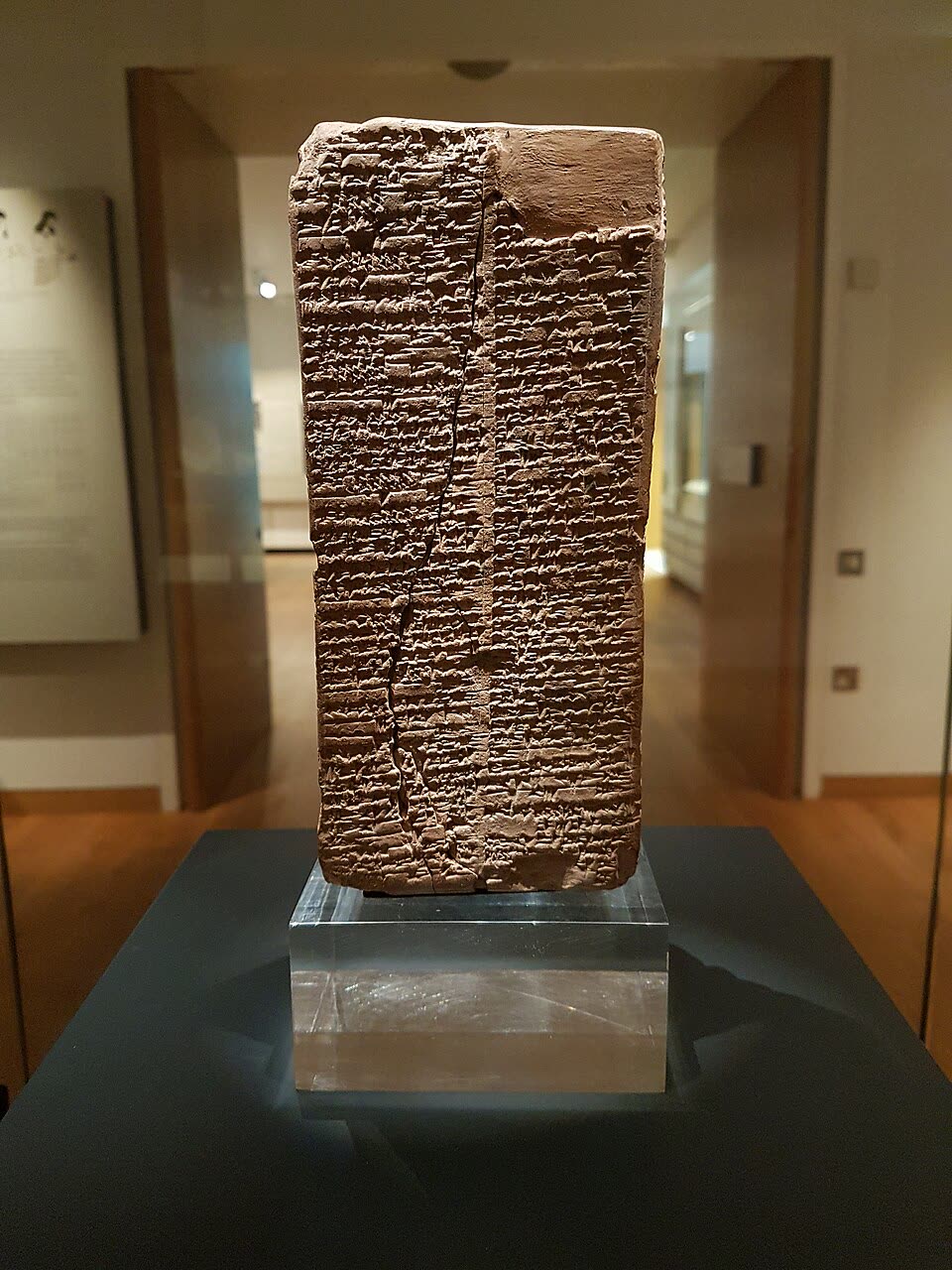
The King List puts Lugalbanda after Enmerkar and before the fisherman Dumuzid. The Weld-Blundell Prism, a clay copy of the work dated by the Ashmolean Museum to around 1800 BCE, preserves the entry with the divine sign before Lugalbanda's name. The reign of 1,200 years belongs to the legendary part of a text that presents kingship as passing between cities. The numeral records what scribes claimed for Uruk's early rulers. It cannot establish when Lugalbanda lived. [3][4][5]
The divine sign also appears in early evidence from Abu Salabikh, where a god listGod ListsTexts collecting divine names for preservation, teaching and classification, with varying theological organization.Glossary · Click to read the explanation includes Lugalbanda and a hymn puts him next to Ninsun. Another composition from the site places both figures in a story with Inanna. Jan Lisman's edition follows the difficult text through an encounter in the mountains and a dispute over marriage procedures. Several transitions have to be reconstructed. The witnesses show that Lugalbanda's relation to Ninsun had a place in written tradition quite apart from the two Aratta poems. [6][7]
Gilgamesh calls Lugalbanda his father and Ninsun his mother in version A of Gilgamesh and Huwawa. He invokes them when Enkidu wants him to turn back, then again when he confronts Huwawa. In the King List, by comparison, Gilgamesh's entry describes his father in words the Oxford translation tentatively renders as a phantom. The poems could call on the authority of a divine parent even when another tradition told the royal succession differently. [3][8]
References and notes (8)
- Electronic Text Corpus of Sumerian Literature, Lugalbanda in the Mountain Cave Read lines 35–200, 201–263 and 314–393 on the expedition, the sickness and prayers, the dream and the offerings. Return to the text ↑
- Electronic Text Corpus of Sumerian Literature, Lugalbanda Read lines 50–110, 142–250 and 251–417 on Anzu's nest, the gift, the reunion, Enmerkar's message and Inanna's instructions. Return to the text ↑
- Electronic Text Corpus of Sumerian Literature, The Sumerian King List Read lines 95–133 on Uruk's succession and the entries for Lugalbanda, Dumuzid and Gilgamesh. Return to the text ↑
- Stephen Langdon, The Weld-Blundell Collection, volume II Read pp. 11–12, W-B 1923.444 column III, for the prism's reading of Lugalbanda and his reign. Return to the text ↑
- Ashmolean Museum, Sumerian King List Read the date, clay medium, collection number and explanation of how the list depicts the transfer of kingship. Return to the text ↑
- J. D. Bing, Gilgamesh and Lugalbanda in the Fara Period Read pp. 1–3 on the Abu Salabikh god list, hymn and literary tablet. Return to the text ↑
- Jan Lisman, The (Inchoate) Marriage of Lugalbanda and Ninsumuna Read section 2 on the surviving manuscript, reconstructed narrative, and difficulty of reading the early composition. Return to the text ↑
- Electronic Text Corpus of Sumerian Literature, Gilgamesh and Huwawa, Version A Read lines 90–95 and 130–144 on the repeated invocation of Ninsun and Lugalbanda. Return to the text ↑
Suggest a correction · Suggest a source for this record
Cite this record
IL Archive, «Lugalbanda, the Hero Who Ran to Uruk», https://ilarchive.com/en/people/lugalbanda
Continue reading