Person · Figure
Nabonidus
- Names
- Nabonidus · Nabû-naʾid
- Region
- Mesopotamia
Nabonidus took the Babylonian throne in 556 BCE and lost it to Cyrus in 539 BCE. His building inscriptions and the records of his years at Tayma show a reign that later authors depicted in sharply different ways.
Estimated reading time: 5 min Published Last reviewed:
Share article
Text
Introduction
An entry in the Nabonidus Chronicle places the king at the Arabian oasis of Tayma while his heir and officials remained in Babylonia. It says the New Year’s festival did not take place, although offerings at the principal shrines continued. It is a brief account of how the absence of Nabonidus, the last Neo-Babylonian monarch, affected a city that still dated its documents by his reign. His own inscriptions and monuments describe the same years from a different place and with a different purpose. [1]
The throne and its obligations
Nabonidus took power in 556 BCE after the brief reign of Lâbâši-Marduk, who was removed in a coup. The earliest surviving dated document naming Nabonidus as king comes from June 556. His first full regnal year began in 555, which accounts for the two starting dates used in accounts of his reign. In a damaged stele from BabylonBabylonBabylon is an ancient city in central present-day Iraq, south of BaghdadGlossary · Click to read the explanation he presents himself as an experienced envoy who had served Nebuchadnezzar IINebuchadnezzar IIBabylonian king, 605–562 BCE, appearing in Daniel and independently attested in inscriptions and building remains.Glossary · Click to read the explanation and Neriglissar. The inscription gives his account of prior service, while the part that might have told us more about the transfer of power is missing. [1]
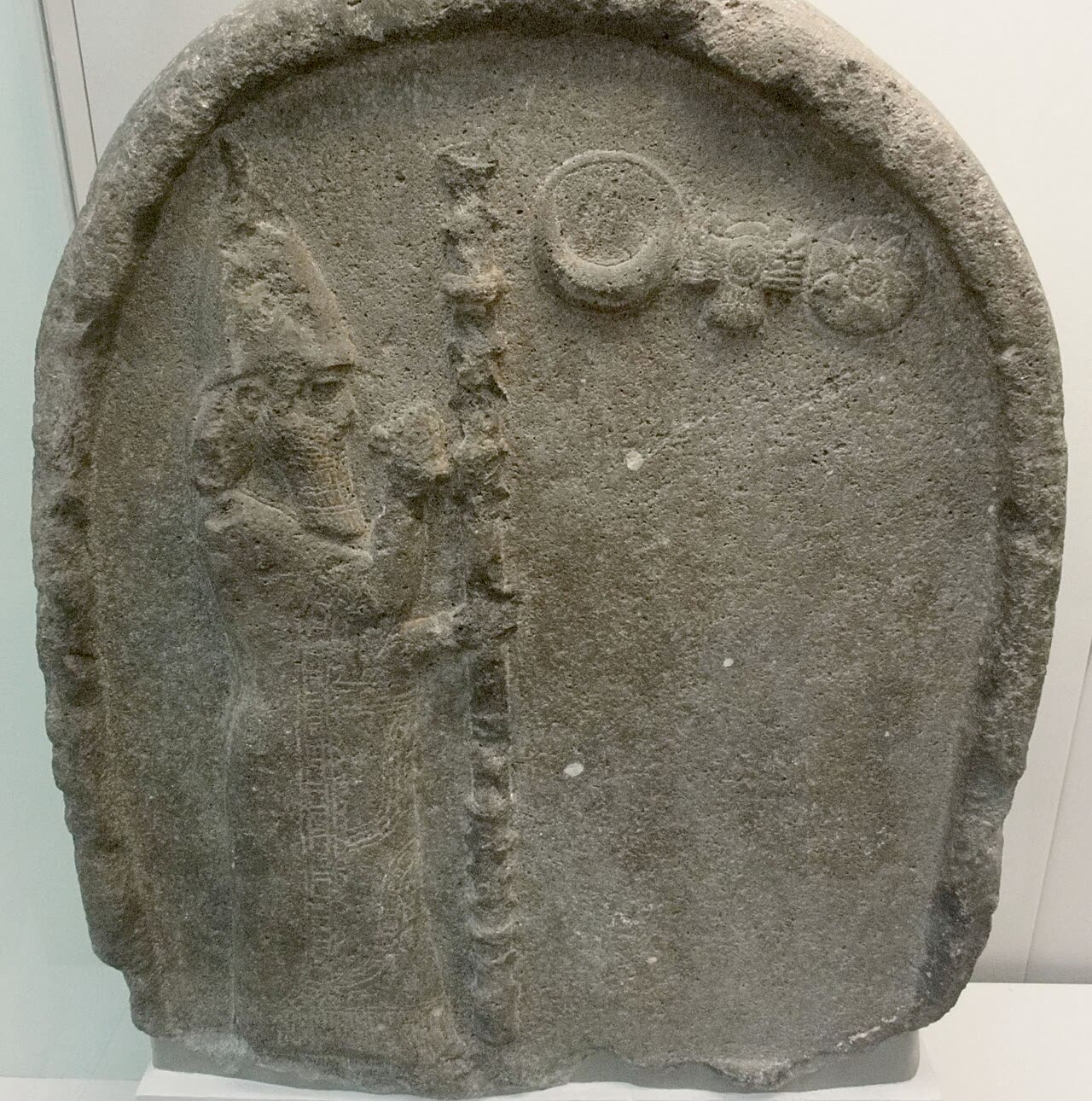
Other inscriptions name his father, Nabû-balāssu-iqbi, and his mother, Adad-guppi. The latter’s commemorative stele says she placed her son in the service of the previous kings. It also makes her devotion to SînNanna / Su’en / SinMesopotamian moon god known as Nanna, Su’en and Sîn/Sin. Worshipped especially at Ur and Harran, he is associated with the crescent and lunar cycle; names and myths have different histories.Glossary · Click to read the explanation at HarranHarranHistoric city in southeastern Türkiye, south of Şanlıurfa; Genesis places Abraham’s family there on its journey towards Canaan.Glossary · Click to read the explanation part of the story of her son’s appointment to the throne. Nabonidus himself invokes the moon god on the Tarif Stele pictured here. The damaged inscription credits Sîn’s command for the return of rains through Adad and the opening of springs through EaEnkiMesopotamian deity also known as Ea, linked with Eridu and the Abzu (deep fresh waters), wisdom, incantations, and narratives of creation and cosmic order. Later written attestations do not identify the deity of Eridu’s earliest layers.Glossary · Click to read the explanation. It goes on to list quantities of commodities available for a shekel of silver. The prices give the claim of restored abundance a specific form. [1] [2] [3]
The years in Arabia
The period of residence at Tayma occupied roughly a decade, ending around 543 BCE. In the Harran inscription Nabonidus says the moon god took him away from BabylonBabylonBabylon is an ancient city in central present-day Iraq, south of BaghdadGlossary · Click to read the explanation and that he travelled among several Arabian towns, including Tayma and Dadanu. The later Verse Account gives this sojourn a hostile interpretation and portrays the king as lavishing attention on an oasis at the expense of Babylon. Tayma lay on routes connecting Arabia to the LevantThe LevantThe Levant is a regional name for lands along the eastern MediterraneanGlossary · Click to read the explanation and Babylonia. Its position helps explain the interest in the oasis but leaves open why Nabonidus made it his residence for so long. [1] [2] [4]
The Saudi-German excavations at Tayma found cuneiformCuneiformWriting with wedge-shaped signs, developed from Mesopotamian recording traditions and used for several languages from the third millennium BCE.Glossary · Click to read the explanation inscriptions that give independent evidence of a royal presence. One damaged stone bears a Babylonian-style relief and mentions MardukMardukBabylon’s leading god, worshipped at Esagil and elevated in the Akkadian Enūma eliš. His symbols include a spade and mušḫuššu dragon. His earliest origins remain obscure; Nibiru is no evidence of a planetary homeland.Glossary · Click to read the explanation and Zarpanitu. The editors attribute it to Nabonidus on the basis of the script, relief and historical setting because the opening with the royal name has been lost. Meanwhile, the chronicle records that the designated heir, Belshazzar, stayed in Babylonia with officials and troops. Documents continued to call him the king’s son, even though he exercised authority during his father’s absence. In several of those years, the chronicle says, the statues of Nabû and Marduk did not take their customary parts in the New Year’s festival. [1] [4] [5]
Temples and competing accounts
After his return, Nabonidus rebuilt Ehulhul, Sîn’s temple at Harran. His building account describes foundations laid over those associated with earlier Assyrian kings and the installation of the temple’s divine residents. In one version of the royal dream, MardukMardukBabylon’s leading god, worshipped at Esagil and elevated in the Akkadian Enūma eliš. His symbols include a spade and mušḫuššu dragon. His earliest origins remain obscure; Nibiru is no evidence of a planetary homeland.Glossary · Click to read the explanation commands the work in the presence of Sîn. In the Harran stele, Sîn gives the command. In the cylinder account of the dedication, the king describes leading the gods out of Babylon and seeing them settled again at Harran. He offers gifts and likens the city’s radiance to that of the moon. The same king also records work at Sippar on sanctuaries of the sun god ŠamašShamashMesopotamian god of the sun and justice, shown before Hammurabi on an eighteenth-century BCE stele preserved in the Louvre.Glossary · Click to read the explanation and the goddess Anunītu. These inscriptions preserve religious claims and building projects at particular places. The Verse Account, by contrast, frames his devotion to the moon god as an accusation. How far this reflects a program to displace Marduk in Babylon remains disputed. [1] [2] [6]
The last year
For 539 BCE the chronicle first records the celebration of the New Year’s rites. Later in the year it describes divine statues being brought from several cities to Babylon, before Cyrus II defeated the Babylonian army at Opis. The chronicle then gives distinct dates for the seizure of Sippar, the entry of the commander Ugbaru and Persian troops into Babylon, and the arrival of Cyrus himself in the capital. It says that Nabonidus fled and was captured in Babylon. Its description of an entry without a battle at the capital follows an account of killings at Opis in the same campaign. [1]
The Cyrus Cylinder depicts the change of rule as Marduk’s choice of a ruler who would set matters right. It says that the god placed Nabonidus in Cyrus’s hands and sanctioned the return of divine statues to their sanctuaries. The cylinder credits Cyrus with reversing the former king’s actions, much as Nabonidus’s temple accounts credit him with bringing back gods after an earlier calamity. The two reigns meet in these acts of restoration as each ruler presents them. The chronicle anchors the loss of the throne in dated events, while the royal texts show how a conqueror and the king he displaced each claimed the gods’ approval. [1] [2] [7]
References and notes (7)
- Frauke Weiershäuser and Jamie Novotny, RINBE 2 and Nabonidus Chronicle Introduction pp. 3–6 and 11–14, chronicle pp. 25–27, especially ii 10–15 and iii 5′–22′ Return to the text ↑
- Frauke Weiershäuser and Jamie Novotny, Nabonidus’s royal inscriptions in RINBE 2 Nos. 28, 43, 47 and 2001, Ehulhul Cylinder, Tarif and Harran steles, and the Adad-guppi inscription Return to the text ↑
- L. W. King, Babylonian Boundary-Stones and Memorial-Tablets in the British Museum pp. 128–129, no. 37 and plates XCIII–XCIV, preserved relief and text of BM 90837 Return to the text ↑
- Hanspeter Schaudig, the cuneiform inscriptions in Taymāʾ II pp. 3–5, chronology, caravan routes, material evidence and Verse Account ii 25′–29′ Return to the text ↑
- Ricardo Eichmann, Arnulf Hausleiter and Hanspeter Schaudig, Archaeology and Epigraphy at Tayma pp. 169–173, stele TA 488 and criteria for its attribution Return to the text ↑
- K. Moukarzel, The Religious Reform of Nabonidus, A Sceptical View pp. 157–161, Verse Account and its polemical representation of the king Return to the text ↑
- Cyrus Cylinder, translated in R. J. van der Spek, Cyrus the Great, Exiles, and Foreign Gods Appendix A, lines 4–19 and 22–35, capture and return of divine images Return to the text ↑
Suggest a correction · Suggest a source for this record
Cite this record
IL Archive, «Nabonidus», https://ilarchive.com/en/people/nabonidus
Continue reading