Person · Researcher
Samuel Sandmel
- Timeline
- From 1911 CE to 1979 CE
Samuel Sandmel (1911–1979), an American Jewish rabbi and scholar of the New Testament and Hellenistic Judaism, studied Jewish–Christian relations and warned against abusive textual parallels without denying genuine literary influence.
Estimated reading time: 7 min Published Last reviewed:
Share article
Text
Introduction
Samuel Sandmel (1911–1979) was an American Jewish rabbi and scholar of the New Testament and Hellenistic Judaism, including Jewish traditions expressed in Greek in the ancient Mediterranean world. He is best remembered for warning against “parallelomaniaParallelomaniaOverstating textual or conceptual parallels and inferring historical dependence without adequate contextual, chronological, or transmission evidence; not a rejection of comparison.Glossary · Click to read the explanation,” but he also wrote on early Christianity, biblical interpretation, and Jewish–Christian relations. This entry places his methodological argument within his career and wider scholarship, tests it against examples he actually discussed, and distinguishes its enduring force from judgments that later research has challenged.
Education and academic career
Sandmel was born in Dayton, Ohio, in 1911. He graduated from the University of Missouri in 1932, was ordained at HebrewHebrewA Northwest Semitic language of the Canaanite group, encompassing Iron Age epigraphy, Biblical, Rabbinic, medieval and Modern Hebrew; its scripts and pronunciations changed over time.Glossary · Click to read the explanation Union College in 1937, and worked in Jewish campus ministry before earning his doctorate at Yale University in 1949 under Erwin R. Goodenough, a historian of Hellenistic Judaism. He taught at Vanderbilt University from 1949 to 1952, then became professor of Bible and Hellenistic literature at Hebrew Union College–Jewish Institute of Religion and served as its provost from 1957 to 1966. In the year of his death, 1979, he held a professorship of religion at the University of Chicago. [2][3]
His intellectual formation helps explain his priorities. He did not limit his research to Palestinian rabbinic writing but attended closely to Greek-writing Jews, especially Philo of AlexandriaPhilo of AlexandriaGreek-writing Jewish interpreter in Roman Alexandria (roughly first century CE), who read the Torah philosophically while defending its practices; his works survive through Greek copying and Armenian translation.Glossary · Click to read the explanation, a first-century CE Jewish philosopher, and the historian Josephus. He asked how the Gospels and the letters of Paul the ApostlePaul the ApostlePaul was a first-century CE Christian letter writer whose letters preserve early Christian formulations.Glossary · Click to read the explanation could be read against the varied Jewish worlds of the Roman period: neither completely isolated from them nor merely assembled from borrowed earlier texts. [3]
A project larger than a single term
In A Jewish Understanding of the New Testament (1956), Sandmel addressed Jewish readers seeking a historical understanding of Christian scripture. His preface rejects two opposite responses lacking sustained reading: dismissing the New Testament wholesale as alien, or enthusiastically embracing it simply because some teachings resemble Jewish teachings. In a chapter on the historian's approach, he distinguishes explaining the aims and context of religious claims from accepting those claims as one's own. The book promotes informed understanding between religious communities, not his adoption of Christian doctrine. [4]
His chapter “The Church and the Law of MosesMosesCentral figure in Exodus, Torah traditions and the Qur’an; childhood accounts differ in detail.Glossary · Click to read the explanation” offers a concrete example of his comparative work. He analyzes how Philo related Mosaic law to the Greek philosophical concept of the “law of nature,” then compares this with Paul's handling of the Torah and the status of non-Jewish believers, drawing on Romans 2:14–16. Sandmel's comparison finds real similarities and differences without treating them as automatic proof that Paul copied Philo. This is his historically situated interpretation, not a claim of scholarly unanimity or a newly recovered ancient text. [5]
Other books include The Genius of Paul (1958), The Hebrew Scriptures (1963), We Jews and You Christians (1967), and Judaism and Christian Beginnings (1978). Their range reflects a career in historical research, interpretation, teaching, and interreligious engagement rather than one limited to criticizing a comparative technique. [2]
The 1961 address and 1962 article
Sandmel delivered his presidential address to the Society of Biblical Literature in St. Louis on 27 December 1961. Published as “Parallelomania” in the Journal of Biblical Literature, volume 81, number 1 (1962), pages 1–13, it describes parallelomaniaParallelomaniaOverstating textual or conceptual parallels and inferring historical dependence without adequate contextual, chronological, or transmission evidence; not a rejection of comparison.Glossary · Click to read the explanation as the scholarly excess of magnifying similarities between passages and then treating resemblance as proof of literary dependenceLiterary dependenceA historical relation in which a text was composed using another text or version; similarity alone cannot establish its direction.Glossary · Click to read the explanation moving in an already assumed direction. His concise original formulation is: “The key word in my essay is extravagance.” [1]
He said he had encountered the word in an older French book but could not recall its author or title, and he supplied a further bibliographical lead in a footnote. He therefore cannot be credited with coining it, nor should his uncertain recollection be treated as a secure first attestation. More importantly, he did not reject comparisons or the possibility of literary influence. He objected to the unsupported leap from resemblance to a confident story of borrowing. His three main fields were rabbinic literature and the Gospels, Philo and Paul, and the Dead Sea ScrollsDead Sea ScrollsManuscript collections from the Judaean Desert, best known through Qumran: diverse works, languages and textual forms, with copying distinguished from composition.Glossary · Click to read the explanation and the New Testament. [1]
From verbal resemblance to persuasive evidence
Sandmel first offers an example that rules out blanket skepticism: close analysis of the parallels between Samuel–Kings and Chronicles can support the judgment that the Chronicler used earlier narratives. But the verbal similarity between Philo's Greek nomos agraphos (“unwritten law”) and the rabbis' torah she-be'al pe (“oral Torah”) proves much less. On his reading, Philo is discussing written statutes in relation to the philosophical law of nature, while the rabbis discuss the authority of explanations and expansions of the Pentateuch. The argument rests on the different functions of the expressions within their traditions, not on denying that both involve unwritten teaching. [6]
His second example concerns Genesis 6:9. Calling NoahNoahNoah is the flood-story figure in Genesis and a prophet in the Qur’anGlossary · Click to read the explanation righteous “in his generations” allowed Philo and certain rabbis to assess his righteousness in comparison with others. Their resemblance might derive from independent interpretations of shared scripture rather than direct borrowing in either direction. Equally, the number “259” that he mentions for possible parallels between Paul and the rabbis is expressly hypothetical, not the result of a count. The task is to distinguish a common textual inheritance from possible interaction and from demonstrable borrowing with an identifiable source and direction. [6]
Context, late sources, and comparative bias
Sandmel subjected the massive commentary by Hermann Strack and Paul Billerbeck, Kommentar zum Neuen Testament aus Talmud und Midrasch (“Commentary on the New Testament from the Talmud and Midrash”), to sustained criticism. He acknowledged its usefulness as a collection of evidence, but objected to rabbinic excerpts stripped of context, and to Babylonian material that might have been written down in the fifth century CE being treated as the immediate source of first-century Christian passages. Accumulating parallels could create an illusion of weight; some comparisons, he argued, even ranked a saying attributed to Jesus above an almost identical rabbinic saying. [7]
The chronological distinction is essential. The lifetime of Jesus and Paul in the first century CE is not the date of the editing of later rabbinic compilations, still less the date of their earliest surviving manuscript. A late compilation can preserve earlier traditions, but that requires independent evidence. Conversely, distinctive verbal detail, sustained sequence, and plausible access can strengthen a genuine case for influence. The warning is neither an automatic veto of connections nor a license to infer them from resemblance alone. [7]
Qumran: the argument's strength and the scholar's limits
The discovery of the Dead Sea Scrolls from 1947 onward formed part of the heated debate to which Sandmel responded. He challenged attempts to turn the sectarian writings associated with QumranQumranArchaeological site northwest of the Dead Sea near manuscript caves; its settlement and the groups who deposited the scrolls are studied together but not assumed identical. It is not synonymous with all Dead Sea Scrolls.Glossary · Click to read the explanation, near the northwestern shore of the Dead SeaDead SeaThe Dead Sea is a salt lake in the Jordan Rift Valley, near sites where ancient manuscripts were foundGlossary · Click to read the explanation, into a ready-made script for Jesus' career or Paul's theology. In his 1962 article he valued biblical manuscripts from the caves much more highly than the sect's own compositions, and pointed to the absence of explicit references to Jesus or Paul as a reason to doubt extravagant claims of a special link. Yet the absence of their names cannot, by itself, erase the value of the sectarian writings for reconstructing Jewish ideas and practices of the period. [8]
Historian Jason Kalman's 2009 study identifies a less persuasive dimension of Sandmel's position. Surveying his publications and their reception, Kalman finds that he continued to underrate the scrolls even as publication and study advanced. He reports Raymond Brown's counterargument: although sectarian and not representative of all Judaism, these manuscripts are close to the first century in a way many rabbinic compilations, known through later redactions, are not. Sandmel's warning about inflated claims remains forceful; a sweeping dismissal of Qumran's evidentiary value does not follow from it, and his assessments of the 1960s should not be mistaken for settled scholarship. [9]
An enduring but testable legacy
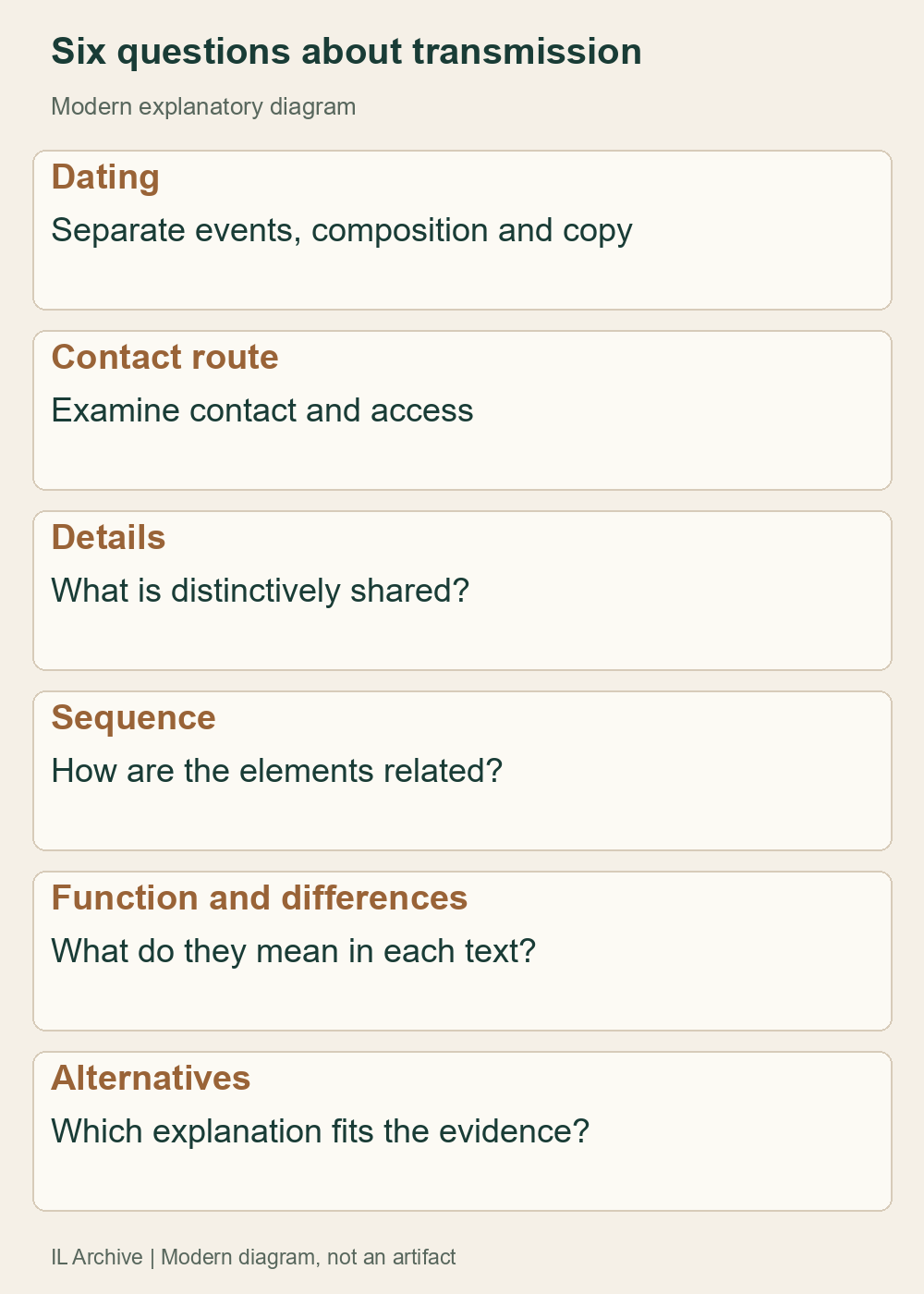
Read together, Sandmel's works reveal a Jewish interpreter of early Christianity, a student of Greek-speaking Jewish traditions, and a writer intent on more knowledgeable Jewish–Christian encounters. His warning against parallelomania is a question about how arguments are made, not a ban on comparisons: When are the witnesses dated? What distinctive material is shared? Was contact possible? Could a common environment explain the resemblance better? These questions are useful precisely because they invite textual testing while leaving Sandmel's own historical judgments open to revision.
References and notes (9)
- Samuel Sandmel, “Parallelomania,” Journal of Biblical Literature 81, no. 1 (1962): 1–13. Printed pp. 1–2: 27 Dec. 1961 address, definition, legitimate influence, and uncertain earlier use; text read in an online transcription, not the restricted publisher PDF. Return to the text ↑
- “Sandmel, Samuel,” Encyclopaedia Judaica, 2nd ed., biographical entry. Online biographical entry: dates, appointments, and selected publications. Return to the text ↑
- Jason Kalman, “Optimistic, Even with the Negatives: HUC-JIR and the Dead Sea Scrolls, 1948–1993,” American Jewish Archives Journal 61 (2009). Printed pp. 25–26, especially Sandmel’s education, appointments and research interests; PDF page numbering differs. Return to the text ↑
- Samuel Sandmel, A Jewish Understanding of the New Testament (Cincinnati: Hebrew Union College Press, 1956). Printed preface pp. xi–xviii and “The Historian’s Approach,” pp. 7–12, read through digital OCR transcription. Return to the text ↑
- Samuel Sandmel, A Jewish Understanding of the New Testament (1956), “The Church and the Law of Moses.” Printed pp. 64–67, including Philo, Paul, and Romans 2:14–16; digital OCR transcription. Return to the text ↑
- Samuel Sandmel, “Parallelomania” (1962). Printed pp. 2–5: Chronicles and Samuel–Kings, nomos agraphos and oral Torah, Genesis 6:9, and the hypothetical “259” example. Return to the text ↑
- Samuel Sandmel, “Parallelomania” (1962). Printed pp. 8–11, on Strack–Billerbeck: excerpts, late dating, accumulation and bias. Return to the text ↑
- Samuel Sandmel, “Parallelomania” (1962). Printed pp. 11–13, on Qumran discoveries, biblical copies and sectarian writings. Return to the text ↑
- Jason Kalman, “Optimistic, Even with the Negatives” (2009), American Jewish Archives Journal 61. Printed pp. 29–32; Kalman’s analysis and his secondary quotation of Raymond Brown’s 1971 review (original review not read). Return to the text ↑
Suggest a correction · Suggest a source for this record
Cite this record
IL Archive, «Samuel Sandmel», https://ilarchive.com/en/people/samuel-sandmel
Continue reading