Period
The Jemdet Nasr Period (c. 3100–2900 BCE)
- Timeline
- From 3100 BCE to 2900 BCE
- Region
- Mesopotamia
A short phase around the turn of the fourth to the third millennium BCE, named after a mound in central Iraq. Its painted pottery, administrative tablets and seal impressions preserve evidence of contacts between cities.
Estimated reading time: 5 min Published Last reviewed:
Share article
Text
Introduction
The Jemdet Nasr period is the name archaeologists give to a brief stretch of southern Mesopotamian history between the UrukUrukAncient city at Warka in southern Iraq, a major urban centre around 3200 BCE that preserved early writing and accounting tablets.Glossary · Click to read the explanation period and the Early Dynastic period. It is named after a mound in central IraqIraqIraq is a modern country encompassing much of ancient MesopotamiaGlossary · Click to read the explanation where painted pottery and some of the oldest clay tablets were dug up. This entry gives the usual dates, explains why they are uncertain, and sets out what the finds show and where the evidence stops.
A name taken from one mound
Jemdet Nasr is a tell, a settlement mound, in central Iraq, about 26 kilometres northeast of ancient Kish. The excavation plan distinguishes Mounds A and B. The large building discussed below lies in the northeast of Mound B. [7]
In 1925, a local resident brought finds said to come from Jemdet Nasr to the expedition excavating at Kish. Stephen Langdon began excavating Jemdet Nasr in 1926, and a second season followed in 1928. Ernest Mackay published the excavation report in 1931. Roger Matthews returned for two seasons in 1988 and 1989. The early excavators had recorded the building and the context of its finds only sketchily, so the renewed work revisited their plans and field notes. [7][8][9]
Dates, and why they are loose
This entry uses about 3100–2900 BCE for the archaeological period. The Jemdet Nasr research project also gives a broader range beginning around 3200 BCE. [8][7] The CuneiformCuneiformWriting with wedge-shaped signs, developed from Mesopotamian recording traditions and used for several languages from the third millennium BCE.Glossary · Click to read the explanation Digital Library Initiative uses about 3200–3000 BCE for the Uruk III writing phase in its catalogue. [10] Roger Matthews and Amy Richardson’s study of city seals spans about 3200–2750 BCE because it compares material from the end of Late Uruk through Early Dynastic I. [13]
In southern MesopotamiaMesopotamiaHistorical region associated with the Tigris and Euphrates: Uruk, Ur, Eridu, cuneiform, Sumer, Akkad, Babylon and Assyria, their languages and cults, and the limits of archaeological evidence.Glossary · Click to read the explanation the period falls between Late Uruk and Early Dynastic I. [8] Part of that span overlaps with the start of the Ninevite V pottery horizon in northern Mesopotamia and with the use of Proto-Elamite writing in the Susiana plain and the Iranian highlands. [17][18]
Painted pottery
Painted pottery is a hallmark of the period, and some vessels have designs in more than one colour. A jar rim in the excavation archive, for instance, has a geometric design painted in black and plum. Painted vessels were among the finds in the large building at Jemdet Nasr. The excavation records leave their distribution across the settlement and the social status of their users uncertain. [7] Woolley also recorded pottery of this type in early graves at Ur. [16]
A large building and its tablets
Langdon uncovered a large mudbrick building in the northeast of Mound B. The later excavators interpreted a series of large round installations in this area as ovens, perhaps part of a kitchen associated with the building. [7] Matthews and Richardson report that 243 proto-cuneiformProto-cuneiformEarly southern Mesopotamian script (c. 3350–3000 BCE): clay tablets with counting systems and signs for commodities, people and offices, as well as lexical lists; not yet a full rendering of speech.Glossary · Click to read the explanation tablets were recovered from the building. Published pieces from the site are held at the Ashmolean Museum in Oxford and the Iraq Museum in Baghdad. [13][14]
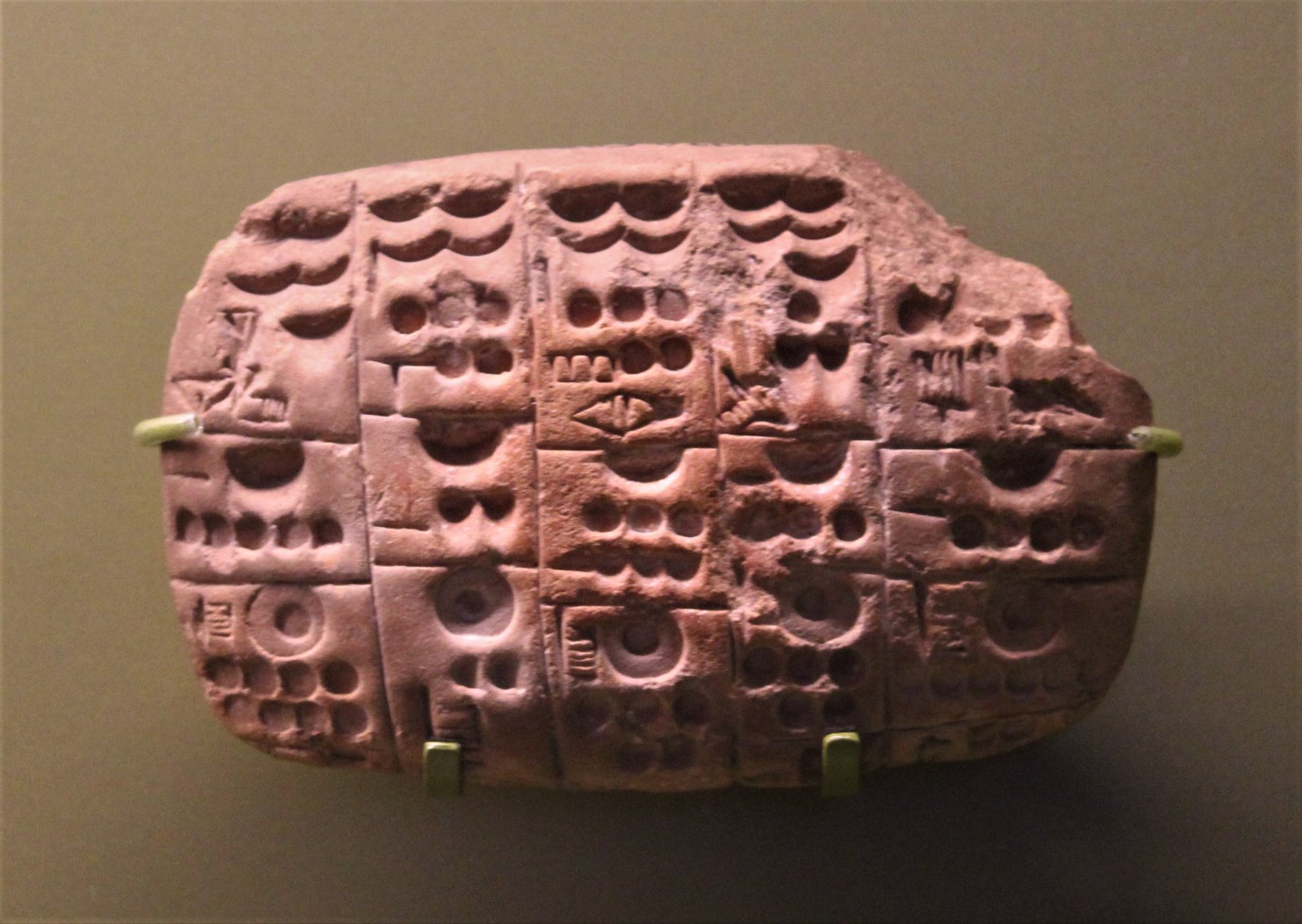
The tablets are written in proto-cuneiformProto-cuneiformEarly southern Mesopotamian script (c. 3350–3000 BCE): clay tablets with counting systems and signs for commodities, people and offices, as well as lexical lists; not yet a full rendering of speech.Glossary · Click to read the explanation, an early stage of cuneiformCuneiformWriting with wedge-shaped signs, developed from Mesopotamian recording traditions and used for several languages from the third millennium BCE.Glossary · Click to read the explanation writing. Many signs are pictorial, and the accounts record goods and quantities with little indication of sentence structure. The tablets from the building document activities such as the allocation of grain, dairy products and textiles and the management of workers and livestock. SumerianSumerian languageAncient language of southern Mesopotamia, clearly attested in third-millennium BCE texts and maintained in learning and ritual after its spoken use declined.Glossary · Click to read the explanation is a common proposal for the language behind this early script, which is difficult to identify with certainty. [13][15][21]
Scribes used several numerical systems, depending on what they counted or measured. In Robert Englund’s reading of a Jemdet Nasr account, MSVO 1:93, dry cereal products are counted in a system with groupings of 120 and beer in a system with groupings of 60. The grain needed to make those products is given in capacity measures. [15]
The Ashmolean tablet on this page, AN1926.583, is known as the Field of the EN Tablet. Its front records the dimensions and areas of five fields, as reflected in the museum’s title. The CDLI tablet essay counts six fields in the account as a whole. On the reverse, the edition identifies an entry for the EN’s field, entries for measured land and wooded perimeter land, and a combined total. [10][11][12] The CDLI commentary interprets the distribution as two thirds for the EN and the remaining third divided unevenly among five officials. [12] The wider archaic corpus also contains lists of words and signs arranged by subject. One example is the Archaic City List. [13][21]
Seals that list cities
Thirteen tablets from Jemdet Nasr carry impressions from the same cylinder sealCylinder sealSmall engraved cylinder rolled over soft clay to leave an extended image. Used to secure, document and identify administrative actions; its pictures do not automatically constitute writing.Glossary · Click to read the explanation. Matthews and Richardson read signs for Ur, Larsa, Nippur, Uruk, Keš and Zabala among those in the upper register. Some signs remain uncertain. Related city seal impressions are attested at Uruk and at Ur in Early Dynastic I. Researchers tentatively link a tablet in Berlin that bears the same seal as the Jemdet Nasr tablets to Tell Uqair. [13][22]
Matthews called these impressions city seals. On the basis of the boat scenes on impressions from Tell Uqair, Matthews and Richardson propose that they may record contacts linked to journeys of cult statues, possibly including a statue of InannaInanna / IshtarA prominent Mesopotamian goddess whose Sumerian name Inanna became associated with Akkadian Ishtar across diverse traditions. She was associated with desire, war, royal authority and Venus, while local forms and genealogies varied among texts.Glossary · Click to read the explanation. The accounts on the Jemdet Nasr tablets record small quantities of goods, consistent with one proposed role in ceremonial offerings. Thorkild Jacobsen had proposed that impressions from Ur recorded deliveries to that city by a league of cities. The purpose of the seal and the political ties among the cities remain open questions. [7][13]
Toby Wilkinson identifies two Near Eastern cylinder seals found in excavated graves at Naqada in Egypt. These objects are evidence that goods from the Near East reached Predynastic Egypt. [19][23]
Is it a real period?
Archaeologists debate whether Jemdet Nasr is best understood as a distinct chronological phase or a regional style. Roger Matthews argued that renewed study of the pottery and its contexts makes the phase recognisable. The name remains widely used for pottery and tablets from the transition between Late Uruk and the Early Dynastic period in southern Mesopotamia. [8][20]
What can be said
The tablets document accounting for land, labour and goods. The seal impressions show that many of the same city names recur, with variations in signs and sequence. The accounts and impressions support interpretations of contacts between cities, while the precise political arrangements and some readings of names remain uncertain. [13][21]
References and notes
- Wikipedia, 'Jemdet Nasr' (secondary summary of Mackay 1931, Matthews 1989–90 and later reports) Page read: location, size of mounds, excavation history 1925–1989, central building 92 x 48 m, tablets, sealing with city names, pottery, dates Return to the text ↑
- Wikipedia, 'Jemdet Nasr period' (secondary summary) Page read: dates and revisions, definition at the 1930 Baghdad conference, sites, painted pottery, writing and counting systems, seals, Naqada seal, relation to Uruk and Early Dynastic, debate whether a period or style Return to the text ↑
- Wikipedia, 'Proto-cuneiform' (secondary summary; cites Englund, Nissen, Damerow) First 100,000 of 167,696 characters: Uruk IV vs Uruk III dates and sign form, tablet count from Jemdet Nasr, proportion of lexical lists, field-area tablet AN1926.583 Return to the text ↑
- Wikimedia Commons file description, 'Jemdet Nasr tablet AN1926.583.jpg' (cites Ashmolean Museum AN1926.583 and MSVO 1,2) Description of the tablet read via API: addition of five field areas, division in three, EN and five individuals Return to the text ↑
- Matthews and Richardson, 'Cultic resilience and inter-city engagement at the dawn of urban history: protohistoric Mesopotamia and the city seals, 3200-2750 BC', World Archaeology 50(5), 2019, 723–747 Only the abstract and search-result descriptions were seen; the full text was not accessible, so their interpretation is reported cautiously Return to the text ↑
- Wikipedia, 'Ancient City Seals' (secondary summary; cites Matthews 1993, Jacobsen, Steinkeller, Yoffee) Page read: where and when city seals are found, city names, cultic-journey, league and trade interpretations Return to the text ↑
- University of Reading, Jemdet Nasr Project, “The Site.” ‘Location’, ‘The Early Excavations’, ‘The Relevance of the Cultural Assemblage’ and ‘The 1988–89 Seasons of Excavation’, including contour plan and images JN23_06, JN18_03 and JN12_06. Return to the text ↑
- Mónica Palmero Fernández, “Using DSLR to ‘Scan’ Colour Slides: Learning from the Digitising Jemdet Nasr 1988–1989 Project,” Internet Archaeology 55 (2020). §2, ‘Research Context’, on the site, the 1926 and 1928 and the 1988 and 1989 campaigns, the range c. 3200/3100–2900 BCE and the periodisation debate. Return to the text ↑
- Ernest Mackay, Report on Excavations at Jemdet Nasr, Iraq, with a preface by Stephen Langdon (Chicago: Field Museum Press, 1931). Stony Brook University Archive of Mesopotamian Archaeological Reports catalogue for the publication, date and publisher. Return to the text ↑
- Cuneiform Digital Library Initiative, “MSVO 1, 002 (P005069),” Ashmolean AN1926.583. Chronology, collection fields and transcription with translation and calculations, obverse §§1–5 and reverse columns 1–2. Return to the text ↑
- Ashmolean Museum, University of Oxford, “Tablet with calculation and addition of the areas of five fields,” AN1926.583. Collection record, title and alternative name, place of excavation, date, allocation and accession number. Return to the text ↑
- Cuneiform Digital Library Initiative, “Controlling the Means of Production in the 4th Millennium BC,” tablet P005069, AN1926.583. Commentary on the six fields and the interpretation of the distribution. It cites Nissen, Damerow and Englund, Archaic Bookkeeping (Chicago, 1993), pp. 55–57. Return to the text ↑
- Roger Matthews and Amy Richardson, “Cultic Resilience and Inter-City Engagement at the Dawn of Urban History: Protohistoric Mesopotamia and the ‘City Seals’, 3200–2750 BC,” World Archaeology 50, no. 5 (2019), pp. 723–747. Introduction, the Uruk III and Early Dynastic I case studies, figs. 2–9 and 15–18, and the previous and new interpretations. Published version at the University of Reading. Return to the text ↑
- Robert K. Englund, Jean-Pierre Grégoire and Roger J. Matthews, The Proto-Cuneiform Texts from Jemdet Nasr. I: Copies, Transliterations and Glossary, MSVO 1 (Berlin: Gebr. Mann, 1991). CDLI catalogue of published texts, including nos. 2, 22–23, 97–100 and 167–168, with Oxford and Baghdad holdings and individual provenance qualifications. Return to the text ↑
- Robert K. Englund, “Accounting in Proto-Cuneiform,” in Karen Radner and Eleanor Robson, eds., The Oxford Handbook of Cuneiform Culture (Oxford University Press, 2011), pp. 32–50. Pp. 39–42 and figs. 2.4–2.6, particularly MSVO 1:93, the counting of dry and liquid products and measures of grain capacity. Return to the text ↑
- Leonard Woolley, The Early Periods, Ur Excavations IV (Philadelphia, 1955). P. 27, ‘Jamdat Nasr Pottery’, including pottery in early graves from the Ur excavations. Return to the text ↑
- Francesca Simi, The Tell Gomel Archaeological Survey: Surface Research and Off-Site Investigations in the Heart of the Navkur Plain, Iraqi Kurdistan, PhD thesis (Ca’ Foscari University of Venice, 2019), vol. I. §6.7, p. 135, on Ninevite V pottery and the dates from Tell Brak and Tell Leilan. Return to the text ↑
- Robert K. Englund, “Elam iii. Proto-Elamite,” Encyclopaedia Iranica. Opening discussion of the geographical and chronological range of the Proto-Elamite script. Return to the text ↑
- Toby A. H. Wilkinson, “Uruk into Egypt: Imports and Imitations,” in J. N. Postgate, ed., Artefacts of Complexity: Tracking the Uruk in the Near East (British School of Archaeology in Iraq, 2002). ‘Cylinder seals’, pp. 241–242, including figs. 5–6 on the two pieces from Naqada graves. Return to the text ↑
- Roger Matthews, “Defining the Style of the Period: Jemdet Nasr 1926–28,” Iraq 54 (1992), pp. 1–34. Open extract on the periodisation debate and reanalysis of the pottery and contexts, read with the author’s abstract for “Jemdet Nasr: The Site and the Period”. Return to the text ↑
- Walther Sallaberger and Ingo Schrakamp, “Philological Data for a Historical Chronology of Mesopotamia in the 3rd Millennium,” in History & Philology, ARCANE III (Turnhout: Brepols, 2015). §4.1, pp. 53–54, on the composition of the wider archaic corpus and limits on identifying the language of the earliest writing. Return to the text ↑
- Roger Matthews and Amy Richardson, “Uruk and Ur in the City Seal Impressions, 3100–2750 BC: New Evidence, New Approaches,” in Walter Sommerfeld, ed., Dealing with Antiquity: Past, Present & Future, AOAT 460 (Ugarit-Verlag). Figs. 2–4 and table comparing the impressions and lists. The figure confirms the thirteen tablets from Jemdet Nasr. Return to the text ↑
- University College London, Digital Egypt for Universities, “Cylinder Seals in Mesopotamia.” Discussion of overlapping Uruk and Jemdet Nasr styles and the Petrie Museum cylinder seal from Naqada tomb 1863. Return to the text ↑
Suggest a correction · Suggest a source for this record
Cite this record
IL Archive, «The Jemdet Nasr Period (c. 3100–2900 BCE)», https://ilarchive.com/en/periods/jemdet-nasr-period