Ancient text
Infancy Gospel of Thomas
A text for line-by-line reading, with transliteration, translation, and resources.
- Names
- Childhood Deeds of Jesus · Infancy Gospel of Thomas · Paidika
A noncanonical Christian infancy gospel about Jesus aged five to twelve. A critical comparison of its Greek, Syriac and Latin witnesses, including the Hamburg papyrus dated to the fourth/fifth century.
Estimated reading time: 9 min Published Last reviewed:
Share article

Text
Introduction
The Infancy Gospel of Thomas recounts years in the boyhood of JesusJesus ChristJesus Christ is Christianity’s central figure, who lived in the first century CEGlossary · Click to read the explanation that the canonical Gospels scarcely narrate: play, water and clay, encounters with teachers, helpful wonders, and disturbing acts that alarm families. This entry asks what its different forms actually say, how their sequence and wording changed, and which witnesses can date the tradition. The familiar title does not establish the apostle Thomas as its author. [8]
This is an examination of a noncanonical Christian narrative and its transmission, not a claim that its miracles occurred. It differs from the sayings Gospel of Thomas, the Protevangelium of James about the beginnings of Mary and Jesus, and such other collections as Pseudo-MatthewGospel of Pseudo-MatthewLatin work on Mary and Jesus’ childhood, distinct from canonical Matthew.Glossary · Click to read the explanation and the Arabic and Armenian infancy gospels, even where individual stories overlap. [8]
Title, authorship, and narrative scope
Scholars abbreviate the work IGT. Its openings, episode order, and chapter divisions vary across recensions, or distinct transmitted forms. Later Greek texts contain a preface spoken by “Thomas the Israelite,” whereas the earlier core reconstructed through older witnesses circulated as deeds of the boy Jesus without a secure attribution. The expanded Greek D opening even names James as narrator. These shifting ascriptions identify no demonstrable historical author; the Thomas named in the sayings gospel must not be conflated with this title. [5] [8] [17]
The common narrative core begins when Jesus is five and ends when he is twelve. These ages belong to the narrated first-century setting, not the time when the text was composed. The closing Temple scene retells LukeGospel of LukeNew Testament gospel where Satan asks to test the disciples in 22:31–32.Glossary · Click to read the explanation chapter 2, while the other schoolroom and miracle episodes have no equivalent account in the canonical Gospels in this form. [4] [14]
Boys, clay birds, and conflicting deeds
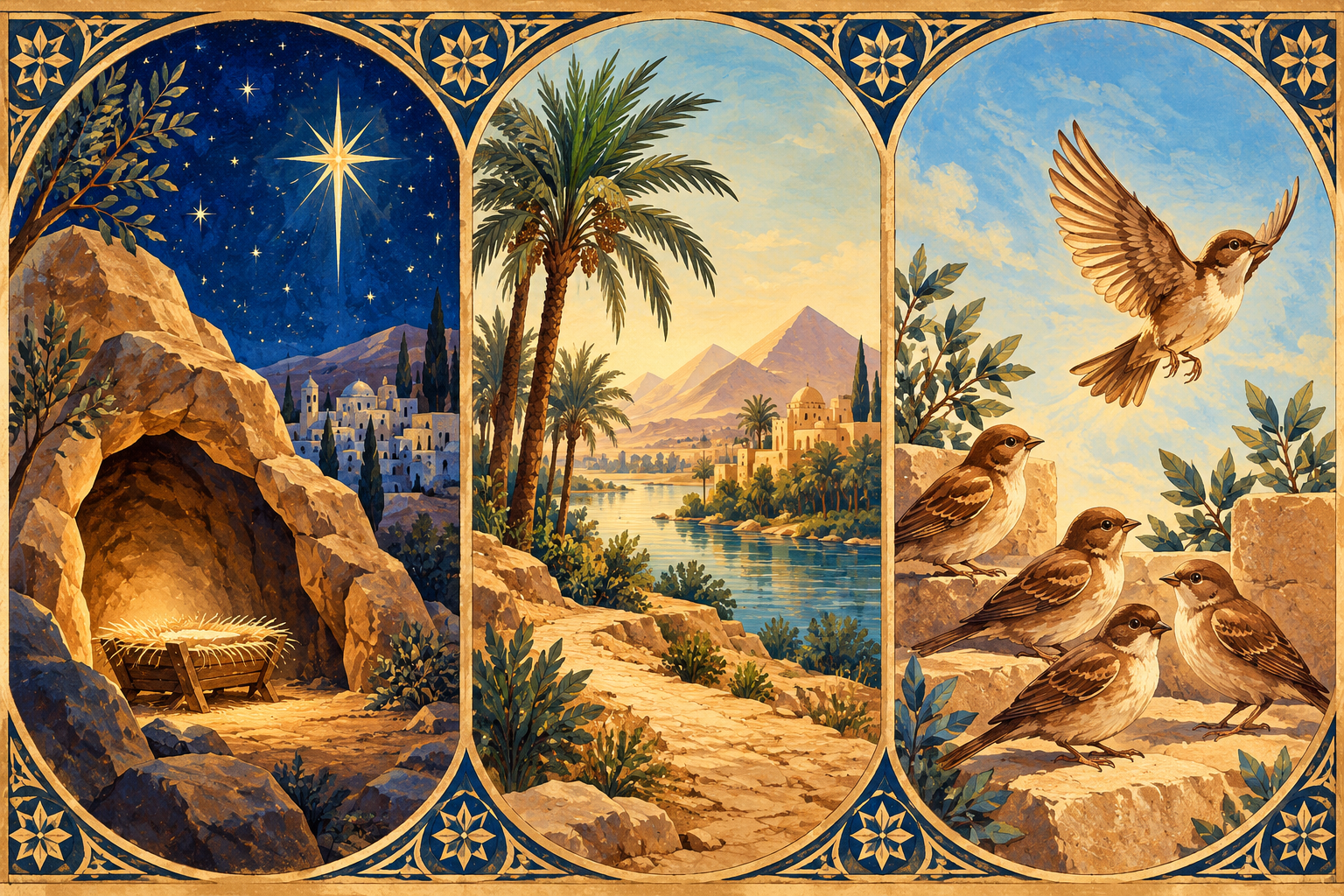
In Greek S, after rain, Jesus gathers water from a stream into pools and makes it clean by a word. On the Sabbath he models twelve sparrows out of clay. Someone reports the action to Joseph, who rebukes the boy; Jesus claps his hands and commands the sparrows to fly. Walker's First Greek Form places this in chapter 2. Greek B, however, places the destruction of the pools before the birds take flight and puts the birds in its chapter 3. These different actions should not be fused into a single supposedly universal text. [3] [4] [6]
The water becomes a source of conflict. The son of Annas the scribe, styled differently in some witnesses, drains the pools and withers after Jesus curses him. Another child collides with Jesus and dies after a pronouncement. The wonders emphasize the power of speech, but also provoke fear, parental accusations, and Joseph's embarrassment. These violent accounts must neither be erased from the narrative nor prematurely assimilated to its healing miracles. Even the offending child's identity and the curses' precise wording differ between forms. [3] [4] [5]
Zacchaeus and the problem of teaching
A teacher called Zacchaeus offers to teach Jesus letters and the manners owed to elders and peers. The pupil reverses the relation of authority: how can a teacher instruct him in beta without knowing alpha? The dialogue turns an ordinary lesson into a contest over what counts as knowledge. The elaborate account of alpha's strokes is part of the narrative's literary presentation of extraordinary wisdom; it is not independent evidence for classroom practice at first-century Nazareth. [3] [4] [7]
In Greek S, the teacher's humiliation leads toward relief: Jesus announces that those struck by his curses have been healed. The subsequent stories include raising Zeno after a fall from a roof, lengthening a carpenter's beam for Joseph, saving James from a snakebite, and helping an injured worker. Yet it would be misleading to describe all the traditions as one smooth moral progression. Another teacher dies after striking Jesus, although his restoration is told in some versions. The abbreviated Greek B leaves out sections crucial to this apparent movement; an arc of reconciliation in S or A cannot be assumed to occur in every recension. [4] [5] [6]
Two short, testable testimonies
The nineteenth-century English translation by Alexander Walker represents the boy challenging his teacher in First Greek Form, chapter 6: in substance, “You do not know alpha's nature; how can you teach another beta?” This is a historical intermediary translation of an edited Greek text, not a quotation from the Hamburg papyrus or a record of Jesus' historical speech. Its significance is the scene's reversal of educational authority. [3]
There is also earlier patristic testimony. Around the late second century, Irenaeus of LyonIrenaeus of LyonLate-second-century Christian writer who mentioned the child Jesus and a teacher.Glossary · Click to read the explanation describes a story used by a group he calls the Marcosians: the boy, pressed to pronounce alpha and beta, requires his teacher to explain alpha first. The passage witnesses the circulation of a schoolroom motif at that date. It does not prove that the entire later collection of nineteen chapters, or its attribution to Thomas, already existed in that form. Irenaeus' objections to one group's interpretation do not automatically classify every version of the infancy text as “Gnostic.” [7] [13]
The Hamburg papyrus: surviving letters and restorations
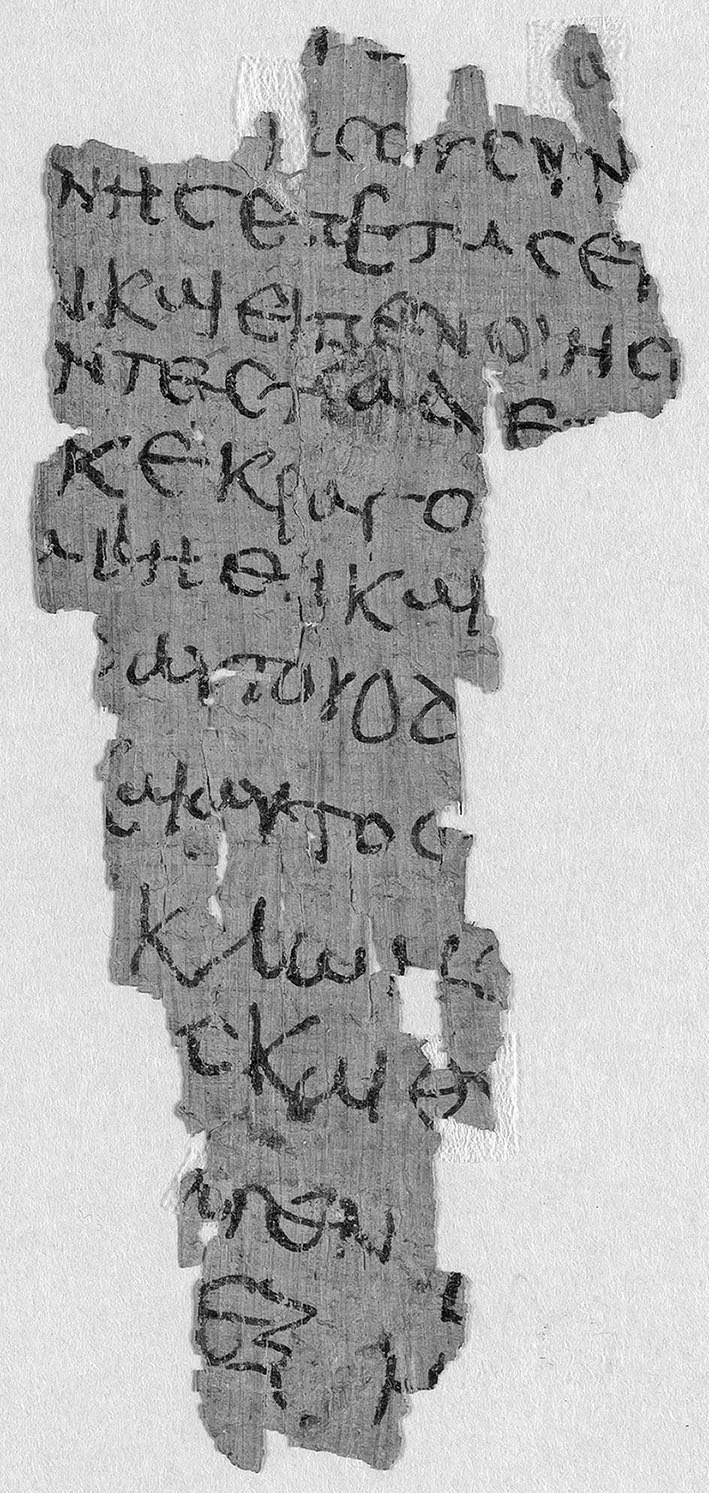
P.Hamb.Graec. 1011, paleographically dated to the fourth or early fifth century CE, is the earliest currently known material witness to the work. It preserves only part of the clay-birds and pools sequence, not a full gospel. Lajos Berkes and GabrielGabriel / JibrīlA Semitic theophoric name for an interpreter of visions in Daniel and a messenger in Luke; named Jibrīl in the Qurʾan. His functions depend on each textual context.Glossary · Click to read the explanation Nocchi Macedo edited the original Greek fragment in 2024. In 2025 they published a second, adjoining piece, 1011/1; the joined remnants measure about 14.2 × 6.5 cm, and their edition now numbers nineteen fragmentary lines. The informal hand and layout may indicate a writing exercise, possibly educational, but neither a child copyist nor a school or monastery is demonstrable. [2] [1]
A brief sample from lines 7–8 of the diplomatic transcription of the joined fragments retains their late Greek letterforms and incomplete edges: [1]
Among the traces are the name of Jesus, the opening of a form of “clap,” and part of “command.” The closing square bracket marks the broken left edge of each line; no missing clause has been silently supplied. The editors now reconstruct the participle ϲυνκρο|[τήϲαϲ] (“having clapped,” spelled νκ rather than γκ), where their 2024 proposal had supplied a different finite verb. This approaches Greek S at one point, but line-length constraints elsewhere imply a shorter text or alternative arrangements, and other readings diverge from S; the editors suggest that the papyrus is stylistically closer to A in some respects. Only the letter-traces are materially preserved: the full grammatical sequence is an explicit editorial reconstruction, not an intact quotation from the papyrus. [1] [2]
Recensions, languages, and three different chronologies
Three chronologies must be kept apart. The narrated childhood belongs to the first-century story-world. The formation of stories and compilation, widely but not unanimously placed in the second century CE, is a historical hypothesis concerning composition and editing. The surviving copies and translations mostly belong to later centuries. Greek is the leading candidate for the language of composition, reinforced by manuscript and linguistic evidence, but that does not date every episode to one decade or make a late Greek manuscript identical to an original. [2] [8] [13]
- About 180–190 CE: Irenaeus attests a related alphabet-teaching story, not the whole preserved gospel. [7]
- Fourth or early fifth century: the Greek Hamburg fragment, first published in 2024 and joined to a newly found piece in the 2025 edition; it contains only part of the birds episode and its continuation. [2] [1]
- Fifth and sixth centuries: early SyriacSyriacAn Aramaic literary language rooted in Edessa, first attested in non-Christian inscriptions and later prominent in Christian writing, scholarship, translation and liturgy.Glossary · Click to read the explanation witnesses, including BL Add. 14484 and Göttingen Syr. 10, and an early Latin palimpsest preserve versions related to a shorter narrative core without exact identity. [15] [8]
- Eleventh century: Codex Sabaiticus 259 preserves Greek S, important because several of its readings resemble older versions, but it also contains additions and is not the lost original. [4] [2]
- Later Middle Ages: numerous manuscripts preserve the familiar nineteen-chapter Greek A; Greek B abridges and Greek D adds an Egyptian preface. Latin, Slavonic, Ethiopic, Georgian, Irish, Arabic, and Armenian traditions participate in differing compilations and transmission histories. [5] [6] [17] [8]
The familiar nineteen-chapter Greek A owes much of its modern circulation to Tischendorf's edition. Tony BurkeTony BurkeScholar of Christian apocrypha who edited Greek and Syriac infancy traditions.Glossary · Click to read the explanation re-edited it with additional manuscripts and identified omissions and textual faults in the older printed version. Greek S, the early Syriac tradition, and Latin witnesses offer evidence for earlier textual layers, not a single error-free line of descent. The divergence in length and ordering is itself part of the history being studied. [5] [4] [15]
Clay birds in neighboring texts
The overlap is real, but details matter. The Arabic Infancy GospelArabic Infancy GospelA noncanonical Arabic Christian collection about Jesus’ birth, the journey to Egypt and childhood miracles, with structurally different Oxford and Florence recensions; distinct from the Infancy Gospel of Thomas.Glossary · Click to read the explanation, in Walker's English version, has figures of several animals moving by command in chapter 36; chapter 46 has clay sparrows take flight after Jesus claps. In the Armenian Infancy Gospel, an English translation published by Abraham Terian recounts one sparrow animated by blowing in chapter XVIII.2. The Armenian wording was not checked against its original manuscript here: this detail is attributed to Terian's English translation, not passed off as a fresh transcription of the Armenian. [9] [10]
The Qur'anThe QuranThe central scripture of Islam, consisting of 114 Arabic surahs; its study distinguishes Quranic discourse from manuscript history, reading traditions, and historical inference.Glossary · Click to read the explanation, 3:49 and 5:110, describes shaping a bird-like form from clay, blowing into it, and its coming to life by God's permission. The agent's action, explicit qualification of divine permission, and religious-literary context differ. Shared narrative stock or interactions among traditions are historically possible, but resemblance alone identifies neither a particular manuscript nor the route by which these motifs entered the Qur'anic account. Nor should the Arabic and Armenian infancy gospels be collapsed into IGT as a single fixed book. [11] [16] [8]
Historical interpretation and its limits
Play, anger, education, punishment, and rescue inhabit the same text. Curses may offend modern readers; analyzing them historically also requires comparing punitive miracle traditions, the boy's extraordinary authority, everyday schooling and discipline, and how a given recension distributes reversal or healing. Reidar Aasgaard has advanced approaches emphasizing storytelling, childhood, and possible audiences, while subsequent scholarship explores how textual versions handle the deaths of other children. For those broad scholarly perspectives, only accessible publisher descriptions and abstracts were used here; restricted book chapters are not being claimed as read. [12] [13]
The most defensible account is of a changing Christian narrative tradition, not a historically documented biography of Jesus' boyhood or a composition proven to be by the apostle Thomas. The evidence combines early circulation of a schoolroom motif, wide multilingual transmission, and repeated reworking of punitive and restorative scenes. Reconstructing every line of an “original” work, or pinpointing one place where a single author assembled it, remains beyond what the surviving fragments can establish, even with the important Hamburg addition. [1] [8] [13]
References and notes (17)
- Lajos Berkes and Gabriel Nocchi Macedo, “A Bit More of Jesus’s Childhood,” ZPE 236 (2025), joint edition of P.Hamb.Graec. 1011 and 1011/1. pp. 84–88, especially lines 7–8, plate, and reconstruction. Return to the text ↑
- Lajos Berkes and Gabriel Nocchi Macedo, “The Earliest Manuscript of the So-called Infancy Gospel of Thomas,” ZPE 229 (2024). pp. 68–74, first edition of the papyrus before the adjoining fragment. Return to the text ↑
- Walker’s Greek forms. Infancy Gospel of Thomas; Alexander Walker, First Greek Form1–19; Second Greek Form1–11 Return to the text ↑
- Tony Burke, “Infancy Gospel of Thomas: Greek S,” English translation and witness note (2010). Introduction and chapters 1–17, especially 2–9 and 13–17. Return to the text ↑
- Tony Burke, “Infancy Gospel of Thomas: Greek A,” introduction to his critical edition and translated episodes. Introduction and chapters 1–9, including recension history. Return to the text ↑
- Tony Burke, “Infancy Gospel of Thomas: Greek B,” shortened recension. Introduction and chapters 1–11, especially 2–7. Return to the text ↑
- Irenaeus, Against Heresies 1.20.1, in the Roberts–Rambaut English translation (1885) reproduced by New Advent. Book I, ch. 20, §1; English intermediary, no direct original-language collation. Return to the text ↑
- Identity and selected witnesses. Tony Burke, e-Clavis: Infancy Gospel of Thomas; summary and selected witness catalogue Return to the text ↑
- Arabic Infancy Gospel, Alexander Walker’s nineteenth-century English translation, New Advent. Chapters 36 and 46, English translation. Return to the text ↑
- Abraham Terian, The Armenian Gospel of the Infancy (Oxford University Press, 2008), accessible English translation. Chapter XVIII.2 and note 378; no Armenian-language manuscript collation. Return to the text ↑
- Qur’an, 3:49, Arabic text on Quran.com. Qur’an 3:49; clay, breathing, divine permission. Return to the text ↑
- Reidar Aasgaard, The Childhood of Jesus: Decoding the Apocryphal Infancy Gospel of Thomas (2009). Publisher description, JSTOR table of contents, and brief previews only—not full chapters. Return to the text ↑
- David Cielontko, Tobias Nicklas, and Jan N. Bremmer, eds., The Infancy Gospel of Thomas (Peeters, 2025). JSTOR publisher description, contents, and short chapter previews only; no claim to restricted chapters. Return to the text ↑
- Gospel of Luke 2:41–52, NRSVUE as displayed at Bible Gateway (reference, not extended quotation). Luke 2:41–52; the twelve-year-old in the Temple. Return to the text ↑
- Tony Burke, “The Infancy Gospel of Thomas: Syriac,” introduction and English translation. Manuscript descriptions and chapters 2–7 in English; original Syriac not collated. Return to the text ↑
- Qur’an, 5:110, Arabic text on Quran.com. Qur’an 5:110; clay, breathing, divine permission. Return to the text ↑
- Tony Burke, “Infancy Gospel of Thomas: Greek D,” expanded recension attributed to James. Introduction, Egyptian preface, and chapters 1–4. Return to the text ↑
Archive records may be reviewed and refined as better evidence or sources become available. Suggest a correction
Suggest a correction · Suggest a source for this record
Cite this record
IL Archive, «Infancy Gospel of Thomas», https://ilarchive.com/en/texts/infancy-gospel-of-thomas
Continue reading