Entity · Concept
Linguistic reconstruction
A reference page linking a name, group, or concept to the materials that discuss it.
How linguists reconstruct unattested older forms from regular sound and morphological correspondences—and where the evidence stops.
Estimated reading time: 4 min Published Last reviewed:
Share article

Text
Introduction
How can a linguist propose sounds or words from a language that left no surviving document? This entry explains linguistic reconstruction as a systematic inference from attested languages to an earlier stage. It distinguishes a proposed form from a word actually preserved in an inscription or manuscript. A Semitic example shows why this matters for the history of divine names and vocabulary, without turning linguistic evidence into unsupported religious or historical conclusions. [2]
What is reconstructed?
Historical linguistics investigates language change over time. When the genetic relationship between languagesLinguistic relatednessCommon linguistic descent demonstrated by systematic sound and morphological correspondences, unlike borrowing or accidental resemblance.Glossary · Click to read the explanation descending from a shared ancestor has been established, their vocabulary, sounds, and inflections can be compared to infer aspects of that ancestor. The proposed ancestor is called a proto-language. It may be entirely unattested, although surviving older texts can sometimes help test a proposed reconstruction. A reconstruction is a revisable scholarly inference, not a newly discovered ancient document. [1][3]
Researchers chiefly reconstruct sound systems, word forms, and elements of morphology; semantic and syntactic reconstruction generally demand additional caution. An asterisk before a form such as ∗ʾil- signals that the form is reconstructed. The asterisk is not an ancient letter, nor does it mean that the form was directly copied from a speaker's manuscript. [4]
How does the comparative method work?
The comparative method begins by identifying cognate words, inherited from a common source in related languages. Their meanings, histories, and possible borrowing must be evaluated. The next question is whether a sound in one language corresponds regularly to a particular sound in another, under definable phonetic conditions, across multiple independent word sets. Recurring correspondences are more telling than a superficial resemblance between two spellings. [3][7]
From these correspondence sets, linguists propose earlier phonemes and test whether systematic sound changes can account for the daughter-language forms. Shared inflectional patterns may strengthen or complicate the analysis. Analogy, borrowing, and dialect contact can disturb simple patterns; the comparative method therefore does not amount to matching written letters and mechanically taking their average. [1][3]
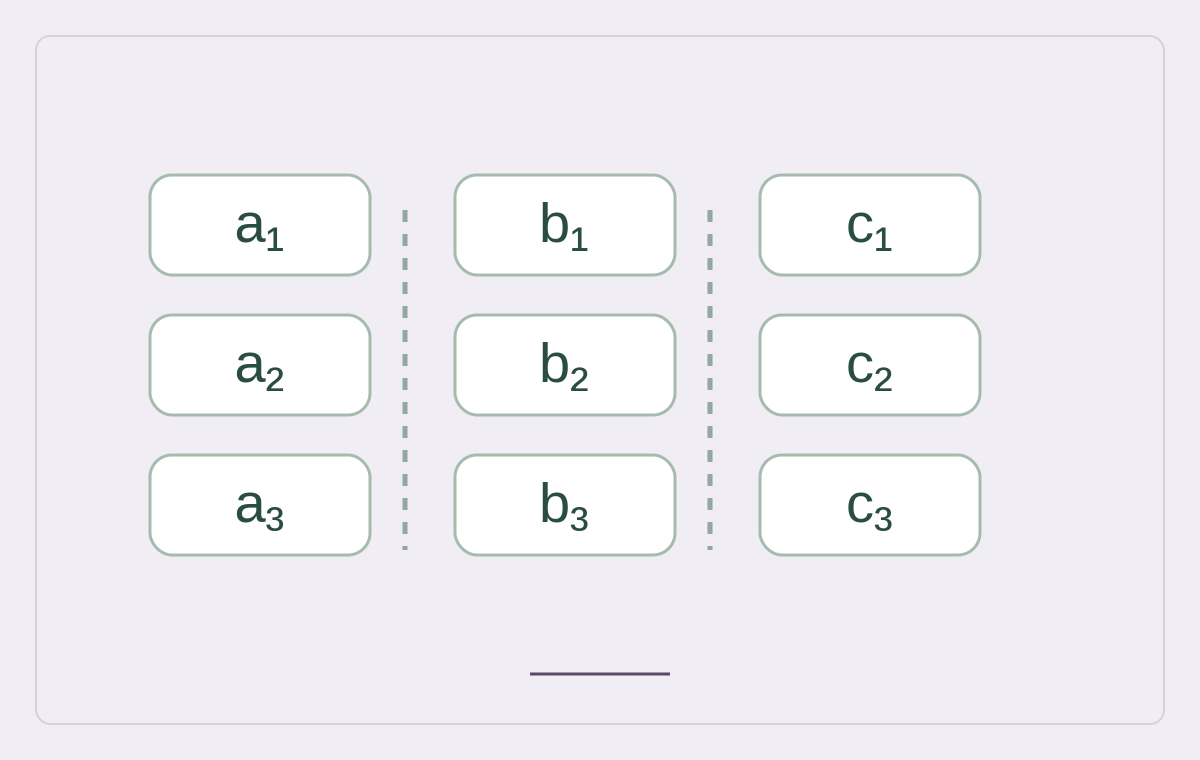
In the schematic illustration above, columns stand for imaginary languages and rows for sets of corresponding words. The letters a, b, and c and their subscripts are teaching placeholders, not transcribed linguistic data. By themselves they establish no reconstructed sound: recurrent correspondences would first need to be demonstrated. [3]
A Semitic example
Across the Semitic languagesSemitic languagesA branch of the Afroasiatic language family, including Akkadian, Ugaritic, Hebrew, Aramaic, Arabic, Ethio-Semitic and South Arabian languages; a linguistic, not racial or religious, classification.Glossary · Click to read the explanation, attested forms include AkkadianAkkadianAn ancient East Semitic language written in cuneiform from the third millennium BCE; its varieties include Babylonian and Assyrian, and it served in international diplomacy.Glossary · Click to read the explanation il- in scholarly transliteration, Ugaritic ʾil, and HebrewHebrewA Northwest Semitic language of the Canaanite group, encompassing Iron Age epigraphy, Biblical, Rabbinic, medieval and Modern Hebrew; its scripts and pronunciations changed over time.Glossary · Click to read the explanation ʾel. Broader comparison supports reconstructing ∗ʾil- meaning “god.” The historical linguist Benjamin D. SuchardBenjamin D. SuchardHistorical linguist studying Hebrew, Aramaic and the history of Semitic languages.Glossary · Click to read the explanation discusses this evidence while distinguishing ∗ʾil- from the reconstructed form ∗ʾilāh- and its subsequent development. The argument depends on the wider Semitic phonological and morphological system, not on this isolated resemblance. [5]
This helps contextualize the Semitic word “El”Semitic ilAn ancient Semitic word meaning “god,” with cognates across several languages. It may function as a common noun or a proper name according to context; it is not always Ugaritic El.Glossary · Click to read the explanation and scholarly discussion of Proto-SemiticProto-SemiticThe inferred ancestral language of Semitic, reconstructed from comparative sound, morphological and lexical evidence; no direct Proto-Semitic inscription survives.Glossary · Click to read the explanation. A shared linguistic origin, however, does not independently date a particular belief or establish that every community used a related word with the same theological meaning. [5][6]
Comparative and internal reconstruction
Comparative reconstruction uses evidence from two or more related languages or varieties. Internal reconstruction instead examines alternations within a single language—for example, differing shapes of a word in its own inflectional forms—to infer an earlier pattern in that language's history. The two approaches can complement one another, but they draw on different evidence and need not reconstruct the same historical stage. [4]
What can the evidence establish?
A proposal is stronger when many independent correspondences converge, when older records support it, and when it fits plausible patterns of change. Gaps in the record, shifting meanings, borrowing, and accidental similarity place limits on what can be recovered. A past phonological contrast may be well supported even when its precise phonetic realization or range of use remains uncertain. [6][7]
A reconstructed word alone does not establish a homeland, a precise date, an ethnic identity, or a religious system. Those questions require independent archaeological and historical arguments. For this reason, IL Archive presents reconstructed forms alongside their attested comparanda and the scholarship that proposes them, rather than treating them as quotations from lost documents. [2][4]
References and notes (7)
- Roger Lass, Historical Linguistics and Language Change, chapter 5: The nature of reconstruction (1997), pp. 215–276 Available chapter summary on correspondences, reconstruction and its limits; the complete chapter was not consulted. Return to the text ↑
- Jay Jasanoff, “Historical Linguistics,” Harvard University faculty resource, section “The comparative method.” Online section “The comparative method” on the author’s page, not a whole book. Return to the text ↑
- Robert L. Rankin, “The Comparative Method,” in The Handbook of Historical Linguistics, eds. Brian D. Joseph and Richard D. Janda (Wiley-Blackwell, 2003); publisher’s chapter summary. Publisher’s abstract and chapter headings; complete restricted chapter not consulted. Return to the text ↑
- Martine Robbeets, “Comparative Reconstruction in Linguistics,” Oxford Bibliographies (28 March 2018), available Introduction. Publisher’s publicly available introduction only; full reference article not read. Return to the text ↑
- Benjamin D. Suchard, “Semitic ∗ʾilāh- and Hebrew אלהים: From plural ‘gods’ to singular ‘God’,” Journal for the Study of the Old Testament 49/4 (2025), 460–474; evidence for ∗ʾil- in the opening discussion and the account of ∗ʾilāh-. Open text: abstract, introduction and Akkadian/Ugaritic/Hebrew comparanda, main argument and conclusion; no long quotations. Return to the text ↑
- Rebecca Hasselbach, Case in Semitic: Roles, Relations, and Reconstruction (Oxford University Press, 2013), chapter 1, “Introduction,” pp. 1–15; publisher’s abstract on methods and data limits. Publisher’s abstract only; full chapter not consulted. Return to the text ↑
- Don Ringe and Joseph F. Eska, Historical Linguistics: Toward a Twenty-First Century Reintegration (Cambridge University Press, 2013), ch. 10 “Reconstruction,” pp. 228–255; publisher’s summary. Available chapter summary only, not full restricted pages. Return to the text ↑
Suggest a correction · Suggest a source for this record
Cite this record
IL Archive, «Linguistic reconstruction», https://ilarchive.com/en/entities/linguistic-reconstruction
Continue reading