Entity · deity
Athirat
A reference page linking a name, group, or concept to the materials that discuss it.
- Timeline
- From 1400 BCE to 1200 BCE
A high-ranking goddess commonly understood as El’s consort in Ugaritic texts; associated with the progenitress epithet and the palace intercession.
Reading path
Links recorded in this entry.
Periods
When does it appear?
- From 1400 BCE to 1200 BCE
Dates
Dates have distinct roles. The timeline uses creation, composition or historical coverage, rather than publication or discovery dates.
- Historical coverage
- Approximately From 1400 BCE to 1200 BCE
Text
Motherhood and intercession
Ugaritic ʾaṯrt names Athirat, also rendered Asherah. Her qnyt ilm epithet is translated progenitress or creator of the gods, depending on the verb’s interpretation. Seventy of her sons appear in KTUKTU: Ugaritic Text ReferencesAbbreviation for a modern scholarly corpus of alphabetic cuneiform texts; its numbers are references, not dates.Glossary · Click to read the explanation 1.4 VI 44–46; the passage supplies no complete fixed pantheonPantheonThe set of deities associated with a religious tradition, including their roles and relationships.Glossary · Click to read the explanation list.
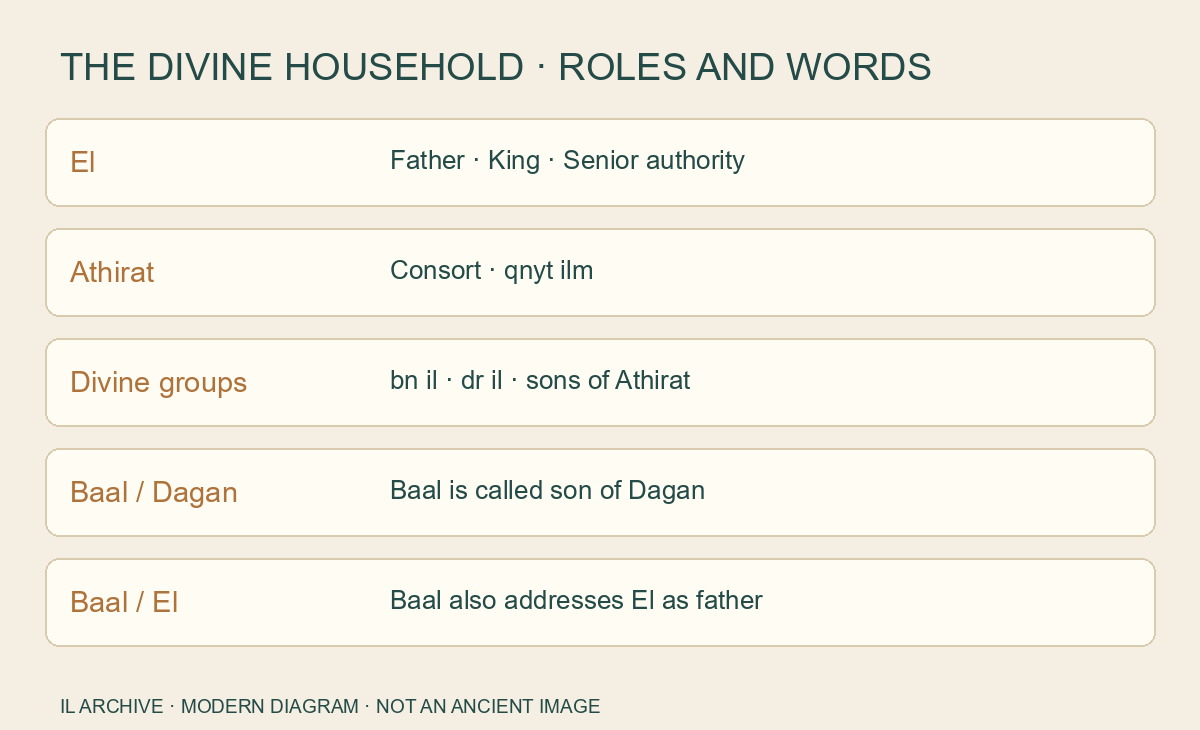
She intercedes with El for BaalBaalStorm god and protagonist of Ugarit’s Baal Cycle; exercises active kingship while El retains importance and authorizes the palace.Glossary · Click to read the explanation’s palace and permission is obtained. The accompanying modern diagram collects roles and designations, not a definitive birth genealogy or an image of the goddess. [1][2][3]
References and notes
- Sang Youl Cho (2007). Pro-Angelology in the Ugaritic Texts and the Hebrew Bible: A Comparative Study of the Nature and Roles of Lesser Deities. PhD thesis, University of Edinburgh. Selected passages: pp. 13–15 group designations and pḫr bʿl; p. 77 Baal/Anat parentage; pp. 93–94 Athirat, qnyt ilm, KTU 1.4 VI 44–46 and seventy. Interpretive disagreements retained, not a consensus on pantheon membership. Not a full-thesis reading. Return to the text ↑
- Jeffery B. Lloyd (1994). The Goddess Anat: An Examination of the Textual and Iconographic Evidence from the Second Millennium B.C. PhD thesis, University of Edinburgh. Pp. 182–185: KTU 1.3 V, gray-hair threat, wisdom and El’s fatherhood, textual gaps and debate over El’s decline. P. 192: Athirat’s intercession and successful palace request. P. 184 visually checked. Thesis not read in full; restorations retained as restorations. Return to the text ↑
- Jesús-Luis Cunchillos (1985). Conférence de M. Jesús-Luis Cunchillos. École pratique des hautes études, Section des sciences religieuses, Annuaire 94 (1985–1986), pp. 279–282. P. 279: bny bnwt and “créateur des créatures,” qnyt ilm and the discussion of qny. Selected page read in Persée; no complete cosmic creation story inferred. Return to the text ↑
Research history
Substantive changes are retained here. Minor copy edits remain in the internal operational log.
-
Substantive record update
Suggest a correction · Suggest a source for this record
Cite this record
IL Archive, «Athirat», Edition 2, https://ilarchive.com/en/entities/athirat